

In England, the Care Quality Commission (CQC) requires regulated care services to respect people’s dignity, choices and consent. These are not just workplace expectations they are essential standards that residential support workers must understand.
But how would you explain these responsibilities when an interviewer asks, “What would you do if a resident refused your care?”
Preparing for residential support worker interview questions involves more than memorising answers. Employers want candidates who understand safeguarding, person centred care, communication and safe decision-making.
Common interview questions assess how you would protect residents, respect their independence, respond to emergencies and work effectively with colleagues. Strong answers show practical judgement and a willingness to seek guidance.
HF Online’s Safeguarding Children Job Ready Programme with Complete Career Guide 2026 covers safeguarding awareness, communication and interview preparation, particularly for those interested in children’s services.
What Does a Residential Support Worker Do?
A residential support worker helps people living in care settings with everyday activities while promoting dignity, independence and wellbeing.

Typical responsibilities include:
- Supporting personal care and daily routines.
- Encouraging residents to make choices.
- Recognising and reporting safeguarding concerns.
- Helping people communicate their needs.
- Recording important information and sharing updates with colleagues.
The UK Government’s care workforce pathway identifies compassion, respect, honesty and responsibility as important care-sector values in England.
The following residential support worker interview questions focus mainly on adult residential care. Children’s residential roles can involve different safeguarding requirements.
What Do Employers Look for in Residential Support Worker Interviews?
When reviewing support worker interview questions and answers, employers often look for practical judgement rather than perfect wording.
| Key Quality | What Employers Want to Hear |
|---|---|
| Compassion | You understand individual needs. |
| Safeguarding | You recognise and report concerns. |
| Communication | You listen and explain clearly. |
| Respect | You protect dignity and privacy. |
| Teamwork | You share information appropriately. |
| Responsibility | You follow procedures and seek help. |
The Care Quality Commission (CQC) explains that people receiving regulated care in England should receive person-centred support that respects their dignity.
When answering care interview questions, connect these values to realistic workplace actions.
25 Residential Support Worker Interview Questions and Model Answers
The following residential support worker interview questions include sample answers you can adapt to your experience.
These examples demonstrate suitable approaches. Your actual answers should reflect your knowledge, the employer’s procedures and your own experience.
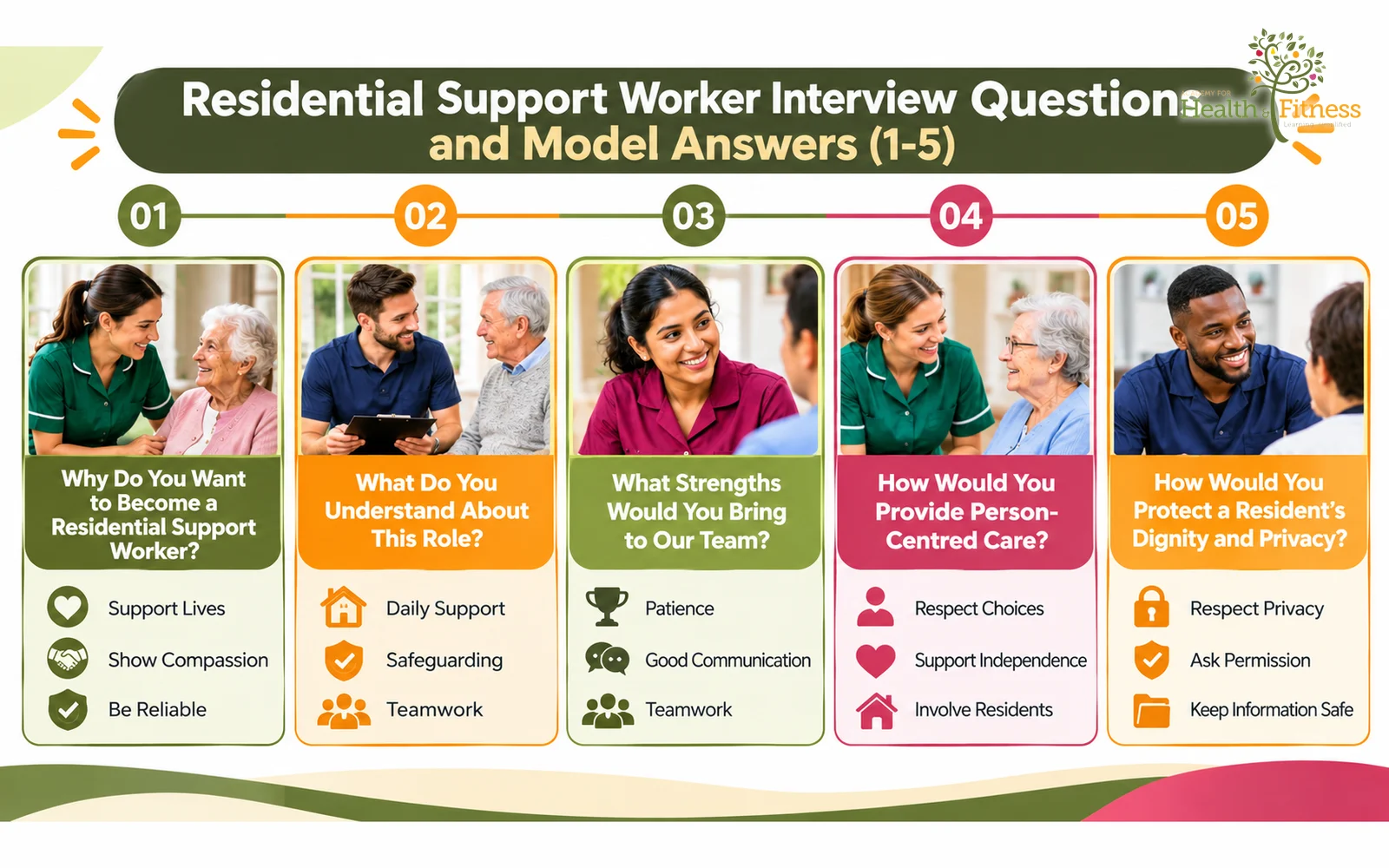
1. Why Do You Want to Become a Residential Support Worker?
Model Answer:
“I want to support people in living safe, fulfilling and independent lives. I understand that residential care involves respecting individual choices, building trust and helping with daily routines. I’m patient, dependable and willing to develop the skills needed to provide good support.”
What employers assess: motivation, compassion and understanding of the role.
2. What Do You Understand About This Role?
Model Answer:
“A residential support worker helps residents with everyday activities while respecting their choices and privacy. Responsibilities may include personal care, safeguarding, communication, record-keeping and teamwork. I would follow each person’s care plan and ask for guidance whenever necessary.”
What employers assess: Awareness of daily responsibilities and professional boundaries.
3. What Strengths Would You Bring to Our Team?
Model Answer:
“My main strengths are patience, communication and reliability. I listen carefully, remain calm under pressure and respect different needs. I also understand that teamwork matters because residents depend on consistent support.”
What employers assess: Personal qualities and teamwork.
If you have limited experience, our planned guide on how to get a safeguarding job with no experience can help you identify transferable skills.
4. How Would You Provide Person-Centred Care?
Model Answer:
“I would ask residents about their preferences and involve them in decisions. For example, if someone preferred a later breakfast, I would consider their wishes and support plan rather than automatically following a fixed routine.”
What employers assess: Respect for choice and independence.
5. How Would You Protect a Resident’s Dignity and Privacy?
Model Answer:
“I would knock before entering, explain what I’m doing and ask permission before providing personal care. I would protect private information and encourage residents to do tasks independently where possible.”
What employers assess: Respect, consent and confidentiality.
Safeguarding and Consent Interview Questions
These residential support worker interview questions test your ability to recognise risks while respecting residents’ rights.
6. What Would You Do if a Resident Disclosed Abuse?
Model Answer:
“I would listen calmly, take the concern seriously and avoid promising secrecy. I would check immediate safety, report the disclosure through safeguarding procedures and record the person’s words accurately. I would not investigate the allegation myself.”
What employers assess: Safe safeguarding responses.
For broader career information, see our guide to safeguarding jobs in the UK.
7. How Would You Respond if a Resident Refused Personal Care?
Model Answer:
“I would respect their decision, ask whether something was worrying them and explain the available options. I would not force care. If refusal created a serious concern, I would follow the care plan and seek appropriate guidance.”
What employers assess: Consent, communication and dignity.
8. What Would You Do if You Noticed Unexplained Bruising?
Model Answer:
“I would check whether the resident needed immediate help, listen without making assumptions and report the concern promptly. I would record what I observed factually and follow the organisation’s safeguarding procedures.”
What employers assess: observation, reporting and professional judgement.
9. What Does the Mental Capacity Act Mean in Residential Care?
Model Answer:
“In England and Wales, the Mental Capacity Act 2005 helps protect people who may have difficulty making particular decisions. I would presume capacity unless assessed otherwise and support residents to make their own decisions.”
What employers assess: Basic understanding of capacity and individual rights.
The Mental Capacity Act 2005 provides the relevant legal principles for England and Wales.
10. What if a Resident’s Family Requested Confidential Information?
Model Answer:
“I would not automatically share private information because someone is a relative. I would follow confidentiality procedures, check whether disclosure was authorised and seek advice when unsure.”
What employers assess: Privacy and professional boundaries.
How Should You Approach Scenario-Based Care Questions?
Many support worker questions in interview situations begin with “What would you do if…?”
A useful approach is to explain:
- Immediate safety: Is anyone at risk?
- Respect: What does the resident want?
- Action: What can you safely do within your role?
- Escalation: When should you contact a senior colleague?
- Recording: What information must be documented?
This approach also helps with care worker interview questions and answers involving behaviour, emergencies and difficult decisions.
The updated 2025 Care Certificate standards cover safeguarding, communication, privacy and dignity, making them useful preparation topics.
Whether you’re practising support worker questions in interview sessions or reviewing care interview questions, focus on safe, honest and person-centred answers.
Good care worker interview questions and answers demonstrate that you know your responsibilities and recognise when professional support is necessary.
These first ten residential support worker interview questions establish the essential values before moving into emergency scenarios, daily routines and teamwork.
Residential Support Worker Interview Questions: Behaviour and Emergencies
These residential support worker interview questions assess how you respond to challenging situations while keeping residents safe.

11. How Would You Respond to an Angry Resident?
Model Answer: “I would stay calm, listen carefully and give the resident space. I would try to understand their concerns, avoid arguing and seek assistance if safety became an issue.”
12. What Would You Do if Two Residents Started Arguing?
Model Answer: “I would assess immediate risks, speak calmly and encourage separation where safe. I would follow the care plan, report the incident and record relevant facts.”
13. How Would You Handle a Medical Emergency During a Night Shift?
Model Answer: “I would assess immediate safety, call 999 when necessary, follow emergency procedures and provide assistance within my training. I would inform the appropriate senior staff.”
14. What Would You Do if the Fire Alarm Sounded Overnight?
Model Answer: “I would follow the home’s fire evacuation plan, raise the alarm and help residents according to their evacuation arrangements, without putting myself or others at unnecessary risk.”
15. How Would You Respond if a Resident Mentioned Self-Harm?
Model Answer: “I would listen without judgement, take the concern seriously, assess immediate safety within my role and seek urgent professional help when needed. I would follow safeguarding procedures.”
Daily Care and Independence Interview Questions
These care interview questions assess how candidates balance safety with personal choice.
16. How Would You Support Someone With Their Daily Routine?
Model Answer: “I would follow their support plan, ask about their preferences and encourage independence. I would provide assistance respectfully rather than completing every task for them.”
17. How Would You Encourage Independence?
Model Answer: “I would identify what the resident can already do and offer suitable support. For example, I might help them practise preparing a simple meal safely.”
18. What if a Resident Disagreed With the House Routine?
Model Answer: “I would listen to their preferences and explore reasonable adjustments. A resident’s home should respect individual choice, not simply staff convenience.”
19. How Would You Support Someone With Communication Difficulties?
Model Answer: “I would use clear language, allow time to respond and follow their communication plan. Pictures, gestures or communication aids may be helpful.”
20. What Would You Do if a Medicine Record Was Incorrect?
Model Answer: “I would report the discrepancy immediately, follow medicines procedures and avoid administering medication until the concern was appropriately resolved.”
Teamwork and Professional Practice Questions
These support worker interview questions and answers focus on reliability, accurate records and teamwork.
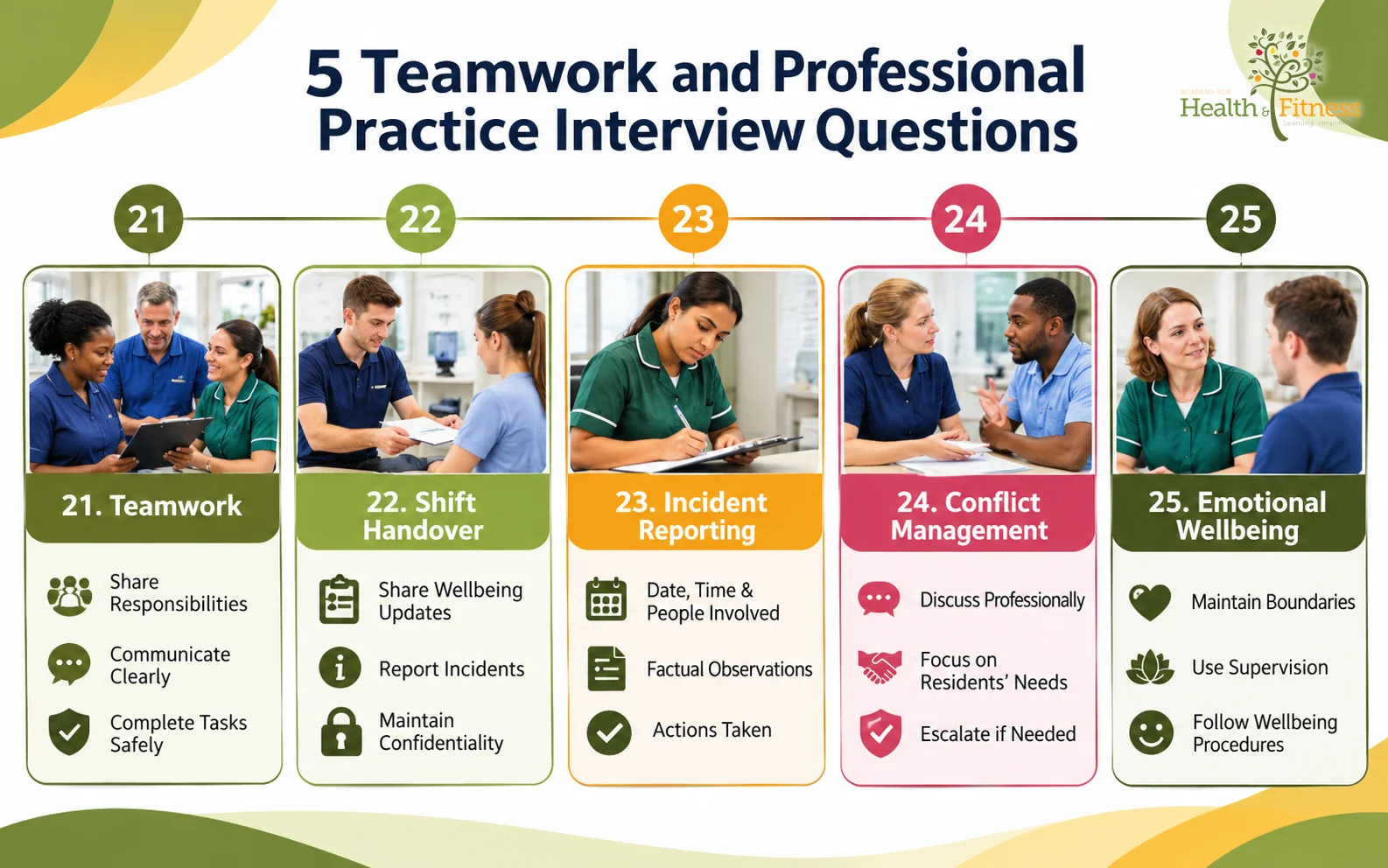
21. Tell Us About a Time You Worked Successfully in a Team.
Model Answer: “During a busy shift in a previous role, I shared responsibilities, communicated clearly and helped colleagues complete urgent tasks. We finished safely and on time.”
22. How Would You Give a Good Shift Handover?
Model Answer: “I would communicate important changes in wellbeing, incidents, outstanding tasks and relevant care information, following confidentiality procedures.”
23. What Should an Incident Report Include?
Model Answer: “I would record the date, time, people involved, factual observations, actions taken and who was informed. I would avoid unsupported opinions.”
24. How Would You Handle Disagreements With Colleagues?
Model Answer: “I would discuss the issue professionally and focus on residents’ needs. If safety remained a concern, I would escalate it appropriately.”
25. How Would You Manage Emotional Stress?
Model Answer: “I would maintain professional boundaries, use supervision, communicate concerns and follow workplace wellbeing procedures.”
How to Answer Interview Questions Using STAR
The STAR method helps structure care worker interview questions and answers involving previous experience.
- Situation: Explain what happened.
- Task: Describe your responsibility.
- Action: Explain what you did.
- Result: Share the outcome.
Use genuine examples from employment, volunteering or education.
How to Prepare Without Care Experience
You don’t need previous residential care experience to make a positive impression at an interview. Employers also value patience, kindness, communication and a willingness to support others.
When preparing for support worker questions in interview sessions, think about skills you have gained through previous jobs, volunteering, education or everyday responsibilities.

For example:
- Customer service: Demonstrates patience, communication and problem-solving.
- Volunteering: Shows compassion, responsibility and teamwork.
- Retail or hospitality: Highlights reliability and the ability to stay calm under pressure.
- Personal experience: May demonstrate empathy and understanding, although it does not replace professional training.
If you’re starting from scratch, understanding how to get a safeguarding job with no experience can help you identify useful training and entry-level opportunities.
You may also want to consider different safeguarding jobs in the UK to understand how residential support work fits into the wider care sector.
Before your interview, research the employer, practise realistic questions and prepare honest examples using the STAR method. Focus on showing your potential rather than worrying about experience you haven’t gained yet.
Common Interview Mistakes to Avoid
Even well-prepared candidates can make mistakes during residential support worker interviews. Employers want to see that you understand your responsibilities and can make safe, respectful decisions.
When answering support worker questions in interview sessions, avoid these common mistakes:
- Ignoring residents’ choices: Never suggest forcing someone to accept care. Respect their dignity and preferences.
- Overlooking safeguarding concerns: Explain how you would recognise, report and record concerns promptly.
- Sharing confidential information: Always protect residents’ privacy and follow workplace procedures.
- Acting beyond your training: Be clear about when you would ask a senior colleague for guidance.
- Giving unrealistic answers: Use honest examples rather than claiming experience you do not have.
The Skills for Care Care Certificate standards provide useful guidance on safeguarding, communication and dignity.
Remember, a strong interview answer shows both what you would do and why it is the right approach.
How Can Support Worker Training Help?
HF Online’s Safeguarding Children Job Ready Programme with Complete Career Guide 2026 covers safeguarding, communication, person-centred support and health and safety.
It may help beginners prepare for common care interview questions.
However, online training does not guarantee employment or replace workplace competence assessments.

Walk Into Your Interview Job-Ready
For aspiring residential support workers who want safeguarding knowledge and career guidance to back up their interview answers.
- 30 core courses plus 10 career support courses
- Includes Caring for Children and Young People Level 2
- 1 year access with 24/7 tutor support
Final Thoughts
A successful residential support worker interview is not about having perfect answers. It is about showing that you genuinely care about people’s wellbeing, respect their choices and understand the importance of providing safe, person-centred support.
Preparing for residential support worker interview questions can help you feel more confident when discussing safeguarding, communication, teamwork and everyday care responsibilities.
Remember, strong care worker interview questions and answers should reflect your real skills, experiences and understanding rather than memorised responses. Employers want to see how you would handle challenging situations while protecting residents’ dignity, independence and safety.
Take time to research the care provider, practise realistic scenarios and prepare examples that demonstrate your strengths. Relevant training can also help you build the knowledge needed for residential support roles.
Most importantly, show employers that you are not simply looking for a job — you are ready to make a meaningful difference in someone’s daily life.
FAQs
Common residential support worker interview questions cover safeguarding, communication, emergencies, independence and teamwork.
Yes. Use genuine examples showing transferable skills, willingness to train and sound judgement.
Explain how you would recognise concerns, protect immediate safety, report promptly and record facts accurately.
Review support worker interview questions and answers, practise aloud and use STAR for experience-based questions.
Choose clean, professional clothing suitable for an interview. Follow any instructions from the employer.
1. What questions are asked in a residential support worker interview?
2. How do I pass a support worker interview with no experience?
3. Why do you want to work as a residential support worker?
4. What are the five key qualities of a good support worker?
5. How would you handle challenging behaviour in residential care?
6. What would you do if a resident refused personal care?
7. What are the six principles of safeguarding in adult care?
8. How would you respond to a safeguarding concern in a care home?
9. How do you answer scenario-based support worker interview questions?
10. What questions should I ask at the end of a residential support worker interview?
11. What are the 5 basic interview questions?
12. What are 5 important personal qualities of a support worker?
13. How to prepare for a support worker interview?
14. What are some common questions asked during a support worker interview?
My research on competitors from SERP:
Competitor that does not rank on AIO but rank on google 1st page
1. https\://www.virtual-college.co.uk/resources/support-worker-interview-questions-and-answers
Title
Support Worker Interview Questions and Answers | Virtual College
Description
We explain how to answer some of the most common support worker interview questions to help you prepare effectively and get the role you want.
H1: Support Worker Interview Questions and Answers
H2: Interview questions and answers for support workers
H3: Q: What drew you to this support worker role?
H3: Q: What relevant certifications and training do you have?
H3: Q: What skills and qualities can you bring to this role?
H3: Q: What are your strengths and weaknesses?
H3: Q: Tell me about a time you faced a challenge and how you overcame it
H3: Q: Tell me about a time you worked effectively as part of a team
H3: Q: How do you handle stress or emotionally challenging situations?
H3: Q: A client refuses your care – what do you do?
H3: Q: How would you handle a medical emergency?
H3: Q: How do you communicate with a client’s family?
H2: Questions to ask the interviewer in your support worker interview
H2: Ace your interview with support worker training from Virtual College
H3: Tags:
H3: Solutions
H3: Categories
H3: Company
H3: Contact
Title
Top Residential Care Worker Interview Questions and Answers
Description
Discover the most common residential care worker interview questions and answers to help you stand out and get the job.
H1: Residential Care Worker Interview Questions and Answers
H2: What Employers Are Really Looking For
H2: Common Residential Care Worker Interview Questions (With Answers)
H3: 1. Why do you want to work as a residential care worker?
H3: 2. How would you handle challenging behaviour?
H3: 3. Tell me about a time you worked as part of a team
H3: 4. How do you ensure safeguarding in your role?
H3: 5. How would you support someone with their daily routine?
H2: How to Stand Out in Your Interview
H2: Common Mistakes to Avoid
3. https\://www.indeed.com/career-advice/interviewing/support-worker-interview
Title
36 Support Worker Interview Questions (Plus Sample Answers) | Indeed.com
Description
Discover 36 support worker interview questions and view sample answers you can use to highlight relevant skills like communication and patience.
H1: 36 Support Worker Interview Questions (Plus Sample Answers)
H3: On this page
H3: On this page
H2: KEY TAKEAWAYS:
H2: Build confidence interviewing
H3: Support Worker Hiring Insights
H4: Average pay
H4: Job seekers
H4: Employers hiring
H2: General questions
H2: Questions about background and experience
H2: In-depth questions
H2: Interview questions with sample answers
H3: 1. Do you get attached to your patients?
H3: 2. How do you communicate with a patient's family?
H3: 3. How do you plan personal development activities for a patient?
H2: Related Articles
H3: Interview Question: “Why Do You Want To Be a Caregiver?”
H3: Top Interview Questions and Answers (With 25+ Examples and Tips)
H3: How Much Does a Caregiver Make?
H3: Interview Question: "Why Should We Not Hire You?" (Tips)
H3: Interview Question: "Why Become a Social Worker?"
H3: PCT Interview Questions with Sample Answers
H3: Nursing Interview: "What Are Your Strengths and Weaknesses?"
H3: 10 Sample Answers to Common Interview Questions
H3: 40 Special Education Aide Interview Questions
H3: How To Answer Teacher Strengths and Weaknesses Interview Questions
H3: How To Answer: “Who Is Your Role Model?” (Plus Examples)
H3: Interview Q\&A: How To Answer "What Is Your Greatest Fear?"
H2: Explore more articles
4. https\://interviewpracticeai.com/interview-questions/residential-support-worker
Title
*
Residential Support Worker Interview Questions and Answers
Description
*
Residential support worker interview questions with what each one tests and strong answers to compare with yours. Practise out loud, free.
H1: Residential Support Worker Interview Questions and Answers (2026)
H2: Practise for your own interview
H2: Living together: dignity, choice and routine
H3: A resident wants a lie-in and a takeaway, but the house rota says breakfast at eight and a cooked tea. How do you balance one person's choice with a shared home?
H3: Residential work means someone's home is also your workplace. What do you do to remember whose home it is?
H3: As a keyworker, what do you do in a monthly review with a resident, and who else do you involve?
H3: Two residents argue over the television every evening and one has started shouting. What do you do?
H3: A resident's family asks you to unlock his bedroom and look at his phone because they are worried. What do you do?
H3: How would you help a resident learn to manage his own laundry and weekly budget, step by step?
H2: Night shifts, safety and the premises
H3: On a night shift a usually settled resident is awake and distressed at 3am. What do you do?
H3: The fire alarm goes off at 2am and you are on shift with two other staff. Take us through what you do.
H3: A resident says he has chest pain at night and the on-call manager does not answer. What do you do?
H3: On a sleep-in a resident knocks on your door four times in the night. How do you handle it and what do you record?
H3: You notice the bath tap is scalding hot when you test it. What do you do?
H2: Safeguarding, money and rights
H3: A resident tells you a member of staff was rough with him last night. What do you do?
H3: The petty cash tin for a resident is fifteen pounds short at the end of your shift. What do you do?
H3: A resident who is under a Deprivation of Liberty Safeguards authorisation keeps asking to go home. How do you respond?
H3: A visitor arrives and the resident seems frightened of him. What do you do?
H3: The kitchen is locked at night and a resident asks you for a drink. What do you do, and what do you think of the rule?
H2: Behaviour, incidents and the group
H3: One resident hits another at tea time. Take us through the next fifteen minutes.
H3: One resident keeps teasing another who finds it harder to stand up for himself. What do you do?
H3: A resident tells you she is thinking of hurting herself. What do you do?
H3: At the start of your shift the medicines count does not match the record. What do you do?
H2: Teamwork, handovers and records
H3: What do you want to hear in a good handover, and what do you give at the end of your shift?
H3: You are two staff short on a weekend and outings are planned. What do you do?
H3: You have to write an incident report about something you were part of. What makes a good one?
H3: A colleague seems exhausted and keeps making small mistakes on nights. What do you do?
H2: A home, not just a workplace
H2: Safety, premises and restrictions
H2: Money, records and safeguarding
H2: What the panel scores
H2: Common mistakes to avoid
H2: Questions about the interview
H2: Sources
Table of Contents