

Imagine working in a care home and noticing that residents are repeatedly receiving unsafe care. You want to speak up, but you’re worried about losing your job.
Whistleblowing in health and social care means reporting suspected wrongdoing that may put patients, residents, staff or the public at risk.
It can involve abuse, neglect, unsafe care or attempts to hide serious incidents.
In the UK, workers who make a legally protected disclosure may have protection against unfair treatment or dismissal.
This guide explains whistleblowing in health and social care, your legal rights, common examples and the difference between reporting wrongdoing and raising a safeguarding concern.
For staff who want to strengthen their understanding of safeguarding responsibilities, HF Online’s Vulnerability, Abuse & Safeguarding course covers suspected abuse, reporting procedures and information sharing.
Vulnerability, Abuse & Safeguarding
What Is Whistleblowing in Health and Social Care?
Whistleblowing in health and social care occurs when a worker reports suspected wrongdoing that they reasonably believe affects the public interest.
This could involve unsafe medical practices, poor treatment of vulnerable adults or serious failures in care services.
Under GOV.UK whistleblowing guidance, a disclosure may receive legal protection when it concerns a recognised type of wrongdoing, meets the public-interest requirement and is made through an appropriate channel.

What Is a Whistleblower?
If you’re asking what is a whistleblower, it is someone who raises concerns about wrongdoing within an organisation.
A whistle-blower is simply another spelling of whistleblower. Both terms describe someone speaking up about suspected wrongdoing.
However, not every complaint automatically receives legal protection.
For example, a care worker reporting repeated unsafe medication practices may be making a protected disclosure if the legal requirements are satisfied.
The key question behind what is whistleblowing is whether the concern involves wrongdoing that the worker reasonably believes should be reported in the public interest.
Why Is Whistleblowing Important in Care Settings?
Whistleblowing in health and social care helps organisations identify problems that might otherwise remain hidden.
Care workers often spend considerable time with people who rely on others for support. They may notice changes in behaviour, unsafe practices or signs of neglect.
Speaking up can help organisations:
- Identify possible abuse or neglect.
- Investigate unsafe working practices.
- Address serious failures in care.
- Improve accountability and patient safety.
- Prevent further harm.
Recognising these risks is part of wider safeguarding vulnerable adults responsibilities.
What Are Examples of Whistleblowing in Health and Social Care?
Examples of whistleblowing in health and social care often involve concerns that could affect the safety, dignity or rights of people receiving care.
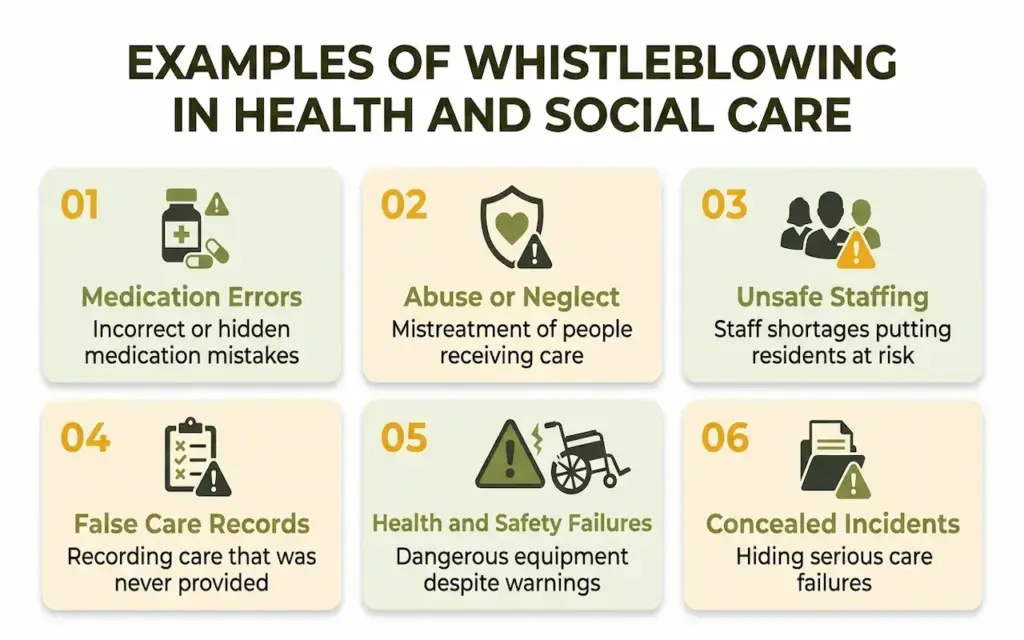
Common situations include:
- Medication errors: Staff repeatedly giving incorrect medication or deliberately hiding serious mistakes.
- Abuse or neglect: A care worker witnessing mistreatment that management refuses to address.
- Unsafe staffing: Serious staff shortages that repeatedly place residents at risk.
- False care records: Employees being instructed to record care that was never provided.
- Health and safety failures: Dangerous equipment being used despite repeated warnings.
- Concealed incidents: Managers deliberately withholding information about serious care failures.
For example, a support worker may notice that residents are regularly left without essential assistance. If managers ignore repeated reports, the worker may need to raise the concern through another appropriate channel.
Whistleblowing in health and social care is not limited to NHS hospitals. It can also arise in care homes, supported living services and other healthcare settings.
However, whether a disclosure qualifies for legal protection depends on the facts and the relevant law.
For additional context about adults who may need protection, see who is a vulnerable adult.
What Is the Difference Between Whistleblowing, Safeguarding and a Complaint?
Although these processes sometimes overlap, they serve different purposes.
Understanding the differences is essential when dealing with whistleblowing in health and social care.
| Type | Main Purpose | Example |
|---|---|---|
| Whistleblowing | Report suspected wrongdoing in the public interest | Reporting repeated unsafe medication practices |
| Safeguarding | Protect someone at risk of abuse or neglect | Reporting suspected abuse of a care-home resident |
| Service complaint | Raise dissatisfaction with a service | Complaining about delays or poor communication |
| Employment grievance | Address a personal workplace issue | Raising a dispute about working arrangements |
A single incident can involve both safeguarding and whistleblowing.
For example, a care worker may need to report suspected abuse immediately through safeguarding procedures while also raising concerns about management concealing the problem.
When Should You Raise a Safeguarding Concern Instead?
If a person may be experiencing abuse or neglect, follow the appropriate safeguarding procedure without delay.
In England, Section 42 of the Care Act 2014 sets out local-authority enquiry duties where specified adult safeguarding conditions are met.
Do not delay urgent safeguarding action while deciding whether a concern qualifies as whistleblowing.
If someone faces immediate danger, contact emergency services or the appropriate safeguarding authority.
What Legal Rights Protect Whistleblowers in the UK?
Legal protection is one of the most important parts of whistleblowing in health and social care.
In Great Britain, the main protections are contained in the Employment Rights Act 1996, as amended by the Public Interest Disclosure Act 1998.
People sometimes search for the whistleblowers act, but that is not the formal title of the main UK legislation.
The relevant whistleblower protection laws aim to protect qualifying workers who report certain types of wrongdoing.

Who Is Protected Under Whistleblower Protection Laws?
Protection can apply to employees, agency workers, apprentices and certain healthcare trainees and NHS practitioners.
To qualify, a worker generally needs to:
- Reasonably believe the information indicates a recognised type of wrongdoing.
- Reasonably believe that making the disclosure is in the public interest.
- Report the concern through a legally appropriate channel.
Protected workers must not suffer unlawful detriment because of a protected disclosure. Employees also have protection against automatic unfair dismissal for making one.
What Changed in April 2026?
From 6 April 2026, qualifying disclosures about sexual harassment received explicit whistleblowing protection in England, Scotland and Wales.
This change does not mean every allegation automatically qualifies. The legal conditions must still be met.
The rules are different in Northern Ireland, where separate whistleblowing legislation applies.
For current Great Britain guidance, refer to Acas whistleblowing law advice.
Understanding these rights helps workers approach whistleblowing in health and social care with clearer expectations about protection and the proper reporting process.
How to Raise a Whistleblowing Concern: Five Practical Steps
Knowing how to report whistleblowing in health and social care helps workers raise concerns clearly while protecting people receiving care.
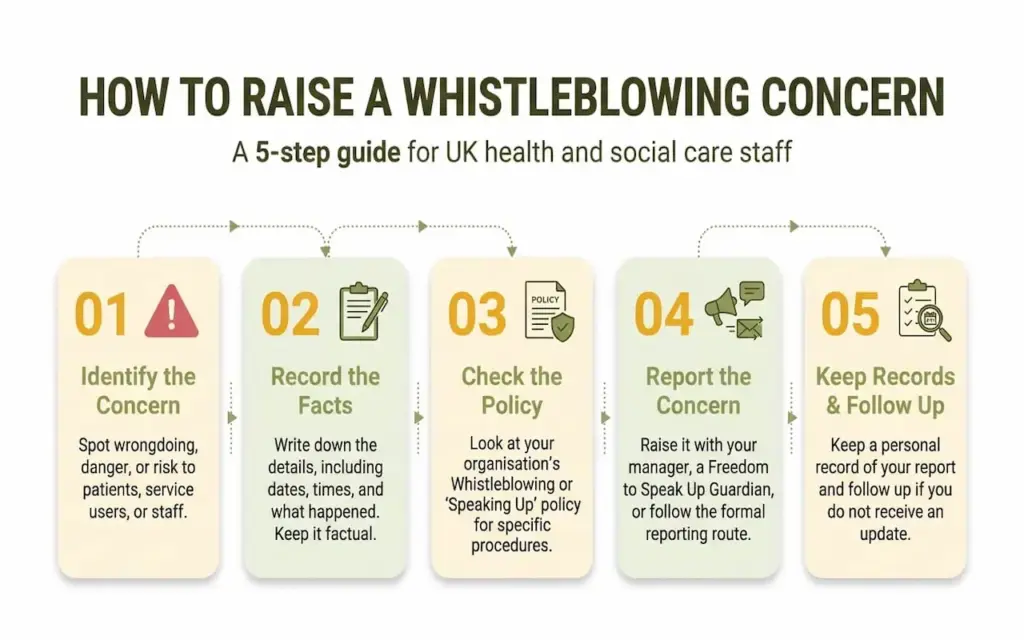
Step 1 — Identify the Concern and Immediate Risks
Check whether the issue involves unsafe care, abuse, neglect or another serious failure.
If someone is in immediate danger, follow urgent safeguarding procedures or contact emergency services. Do not wait for a whistleblowing investigation.
Step 2 — Record the Facts
Write down what you know, including:
- Dates, times and locations.
- What happened or was observed.
- People or services affected.
- Previous reports and responses.
Separate facts from assumptions. Do not remove confidential patient records or investigate colleagues yourself.
Step 3 — Check Your Organisation’s Policy
Review the workplace whistleblowing policy to identify the appropriate reporting contact.
This may be a manager, safeguarding lead or designated speaking-up officer.
Step 4 — Report Through an Appropriate Channel
Report the concern internally where suitable, or contact an appropriate external authority.
Internal reporting is not always a legal requirement before approaching a prescribed regulator. However, the rules for protected disclosures must be followed.
The GOV.UK whistleblowing guidance explains the relevant conditions.
Step 5 — Keep Records and Follow Up
Keep a lawful record of when you reported the concern and any response received.
If serious risks remain unresolved, seek advice about further reporting.
Who Can You Report Whistleblowing Concerns To?
The correct reporting body depends on the care setting, concern and UK nation.
| Location | Relevant Reporting Route |
|---|---|
| England | Care Quality Commission (CQC), for matters within its remit |
| Wales | Care Inspectorate Wales, for relevant social care concerns |
| Scotland | Care Inspectorate, for relevant care-service concerns |
| Northern Ireland | Relevant Health and Social Care authority or prescribed body |
In England, NHS workers may also contact their organisation’s Freedom to Speak Up Guardian.
The NHS England Freedom to Speak Up guidance explains these arrangements.
A whistle-blower should check the regulator’s remit before making an external disclosure. Northern Ireland has different whistleblowing legislation.
Can You Report Whistleblowing Concerns Anonymously?
Yes. Some organisations and regulators accept anonymous reports.
However, anonymous and confidential reporting are different.
- Anonymous reporting: Your identity is not provided.
- Confidential reporting: Your identity is known to the recipient but is handled with appropriate care.
Confidentiality cannot always be guaranteed, especially where information must be shared to protect someone from harm.
The CQC’s reporting guidance explains how it handles staff concerns.
What Happens After You Raise a Concern?
After receiving a report, an organisation may review the information, investigate the concern or refer it to another authority.
Possible outcomes include changes to procedures, staff support, safeguarding action or regulatory intervention.
For whistleblowing in health and social care, the response depends on the seriousness of the issue and available evidence.
The person reporting may receive feedback, although confidential investigation details might not be shared.
What If You Are Treated Unfairly After Whistleblowing?
Speaking up about unsafe care takes courage, and no worker should face unfair treatment for raising a legally protected concern. In Great Britain, whistleblower protection laws protect qualifying workers against unlawful treatment, known as detriment, following a protected disclosure.

Unfair treatment may include:
- Bullying, harassment or intimidation.
- Unfairly reduced working hours or responsibilities.
- Being denied promotion or training opportunities.
- Threats, disciplinary action or dismissal.
Employees are also protected against automatic unfair dismissal for making a protected disclosure.
If you experience retaliation, keep written records of incidents, dates and relevant communications. Seek advice promptly from Acas, your trade union or an employment solicitor.
Act quickly: Employment tribunal claims usually have a deadline of three months minus one day. In certain dismissal cases, applications for interim relief must be made within seven days of dismissal.
Knowing your rights can help you take informed action.
Example: Whistleblowing Concern Report
The following fictional example shows how a care worker might report a concern.
Subject: Concern About Repeated Medication Record Errors
Dear Safeguarding Manager,
I am raising a concern about repeated gaps in medication records within our care service.
On two occasions this month, I noticed incomplete records that may affect residents’ safety. I reported these concerns to my supervisor, but the issue appears unresolved.
Please review the matter under the appropriate reporting procedure and advise whether further information is required.
Kind regards,
Care Team Member
This example should be adapted using accurate facts and appropriate confidentiality safeguards.
How Safeguarding Training Supports Responsible Reporting
Recognising abuse and knowing when to speak up are essential responsibilities in health and social care. Understanding what is whistleblowing and what is a whistleblower helps care workers identify serious concerns, follow reporting procedures and protect people from potential harm.
HF Online’s Vulnerability, Abuse & Safeguarding course covers recognising abuse, responding to safeguarding concerns, whistleblowing and responsible information sharing. This introductory, non-regulated training supports safeguarding awareness but does not provide professional accreditation or additional legal protection.
For a broader understanding, read our guide to safeguarding vulnerable adults, covering types of abuse, warning signs and appropriate action. You can also read who is a vulnerable adult for an explanation of relevant legal definitions and real-life examples.
Together, these topics support confident, informed and responsible reporting.
Final Thoughts
Whistleblowing in health and social care is more than reporting wrongdoing. It is about protecting vulnerable people, promoting safer care and ensuring that serious concerns are not ignored. When healthcare professionals speak up about abuse, neglect or unsafe practices, they can help prevent harm and improve standards across care services.
However, raising a concern requires confidence, clear information and an understanding of the correct procedures. Workers should record incidents accurately, follow appropriate reporting channels and take immediate action when someone’s safety is at risk.
Understanding whistleblower protection laws and your legal rights can also help you make informed decisions without unnecessary fear.
Ultimately, a strong safeguarding culture begins with honesty, accountability and the courage to speak up. Every genuine concern deserves to be taken seriously, and every person receiving care deserves to feel safe.
Frequently Asked Questions
You do not necessarily need proof before raising a concern. Explain what you reasonably believe happened and provide the information available without breaching confidentiality.
A purely personal grievance may not qualify unless it meets the relevant public-interest and wrongdoing requirements.
Yes, in appropriate circumstances. A qualifying disclosure can be made to a relevant prescribed body if the legal conditions are satisfied.
The phrase whistleblowers act commonly refers to UK whistleblowing legislation. In Great Britain, the main protections are in the Employment Rights Act 1996, as amended.
Table of Contents