One overlooked ingredient can turn an ordinary meal into a serious risk. CPD-accredited Certificate Course Food Allergen Awareness Training helps you recognise the 14 regulated allergens, understand Natasha’s Law, identify allergy symptoms and strengthen safer food-service decisions. Ideal for catering and hospitality professionals seeking greater confidence, stronger awareness and better customer protection skills.
4.7
(424 Reviews)
3414 Students
Exclusive Deal! 94% Off, Today Only!
Sale Ends In
CPD Point
Understand allergens, protect customers and strengthen food-service confidence through flexible online learning.
Ready to protect customers, strengthen food safety knowledge and become more confident around allergen risks? Food Allergen Awareness Training gives you focused online learning on food allergies, symptoms, allergen legislation, consumer protection, risk management and safer food storage across catering and food-service environments.
Food allergies affect millions of people across the UK. Around 6% of UK adults — approximately 2.4 million people — have a clinically confirmed food allergy. Meanwhile, a recent UK survey of small and micro food businesses found that 98% used at least one method to train or inform staff about food allergens. That makes accurate allergen awareness more than a box-ticking exercise; it supports safer decisions, clearer communication and greater customer trust.
By completing this Food Allergen Awareness Training, you can:
Whether you work in catering, hospitality, food retail, manufacturing or customer service, this food allergen training can strengthen your CPD and workplace awareness. Start learning today and gain access to structured allergen awareness training online designed to support your professional development in catering, hospitality and food service.
Your learning begins immediately after enrolment, helping you strengthen food allergy awareness and allergen management knowledge without waiting for classroom dates or fixed schedules.
Enrol today and receive:
Limited-time offer: Complete your enrolment today to secure the current course price and certificate benefits available during this promotional period.
The Food Allergen Awareness Training course helps learners understand food allergies, allergic reactions, regulated allergens, UK food information responsibilities and effective allergen risk controls. This allergen awareness training online programme suits beginners, catering staff, hospitality workers, food handlers, supervisors and anyone responsible for serving or communicating information about food.
The course follows six focused learning areas from food allergy fundamentals through to risk management and customer support. You will explore:
These modules build a clear understanding of how allergen mistakes can happen and how stronger processes, accurate information and careful communication can reduce risk. The food allergy awareness course also explains why ingredient checks, storage controls, labelling and customer conversations matter across food-service environments.
UK food businesses must tell customers when any of the 14 regulated allergens appear as ingredients where legislation requires disclosure. The Food Standards Agency also states that food businesses must ensure staff receive allergen training. Therefore, knowledge from an allergen awareness course UK programme can support people working in restaurants, cafés, hotels, takeaways, bakeries, catering operations, food retail and manufacturing.
This course suits beginners as well as existing workers refreshing their understanding. You can study entirely online and revisit modules during your 12-month access period, making it suitable for learners balancing employment or other commitments.
After successful completion, you will receive a CPD certificate recognising your professional development in food allergen awareness.
Enrol today and build stronger allergen awareness for safer food-service decisions.
This food allergen training builds clear workplace awareness, helping learners recognise allergen risks, communicate accurately and support safer food-service decisions.
This Food Allergen Awareness Training is designed to help you build essential, career-focused knowledge of food allergies, regulated allergens, allergen legislation and customer protection, giving you greater confidence when handling allergen information across food-service environments.
This food allergy awareness course suits learners who need clear allergen knowledge for catering, hospitality, retail, manufacturing or food-service responsibilities.
There are no specific entry requirements for this Master Herbalist Diploma. It is open to:
To assess your understanding, the Food Allergen Awareness Training includes an online multiple-choice quiz (MCQ) designed to evaluate your knowledge of food allergies, allergens and food-service responsibilities.
The assessment covers key areas including food allergy causes and symptoms, allergen legislation, consumer protection, allergen controls, food storage, allergy awareness and the responsibilities involved in communicating allergen information.
Learners must achieve a 60% pass mark to complete the assessment successfully. After successful completion, you will receive your CPD Certificate as recognition of your learning and continued professional development.
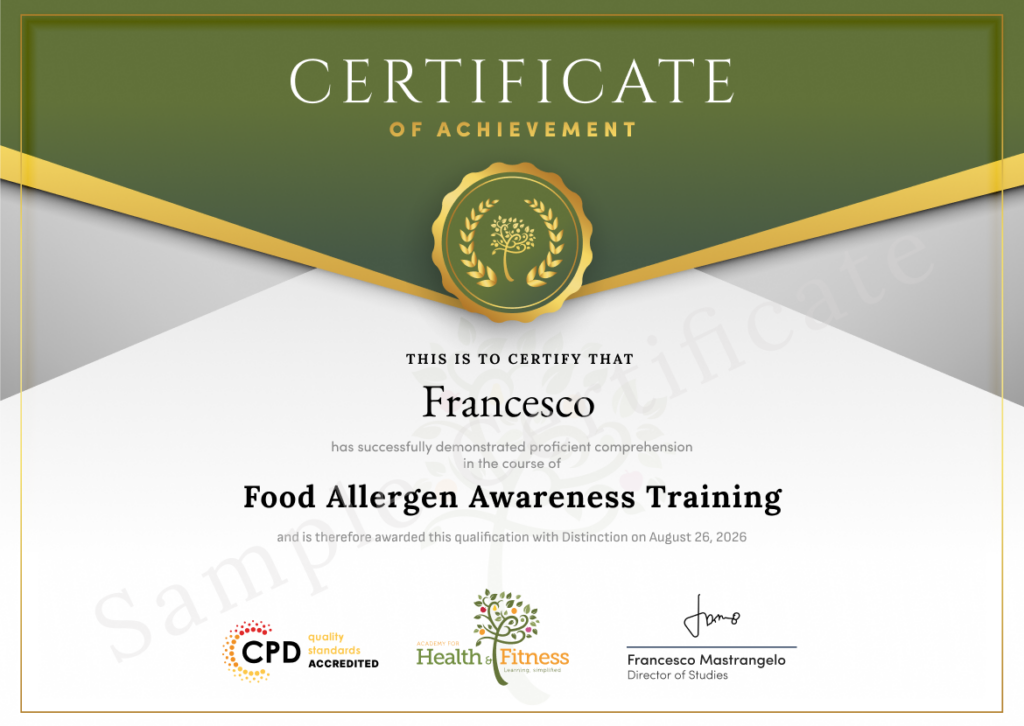
After successfully completing the Food Allergen Awareness Training course, you will qualify for a CPD Certificate as proof of your continued professional development and achievement. This certificate can enhance your professional profile and showcase your commitment to building relevant skills and knowledge. You can receive your digital certificate for only £10, or request a printed hard copy sent by post for just £29 or both for £39.
Food allergen awareness supports many catering, hospitality, manufacturing and food-service roles where accurate ingredient information and customer safety matter.
This CPD course strengthens relevant knowledge but does not replace specialist qualifications, experience or employer requirements for roles that require them.
UK food law identifies 14 regulated allergens: celery, cereals containing gluten, crustaceans, eggs, fish, lupin, milk, molluscs, mustard, peanuts, sesame, soybeans, sulphur dioxide and sulphites above specified levels, and tree nuts. Food businesses must communicate their presence when required by law across relevant sales contexts.
Food businesses have legal duties to provide accurate allergen information, and the Food Standards Agency states that businesses must ensure staff receive allergen training. However, UK law does not require every worker to hold one specific named allergen certificate. Employer requirements may differ by role.
Natasha’s Law refers to UK allergen labelling changes for prepacked for direct sale food. Since 1 October 2021, affected products must display the food name and a full ingredients list, with any of the 14 regulated allergens clearly emphasised within that ingredients list on packaging.
There is no universal legal expiry period for allergen training. Businesses should review staff knowledge regularly and refresh training when procedures, recipes, ingredients, duties or legislation change. Food Standards Agency research shows many businesses use refreshers, with some reporting cycles around 12 to 24 months.
Yes. Allergen awareness training online is relevant to catering staff, chefs, waiting teams, café workers, food handlers and supervisors who communicate ingredient information or support food preparation and service. It can strengthen understanding of allergen risks, customer communication, storage controls and UK labelling responsibilities confidently.
Yes. After completing the online assessment successfully, learners receive a CPD certificate that records their continued professional development in food allergen awareness. It can support a CV, training record or workplace development file, although it does not replace regulated qualifications required for specific specialist roles.
Yes. A food allergy awareness course can suit beginners because it introduces food allergies, symptoms, regulated allergens, legal responsibilities, consumer protection and risk controls in clear stages. Previous food safety experience is not required, making online allergen learning accessible to new hospitality and catering learners.
Allergen cross-contact happens when an allergen transfers unintentionally from one food, surface, utensil, container, ingredient or process to another. Strong allergen controls reduce this risk by separating foods appropriately, checking ingredients carefully, cleaning effectively, storing items correctly and communicating changes clearly across the team consistently.
Allergen labelling helps customers identify ingredients that could trigger allergic reactions and make safer purchasing decisions. UK rules require specific allergen information in different food-selling situations. For prepacked for direct sale foods, Natasha’s Law requires a full ingredients list with regulated allergens clearly emphasised prominently.
Yes. Food allergen training can support professional development for people working in restaurants, cafés, hotels, takeaways, bakeries, catering companies, food manufacturing and retail. It strengthens knowledge relevant to customer safety and food-service responsibilities, but employers may also require experience, food hygiene training or other qualifications.
You receive 12 months of online course access, allowing you to work through the allergen training around employment, study or personal commitments. Self-paced learning also lets you revisit important topics such as food allergy symptoms, the 14 allergens, Natasha’s Law, storage controls and consumer protection.
| Module 01: Understanding Food Allergies | |||
| Understanding Food Allergies | 00:10:00 | ||
| Module 02: More Causes and Symptoms of Food Allergies | |||
| More Causes and Symptoms of Food Allergies | 00:10:00 | ||
| Module 03: Allergen Facts and Legislation | |||
| Allergen Facts and Legislation | 00:10:00 | ||
| Module 04: Practical Precautions and Consumer Protection | |||
| Practical Precautions and Consumer Protection | 00:12:00 | ||
| Module 05: Managing Risks and Storing Food | |||
| Managing Risks and Storing Food | 00:11:00 | ||
| Module 06: Allergy Awareness and Support | |||
| Allergy Awareness and Support | 00:11:00 | ||