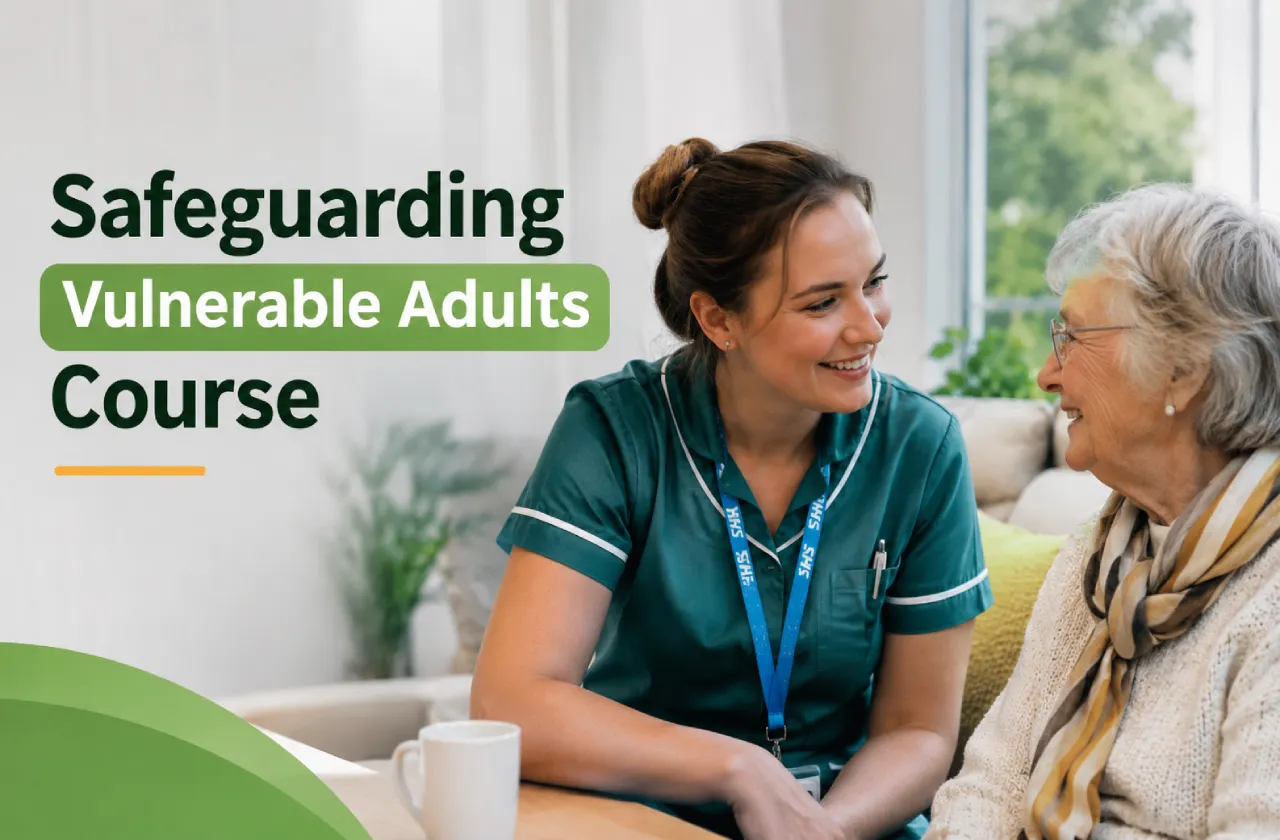


Safeguarding vulnerable adults means protecting people from abuse, neglect and avoidable harm while respecting their dignity, independence and choices. It involves recognising warning signs, taking concerns seriously and ensuring people receive appropriate support.
Abuse is not always obvious. An unexplained injury, sudden withdrawal or repeated failure to provide essential care may indicate that something is wrong. Knowing how to respond can make a meaningful difference, whether you work in health and social care, support a family member or volunteer in your community.
This guide explains the types of adult abuse, common warning signs, reporting procedures and safeguarding responsibilities in the UK.
Safeguarding Vulnerable Adults Training
What Is Safeguarding Vulnerable Adults?
Safeguarding vulnerable adults is the process of protecting adults who may be at risk of abuse or neglect. It also involves preventing harm, promoting wellbeing and supporting people to make decisions about their own lives.
In England, adult safeguarding operates primarily under the Care Act 2014.
Safeguarding is not simply about removing people from unsafe situations. It should also consider their wishes, rights and circumstances.
Who Is Considered an Adult at Risk?
Under Section 42 of the Care Act 2014, a local authority in England must make, or arrange, safeguarding enquiries when it has reasonable cause to suspect that an adult:
- Has care and support needs, whether or not the local authority meets those needs.
- Is experiencing, or is at risk of, abuse or neglect.
- Cannot protect themselves from that abuse or neglect because of their care and support needs.
This may include someone receiving personal care, a disabled adult requiring daily assistance or a person whose health condition affects their ability to protect themselves.
However, being older or having a disability does not automatically mean someone lacks independence or decision-making capacity.
Understanding who may be considered an adult at risk helps carers and professionals recognise when safeguarding support might be needed.
The Care Act framework applies to England. Scotland, Wales and Northern Ireland have their own adult safeguarding legislation and procedures.
What Are the Types of Abuse in Adult Safeguarding?
Adult abuse can take many forms. It may happen once, repeatedly or through a combination of harmful behaviours.
England’s Care and Support Statutory Guidance identifies ten categories of abuse and neglect that safeguarding practitioners should recognise.
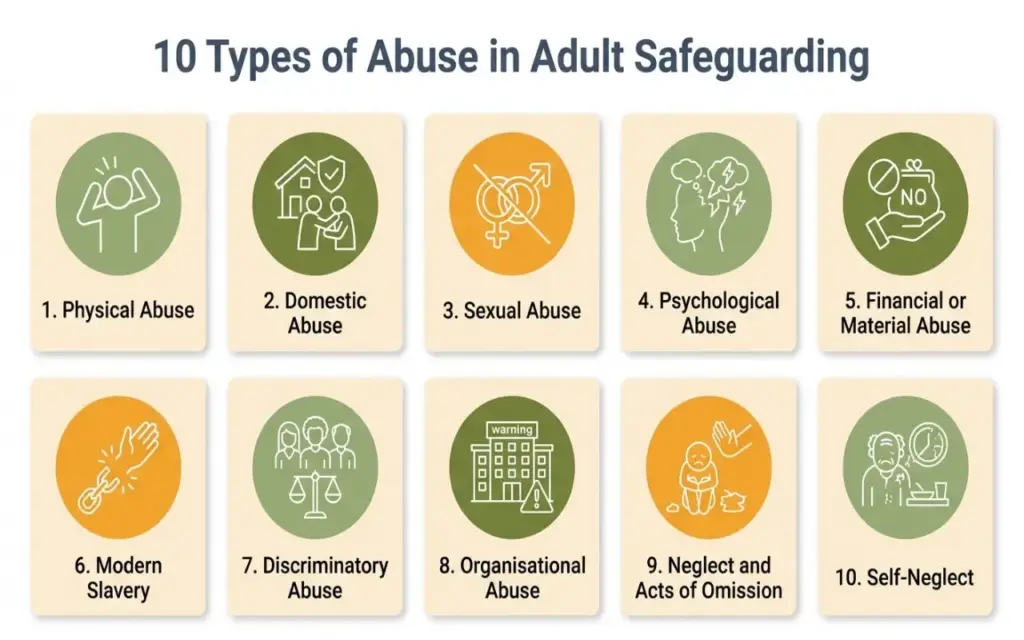
| Type of abuse | What it may involve |
|---|---|
| Physical abuse | Hitting, pushing, inappropriate restraint or misuse of medication. |
| Domestic abuse | Controlling, threatening, violent or coercive behaviour within personal or family relationships. |
| Sexual abuse | Sexual contact or activity without consent, including harassment and exploitation. |
| Psychological abuse | Threats, humiliation, intimidation, isolation or emotional manipulation. |
| Financial or material abuse | Theft, fraud, financial exploitation or misuse of someone’s money or property. |
| Modern slavery | Forced labour, domestic servitude, trafficking or other forms of exploitation. |
| Discriminatory abuse | Harassment or harmful treatment related to characteristics such as disability, race, religion or sexual orientation. |
| Organisational abuse | Harm caused by poor care practices, neglectful routines or institutional failures. |
| Neglect and acts of omission | Failing to provide appropriate food, medication, personal care or necessary support. |
| Self-neglect | Serious neglect of personal hygiene, health or living conditions, including hoarding-related risks. |
These categories are described in the government’s Care and Support Statutory Guidance.
Different forms of abuse may overlap. For instance, someone controlling an adult’s finances may also use threats or intimidation to prevent them from seeking help.
Self-neglect requires particular sensitivity. It does not necessarily involve another person causing harm, and responses should consider the individual’s circumstances, choices and mental capacity.
For more detailed examples and indicators, explore the different types of abuse in adult safeguarding.
What Are the Warning Signs of Abuse or Neglect?

Recognising abuse often begins with noticing something unusual.
An adult may not feel able to explain what is happening. They might fear consequences, depend on the person causing harm or experience difficulties communicating.
Physical, Emotional and Behavioural Warning Signs
Possible indicators include:
- Unexplained injuries: Bruises, burns, fractures or recurring injuries without a clear explanation.
- Changes in behaviour: Withdrawal, anxiety, fearfulness or avoiding particular individuals.
- Poor personal care: Unwashed clothing, dehydration, malnutrition or untreated medical problems.
- Financial difficulties: Missing possessions, unusual withdrawals or unexplained debts.
- Restricted contact: Someone preventing the adult from speaking privately with friends, relatives or professionals.
- Changes in living conditions: Unsafe accommodation, poor hygiene or a lack of essential supplies.
- Repeated care failures: Missed medication, ignored care plans or unmet support needs.
The NHS guidance on abuse and neglect of adults at risk provides further examples, particularly for older adults and their carers.
Why One Warning Sign Does Not Always Prove Abuse
A warning sign is not automatically proof of mistreatment.
For example, weight loss might result from illness rather than neglect. However, unexplained weight loss combined with poor hygiene, missed medication and withdrawal could indicate a safeguarding concern.
Consider an older adult who suddenly stops attending community activities and becomes anxious whenever a particular relative visits. These changes warrant sensitive attention, even when the cause is unclear.
The important point is to recognise concerns, record relevant observations and seek appropriate advice rather than investigate independently.
What Should You Do If You Suspect an Adult Is Being Abused?
If you suspect abuse or neglect, take the concern seriously and act promptly. You do not need to establish proof before raising a safeguarding concern.
The appropriate response depends on the circumstances, immediate risks and your responsibilities.
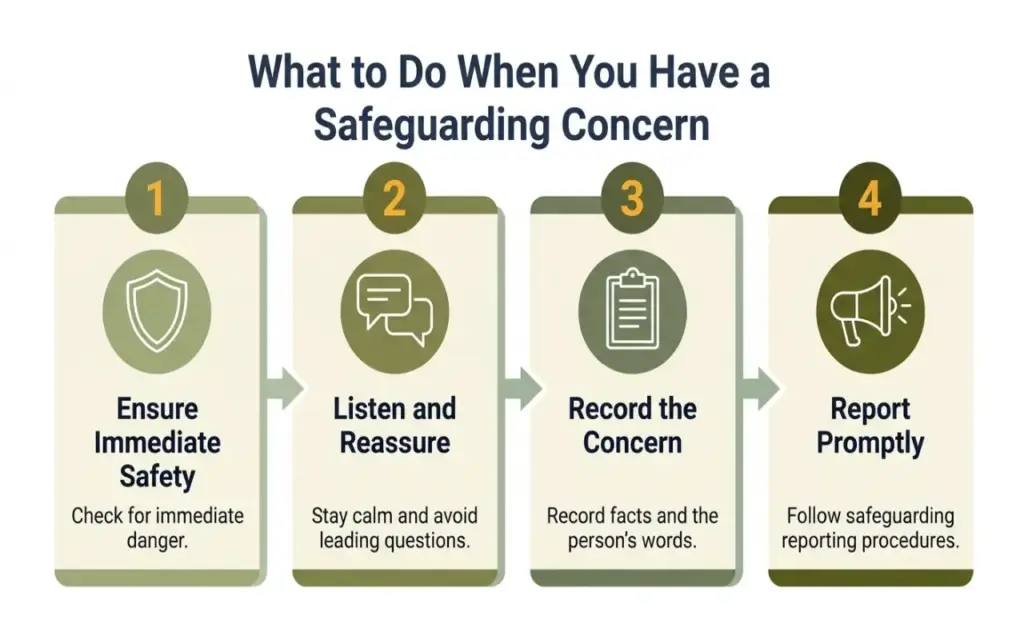
Step 1: Make Sure the Person Is Safe
Check whether the adult is in immediate danger.
If someone faces immediate harm or requires emergency assistance, call 999. Arrange urgent medical attention when necessary.
If you work in a care setting, follow your organisation’s safeguarding procedures while prioritising immediate safety.
Avoid confronting the alleged abuser yourself, particularly when doing so could increase the risk.
Step 2: Listen and Respond Calmly
If someone tells you they have experienced abuse, allow them to speak without interruption.
You should:
- Listen carefully and take their account seriously.
- Use calm, respectful language.
- Ask open questions only when clarification is necessary.
- Avoid blaming, questioning their honesty or making assumptions.
- Explain what may happen next.
Do not promise complete secrecy. You may need to share relevant information with appropriate professionals to protect the person or others.
For example, if a care home resident tells a support worker that another person has threatened them, the worker should listen, explain the reporting process and avoid trying to establish the truth through repeated questioning.
Step 3: Record What You Have Seen or Heard
Accurate records help safeguarding professionals understand concerns and determine appropriate action.
Record:
- The date, time and location of the concern.
- What you observed or were told.
- The adult’s own words, where possible.
- Details of anyone involved or present.
- Any immediate action taken.
- Who received the report and when.
Keep observations separate from personal opinions.
For example, write “The resident said they had not received their medication” rather than “The staff deliberately neglected the resident” unless the latter has been properly established.
Keep records secure and follow relevant confidentiality procedures.
Step 4: Report the Concern Promptly
Report concerns through the appropriate safeguarding route.
In a care workplace, this will usually involve a safeguarding lead, manager or designated reporting procedure. If that route is inappropriate, an external referral may be necessary.
The NICE recommendations on responding to suspected abuse emphasise immediate safety, appropriate recording, prompt reporting and avoiding independent investigations.
Remember that the purpose of reporting is to ensure the concern receives proper attention, not to make a personal judgement about someone’s guilt.
How Do You Report a Safeguarding Concern About an Adult?
Reporting routes differ depending on where the concern arises and whether immediate protection is required.
In England, local authorities have adult safeguarding responsibilities. Care organisations also have reporting and escalation arrangements.
Who Should You Contact?
| Situation | Appropriate action |
|---|---|
| Someone is in immediate danger | Call 999. |
| You suspect abuse in a care workplace | Follow the safeguarding procedure and report to the appropriate lead or manager, unless they are implicated. |
| You are concerned about someone in the community | Contact the relevant local council’s adult safeguarding team. |
| A crime may have occurred without immediate danger | Consider contacting the police on 101, alongside appropriate safeguarding reporting. |
| Your concern is ignored or the reporting route is unsafe | Escalate through another appropriate safeguarding or external reporting channel. |
You can normally find the local authority’s adult safeguarding contact information on its official council website.
What If the Concern Involves Your Manager?
Reporting can be difficult when the person involved is a manager, supervisor or someone in a position of authority.
You should not assume that the concern must remain within the organisation.
Depending on the circumstances, alternative routes may include a senior manager who is not implicated, the local authority safeguarding team or an appropriate external body.
Care workers should also understand raising concerns through whistleblowing when ordinary reporting channels are unsuitable or ineffective.
Whistleblowing involves raising certain concerns about wrongdoing in the public interest. It may overlap with safeguarding, but the two processes are not identical.
What Are the Six Principles of Safeguarding Adults?
The Care Act statutory guidance identifies six principles that underpin adult safeguarding in England.
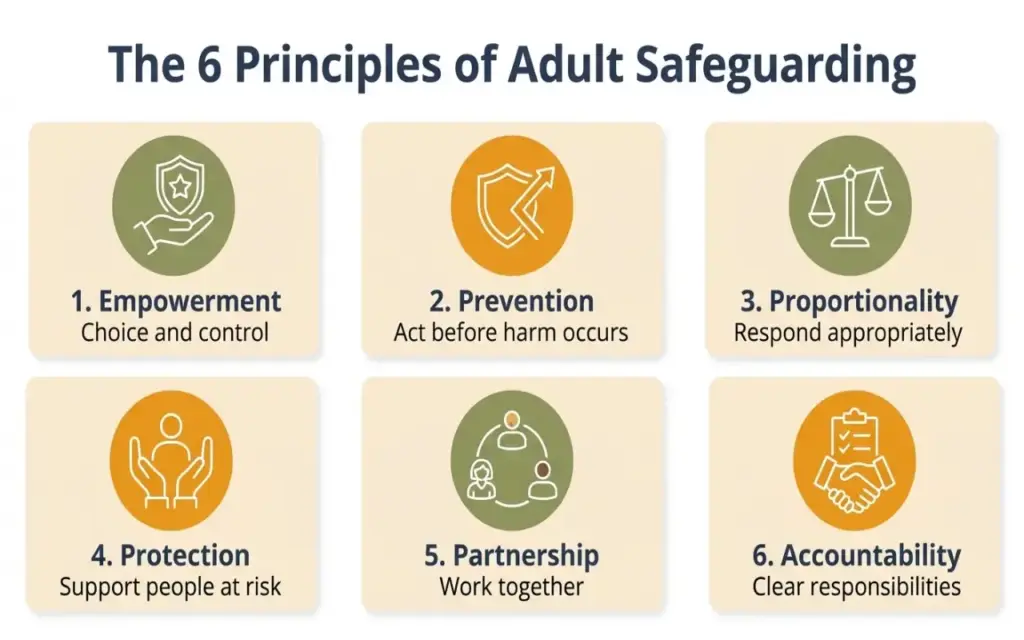
| Principle | Meaning in practice |
|---|---|
| Empowerment | Support adults to make informed choices and express their wishes. |
| Prevention | Take action before harm develops or worsens. |
| Proportionality | Respond in a way that reflects the seriousness of the risk. |
| Protection | Provide support and representation where needed. |
| Partnership | Work with relevant people, services and organisations. |
| Accountability | Maintain clear responsibilities and transparent decision-making. |
These principles help ensure safeguarding is not simply something done to an individual. Wherever possible, the person should participate in decisions affecting their safety and wellbeing.
Why Consent, Mental Capacity and Individual Wishes Matter
Adults have the right to participate in decisions about their lives.
A person should not be assumed to lack mental capacity simply because they make a decision someone else considers unwise.
Where capacity is in question, the relevant legal framework and decision-specific assessment requirements must be followed.
Sometimes care arrangements may also restrict a person’s freedom. Deprivation of Liberty Safeguards in care settings are an important part of understanding when particular restrictions require legal authorisation.
The Department of Health and Social Care’s September 2026 update on deprivation of liberty explains changes following a Supreme Court judgment in June 2026.
How Can Abuse of Vulnerable Adults Be Prevented?
Prevention depends on everyday behaviour as much as formal safeguarding procedures.
Care organisations, professionals and families can help reduce risks by:
- Promoting dignity and choice: Involve adults in decisions about their care.
- Encouraging communication: Make it easier to express concerns without fear of dismissal.
- Maintaining safe care practices: Follow care plans, professional standards and appropriate supervision.
- Recognising early warning signs: Take repeated concerns and changes in wellbeing seriously.
- Keeping accurate records: Document relevant information and share it appropriately.
- Supporting staff knowledge: Provide role-appropriate safeguarding awareness and training.
A workplace culture that encourages questions and responds constructively to concerns can help prevent poor practice from becoming normalised.
Prevention also means listening to the people receiving support. Their experiences can reveal problems that might otherwise remain unnoticed.
Why Is Safeguarding Training Important for Care Workers?
Safeguarding training helps professionals recognise concerns, understand their responsibilities and respond through appropriate procedures.
For care workers, healthcare assistants, support staff and volunteers, this knowledge can be useful in everyday interactions with adults who need support.
Training expectations vary according to the role, employer and applicable guidance. Understanding safeguarding training requirements across different sectors can help learners identify what may be expected in their workplace.
If you want to develop your knowledge, HF Online offers Safeguarding Vulnerable Adults Training, a CPD-accredited online course covering safeguarding principles, UK legislation, abuse and neglect, communication, professional responsibilities and incident reporting.
The course is designed for learners and professionals across health, social care, fitness and community support. Successful completion supports continuing professional development but does not automatically provide a regulated vocational qualification, professional licence or guaranteed employment.
Conclusion
Safeguarding vulnerable adults begins with recognising concerns, listening carefully and taking appropriate action. Whether you are a care professional, volunteer or family member, knowing the warning signs and reporting routes can help protect people from harm.
Effective safeguarding also respects personal dignity, independence and choice. It is about supporting people to live safely while remaining involved in decisions about their own lives.
Frequently Asked Questions About Safeguarding Vulnerable Adults
Yes. You can raise a safeguarding concern based on reasonable suspicions or observations. You should not wait until you have investigated or established proof. Report the concern through the appropriate route.
Their wishes and mental capacity should be considered. Professionals must respect individual rights while assessing risks and deciding whether further action or information sharing is necessary under the applicable framework.
Yes. Abuse and neglect can occur in private homes, hospitals, supported living, community services and online environments. Safeguarding concerns are not limited to residential care.
No. England, Wales, Scotland and Northern Ireland have different adult safeguarding legislation and procedures. The underlying aim of protecting adults from abuse and neglect is shared, but statutory duties and referral arrangements vary.
Table of Contents