

Interested in protecting children but worried you have never worked in safeguarding? Many people face this challenge when starting a career in schools, childcare or community services.
The good news is that previous safeguarding experience is not always needed for entry-level support roles.
You can start a safeguarding career without direct experience by gaining relevant training, volunteering with children, building transferable skills and applying for suitable beginner roles. Specialist safeguarding positions usually require further qualifications and experience.
If you are searching for safeguarding jobs no experience, HF Online’s Safeguarding Children Job Ready Programme with Complete Career Guide 2026 offers safeguarding-related training alongside CV writing, interview preparation and career guidance.
This guide explains where to begin and how to prepare for your first role.
No Experience Needed
Get Job Ready in Safeguarding
Safeguarding children training plus CV writing, interview prep and career guidance in one programme.
Enrol NowCan You Get a Safeguarding Job With No Experience?
Yes, you can work towards a safeguarding-related role without previous safeguarding employment. However, your options depend on the position, employer and qualifications required.
When searching for safeguarding jobs with no experience, focus on support positions where safeguarding forms part of everyday responsibilities.

What Counts as a Safeguarding Job?
Safeguarding means taking action to protect children and vulnerable people from abuse, neglect and other harm.
Many employees have safeguarding responsibilities even when the word does not appear in their job title.
Examples include teaching assistants, childcare workers, youth support staff and children’s residential support workers.
In England, the Department for Education’s Keeping Children Safe in Education 2026 states that safeguarding is everyone’s responsibility within schools and colleges.
Which Safeguarding Roles Need Experience?
Specialist roles, including designated safeguarding leads, safeguarding managers and child protection practitioners, generally require relevant experience and additional training.
Some positions also require professional qualifications or registration.
Which Entry-Level Jobs Can Lead Towards Safeguarding Work?
When looking for safeguarding jobs with no experience, start with roles where you can build relevant skills under appropriate supervision.
Not every position is open to complete beginners, so always check the job description.
| Job Role | How It Builds Relevant Experience |
|---|---|
| Teaching Assistant | Supporting pupils and following school safeguarding procedures |
| Learning Support Assistant | Supporting children with additional needs |
| Childcare Assistant | Helping children in supervised early years settings |
| Youth Support Worker | Supporting young people’s wellbeing and development |
| Children’s Residential Support Worker | Supporting children with daily care and routines |
| Charity Support Worker | Assisting families or community programmes |
Teaching and Learning Support Assistants
Teaching assistants help pupils participate in school activities and support classroom staff.
The National Careers Service explains that volunteering may help applicants gain relevant experience. Schools set their own entry requirements, often including English and maths qualifications.

Children's Residential Support Workers
Residential support workers help children and young people who cannot live with their families.
The role may involve daily routines, emotional support, teamwork and careful record-keeping.
Our guide to children’s residential support worker roles explains the responsibilities, pay and possible entry routes.
Youth and Community Support Roles
Youth support work can provide experience communicating with young people and supporting group activities.
The National Careers Service youth worker profile outlines volunteering, training and employment routes.
These positions can provide a useful starting point for a longer-term safeguarding career.
How to Get a Safeguarding Job With No Experience: Six Practical Steps
A successful job search needs more than submitting applications. The following steps can help you prepare for suitable entry-level opportunities.
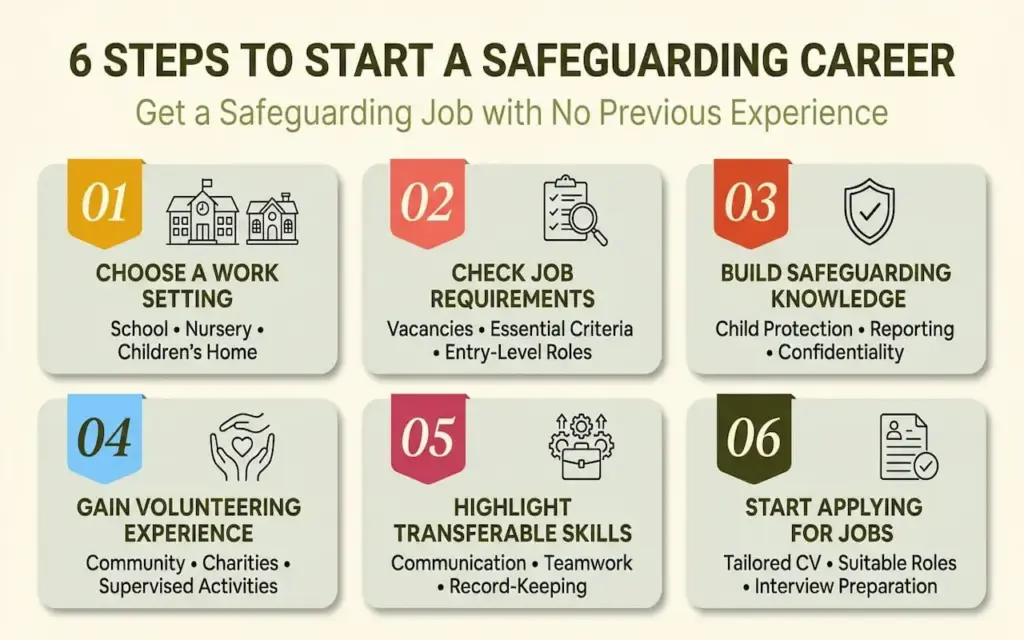
Step 1 — Choose Your Preferred Work Setting
Think about where you would like to work.
Possible settings include:
- Primary and secondary schools.
- Nurseries and childcare centres.
- Children’s residential homes.
- Youth organisations.
- Community charities.
Each setting has different responsibilities and recruitment requirements.
Choosing one or two areas can help you focus your training and applications.
Step 2 — Check the Actual Job Requirements
Search for safeguarding vacancies using job boards, school websites, local council recruitment pages and charity career pages.
Read the essential criteria carefully.
Some roles require qualifications or previous experience, while others may offer training or an apprenticeship route.
Useful search terms include entry level safeguarding jobs, teaching assistant, childcare assistant and youth support worker.
If you search for safeguarding jobs no experience, check the advertised duties rather than relying on the search result title.
Step 3 — Build Basic Safeguarding Knowledge
Before applying, develop an understanding of:
- Signs of abuse and neglect.
- Safeguarding responsibilities.
- How to report concerns.
- Confidentiality and information sharing.
- Professional boundaries.
For example, if a child tells you something worrying, you should listen calmly, avoid promising secrecy and report the concern promptly through the organisation’s safeguarding procedure.
Do not investigate the concern yourself.
HF Online’s Safeguarding Children Job Ready Programme includes child safeguarding, neglect awareness and online safety topics alongside career preparation.
Training can improve your understanding, but it does not replace workplace induction or professional qualifications.
Step 4 — Gain Relevant Experience Through Volunteering
Volunteering can help you gain experience before applying for paid safeguarding jobs.
Consider opportunities with community groups, children’s charities or local schools.
You might assist with supervised activities, help organise resources or support community events.
Important 2026 update: From 1 September 2026, changes to regulated activity rules mean that some regularly supervised volunteers working with children are now included within regulated activity. Appropriate safeguarding checks may therefore be needed.
Follow the organisation’s recruitment process and the government’s DBS guidance.
Step 5 — Identify Your Transferable Skills
You may already have useful experience from retail, hospitality, administration or volunteering.
For example:
- Customer service can demonstrate patient communication.
- Administration can demonstrate accurate record-keeping.
- Teamwork can demonstrate cooperation.
- Volunteering can show commitment and responsibility.
These examples can strengthen your application for a safeguarding career, even without direct professional experience.
Step 6 — Start Applying for Suitable Opportunities
Review safeguarding vacancies regularly and tailor your CV to each role.
Focus on your genuine experience, relevant training and willingness to follow safeguarding procedures.
Keep a simple record of applications and interview feedback.
Starting with a suitable support role can help you build experience before considering more specialist responsibilities.
The goal is not to claim experience you do not have. It is to show employers that you understand the responsibilities, meet their entry requirements and are ready to develop your skills.
What Qualifications Do You Need for Safeguarding Jobs?
Qualifications depend on the role and employer. Some entry-level safeguarding jobs accept applicants with transferable skills, while specialist positions require professional training or experience.
Is a Safeguarding Certificate Enough?
A safeguarding certificate can demonstrate relevant knowledge, but it does not automatically qualify you for every position.
Employers may also require references, appropriate background checks and workplace training.
Do You Need a University Degree?
Not for every support role. However, professional positions such as social worker require recognised qualifications and registration.
What Skills Do Safeguarding Employers Look For?
When searching for safeguarding jobs with no experience, focus on skills you can demonstrate through previous work, education or volunteering.

Employers may value:
- Communication: Listening carefully and speaking clearly.
- Empathy: Treating children and families respectfully.
- Record-keeping: Writing accurate, factual notes.
- Teamwork: Following instructions and working with colleagues.
- Confidentiality: Sharing sensitive information appropriately.
For example, someone who has handled private customer information may already understand the importance of discretion.
These transferable skills can support the early stages of a safeguarding career.
How Do You Write a Safeguarding CV Without Experience?
A strong beginner CV should focus on relevant abilities rather than missing employment history.
Example CV Personal Profile
Motivated and caring individual seeking an entry-level child support role. Confident in communication, teamwork and organising daily tasks. Interested in children’s safety and wellbeing, with a commitment to following safeguarding procedures and developing professional skills.
Adjust this example to reflect your genuine abilities.
What Should You Include?
Your CV should highlight:
- Relevant training and qualifications.
- Volunteering or community involvement.
- Communication and organisational skills.
- Previous responsibilities involving trust or confidentiality.
- Clear examples of teamwork and reliability.
Tailor each application to the employer’s requirements.
What Safeguarding Interview Questions Might You Be Asked?
Employers may ask how you would respond to a concern involving a child.
Question: What would you do if a child told you something worrying?
Example answer:
“I would listen calmly, take the child seriously and avoid promising secrecy. I would record the facts and report the concern promptly through the organisation’s safeguarding procedure. I would not investigate it myself.”
England’s Keeping Children Safe in Education 2026 requires school and college staff to follow safeguarding procedures and report concerns promptly.
Practising suitable answers can improve confidence before interviews.
How Can HF Online's Safeguarding Job Ready Programme Help?
If you are considering a safeguarding career, combining subject knowledge with practical job-search preparation may be useful.
HF Online’s Safeguarding Children Job Ready Programme with Complete Career Guide 2026 brings together safeguarding-related training and career development resources.
The programme advertises:
- Safeguarding children and child neglect awareness courses.
- Online safety and child development topics.
- CV writing and job-search training.
- Interview preparation and communication skills.
- Flexible online study and career-support options.
It may help beginners prepare for safeguarding jobs no experience searches, but training does not guarantee employment or replace required professional qualifications.
Final Thoughts
Starting a safeguarding career without experience is possible through realistic entry-level opportunities, relevant training and supervised experience.
Focus on developing communication skills, understanding safeguarding procedures and presenting your genuine abilities clearly.
When applying for safeguarding jobs, read each job description carefully and continue building practical experience.
With preparation, patience and a clear career direction, you can take meaningful steps towards supporting children’s safety and wellbeing.
Your First 30 Days: A Safeguarding Career Preparation Plan
Use this simple four-week plan to organise your next steps.
| Week | Suggested Action |
|---|---|
| Week 1 | Choose suitable entry-level roles |
| Week 2 | Review requirements and training options. |
| Week 3 | Research volunteering opportunities. |
| Week 4 | Update your CV and start applying |
Check safeguarding vacancies on employer websites, local council recruitment pages and established job boards.
This plan supports preparation; it does not promise employment within 30 days.
Frequently Asked Questions
Can I Get a Safeguarding Job Without Experience?
Yes, some entry-level support roles may be suitable. Search for safeguarding jobs no experience and check each vacancy's essential criteria.
What Qualifications Do I Need to Work in Safeguarding?
Requirements vary. Some support roles accept beginners, while specialist positions need further training, experience or professional registration.
Can Volunteering Help Me Get a Safeguarding Job?
Yes. Suitable volunteering can build relevant experience. From September 2026, changes to regulated-activity rules affect DBS checks for some supervised volunteers working with children.
Where Can I Find Safeguarding Vacancies?
Check school websites, local authorities, charities and established recruitment platforms. Review safeguarding vacancies regularly and compare entry requirements.
Can Online Safeguarding Training Help Me Get a Job?
Training can strengthen your knowledge and support applications, but employers also consider experience, qualifications and suitability.
No Experience Needed
Get Job Ready in Safeguarding
Safeguarding children training plus CV writing, interview prep and career guidance in one programme.
Enrol NowTable of Contents