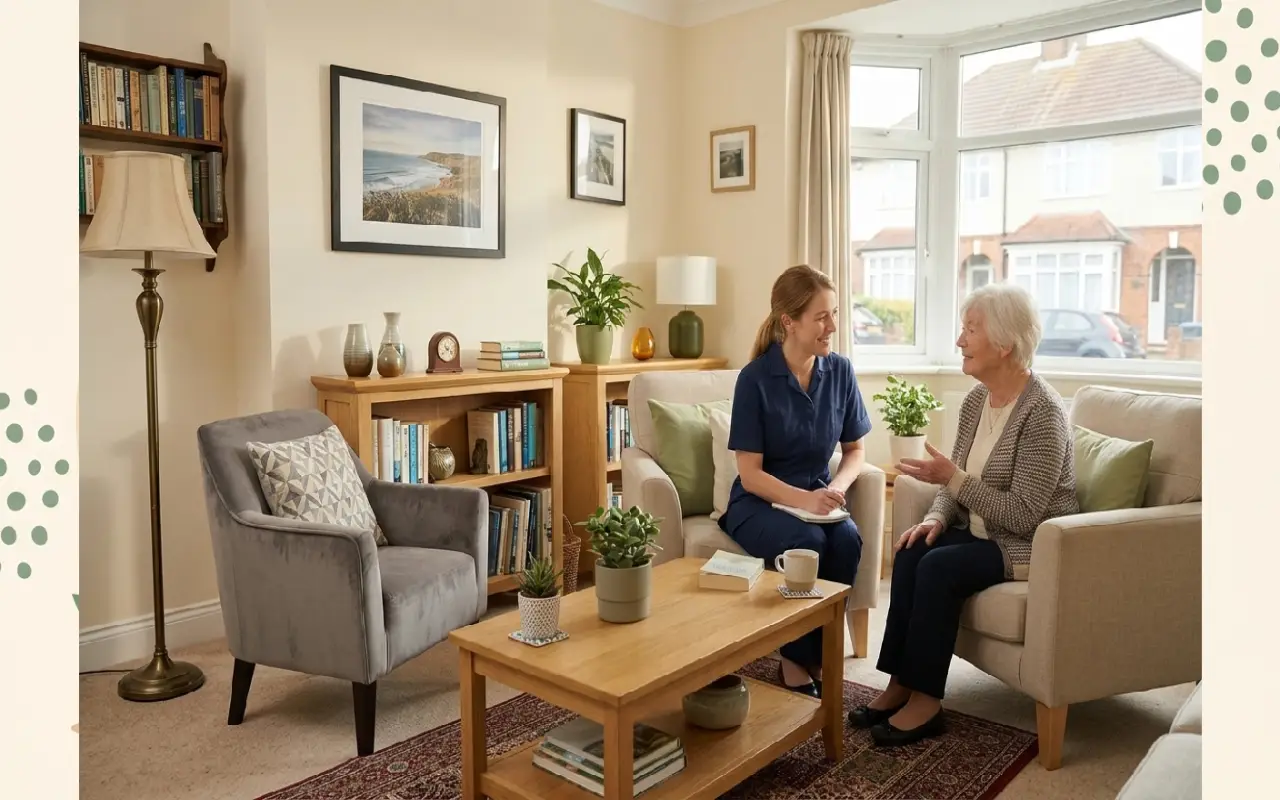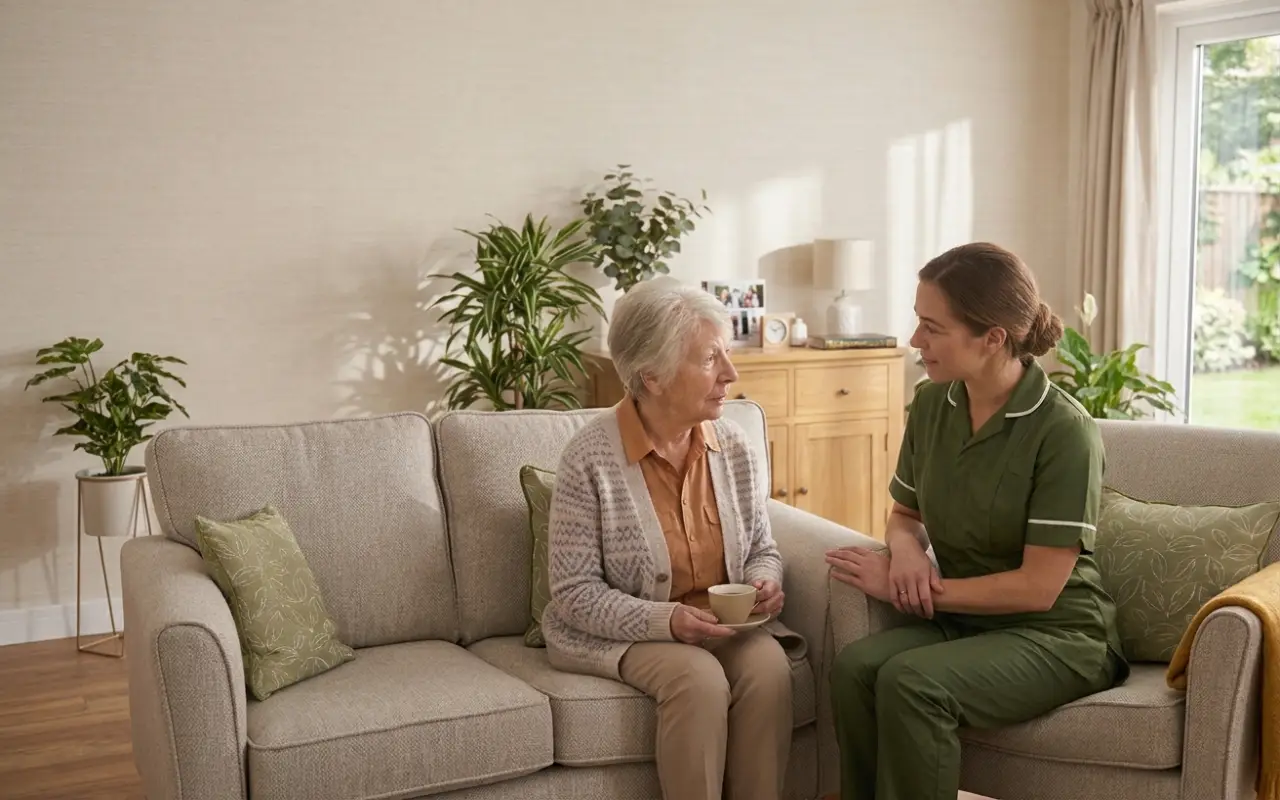


Imagine a care-home resident who needs constant support but regularly asks to leave the building. Staff want to keep them safe, yet restricting their freedom raises important legal questions.
Deprivation of liberty safeguards (DoLS) are legal protections designed to ensure that restrictions on a person’s liberty are properly assessed, authorised where necessary and open to challenge.
In England and Wales, DoLS forms part of the Mental Capacity Act 2005. A major Supreme Court judgment on 2 June 2026 also changed how deprivation of liberty is identified.
This guide explains the law, care staff responsibilities and practical examples. HF Online’s Vulnerability, Abuse & Safeguarding course also covers restrictive practices, safeguarding and deprivation of liberty.
Vulnerability, Abuse & Safeguarding
What Are Deprivation of Liberty Safeguards (DoLS)?
The deprivation of liberty safeguards protect adults aged 18 or over in hospitals and care homes when they lack capacity to consent to their care arrangements and those arrangements amount to a deprivation of liberty.
DoLS requires a lawful authorisation process, independent assessments and safeguards to protect the person’s rights.
For care staff, the key principle is simple: keeping someone safe does not automatically justify restricting their freedom.

Why Were DoLS Introduced?
DoLS helps protect the right to liberty under Article 5 of the European Convention on Human Rights.
Its purpose is to ensure that any deprivation is necessary, proportionate and in the person’s best interests.
The safeguards also provide access to representation, reviews and legal challenges.
What Is the Difference Between Restriction and Deprivation of Liberty?
A restriction limits someone’s choices or movement. A deprivation of liberty involves a more serious interference with their freedom.
For example, supporting a resident when walking outdoors is not necessarily a deprivation of liberty. Preventing them from leaving for long periods may require closer examination.
The legal decision depends on the full circumstances, not one restriction alone.
What Changed to Deprivation of Liberty Law in June 2026?
A significant change to deprivation of liberty safeguards followed the UK Supreme Court judgment on 2 June 2026.
Previously, the Cheshire West approach used an acid test based on continuous supervision and control and whether someone was free to leave.
The Supreme Court ruled that this test was insufficient on its own.
What Is the New Multifactorial Assessment?
Professionals must now consider several factors, including:
- The type and duration of restrictions.
- How restrictions are applied.
- Their effects on the individual.
- The person’s wishes and objections.
- Whether the person can give valid consent to the arrangements.
Importantly, lacking legal capacity to decide about care arrangements does not automatically mean a person cannot express valid consent for the separate purpose of assessing deprivation of liberty.
However, silence or cooperation must not automatically be treated as consent.
The Department of Health and Social Care’s September 2026 guidance confirms that the judgment applies immediately.
What Does This Mean for Care Staff?
Care workers should observe restrictions carefully, record the person’s wishes and report concerns to an appropriate senior professional.
They should not decide independently whether a deprivation is legally justified.
The deprivation of liberty safeguards process remains in place where an authorisation is required.
What Changed to Deprivation of Liberty Law in June 2026?
The deprivation of liberty safeguards apply to adults aged 18 or over in hospitals or care homes in England and Wales when the relevant legal conditions are met.
A person may need DoLS protection if they lack capacity to consent to their care arrangements and those arrangements amount to a deprivation of liberty.
For supported living or care at home, authorisation normally involves the Court of Protection instead.
Do DoLS Apply to People With Dementia?
Yes, potentially. However, dementia alone does not mean someone lacks mental capacity.
The decision depends on an individual assessment of their abilities, care arrangements and circumstances.
For related information, see our guide to who is a vulnerable adult, which explains relevant legal definitions and examples
What Is Mental Capacity Under the Mental Capacity Act 2005?
Mental capacity means being able to make a particular decision when it needs to be made.
The phrase mental cap sometimes appears in searches, but mental cap is not the formal legal term.
What Are the Five Principles of the Mental Capacity Act?
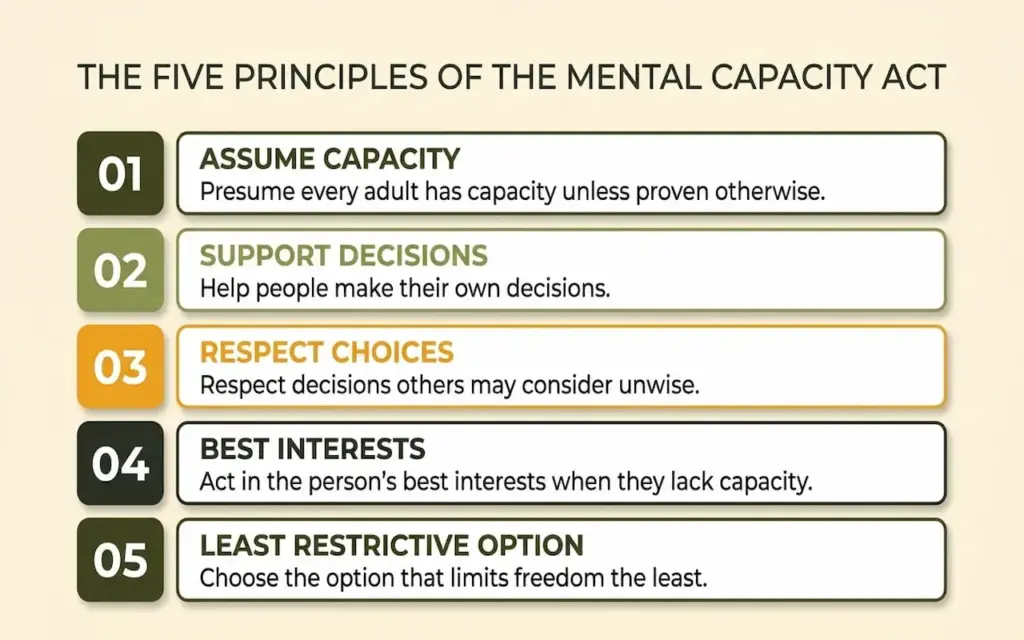
According to GOV.UK guidance, the five principles are:
- Assume a person has capacity unless established otherwise.
- Support them to make their own decisions.
- Respect decisions others may consider unwise.
- Act in their best interests when they lack capacity.
- Choose the least restrictive suitable option.
These principles help staff respect individual choice while providing appropriate care.
How Does DoLS Relate to Safeguarding and the Care Act?
Protecting vulnerable adults means respecting both their safety and personal freedom. The safeguarding meaning in adult care focuses on preventing abuse, neglect and avoidable harm while protecting dignity and individual rights.
This safeguarding definition is broader than DoLS, which addresses situations where care arrangements restrict someone’s liberty. The definition of safeguarding also includes recognising risks, reporting concerns and taking appropriate action.
For further guidance, see our article on safeguarding vulnerable adults, covering common types of abuse, warning signs and protective measures.
Some people search for the Carers Act when checking legal responsibilities. However, the correct legislation includes the Care Act 2014, which covers adult safeguarding and carers’ assessments in England.
The deprivation of liberty safeguards operate under the Mental Capacity Act 2005, ensuring that necessary restrictions are legally assessed and individual rights remain protected.
Examples of Deprivation of Liberty in Care Homes
Understanding deprivation of liberty safeguards becomes easier through everyday care situations.
Consider these examples:
- Restricted movement: A resident repeatedly asks to leave, but staff prevent them from going outside.
- Constant supervision: Someone receives continuous one-to-one support and has little freedom to move independently.
- Restrictive medication: Medication is used to control behaviour, affecting the person’s ability to express objections.
These situations may require assessment, but none automatically proves a deprivation of liberty.
Following the June 2026 Supreme Court judgment, professionals must consider the person’s circumstances, wishes, feelings and the effects of restrictions.
How Does the DoLS Authorisation Process Work?
The deprivation of liberty safeguards process provides independent checks before qualifying restrictions are legally authorised.
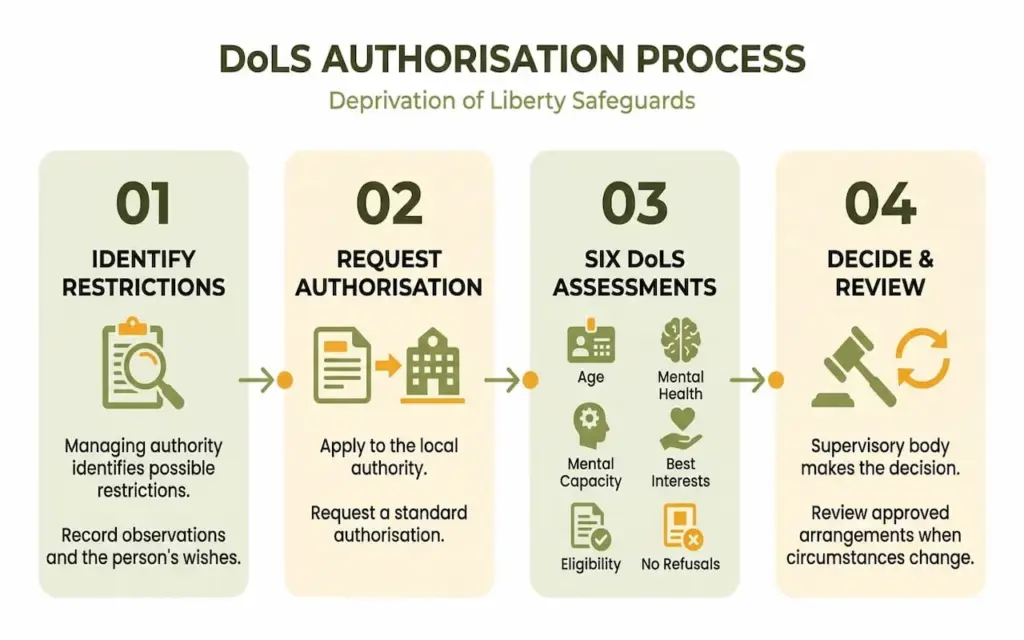
Step 1 — Identify Possible Restrictions
The care home or hospital, known as the managing authority, identifies arrangements that may deprive someone of liberty.
Staff should record relevant observations and the person’s expressed wishes.
Step 2 — Request a Standard Authorisation
The managing authority applies to the local authority, known as the supervisory body, for assessment and authorisation.
Step 3 — Complete the Six DoLS Assessments
The six assessments cover:
- Age: The person must be at least 18.
- Mental health: The relevant statutory condition must be met.
- Mental capacity: Whether the person lacks capacity to decide about the care arrangements.
- Best interests: Whether the deprivation is necessary, proportionate and in their best interests.
- Eligibility: Whether the arrangements conflict with relevant Mental Health Act requirements.
- No refusals: Whether a relevant valid refusal or decision prevents authorisation.
Step 4 — Decide and Review
The supervisory body considers the assessments and decides whether authorisation is appropriate.
Approved arrangements must remain necessary and should be reviewed when circumstances change.
The DoLS Code of Practice explains the process, although its older description of deprivation of liberty must be read alongside the 2026 judgement.
Standard vs Urgent DoLS Authorisation
There are two main types of deprivation of liberty safeguards authorisation.
| Feature | Standard | Urgent |
|---|---|---|
| Authorised by | Supervisory body | Managing authority initially |
| Purpose | Planned or ongoing arrangements | Immediate need |
| Timeframe | Assessment normally within 21 days | Up to 7 days |
| Duration | Up to 12 months | Possible further 7-day extension |
An urgent authorisation requires a standard application to be pursued. It cannot be used as an ongoing substitute for proper assessment.
What Rights Does a Person Have Under DoLS?
The deprivation of liberty safeguards protect an individual’s rights, dignity and freedom.
Important protections include:
- Having a relevant person’s representative.
- Accessing independent advocacy when applicable.
- Requesting a review of an authorisation.
- Challenging an authorisation through the Court of Protection.
- Receiving care that avoids unnecessary restrictions.
The Court of Protection guidance explains how authorisations can be challenged.
What Should Care Staff Do If They Have Concerns?
Care staff play a vital role in protecting vulnerable people from unnecessary restrictions. If someone’s freedom appears unfairly limited, raising concerns promptly can help protect their safety, dignity and rights.

Follow these five practical steps:
- Check immediate safety: Identify any urgent risks and take appropriate action.
- Listen carefully: Respect the person’s wishes, feelings and concerns.
- Keep accurate records: Document restrictions, objections and changes in behaviour.
- Report your concerns: Inform your manager, safeguarding lead or relevant professional.
- Request a review: Seek professional assessment if restrictions appear unnecessary or excessive.
Understanding mental capacity and deprivation of liberty safeguards helps staff support individual choices without compromising safety.
For further guidance, see our articles on safeguarding vulnerable adults and who is a vulnerable adult, which explain safeguarding responsibilities, legal definitions and signs of abuse.
Always follow appropriate procedures rather than removing essential safety measures independently.
How Do DoLS Relate to Safeguarding and Carer Rights?
The safeguarding meaning in adult care centres on protecting people from abuse, neglect and avoidable harm.
This safeguarding definition includes respecting individual rights and supporting wellbeing. The definition of safeguarding is wider than DoLS because it covers different risks, not only restrictions on liberty.

Although people search for carers act or the Carers Act, the correct legislation includes the Care Act 2014 and Mental Capacity Act 2005.
The terms carers act and the Carers Act should not be confused with DoLS legislation.
Similarly, mental cap is informal shorthand, not a legal term. Proper mental capacity assessments remain essential. The phrase mental cap should never replace the full terminology in care records.
Are DoLS Being Replaced by Liberty Protection Safeguards?
The Liberty Protection Safeguards (LPS) were introduced through the Mental Capacity (Amendment) Act 2019 as a planned replacement for the existing deprivation of liberty safeguards (DoLS) system in England and Wales.
LPS aims to provide a broader legal framework, covering people aged 16 and over and care arrangements in settings such as hospitals, care homes and supported living.
However, as of November 2026, LPS has not come into force, and no new implementation date has been confirmed.
The existing DoLS system therefore remains in use. Following the Supreme Court judgement of June 2026, care providers must also apply the updated legal approach when assessing possible deprivation of liberty.
For care professionals, the priority remains clear: respect individual rights, follow current legal procedures and ensure that restrictions are necessary and proportionate.
Safeguarding and Deprivation of Liberty Training
Every person receiving care deserves to feel safe, respected and in control of their life wherever possible. For care professionals, understanding deprivation of liberty safeguards is essential for recognising unnecessary restrictions, protecting individual rights and providing person-centred support.
Effective safeguarding involves more than following procedures. Care workers must understand mental capacity, recognise signs of abuse or neglect, and know when restrictive practices require further assessment or reporting.
HF Online’s Vulnerability, Abuse & Safeguarding course covers key topics, including restrictive practices, restraint, deprivation of liberty, safeguarding procedures and responding to suspected abuse.
This introductory, non-regulated training can help care assistants, support workers and aspiring care professionals strengthen their safeguarding awareness and understanding of responsible care practices.
However, the course does not replace specialist DoLS assessor qualifications, supervised practical training or workplace-specific safeguarding requirements.
Final Thoughts
Protecting someone’s safety should never mean overlooking their right to freedom, dignity and personal choice. The deprivation of liberty safeguards play a vital role in ensuring that care arrangements are lawful, necessary and respectful of individual rights.
Following the June 2026 legal changes, care professionals must consider each person’s unique circumstances, wishes and feelings before restrictions are assessed. Understanding mental capacity, recognising unnecessary limitations and following appropriate safeguarding procedures are essential parts of responsible care.
Accurate record-keeping, timely reporting and regular reviews can help prevent inappropriate restrictions while supporting safer, more compassionate care environments.
Ultimately, good safeguarding is about finding the right balance between protection and independence. Every individual deserves care that respects their voice, values their choices and protects their fundamental rights.
By keeping these principles at the heart of everyday practice, care staff can help create safer, more respectful and person-centred care environments.
Frequently Asked Questions
They are legal protections for qualifying adults in hospitals and care homes whose care arrangements amount to a deprivation of liberty.
Age, mental health, mental capacity, best interests, eligibility and no refusals.
Presume capacity, support decisions, respect unwise choices, act in best interests when capacity is lacking and choose the least restrictive option.
A standard authorisation can last up to 12 months, subject to its conditions and review.
No. As of November 2026, DoLS remains the applicable system in England and Wales.
Table of Contents