

After pandemic disruption, monthly food hygiene rating inspections in 2023/24 returned to pre-pandemic levels with an average of 16,931 ratings issued per month.
Recent rise in food safety inspections and tighter workplace standards means more UK employers now expect certified food hygiene training before day one. From cafés to care homes, online food hygiene training is reshaping how professionals qualify, learn, and stay compliant without stepping into a classroom.
Food hygiene training online equips learners with essential knowledge on food safety, legal compliance, and best practice. It offers flexible, recognised certification that meets UK regulations while supporting safer workplaces and stronger career prospects across the food industry.
In this blog, you’ll learn how online food hygiene training works, which certification level you need, its benefits for individuals and businesses, and how it can support long-term career growth in the UK food sector.
What Is Food Hygiene Training?
Food hygiene training teaches you how to handle food safely and responsibly at work. It shows you how to reduce the risk of food poisoning and meet UK food safety standards. So, whether you prepare meals, serve food, or run a food business, this training helps you do things the right way.
At the same time, food hygiene training focuses on everyday actions. For example, it covers correct handwashing, safe food storage, and proper cleaning routines. As a result, you build good habits that protect customers and support a safe working environment.
UK Legal Requirements for Food Hygiene Training

In the UK, food hygiene training follows a clear legal sequence. If you understand this order, it becomes much easier to stay compliant. So, let’s break it down step by step, exactly as the law expects.
1. Register the Food Business
First, before you sell or prepare any food, you must register your food business with your local council. This applies whether you run a restaurant, a home-based business, or a food stall. You must register at least 28 days before trading, and importantly, registration is free.
2. Make Sure Staff Are Trained for Their Role
Next, UK law requires all food handlers to receive training that matches what they do at work. For example, someone cooking food needs more training than someone only serving drinks. The Food Standards Agency clearly states that training must be “appropriate, supervised, and ongoing.”
So, you cannot delay training until later. Staff should receive it before or as soon as they start handling food.
3. Follow Food Safety and Hygiene Regulations Daily
After training, you must apply food hygiene rules in daily work. This includes:
- Washing hands correctly and regularly
Preventing cross-contamination - Storing food at safe temperatures
- Cleaning equipment and surfaces properly
Because inspectors focus on daily behaviour, training alone is not enough. You must show good practice in action.
4. Put Food Safety Management in Place (HACCP)
Then, every food business must follow a food safety management system based on HACCP principles. In practice, most UK businesses use Safer Food, Better Business packs to do this. So, you must identify risks, control them, and keep simple records.
5. Keep Training and Safety Records
You also need to keep evidence. This includes staff training certificates, cleaning schedules, and temperature logs. During inspections, officers often ask to see these records to confirm compliance.
6. Prepare for Food Hygiene Inspections
Finally, local authority inspectors will visit your premises. They check training knowledge, food handling practices, and records. As a result, proper training directly affects your food hygiene rating.
Levels of Food Hygiene Certification (UK Standards)
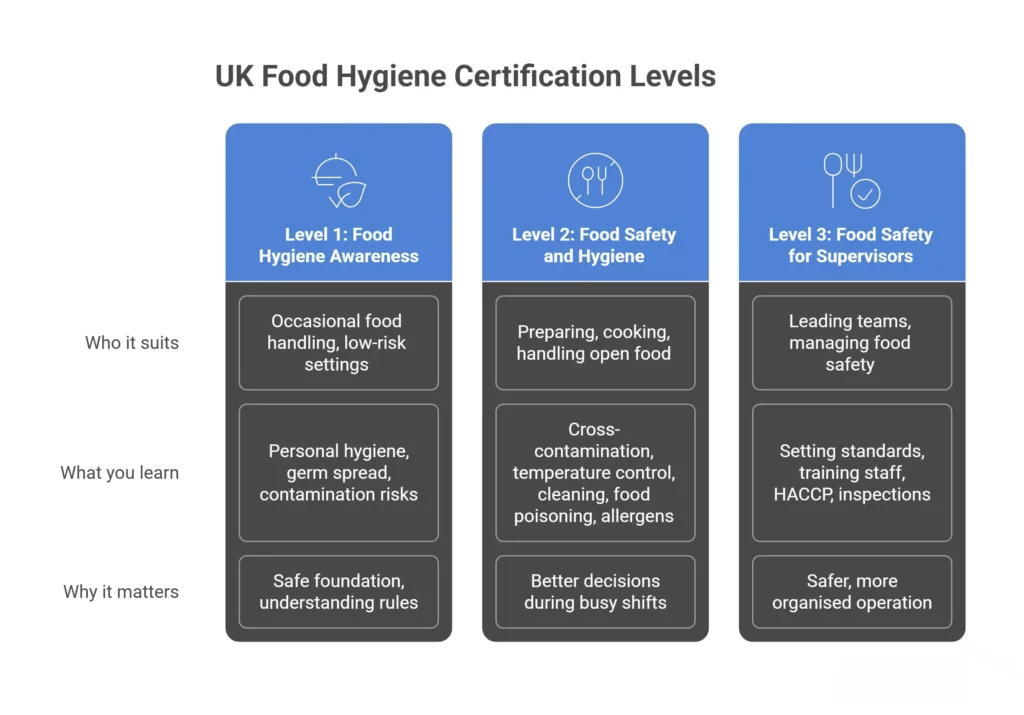
In the UK, food hygiene certificates come in levels because not everyone does the same job. So, the right level depends on what you handle, how often you handle it, and whether you supervise others. When you choose well, you stay compliant and you feel more confident at work.
Below, we’ll walk through each level in a clear way, with who it’s for, what you learn, and where it helps.
Level 1: Food Hygiene Awareness (Entry Level)
Who this level suits
Level 1 works best if you handle food only occasionally or you work in a low-risk setting. For example, you might:
- Serve packaged snacks
- Handle wrapped sandwiches
- Work front of house with limited food contact
- Help with simple kitchen tasks under supervision
What you learn
Even though Level 1 is basic, it still covers the habits that prevent common mistakes. So, you’ll usually learn:
- Why personal hygiene matters (hands, hair, uniforms)
- How germs spread through food handling
- Simple steps to reduce contamination risks
- Basic cleaning awareness in food areas
Why it matters
Research shows that 12% of people take unsafe actions (like poor storage or undercooking) in the kitchen, increasing food risk. Level 1 gives you a safe foundation. Also, it helps you understand “why” rules exist, which makes it easier to follow them on shift.
Level 2: Food Safety and Hygiene for Food Handlers (Most Common in the UK)
Who this level suits
Level 2 is the standard certificate most UK employers expect. So, if you prepare, cook, or handle open food, this level usually fits you. For example, it suits:
- Chefs and kitchen assistants
- Café and restaurant staff handling food
- Takeaway workers preparing meals
- Care home and school catering teams
- Bakery and deli staff
What you learn
Level 2 course goes beyond awareness and focuses on daily working practices. Because of that, you’ll cover topics such as:
- Cross-contamination control (raw vs ready-to-eat foods, separate boards, safe storage)
- Temperature control (safe chilling, cooking, reheating, hot holding)
- Cleaning routines (what to clean, when to clean, and why it matters)
- Food poisoning prevention (how it happens and how to stop it)
- Allergen awareness (avoiding mix-ups and following safe processes)
Why it matters
Level 2 helps you make better decisions during busy shifts. So, instead of guessing, you know what “safe” looks like, even when the kitchen gets hectic.
Quick real-life example
If you prep chicken and salad in the same area, Level 2 teaches you to separate tasks, clean properly between steps, and store items safely. As a result, you reduce the risk of cross-contamination straight away.
Level 3: Food Safety for Supervisors and Managers (Leadership Level)
Who this level suits
Level 3 suits anyone who leads a team or manages food safety in a workplace. So, if you supervise staff, train others, or run a food business, Level 3 often makes the most sense. It’s common for:
- Kitchen supervisors and head chefs
- Team leaders and shift managers
- Restaurant and catering managers
- Small food business owners
What you learn
Level 3 covers the bigger picture. In addition to food handling, you learn how to manage systems and people, including:
- Setting food safety standards for the team
- Training and supervising staff (and correcting unsafe habits)
- Managing cleaning schedules and checks
- Understanding HACCP principles and using food safety management systems
- Preparing for inspections and keeping strong records
Why it matters
Level 3 helps you run a safer, more organised operation. Also, it shows employers you can take responsibility, which supports promotion into senior roles. For managers and supervisors, the Food Hygiene and Safety Level 3 online course allows you to learn at your own pace while covering advanced topics like HACCP, inspections, and leadership in food safety.
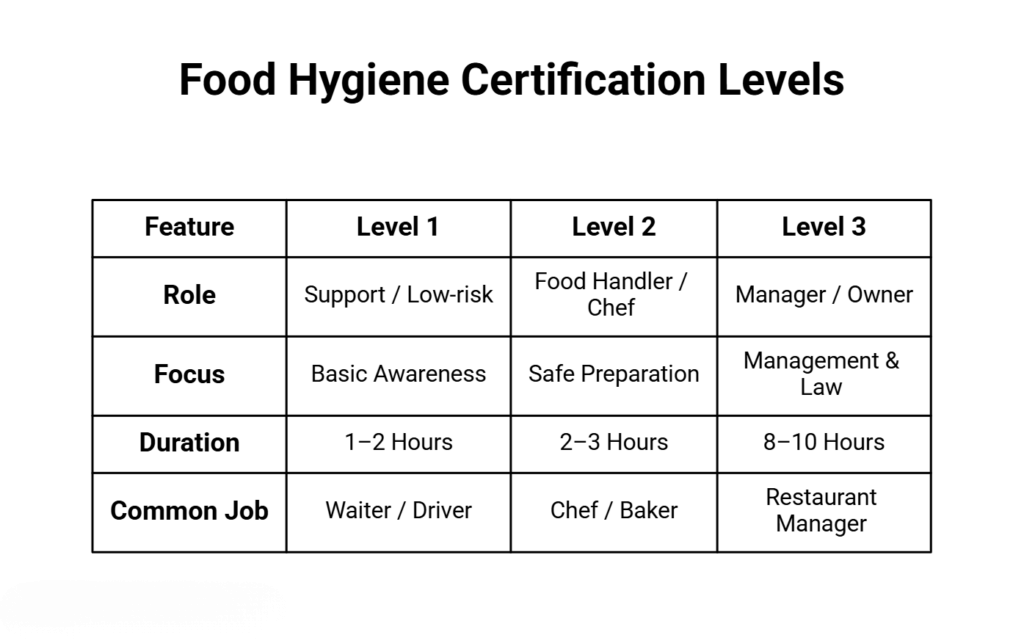
Comparison at a Glance
What Is Online Food Hygiene Training?
Online food hygiene training is a simple way to learn how to handle food safely using the internet. Instead of attending a classroom course, you study online at a time that suits you. So, you can learn from home, at work, or even on your phone.
How Online Training Works
First, you choose the right course level for your role. Then, you complete short lessons that explain food safety in clear, practical terms. Along the way, you answer quick quizzes to check your understanding. Finally, you take a short assessment and receive your certificate once you pass.
Why It Is Easy and Effective
Because you control the pace, you can pause, repeat topics, and learn without pressure. As a result, online food hygiene training feels straightforward, flexible, and easy to fit around everyday work and life.
Benefits of Food Hygiene Training Online
Online food hygiene training works because it fits real working life. Instead of forcing you into a fixed schedule, it gives you control. So, whether you are starting a new role or updating your skills, learning online keeps things simple and practical.
Below are the main benefits, explained clearly and in order.
Flexible Learning That Fits Around You
First of all, online training lets you choose when to learn. You are not tied to a classroom or set times. So, if you work shifts or long hours, you can study when it suits you.
Because lessons are short, you can also pause and return later. As a result, training feels less stressful and easier to complete.
Faster Completion and Instant Certificates
Online food hygiene courses move at your pace. If you focus, you can finish quickly. So, instead of waiting days for results, you often receive your certificate as soon as you pass.
This helps when you:
- Need proof of training before starting work
- Want to update records quickly
- Prepare for an inspection
As a result, there is no unnecessary delay.
Lower Cost, Better Value
Online training usually costs less than classroom courses. Because there are no travel or venue fees, you save money straight away.
For businesses, this matters even more. Staff can train individually, which avoids shutting the workplace or paying for group sessions. So, training becomes easier to manage and budget for.
Clear Learning You Can Control
Not everyone learns at the same speed. Online training respects that. So, if you need more time on a topic, you can slow down. If something feels familiar, you can move on.
This freedom helps you understand food hygiene rules properly. As a result, you apply them more confidently at work.
Works for All Types of Food Roles
Online food hygiene training suits many people, including:
- New starters in hospitality and catering
- Experienced staff refreshing knowledge
- Supervisors managing compliance
- Self-employed food business owners
So, no matter your role, online training adapts to your needs.
In short, online food hygiene training saves time, reduces costs, and keeps learning simple. Next, we’ll explain how online certification works from start to finish.
How Online Food Hygiene Certification Works

Online food hygiene certification follows a clear and simple process. So, instead of guessing what happens next, you always know where you are and what to do. Because everything stays online, you move through the steps at your own pace.
Let’s walk through the process from start to finish.
Step 1: Choose the Right Course Level
First, you select the course level that matches your role. So, if you handle food daily, Level 2 usually fits. However, if you manage staff or run a business, Level 3 often works better.
Choosing the right level matters. Because when the course matches your job, the learning feels relevant and useful.
Step 2: Complete the Online Training
Next, you start the training itself. Lessons come in short sections, which makes learning easier. So, instead of long lectures, you work through clear explanations, examples, and visuals.
At the same time, you can pause, repeat topics, or return later. As a result, learning fits around your schedule.
Step 3: Check Your Knowledge with Quizzes
Throughout the course, you answer short quizzes. These help you check understanding before moving on. So, if something feels unclear, you can revisit it straight away.
Because quizzes are low pressure, they help build confidence rather than stress.
Step 4: Take the Final Assessment
Once you finish the lessons, you take a final assessment. This usually involves multiple-choice questions based on what you learned.
If you pass, you move on immediately. If not, many courses allow free retakes. So, you get another chance without extra cost.
Step 5: Receive Your Certificate
Finally, after passing the assessment, you receive your food hygiene certificate. In most cases, you can download it instantly.
You can then:
- Show it to your employer
- Keep it for inspection records
- Print it if needed
In short, online food hygiene certification keeps the process clear, flexible, and fast. Next, we’ll look at who needs food hygiene training in the UK and why it applies to so many roles.
Who Needs Food Hygiene Training in the UK?
In the UK, food hygiene training applies to more people than many realise. So, if you handle food in any way at work, you usually need some level of training. Because food safety affects public health, the law expects everyone involved to understand basic hygiene rules.
Let’s look at who needs training and why it matters.
Food Handlers and Kitchen Staff
First of all, anyone who prepares, cooks, or handles open food needs food hygiene training. So, if you work in a restaurant, café, or takeaway, training is essential.
This includes:
- Chefs and kitchen assistants
- Café and restaurant staff handling food
- Takeaway and fast-food workers
- Bakers and food production staff
Because these roles deal with food daily, proper training helps prevent common mistakes.
Care, Education, and Health Settings
Food hygiene training is just as important outside hospitality. So, if you prepare food for vulnerable people, training becomes even more critical.
This applies to:
- Care home catering staff
- School and nursery kitchen teams
- Hospital and NHS catering workers
In these settings, good hygiene protects people with weaker immune systems. As a result, training plays a vital role.
Mobile, Temporary, and Self-Employed Food Workers
Even if you do not work in a permanent kitchen, you still need training. So, street food vendors, market traders, and mobile caterers must follow the same rules.
This also includes:
- Self-employed food business owners
- Home-based food sellers
- Event and festival food staff
Because you handle food for the public, the responsibility stays the same.
Front-of-House and Support Staff
In some cases, people think they do not need training because they do not cook. However, if you handle food or drinks, training still matters.
For example:
- Staff serving food and drinks
- People handling plated meals
- Staff clearing and cleaning food areas
So, even limited contact with food can carry risks.
Career Benefits of Food Hygiene Training
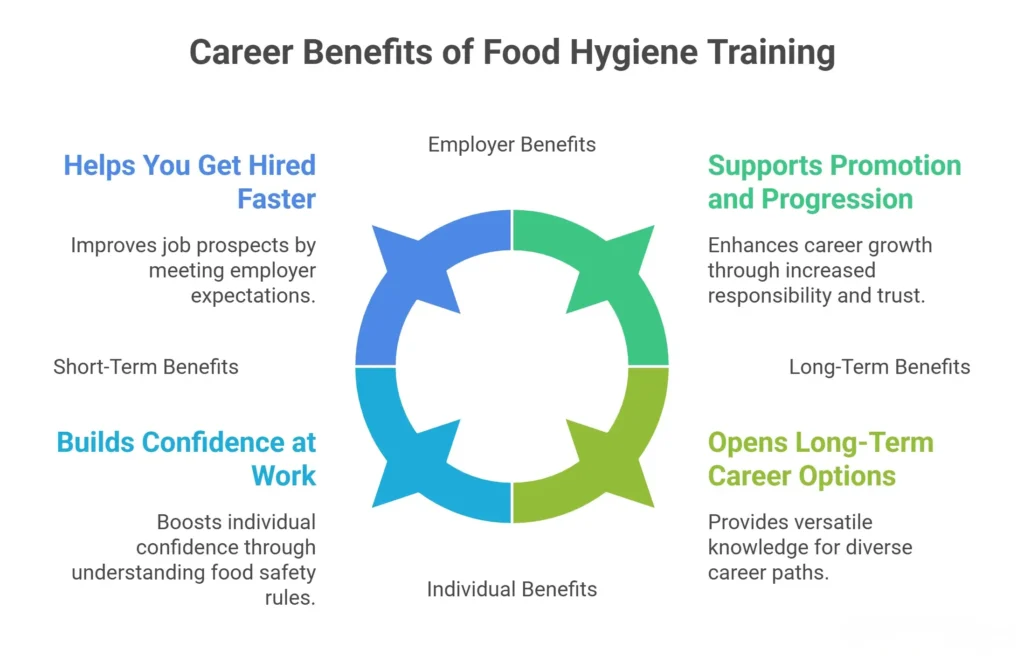
Food hygiene training does more than meet legal requirements. It also supports your career growth. So, whether you are new to the industry or aiming for promotion, the right training can help.
Here are the key career benefits, broken down clearly.
Helps You Get Hired Faster
Many UK employers expect food hygiene training before you start work. So, when you already have a certificate, you stand out. As a result, employers see you as job-ready from day one.
Supports Promotion and Progression
Training shows commitment. Because of that, managers often trust trained staff with more responsibility. So, food hygiene training can help you move into supervisor or team leader roles.
Builds Confidence at Work
When you understand food safety rules, you work with confidence. So, during busy shifts, you know what to do and why it matters. As a result, you make fewer mistakes.
Opens Long-Term Career Options
Food hygiene training supports many career paths. So, whether you move into management, food production, or self-employment, the knowledge stays useful.
Shows Professionalism to Employers
Holding a certificate proves you take food safety seriously. Because of this, employers see you as reliable and responsible.
In short, food hygiene training improves job prospects, builds confidence, and supports long-term career growth.
Benefits for Employers and Businesses
Food hygiene training does not only benefit staff. It also plays a key role in running a safe and successful food business. So, when you invest in proper training, you protect your customers and your reputation at the same time.
Let’s look at how food hygiene training supports businesses across the UK.
Helps You Meet Legal Duties
First of all, UK law requires food businesses to train staff properly. So, when your team holds food hygiene certificates, you meet this legal duty more easily.
Because training shows due care, it also helps during inspections. As a result, you reduce the risk of warnings, fines, or further action.
Improves Food Hygiene Ratings
Training directly affects daily behaviour. So, when staff understand hygiene rules, they follow them more consistently.
This often leads to:
- Cleaner work areas
- Better food storage
- Safer handling practices
As a result, your food hygiene rating is more likely to improve or stay high.
Reduces Risk and Costly Mistakes
Mistakes in food safety can cost time, money, and trust. However, trained staff spot risks early.
For example, if someone notices food stored at the wrong temperature, they can act quickly. So, training helps prevent complaints, illness, and wasted stock.
Builds Customer Trust
Customers care about safety. So, when they see good hygiene practices, they feel more confident eating at your business.
A strong hygiene reputation also brings repeat customers. Because of this, training supports long-term success.
Makes Training Easy to Manage
Online food hygiene training helps employers manage staff training with less effort. So, you can:
- Train new starters quickly
- Keep clear records
- Refresh training when needed
As a result, compliance becomes simpler and more organised.
Choosing the Right Online Food Hygiene Course

Choosing the right online food hygiene course matters more than many people think. So, instead of picking the cheapest or quickest option, it helps to look at quality, recognition, and relevance to your role. When you choose well, you save time and gain real value.
Here’s how to make the right choice and why a Level 3 course can be the best step forward.
Match the Course to Your Role
First of all, think about what you actually do at work. If you supervise staff, manage food safety systems, or run a food business, you need more than basic knowledge. So, a Level 3 course fits much better than entry-level training.
Level 3 training helps you:
- Manage food hygiene procedures
- Train and supervise staff correctly
- Prepare confidently for inspections
Because of this, it suits managers, supervisors, and business owners across the UK.
Choose a Course That Meets UK Standards
Not all online courses offer the same depth. So, you should always choose a course that follows UK food safety guidance and supports legal compliance.
The Food Hygiene and Safety Level 3 course focuses on real workplace needs. As a result, you gain practical knowledge you can use straight away.
Look for Clear and Practical Learning
A good course should explain food safety in plain English. So, instead of long theory, you should get clear examples and real-life scenarios.
This Level 3 course does exactly that. It covers:
- Managing food safety risks
- Applying HACCP principles
- Leading staff and correcting unsafe habits
- Keeping records and inspection-ready systems
Because lessons stay clear and structured, learning feels manageable.
Check for Flexible Learning and Instant Certification
Time matters, especially in busy food businesses. So, flexible online learning helps you train without disruption.
With this course, you can:
- Learn at your own pace
- Pause and return anytime
- Complete training around work
- Download your certificate after passing
As a result, you stay compliant without slowing down operations.
Why This Course Is a Smart Choice
If you want recognised training that supports career growth and business compliance, this Level 3 course stands out. It offers depth, flexibility, and practical value in one place.
In short, choosing the right online food hygiene course means choosing training that works for your role, your schedule, and your future.
Common Myths About Online Food Hygiene Training
Many people still hesitate to choose online food hygiene training because of common myths. However, these ideas often come from outdated views. So, let’s clear things up and look at the facts in a simple way.
Myth 1: Online Food Hygiene Certificates Are Not Accepted
This is one of the most common myths. However, it is not true. In the UK, employers and local authorities accept online food hygiene certificates as long as the course meets legal guidance.
So, if the training covers the right content, the format does not matter. As a result, online certificates work just as well as classroom ones.
Myth 2: Classroom Training Is Always Better
Some people think face-to-face learning is the only effective option. However, online training offers more control. So, instead of rushing through a session, you can learn at your own pace.
Because you can pause and repeat topics, many learners actually understand the content better online.
Myth 3: You Only Need Food Hygiene Training Once
This myth can cause problems. Food safety rules change, and habits slip over time. So, training should be refreshed regularly.
As a result, updating your knowledge helps you stay compliant and confident at work.
Myth 4: Online Training Is Too Basic
People often assume online courses lack depth. However, higher-level courses cover detailed topics like HACCP, inspections, and staff management.
So, online training suits not just beginners, but also supervisors and business owners.
Myth 5: Online Learning Is Hard to Follow
Some worry about using technology. However, most online food hygiene courses use simple layouts and clear language.
Because of this, even people with limited computer skills complete courses without trouble.
Final Thoughts
Online food hygiene training offers a simple and effective way to stay compliant, build skills, and protect customers. So, whether you work in food service or manage a business, the right training helps you work with confidence and care.
In short, choosing recognised online food hygiene training supports legal compliance, career growth, and safer food practices across the UK.