

Saving a life is one of the most powerful things you can do. Care Certificate Standard 12: Basic Life Support teaches care workers how to respond when someone’s heart or breathing has stopped. Knowing what to do in those first moments can mean the difference between life and death.
Care Certificate Standard 12 sets out the knowledge and skills needed to recognise a life‑threatening emergency, start cardiopulmonary resuscitation (CPR) and use an automated external defibrillator (AED). It ensures care workers act quickly and safely, giving someone the best chance of survival.
In this blog you’ll learn:
- What basic life support (BLS) involves
- The CPR steps and emergency response actions
- How to recognise when someone needs help
- Your responsibilities during a life‑threatening emergency
- Practical skills and confidence‑building tips
- Relevant national guidelines and frameworks (e.g., Resuscitation Council UK, NHS)
Why Care Certificate Standard 12 Is a 
Basic life support is the immediate care given to someone when their heart or breathing stops. It supports circulation and breathing through CPR until advanced help arrives. Early and correct BLS keeps oxygen flowing to the brain and vital organs, significantly increasing the person’s chance of survival.
As a care worker you may witness an unresponsive person at home, in a care setting or in public. Preparedness is essential; without prompt action, permanent brain damage or death can occur within minutes. Imagine finding a resident on the floor, not responding and not breathing normally. Your knowledge of Standard 12 helps you stay calm, call for help and begin CPR while awaiting an ambulance. That confidence can save a life.
Understanding What Basic Life Support Involves
BLS combines CPR with early access to emergency services and defibrillation. Its key elements are:
- Prompt recognition of cardiac arrest – noticing when a person has collapsed and is not breathing normally.
- Calling for urgent medical assistance – dial 999/112 and get help on the way.
- Early effective CPR – pressing on the chest to pump blood to the brain, keeping interruptions to a minimum.
- Early defibrillation – using an AED to restore a normal heart rhythm.
- Early advanced life support and post‑arrest care – skilled responders provide airway management, drugs and ongoing care.
CPR can be hands‑only or involve rescue breaths. People without recent training should perform hands‑only CPR, while those trained and confident can give breaths as well. Acting quickly and calmly improves survival; delaying compressions reduces oxygen supply to the brain. In care settings, BLS is part of an emergency care plan and must be practised regularly.
Recognising When Someone Needs Immediate Help

Early recognition triggers the chain of survival. Signs of cardiac arrest include unresponsiveness and abnormal or absent breathing. Slow, laboured breaths or gasping (agonal breathing) should be treated as cardiac arrest. Choking or severe breathing difficulties also require immediate attention.
If a person collapses, check your surroundings for danger, shout for help and gently shake the person to see if they respond. Look for the rise and fall of their chest and listen for normal breathing. Suspect cardiac arrest in any unresponsive person; call 999 without delay. In an example scenario, a colleague collapses and gasps. You check for breathing, call 999 and start chest compressions while a bystander fetches the AED – this swift response could save their life.
Your Responsibilities in an Emergency
Under Standard 12, you must act within your training and organisational policy. The Resuscitation Council UK emphasises that everyone can and should call 999 for any unresponsive person. You should:
- Ensure safety – check the scene is safe for you and the casualty.
- Call 999 immediately – using speakerphone if you are alone, so you can continue assessing breathing and start CPR. The call handler will guide you through the steps.
- Start CPR without delay – press hard and fast in the centre of the chest at a rate of 100–120 compressions per minute and a depth of 5–6 cm.
- Use an AED – anyone can use an AED; attach it as soon as it is available and follow its instructions.
- Stay within your competence – follow your training and company procedures; hand over to paramedics when they arrive.
If you are alone and have no mobile signal, shout for help, fetch a phone and call 999 as quickly as possible. Document what happened afterwards and report any near misses according to your organisation’s policy.
Step‑by‑Step Supportive Actions During CPR
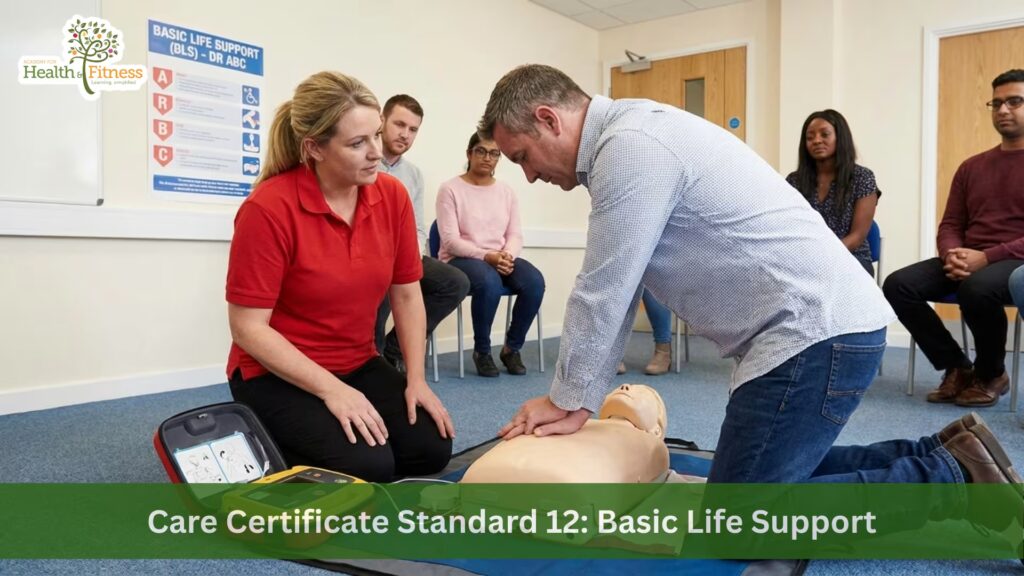
Although Standard 12 does not expect you to teach CPR, you should understand the general steps so you can follow them when guided by a trainer or call handler:
- Check for dangers, shout for help and check responsiveness.
- Assess breathing – look for chest movement, listen and feel.
- Call 999/112 – put the phone on loudspeaker and describe the situation.
- Start chest compressions – interlock your fingers and push down hard and fast in the centre of the chest, allowing full recoil. Continue at 100–120 compressions per minute.
- Add rescue breaths if trained – after 30 compressions, give two breaths by sealing your mouth over theirs and blowing just enough to see the chest rise. If you’re not confident, continue hands‑only CPR.
- Use an AED – the call handler will tell you where the nearest AED is; switch it on and follow the prompts.
- Keep going – continue CPR until the AED says stop, a paramedic arrives or the person shows signs of life.
Hands‑only CPR is an effective alternative when breaths cannot be given; pressing on the chest keeps blood flowing and buys time for professional help.
Everyday Preparation for Emergencies
Preparation builds confidence. The Resuscitation Council UK notes that AEDs should be widely available, housed in unlocked cabinets and accessible 24 hours a day. As a care worker you can:
- Know where the equipment is – locate the nearest AED and first‑aid kit in your workplace.
- Keep your training up to date – attend regular BLS refresher courses; everyone can learn CPR.
- Practice calm communication – rehearse calling 999 and giving clear, concise information.
- Coordinate with your team – agree who will fetch the AED, call for help and perform compressions in an emergency.
- Encourage awareness – share resources with colleagues and families; signpost to trusted guidance from the Resuscitation Council UK or NHS for public education.
These preparations help create a culture where people feel ready to act without hesitation.
When Providing BLS Feels Difficult
Performing CPR can be emotionally challenging. The Resuscitation Council UK recognises that finding someone in cardiac arrest and attempting resuscitation may be traumatic and that lay rescuers may need support. Fear, panic or the presence of distressed relatives can make it hard to focus. Limited space or public settings may add pressure.
If you feel overwhelmed, remember that doing something is better than doing nothing. The risk of causing harm is low. Focus on following the call handler’s instructions and prioritise chest compressions. Afterwards, talk to your manager about debriefing and emotional support. Reflecting on the experience helps build resilience and improve future responses.
Key Guidance You Should Be Aware Of

The Resuscitation Council UK (RCUK) publishes national guidelines on basic life support, updated in 2025, which emphasise early recognition of cardiac arrest, calling 999 for any unresponsive person, starting chest compressions promptly and using an AED. The 2025 guidelines highlight that rescuers no longer need to confirm abnormal breathing before calling; they should initiate the call first and assess breathing while waiting for the call to be answered.
The NHS provides detailed advice for hands‑only and rescue‑breath CPR. If trained, give 30 compressions followed by two breaths, compressing the chest 5–6 cm deep at 100–120 per minute. Those without training should perform hands‑only CPR at the same rate. Follow your employer’s BLS policy and always seek accredited training.
Connecting Care Certificate Standard 12 to Your Wider Care Training
Basic life support links closely with other Care Certificate standards. Good communication (Standard 6) helps you gather information quickly and provide clear instructions during an emergency. Duty of care (Standard 3) reinforces your legal and ethical responsibility to act when someone is at risk. Health and safety (Standard 13) ensures you know how to assess hazards and keep yourself and others safe. Infection prevention and control (Standard 15) reminds you to consider hygiene when providing CPR, such as using face shields if available. Working as part of a prepared team and integrating these standards creates a safer environment for everyone.
Conclusion
Knowing how to perform basic life support gives you the confidence to act when seconds count. Standard 12 empowers care workers to recognise cardiac arrest, call for help and begin lifesaving CPR. By practising these skills and staying prepared, you can make a profound difference to someone’s life.
For structured, flexible learning that supports your growth, explore our Care Certificate Online Training Course.