

Reflective Practice in Health and Social Care: Turning Experience Into Better Care
Have you ever wondered how Reflective Practice in Health and Social Care can help you improve the way you support people and make better care decisions? Many care professionals face moments where the right approach is not always obvious. The answer is not simply to repeat what you have always done. Instead, develop reflective skills that help you learn from experiences, recognise improvements and provide more effective support. The Health and Social Care Level 3 Diploma helps learners understand reflection, communication, safeguarding and person-centred care, giving them the knowledge to improve their professional approach.
Demand for reflective and skilled care professionals continues to grow as the UK health and social care sector faces increasing pressure from an ageing population and rising care needs. The NHS employs over 1.5 million people, while adult social care supports around 1.6 million roles in England. With more than 10 million people in the UK aged 65 and over, care services need professionals who can adapt, improve practice and provide safe, person-centred support through strong reflective skills.
In this guide, you will learn what is reflective practice in health and social care, why reflective thinking matters, the benefits of becoming a reflective practitioner, key reflective practice models including Gibbs, Schön and Kolb, real workplace examples, and how reflection supports communication, safeguarding, professional development and continuous improvement in care settings.
Ready to strengthen your care knowledge and develop the skills needed to provide more effective support? The Health and Social Care Level 3 Diploma helps you develop essential skills in person-centred care, safeguarding, communication and reflective practice to support better outcomes in health and social care settings.
What Is Reflective Practice in Health and Social Care? Meaning, Importance and Role in Improving Care
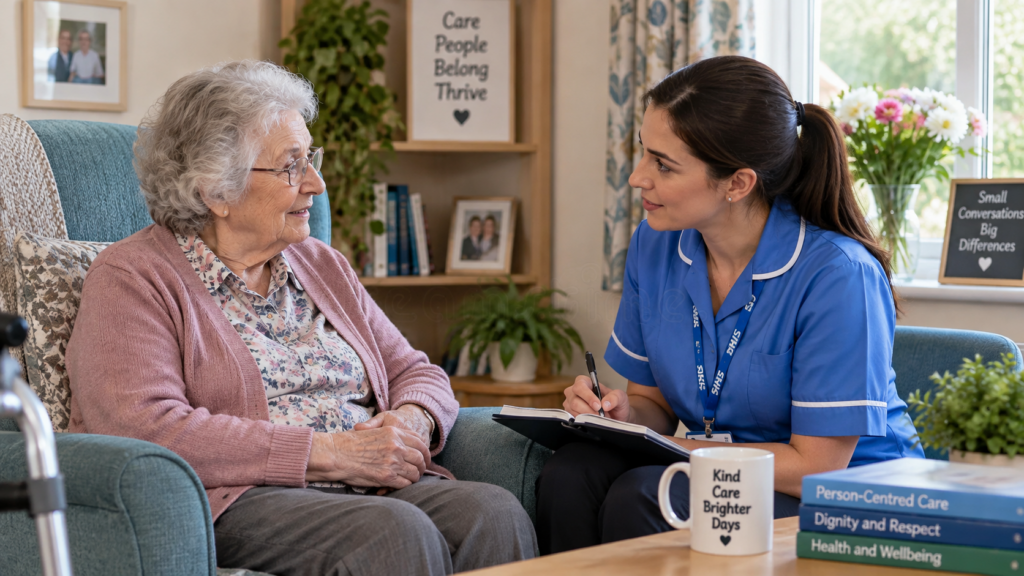
Reflective Practice in Health and Social Care means reviewing your actions, decisions and experiences to understand what happened, why it happened and how you can improve future care. It helps professionals learn from everyday situations instead of simply moving from one task to another. Reflection involves analysing experiences, recognising strengths, identifying areas for improvement and creating better approaches. According to the Health and Care Professions Council, reflection helps professionals gain insight into their practice and apply learning to maintain and improve the quality of support they provide.
Meaning of Reflective Practice in Health and Social Care
Reflective practice allows care professionals to turn experiences into learning opportunities. However, reflection involves more than remembering an event; it requires careful thought about actions, emotions, decisions and outcomes.
A reflective practitioner asks questions such as:
- What happened during the situation?
A care worker reviews the event, the people involved and the actions they took. For example, they may reflect on how they supported a person with dementia during a difficult conversation and consider whether their approach met the individual’s needs. - Why did the situation happen and what did I learn?
Reflection encourages professionals to understand the reasons behind their actions. As a result, they can recognise successful approaches, identify challenges and develop better responses for similar situations. - How can I improve my practice next time?
Reflection focuses on future improvement. Then, professionals use their learning to adjust communication methods, improve decision-making and provide more personalised support.
Reflective thinking in care settings helps healthcare assistants, support workers, nurses and social care professionals develop greater awareness of their responsibilities and the impact of their actions.
Why Is Reflective Practice Important in Health and Social Care?
The importance of reflective practice in health and social care comes from its ability to improve safety, quality and professional development. Care environments involve complex situations where every individual has different needs, preferences and experiences.
Reflective practice supports professionals by helping them:
- Improve decision-making and care quality
Reflection allows professionals to review choices and understand whether their actions supported positive outcomes. By learning from previous experiences, they can make more informed decisions and provide safer care. - Strengthen communication and relationships
Professionals can evaluate how they communicate with individuals, families and colleagues. As a result, they can improve their listening skills, show empathy and build stronger relationships based on trust and respect. - Develop continuous learning habits
Furthermore, reflection encourages professionals to recognise knowledge gaps and identify areas for development. Therefore, workers can use these insights to choose suitable training and build confidence over time.
Role of Reflective Practice in Improving Care
Reflective practice plays an important role in creating better experiences for people receiving health and social care support. It encourages professionals to look beyond routine tasks and consider how their actions affect dignity, independence and wellbeing.
The role of reflective practice includes:
- Supporting person-centred care
Reflection helps professionals understand individual preferences, values and needs. By reviewing their approach, care workers can adapt support methods and ensure people remain involved in decisions about their own care. - Reducing mistakes and improving safety
Professionals can learn from challenging situations, incidents and feedback. In particular, reflection helps them identify what went wrong, understand the causes and make changes that reduce future risks. - Building confident and skilled professionals
In addition, regular reflection develops self-awareness and professional confidence. Workers become better equipped to manage challenges, respond effectively and provide compassionate support in different care environments.
Ultimately, reflective practice helps professionals learn from experience, improve their approach and deliver safer, more effective care.
Benefits of Becoming a Reflective Practitioner: Skills, Confidence and Professional Development
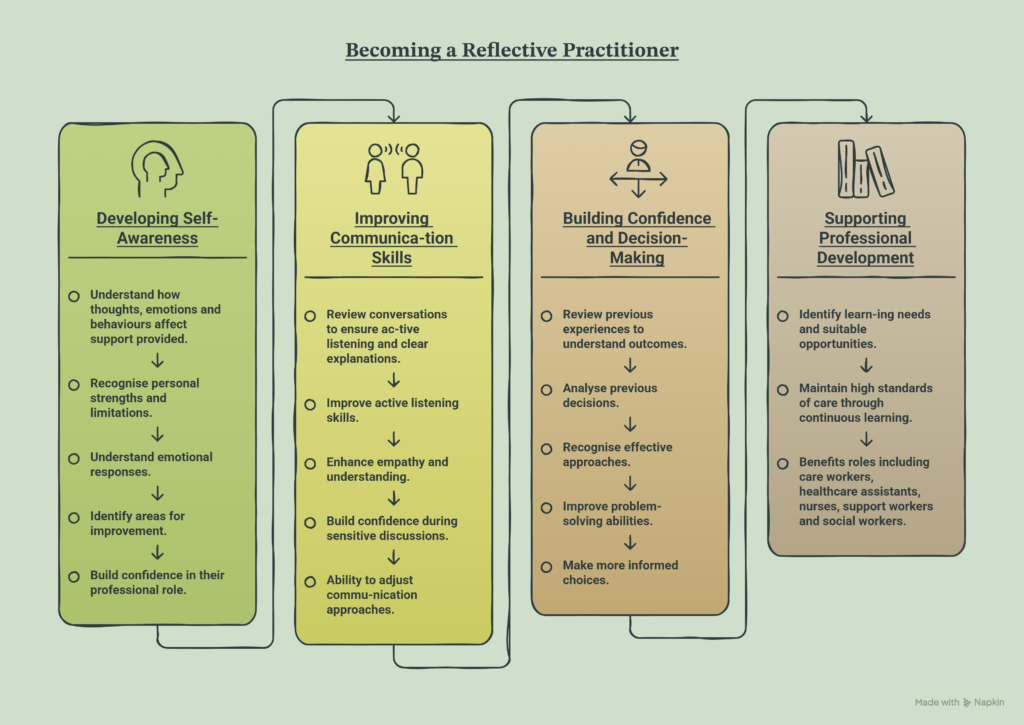
Becoming a reflective practitioner helps healthcare professionals move beyond completing daily responsibilities and encourages them to understand how their actions influence the people they support. The benefits of reflective practice in health and social care include improved self-awareness, stronger communication, better decision-making and continuous professional growth. Reflection allows workers to learn from experiences, recognise areas for improvement and develop more effective approaches to care. According to the Health and Care Professions Council, reflection helps professionals gain insight into their practice and apply learning to improve services and outcomes.
The main benefits of becoming a reflective practitioner can be seen across different areas of professional development:
Developing Self-Awareness
Self-awareness helps care professionals understand how their thoughts, emotions and behaviours affect the support they provide. Through reflection, workers can recognise their strengths, identify challenges and consider how their personal responses influence interactions with individuals receiving care.
For example, a support worker may reflect on feeling frustrated during a difficult conversation and explore the reasons behind that reaction. As a result, they can respond more calmly, manage their emotions and provide more compassionate support.
Reflective practice allows professionals to:
- Recognise personal strengths and limitations
- Understand emotional responses
- Identify areas for improvement
- Build confidence in their professional role
Improving Communication Skills
Effective communication plays an essential role in delivering person-centred care. Reflection helps professionals review conversations and understand whether they listened actively, explained information clearly and responded appropriately to individual needs.
For example, a healthcare assistant may reflect on supporting an anxious patient and recognise that using simple explanations and allowing more time improved the person’s confidence. Therefore, professionals can use this learning to adapt their communication style to different situations.
Reflective practice improves:
- Active listening skills
- Empathy and understanding
- Confidence during sensitive discussions
- Ability to adjust communication approaches
Building Confidence and Decision-Making Skills
Care professionals regularly face situations that require thoughtful decisions. Therefore, reviewing previous experiences can help care professionals understand outcomes and approach similar challenges with greater confidence.
For instance, a care worker who reflects on supporting someone experiencing distress may identify which approaches helped create reassurance. Consequently, they can use this knowledge to respond more effectively in similar situations.
Reflection supports professionals by helping them:
- Analyse previous decisions
- Recognise effective approaches
- Improve problem-solving abilities
- Make more informed choices
Supporting Professional Development
Professional development through reflection helps workers identify learning needs and choose suitable opportunities to improve their knowledge and skills. In addition, reflective practice supports continuous learning and helps professionals maintain high standards of care.
It benefits different roles in health and social care:
Care workers
Reflection helps care workers improve daily support approaches, understand individual needs and develop greater awareness of professional responsibilities.
Healthcare assistants
Healthcare assistants can build confidence, improve teamwork and strengthen their ability to support patients effectively.
Nurses
Similarly, nurses can review decisions, evaluate their practice and continue developing skills that support safe and effective care.
Support workers
Moreover, support workers can adapt their approaches, encourage independence and provide more personalised support.
Social workers
Also, social workers can analyse complex situations, understand different perspectives and improve professional judgement.
Ultimately, becoming a reflective practitioner creates a habit of learning, improvement and better-quality care throughout a professional career.
Reflective Practice Models in Healthcare Explained: Gibbs, Schön, Kolb, Johns and Rolfe Models
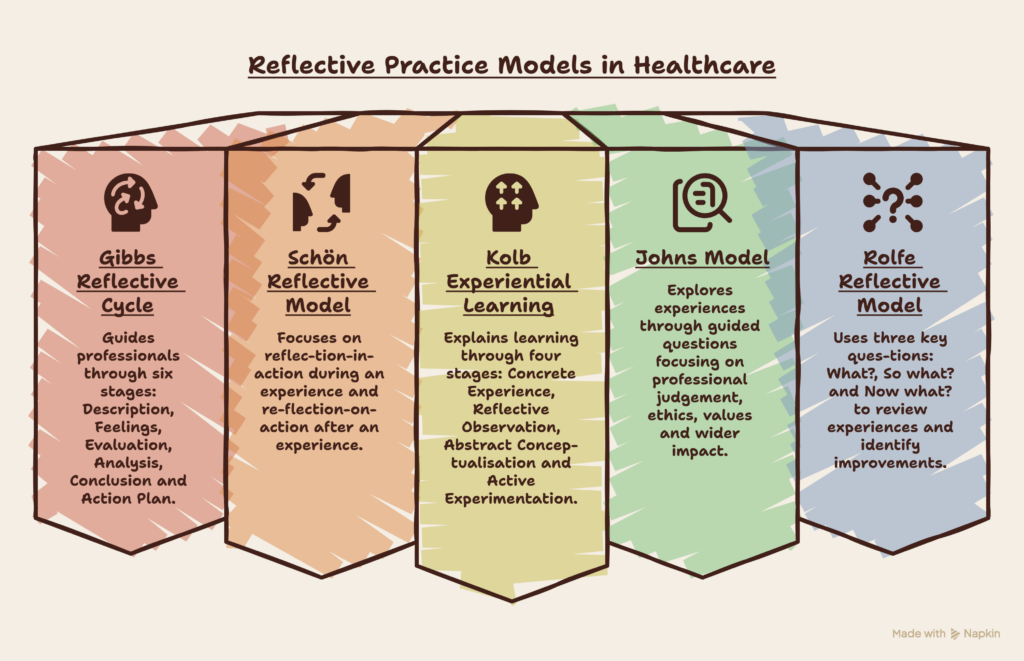
Reflective Practice Models in Healthcare provide structured frameworks that help professionals analyse experiences, understand their actions and identify ways to improve future practice. Instead of reflecting without direction, healthcare professionals can use these models to ask meaningful questions, explore decisions and turn everyday experiences into learning opportunities. Models such as Gibbs, Schön, Kolb and Johns support nurses, healthcare assistants, care workers and social care professionals in developing self-awareness, improving decision-making and strengthening the quality of care they provide. Different reflective practice models suit different situations.
However, each framework helps professionals move from simply remembering an event to actively learning from it:
Gibbs Reflective Cycle
Gibbs’ Reflective Cycle is one of the most widely recognised reflective practice models in healthcare. Specifically, it guides professionals through six stages: Description, Feelings, Evaluation, Analysis, Conclusion and Action Plan. In particular, this model helps workers explore what happened, understand their emotions, identify lessons and plan improvements.
For example, a healthcare assistant who reflects on supporting an anxious patient can review their communication approach, understand what helped the patient feel comfortable and plan how to respond in similar situations.
The six stages include:
- Description: What happened?
- Feelings: What were you thinking and feeling?
- Evaluation: What worked well and what did not?
- Analysis: Why did the situation happen?
- Conclusion: What did you learn?
- Action Plan: What will you do differently next time?
Gibbs’ model is useful because it creates a clear structure for professionals who are new to reflective writing.
Schön Reflective Practice Model
The Schön reflective practice model focuses on how professionals think during and after experiences. It highlights two important approaches: reflection-in-action and reflection-on-action.
Reflection-in-action happens while a situation takes place. Professionals think quickly, adapt their approach and make decisions based on what they observe.
For example, a care worker may notice that a person becomes distressed during support and immediately change their communication style to provide reassurance.
In contrast, reflection-on-action happens after the situation. Then, the professional reviews what happened, considers their decisions and identifies improvements for future practice.
This model helps healthcare professionals develop confidence in responding to changing situations and making informed decisions.
Kolb Experiential Learning Cycle
The Kolb experiential learning cycle explains how professionals learn through experience. In other words, people learn by experiencing situations, reflecting on them, create understanding and applying new knowledge in future activities.
The cycle includes four stages:
- Concrete Experience: The professional experiences a situation.
- Reflective Observation: They review and think about what happened.
- Abstract Conceptualisation: They develop new understanding from the experience.
- Active Experimentation: They apply their learning to future situations.
For example, a support worker may reflect on a challenging behaviour incident, understand possible triggers and use a different approach when a similar situation occurs.
Johns Model of Structured Reflection
Johns’ Model of Structured Reflection helps healthcare professionals explore experiences through guided questions. It focuses on professional judgement, ethics, personal values and understanding the wider impact of decisions.
The model encourages professionals to consider:
- What happened during the experience?
- Why did I respond in that way?
- What influenced my decision?
- How could I improve my future practice?
Johns’ model is particularly valuable in healthcare because professionals often deal with complex situations involving ethical choices, individual needs and professional responsibilities.
Understanding different reflective practice models allows healthcare professionals to choose the approach that best supports their learning, development and improvement.
By using structured reflection, professionals can transform experiences into knowledge and create positive changes in care delivery.
Rolfe Reflective Model
The Rolfe Reflective Model offers a simple but effective framework that helps healthcare professionals review experiences and identify improvements. It uses three key questions that guide reflection and encourage professionals to move from describing an event to understanding its impact and planning future actions.
The model includes three stages:
- What? : This stage focuses on describing the experience clearly. First, professionals identify what happened, who took part and the key details, without analysing the experience yet. For example, a care worker may describe an interaction where a person receiving support became upset during a conversation.
- So what? : This stage explores why the experience matters and what professionals can learn from it. Professionals analyse their actions, emotions and the impact on the individual. For example, they consider what worked well, which challenges occurred and how the situation affected care quality.
- Now what? : This final stage focuses on future improvement. Finally, professionals decide what to do next time, whether they need further learning and how to adapt their approach. As a result, reflection leads to specific changes in how professionals provide care.
The Rolfe Reflective Model is useful because its straightforward structure makes reflection easier for beginners while still encouraging meaningful professional development. By asking these three questions, healthcare professionals can understand experiences, improve their practice and provide more effective support.
How Reflective Practice Is Used in Health and Social Care Settings: Real Workplace Applications
Reflective practice in health and social care settings helps professionals learn from everyday experiences and improve the way they support individuals. It allows workers to look beyond completing tasks and understand how their decisions, communication and actions affect people receiving care. By reviewing situations honestly, professionals can identify successful approaches, recognise challenges and make improvements that strengthen the quality of support they provide. Reflection helps maintain good practice and encourages continuous learning.
In daily care work, reflective learning in healthcare helps professionals examine different situations and choose better approaches for future practice.
It can support professionals when:
Supporting Individuals With Different Needs
Every individual has unique preferences, routines, communication styles and emotional needs. Therefore, care professionals should reflect on whether their approach respects the person’s choices and promotes independence.
For example, a care worker supporting someone with dementia may reflect on how they provided personal care. If the person appeared uncomfortable, the worker can consider whether they adapted their communication, allowed enough time or recognised the person’s preferences.
Reflection encourages professionals to ask:
- Did I respect the person’s choices?
- How well did I support their independence?
- Were my actions respectful of their dignity?
By reviewing these experiences, workers can provide more personalised and respectful care.
Managing Challenging Behaviour
Challenging behaviour often communicates an unmet need, emotion or concern. Reflective practice helps professionals look beyond the behaviour and explore possible reasons behind it.
For example, a support worker may reflect after someone becomes distressed and consider whether pain, confusion, anxiety or communication difficulties contributed to the situation.
This approach helps professionals:
- Understand possible triggers
- Adapt support strategies
- Respond more calmly
- Prevent similar situations in the future
Responding to Feedback
Feedback from colleagues, managers and people receiving care provides valuable opportunities for improvement. A reflective practitioner views feedback as a learning tool rather than criticism.
For instance, feedback about communication style may help a worker recognise strengths while identifying areas where they can improve. In addition, reflection helps professionals consider different perspectives and make positive changes to their practice.
Handling Difficult Conversations
Care professionals often support individuals and families during emotional or sensitive situations. Reflection helps workers review how they communicated, managed emotions and built trust.
After a difficult conversation, a professional may consider whether they listened actively, showed empathy and provided clear information.
As a result, professionals can use what they learn to adapt to challenges, strengthen relationships and provide safer support.
Learning from everyday experiences helps care professionals build confidence, make better decisions and improve care quality.
Reflective Practice Examples for Care Workers: Real Scenarios and Learning Outcomes
Reflective practice examples for care workers help professionals understand how reflection applies to real workplace situations. By reviewing experiences, care workers can identify what worked well, recognise challenges and develop better approaches for future support. Reflection turns everyday interactions into valuable learning opportunities, helping professionals improve communication, understand individual needs and provide safer, more person-centred care.
Real-life situations show how reflective practice helps care workers improve their approach:
Example 1: Communication Difficulties With a Person With Hearing Loss
A care worker noticed that a person with hearing loss became confused during a conversation because they provided instructions too quickly.
The worker reflected on their communication approach and realised that speaking louder did not always improve understanding. Instead, they recognised the importance of facing the person, using clear language and allowing enough time for responses.
As a result, the care worker recognised the need to adapt communication to each person. Moving forward, they planned to reduce background noise, check understanding regularly and create a more comfortable environment for conversations.
Example 2: Supporting an Anxious Patient
A healthcare assistant supported a patient who felt nervous before a procedure. The assistant reflected on how their communication style influenced the patient’s confidence and emotional wellbeing.
They recognised that patience, reassurance and active listening helped the individual feel calmer and more supported. Therefore, the assistant recognised how small communication choices can improve a person’s experience of care.
As a result, the healthcare assistant continued using clear explanations, encouraged questions and focused on creating a reassuring environment during stressful situations.
Example 3: Managing Challenging Behaviour
A support worker experienced a situation where an individual became upset and refused support. Instead of viewing the behaviour negatively, the worker reflected on possible reasons behind the reaction.
They considered whether changes in routine, communication difficulties or unmet needs contributed to the situation. Consequently, the worker began to understand that behaviour may communicate a person’s feelings or needs.
After reflecting, the worker planned to learn more about the individual’s preferences, recognise early warning signs and adapt their support approach.
By learning from their experiences, care workers can improve their responses and provide more effective support for each person.
Reflective Practice, Person-Centred Care and Safeguarding: Improving Support and Safety
Reflective practice, person-centred care and safeguarding work together to help health and social care professionals provide safer and more respectful support. Reflection allows workers to review their decisions, understand individual needs and identify improvements in their approach. By thinking critically about their actions, professionals can protect dignity, encourage independence and respond more effectively to safeguarding concerns. This creates a care environment where individuals feel valued, heard and protected.
When professionals reflect on their daily practice, they can strengthen the following areas:
Reflective Practice and Person-Centred Care
Person-centred care focuses on treating each individual as a unique person with their own preferences, values and goals. Most importantly, reflective practice helps professionals review whether their actions truly respect the person’s choices and support their independence.
For example, a care worker supporting someone with dementia may reflect on how they provide personal care. Instead of focusing only on completing the task, they consider whether they communicated clearly, respected the person’s routine and helped them feel comfortable.
Reflection encourages professionals to ask:
- Did I involve the person in decisions about their care?
- Did I respect their preferences and choices?
- Could I improve the way I provide support?
By reflecting regularly, care workers can adapt their approach and provide more personalised care that protects dignity and wellbeing.
Reflective Practice and Safeguarding
Safeguarding requires professionals to recognise risks, respond to concerns and protect people from harm. In addition, reflective practice helps workers learn from safeguarding situations and improve their future responses.
After a safeguarding concern, professionals can reflect on whether they identified warning signs, followed correct procedures and communicated concerns effectively. For example, reflecting on a missed concern may highlight the need for better training, clearer reporting or improved teamwork.
Reflection supports safeguarding by helping professionals:
- Recognise potential risks earlier
- Improve decision-making
- Strengthen reporting practices
- Create safer care environments
According to the Care Quality Commission (CQC), safe care depends on effective systems, learning from incidents and continuous improvement.
Reflective practice is not about focusing only on mistakes. Instead, it helps professionals learn from both positive and difficult experiences and improve the support they provide.
Although, developing reflective skills helps care professionals strengthen trust, improve quality and protect the wellbeing of the people they support. A strong understanding of safeguarding, person-centred care and professional responsibilities is essential for anyone entering the care sector. The Health and Social Care Level 3 Diploma supports learners in developing knowledge of safeguarding principles, communication and quality care practices.
Reflective Practice and Communication Skills: How Reflection Improves Relationships in Care
Reflective practice and communication skills are closely connected because reflection helps health and social care professionals understand how their words, actions and behaviours influence relationships. Effective communication allows individuals to feel respected, understood and supported, while reflection helps workers identify ways to improve their approach. By reviewing conversations and interactions, professionals can strengthen trust, show empathy and provide more person-centred care in different healthcare environments. Communication experiences often provide valuable learning opportunities.
Through reflection, professionals can improve the following areas:
Improving Active Listening
Active listening involves giving full attention, understanding the person’s message and responding appropriately. Reflective practice helps professionals review whether they allowed enough time for individuals to express themselves, avoided assumptions and checked their understanding.
For example, a care worker supporting a person living with dementia may reflect on whether they listened patiently or rushed the conversation. As a result, they can adapt their communication style, recognise individual needs and create a more supportive interaction.
Active listening through reflection helps professionals:
- Understand individual concerns
- Build stronger relationships
- Respond with greater empathy
- Improve communication confidence
Supporting Distressed Individuals
Healthcare and social care professionals often support people during emotional or stressful situations. In particular, reflection allows workers to review how their tone, body language and responses affected the individual’s experience.
For instance, a healthcare assistant may reflect on supporting an anxious patient and consider whether they provided enough reassurance or created a calm environment. In this way, professionals can develop confidence when handling sensitive conversations.
Reflection encourages workers to consider:
- How they managed emotions
- Whether they showed compassion
- How their approach affected the person
Resolving Misunderstandings
Misunderstandings can occur in any care setting, but reflective thinking helps professionals view situations from different perspectives. Instead of focusing only on what went wrong, reflection encourages workers to ask what they can learn from the experience.
By reviewing conversations, professionals can identify communication barriers, improve explanations and prevent similar issues in the future. Consequently, this approach can strengthen trust between professionals, people receiving care and their families.
Overall, Reflective communication creates stronger relationships by helping care professionals listen better, respond effectively and continuously improve their interactions.
How to Write Reflective Accounts and Maintain a Reflective Journal in Health and Social Care
A reflective account in healthcare allows professionals to record experiences, analyse their actions and identify valuable learning points. Since, reflective writing helps care workers, healthcare assistants and other professionals understand how their decisions affect individuals and improve their future practice. A reflective journal in health and social care supports continuous learning by tracking challenges, achievements, feedback and development needs. The NMC also highlights the importance of reflection in professional learning and improvement.
Writing a meaningful reflective account requires more than describing an event. Instead, professionals should explore their thoughts, analyse outcomes and identify actions for improvement.
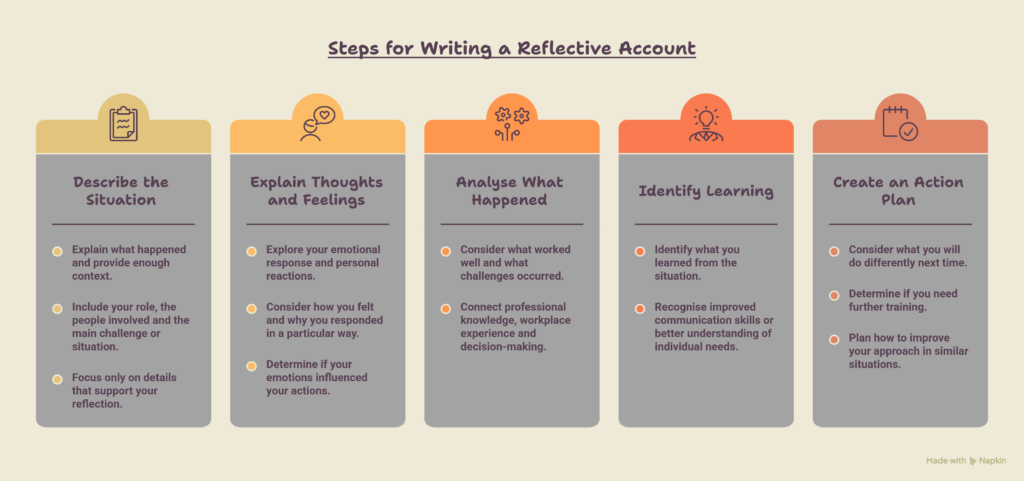
The key steps for writing a reflective account include:
Steps for Writing a Reflective Account
A structured reflective account helps professionals turn experiences into learning. Each stage guides them from describing an event to creating practical improvements for future care.
Describe the Situation
Start by explaining what happened and provide enough context for the reader to understand the experience. For example, include your role, the people involved and the main challenge, while keeping identifying details confidential. However, focus only on details that support your reflection rather than unnecessary information.
Explain Your Thoughts and Feelings
Next, explore your emotional response and personal reactions during the situation. For example, consider how you felt, why you responded in a particular way and whether your emotions influenced your actions. Understanding these reactions helps professionals develop self-awareness and improve future interactions.
Analyse What Happened
Analysis allows professionals to look deeper into the experience. For example, consider what worked well, which challenges arose and why the situation developed. This stage helps connect professional knowledge, workplace experience and decision-making to identify meaningful improvements.
Identify Learning
After analysing the experience, identify what you learned from the situation. For example, you may identify better ways to communicate, understand individual needs or fulfil your responsibilities. Recognising learning helps professionals continue developing their skills.
Create an Action Plan
A reflective account should always lead to future improvement. Therefore, explain what you will do differently next time, whether you need further training and how you will improve your approach.
Maintaining a Reflective Journal in Health and Social Care
A reflective journal provides a regular record of professional experiences, learning and development. For example, professionals can use journals to record challenging situations, achievements, feedback and areas they want to improve.
Especially, maintaining a journal helps care workers recognise progress, identify learning needs and build a habit of continuous professional development. It also provides useful evidence when discussing progress during supervision or professional reviews.
By writing reflective accounts and maintaining journals, healthcare professionals can transform everyday experiences into opportunities for growth, improved decision-making and better-quality care.
Critical Reflection vs Reflective Practice: Understanding the Difference in Health and Social Care
Critical reflection vs reflective practice in health and social care involves two approaches that help professionals learn from experiences and improve the quality of support they provide. While reflective practice focuses on reviewing actions and identifying improvements, critical reflection goes further by questioning assumptions, exploring deeper causes and examining how wider factors influence decisions. Both approaches help care professionals develop awareness, improve judgement and provide more effective person-centred care.
Although both approaches support professional learning, they focus on different levels of analysis:
Reflective Practice
Reflective practice involves reviewing personal experiences, actions and outcomes to identify learning opportunities. Moreover, professionals consider what happened, how they responded and what they can improve in future situations.
For example, a care worker may reflect on a conversation with a distressed person and decide to improve their listening skills or communication approach.
Critical Reflection
Critical reflection involves deeper analysis by questioning beliefs, assumptions and existing methods of working. In particular, professionals explore why situations happen and whether current approaches meet individual needs.
For example, instead of viewing repeated refusal of care as difficult behaviour, a professional may explore possible causes such as communication barriers, personal history or unmet needs.
Critical Reflection vs Reflective Practice: Comparison
| Area | Reflective Practice | Critical Reflection |
|---|---|---|
| Main purpose | Reviews experiences to identify learning and improvement | Examines deeper reasons behind experiences and challenges existing approaches |
| Key focus | Actions, decisions and outcomes | Assumptions, beliefs, values and wider influences |
| Main questions | “What happened?” and “How can I improve?” | “Why did this happen?” and “What factors influenced the situation?” |
| Approach | Encourages professionals to learn from personal experiences | Encourages professionals to question and analyse situations more deeply |
| Example | A care worker reviews how they communicated with an upset individual | A care worker explores why the individual became upset and whether wider needs influenced the situation |
| Benefits | Builds self-awareness, confidence and professional development | Supports better judgement, problem-solving and improved care approaches |
| Outcome | Helps professionals make practical improvements | Helps professionals create meaningful changes in practice |
Both approaches work together to strengthen professional development. Reflective practice helps workers understand their actions, while critical reflection encourages them to explore deeper causes and improve future decisions.
Therefore, understanding this difference helps professionals choose how deeply to examine an experience and identify ways to improve care.
Reflective Practice vs Feedback and Supervision in Care Settings: How They Work Together
Reflective practice vs feedback and supervision in care settings highlights three different but connected approaches that help professionals improve their work. Reflection encourages individuals to review their own experiences, feedback provides insight from others, and supervision creates structured support for professional development. Together, these approaches help care workers understand their strengths, identify areas for improvement and maintain high standards of support in health and social care environments.
Although they serve different purposes, reflective practice, feedback and supervision work together to strengthen professional learning:
Reflective Practice
Reflective practice focuses on personal learning from experiences. In particular, professionals review their decisions, actions and outcomes to understand what happened and how to improve future care.
For example, a care worker may reflect on a challenging interaction and consider what communication approaches worked well and what they could change next time.
Feedback
Feedback provides an external perspective from colleagues, managers, supervisors or individuals receiving care. It helps professionals recognise strengths and identify improvements they may not notice themselves. As a result, professionals can recognise strengths and identify improvements they may not notice themselves.
For instance, a manager may praise a worker’s communication skills while suggesting improvements in record keeping or documentation.
Supervision
Supervision provides planned discussions where professionals review their work, challenges and development needs with a supervisor. In addition, supervision supports accountability, problem-solving and professional growth.
Through supervision, care workers can discuss concerns, set learning goals and receive guidance to improve their practice.
Reflective Practice vs Feedback and Supervision: Comparison
| Area | Reflective Practice | Feedback | Supervision |
|---|---|---|---|
| Purpose | Helps professionals analyse their own experiences, decisions and actions | Provides opinions and observations from other people | Creates structured support for reviewing work and development |
| Main focus | Self-awareness, personal learning and improvement | Strengths, challenges and areas needing attention | Accountability, guidance and professional progress |
| Source | Comes from the individual reflecting on their own practice | Comes from colleagues, managers, supervisors or service users | Usually involves a planned meeting with a supervisor |
| Key question | “What can I learn from this experience?” | “How do others view my practice?” | “How can I improve with professional support?” |
| Benefits | Builds confidence, decision-making and awareness | Offers new perspectives and identifies improvement opportunities | Supports goals, problem-solving and quality improvement |
| Example | A care worker reviews how they handled a difficult conversation | A manager comments on communication skills | A supervisor discusses performance and future development plans |
Together, these approaches create a stronger learning process. Specifically, reflection helps professionals understand their own actions, feedback introduces different viewpoints and supervision provides structured guidance for continued improvement.
Ultimately, combining reflective practice, feedback and supervision helps care professionals develop confidence, improve skills and deliver better-quality support.
Reflective Practice and Continuous Professional Development (CPD): Building a Future in Health and Social Care
Reflective Practice and Continuous Professional Development (CPD) in health and social care work together to help professionals improve their knowledge, skills and confidence throughout their careers. Reflection allows workers to recognise learning needs, review their experiences and choose suitable development opportunities. By combining reflection with CPD, care professionals can continue improving their practice, adapt to changing care requirements and provide safer, more effective support. The NMC also highlights reflection as an important part of professional learning and improvement.
Regular reflection helps professionals identify areas where they can grow. For example, a care worker may recognise the need to improve communication skills, strengthen safeguarding knowledge or develop confidence when supporting individuals with complex needs.
Professionals can use reflection to build their career by focusing on:
How New Care Workers Can Start Reflecting
Reflection does not need to be complicated, especially for beginners. For example, new care workers can review daily experiences and ask simple questions about their actions and learning.
Useful reflection questions include:
- What happened today?
- Which approaches worked well?
- Where did I face challenges?
- What did I learn?
- How will I approach a similar situation next time?
As a result, recording answers to these questions can help new workers develop reflective habits and recognise their progress.
Common Reflection Mistakes
Although reflection supports professional growth, some workers struggle because they approach it incorrectly. Instead, a useful reflection should explore what the experience taught you and what you could change next time.
Common mistakes include:
- Only explaining what happened without analysing the experience
- Avoiding difficult situations instead of learning from them
- Failing to create an action plan for improvement
By avoiding these mistakes, professionals can make reflection more meaningful and useful.
Building Professional Confidence Through Reflection
Reflective practice skills for healthcare professionals support lifelong learning and career development. When workers regularly review their experiences, they become more adaptable, confident and aware of how their actions influence others.
Reflection helps professionals:
- Improve decision-making
- Strengthen communication
- Recognise personal development needs
- Provide higher-quality support
By linking reflection with CPD, healthcare professionals can continue developing their abilities and respond effectively to the changing needs of care environments.
Reflective practice creates a pathway for continuous improvement, helping professionals grow while delivering safer and more person-centred care.
Final Thoughts: Why Reflective Practice Matters in Health and Social Care
Every care experience teaches something valuable. For example, a conversation, challenge or decision can become a learning opportunity when professionals take time to reflect.
Reflective practice in health and social care helps workers understand their actions, strengthen their skills and provide better support for the people they care for.
From using models such as Gibbs, Schön and Kolb to writing reflective accounts and learning from feedback, reflection creates a culture of continuous improvement.
The best care professionals are not those who never face challenges. Instead, they learn from experiences and use that learning to make future care safer, kinder and more effective.
Reflective practice is an essential skill for professionals who want to understand their experiences, improve their approach and provide better support in care settings. The Health and Social Care Level 3 Diploma helps you build knowledge in person-centred care, safeguarding, communication and professional development, including the importance of reflection in improving care quality.
Start learning today and develop the confidence to analyse experiences, strengthen your skills and support positive outcomes for individuals in health and social care environments. Enrol now and take the next step towards building your care knowledge and professional future.
Table of Contents

Frequently Asked Questions
What is reflective practice in health and social care?
Reflective practice in health and social care is a structured process of reviewing experiences, decisions and actions to understand what happened, what was learned and what should change next time. It helps professionals improve judgement, recognise learning needs and strengthen quality and safety of care.
Why is reflective practice important in health and social care?
Reflection helps care workers learn from both positive and difficult experiences. By examining decisions, communication and outcomes, professionals can identify strengths, recognise gaps and plan improvements. Regular reflection also supports safer practice, better person-centred care, professional accountability and more thoughtful responses to future care situations.
What are the main reflective practice models used in healthcare?
Common reflective practice models include Gibbs’ Reflective Cycle, Schön’s reflection-in-action and reflection-on-action, Kolb’s Experiential Learning Cycle, Johns’ structured reflection model and Rolfe’s What? So What? Now What? framework. Each provides a different practical structure for turning workplace experiences into learning and improved future care practice.
What is Gibbs’ Reflective Cycle in health and social care?
Gibbs’ Reflective Cycle uses six stages: description, feelings, evaluation, analysis, conclusion and action plan. In health and social care, a worker can use these stages to review an event systematically, understand what influenced the outcome and decide how to respond more effectively next time professionally.
How does reflective practice improve patient care?
Reflective practice can improve patient and service-user care by helping professionals recognise what worked, what created risk and what could be changed. Reflection can strengthen communication, decision-making and learning from incidents, while encouraging staff to adapt future support around individual needs, preferences and overall safety.
How do you write a reflective account in health and social care?
A reflective account usually describes an experience, explains thoughts or feelings, analyses what went well or poorly, identifies learning and sets out future actions. Healthcare professionals should avoid unnecessary identifiable information and focus on what the experience taught them and how their practice may improve.
What is a reflective journal in health and social care?
A reflective journal is a learning record used to capture experiences, observations, lessons and future actions. Care workers can use it after training, feedback, incidents or challenging situations. Regular entries make patterns easier to recognise and can help identify development needs for supervision or CPD.
What is the difference between reflective practice and critical reflection?
Reflective practice reviews an experience to identify learning and improvement. Critical reflection goes further by questioning assumptions, values, power, context and the reasons behind decisions. In health and social care, critical reflection can help professionals examine not only what happened, but why their response developed.
What is the difference between reflection, feedback and supervision in care settings?
Reflection is personal review, feedback provides observations from other people, and supervision offers structured professional support. They work best together: reflection identifies questions, feedback adds another perspective, and supervision creates space to discuss learning, accountability, development needs and changes that may improve future care outcomes.
How does reflective practice support continuous professional development in health and social care?
Reflective practice supports CPD by helping professionals identify knowledge gaps, evaluate learning and decide what development is needed next. It can connect workplace experiences with training, feedback and professional goals. For some regulated professionals, such as NMC registrants, reflection also forms part of revalidation requirements.