

What Is Safeguarding in Health and Social Care? Why It Matters
Safeguarding in health and social care protects adults and children from abuse, neglect and exploitation while helping them maintain safety, dignity, rights, choices and wellbeing.
For this reason, every care worker must understand how to recognise concerns, respond appropriately and follow safeguarding procedures. Safeguarding may begin with something as small as noticing an unexplained change in behaviour, listening carefully when a person seems worried or questioning a working practice that no longer feels safe. What happens next can make a significant difference to somebody’s life.
Safeguarding is not simply a policy kept in a folder. Instead, it represents the everyday practice of preventing harm, recognising possible warning signs, responding appropriately, recording facts and reporting concerns through the correct route.
This practical guide explains:
- what safeguarding means in health and social care;
- why safeguarding is important;
- whom safeguarding protects;
- the six principles of adult safeguarding;
- the ten types of abuse and neglect;
- how adult safeguarding differs from child protection;
- what a care worker should do when concerned; and
- the main safeguarding laws and guidance that apply in England.
This guide focuses mainly on England. Scotland, Wales and Northern Ireland have their own safeguarding legislation, statutory guidance and reporting arrangements. Always follow the procedures that apply in your location and workplace.

What Does Safeguarding Mean in Health and Social Care?
Safeguarding means taking action to protect a person’s right to live safely and free from abuse and neglect. In health and social care, it includes preventing harm where possible, recognising concerns, responding promptly and working with the right people to reduce risk.
In practice, good safeguarding is both preventive and responsive. It involves creating environments in which people are listened to, staff understand their responsibilities, complaints are taken seriously and unsafe practice can be challenged. It also involves acting correctly when abuse, neglect or exploitation is suspected or disclosed.
To understand adult safeguarding in England, the Care and Support Statutory Guidance explains that safeguarding protects an adult’s right to live safely and remain free from abuse and neglect. It emphasises that organisations should work together to prevent and stop harm while considering the adult’s views, wishes, feelings and beliefs.
As a result, this person-centred approach is often called Making Safeguarding Personal. It means asking what the adult wants to happen and involving them in decisions rather than treating safeguarding as a process carried out around them.
However, for children, safeguarding is wider than responding to known abuse. Working Together to Safeguard Children 2026 describes responsibilities for providing help and support when problems emerge, protecting children from maltreatment, preventing harm to their health or development and helping them grow up with safe and effective care.
Safeguarding is everyone’s responsibility
A designated safeguarding lead, manager or named professional may coordinate concerns, but every person involved in care shares responsibility for safeguarding. In addition, care workers, nurses, managers, reception staff, volunteers, agency workers and other professionals all have a role.
However, their responsibilities are not identical. A frontline care worker is normally expected to recognise, respond, record and report. Managers and safeguarding leads may assess immediate organisational action, make referrals and coordinate with external agencies. Local authorities, police, health services and other statutory bodies decide what formal enquiries or protective action may be required.
Why Is Safeguarding Important in Health and Social Care?
Safeguarding is important because some people receiving care depend on others for personal care, medication, communication, mobility, finances or everyday decisions. These situations can make it harder for people to recognise abuse, disclose concerns or escape harmful situations. Illness, disability, cognitive impairment, communication barriers, isolation or dependence can increase risk, although none of these factors means that abuse is inevitable.
Therefore, effective safeguarding helps health and social care services to:
- protect people from abuse, neglect, exploitation and avoidable harm;
- recognise risks before they become more serious;
- uphold dignity, privacy, autonomy and human rights;
- give people safer ways to express concerns;
- ensure allegations and disclosures receive an appropriate response;
- improve accountability and professional practice;
- identify unsafe systems or organisational cultures; and
- build trust between individuals, families, workers and care providers.
Safeguarding is therefore inseparable from good care. It influences communication, care planning, risk assessment, consent, record-keeping, medication practice, staff conduct and the way a service responds when something appears unsafe.
Build a Stronger Foundation for Care
Safeguarding is one part of safe, person-centred support. HF Online’s Health and Social Care Level 3 Diploma brings it together with communication, care planning, professional responsibilities, mental health, dementia awareness and infection prevention. The flexible online course is designed for beginners and existing care workers who want to strengthen their care knowledge.
Who Does Safeguarding Protect?
Safeguarding applies across the lifespan, but adult safeguarding and child protection use different legal tests and procedures.
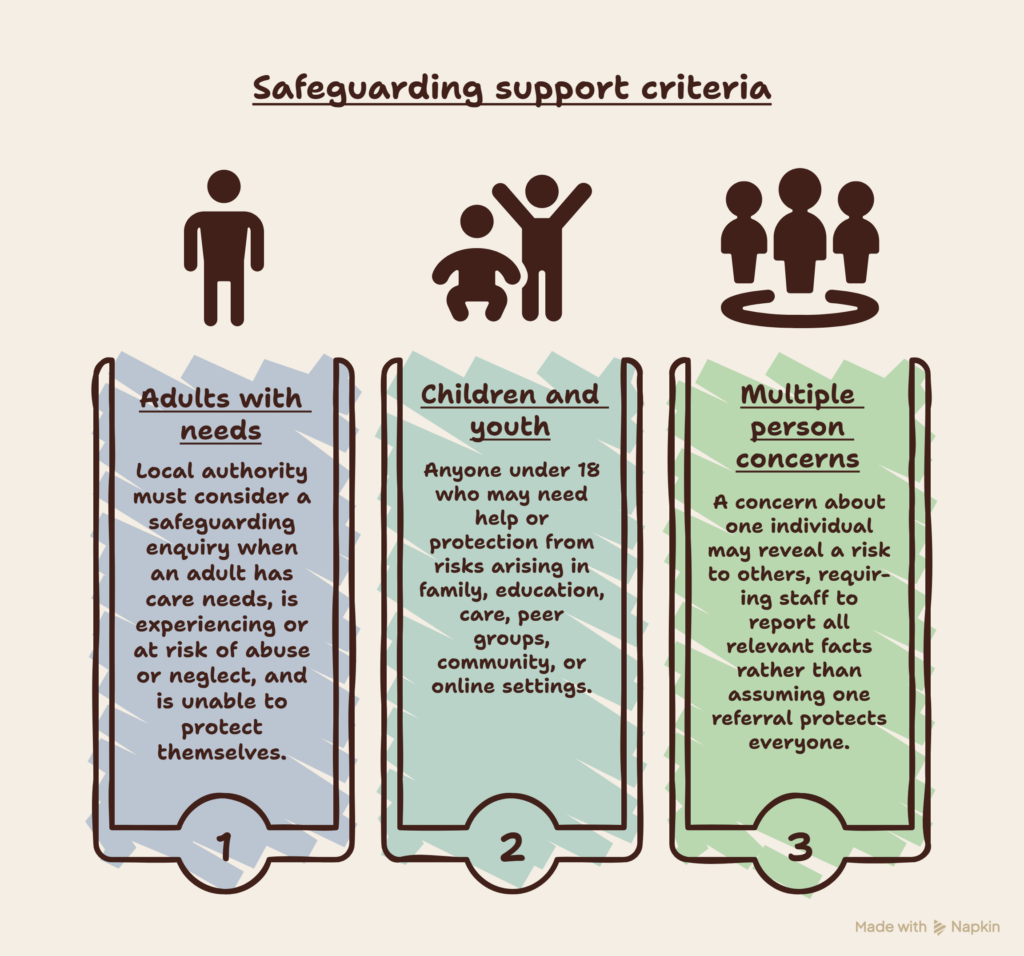
Adults with care and support needs
To understand who receives adult safeguarding support, under Section 42 of the Care Act 2014, Once these conditions are confirmed, in England, a local authority must consider a safeguarding enquiry when it has reasonable cause to suspect that an adult :
- has needs for care and support, whether or not the local authority is meeting those needs;
- is experiencing, or is at risk of, abuse or neglect; and
- because of those needs, is unable to protect themselves from the abuse, neglect or risk of it.
When these conditions apply, the local authority must complete or arrange the enquiries needed to decide the appropriate action.
Importantly, age, diagnosis or disability alone does not determine that the Section 42 duty applies. The focus is on the person’s care and support needs, the risk of abuse or neglect, and whether those needs affect their ability to protect themselves.
If the precise Section 42 criteria do not appear to be met, staff should not simply ignore the concern. Other duties, referrals, risk-management steps or support may still be appropriate. Workers should follow their organisation’s safeguarding procedure and seek advice from the safeguarding lead or local authority.
Children and young people
In England, a child is anyone who has not yet reached their 18th birthday. This includes 16- and 17-year-olds who may live independently, work or appear highly capable.
Any child may need help or protection. Risk may arise within the family, in education or care settings, in peer groups, in the community or online. Factors such as disability, communication needs, exploitation, domestic abuse, family circumstances or dependence on others may make some children less able to recognise, communicate or escape harm. Similarly, children and young people may need safeguarding support when they face risks at home, in education, online or within their community
When a concern affects more than one person
A concern about one individual may reveal a risk to others. An allegation involving a care worker could affect several residents. Abuse in a household might place both an adult and a child at risk. Staff should report all relevant facts and should not assume that a referral concerning one person automatically protects everybody else.
Adult Safeguarding and Child Protection: What Is the Difference?
Adult safeguarding and child protection share the same broad purpose: preventing harm and responding when someone may be unsafe. Both approaches require professionals to notice concerns, maintain accurate records, share information appropriately and work together. The legal frameworks and decision-making principles, however, are different.
Adult safeguarding | Child safeguarding and protection |
Applies to adults who meet the relevant safeguarding criteria | Applies to babies, children and young people under 18 |
Gives significant weight to the adult’s wishes and desired outcomes | Gives central importance to the child’s welfare while hearing their wishes and feelings |
Considers consent, autonomy and decision-specific mental capacity | Considers developmental needs, parental responsibility and the child’s best interests |
Allows an adult with capacity to make a decision others may consider unwise | Requires action when a child is suffering or is likely to suffer significant harm |
Uses adult safeguarding procedures and Care Act duties | Uses child safeguarding and child protection procedures |
Adult safeguarding, consent and mental capacity
Adult safeguarding should begin with the adult’s circumstances, wishes and desired outcomes. An adult may make a decision that professionals or relatives consider unwise, provided the person has the mental capacity to make that particular decision at the relevant time.
The Mental Capacity Act 2005 is important when there is a genuine reason to doubt a person’s capacity. Professionals must assess capacity for each specific decision and at the relevant time. It should not be assumed absent because of a diagnosis, disability, communication difficulty, appearance or unwise choice.
Consent matters, but it is not the only consideration. Information may sometimes need to be shared without consent when another person is at risk, a serious crime may have occurred, coercion affects the adult’s freedom to decide, the adult lacks capacity for the relevant decision or another legal duty applies. The reasons for sharing or not sharing information should be recorded.
Child protection as part of wider safeguarding
Safeguarding children includes early help, family support and preventive action as well as protection from significant harm. Child protection is one part of that wider system. It refers particularly to action taken when a child is suspected of suffering, or being likely to suffer, significant harm.
A child’s wishes and feelings should be heard in a way that reflects their age and understanding. Parents or carers are normally involved, but professionals must consider whether doing so could increase risk or compromise an inquiry.
People who work with children and need deeper knowledge of disclosures, exploitation, online safety, record-keeping and safeguarding coordination can explore the Safeguarding Children Level 3 Designated Lead DSL course. Completing an online course does not itself appoint someone as a DSL; organisations must decide who holds the role and ensure that all applicable training, experience and local requirements are met.
Professionals supporting children within the wider family context may also benefit from the Family Support Worker Level 5 Diploma, which covers safeguarding, child development, family support, communication and relevant professional responsibilities.
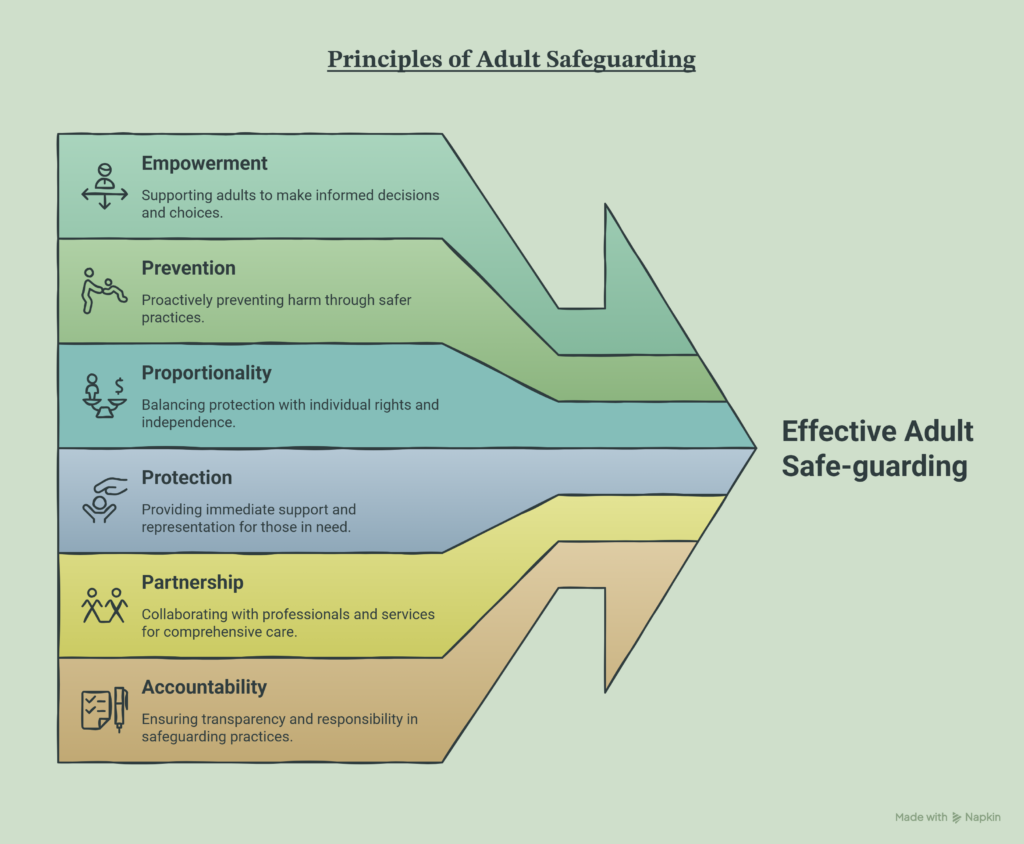
What Are the Six Principles of Adult Safeguarding?
To support consistent safeguarding practice, the Care and Support Statutory Guidance identifies six principles that guide adult safeguarding work in England.
1. Empowerment
Firstly, professionals should support people and encourage them to make their own decisions and provide informed consent. In practice, this means listening to the adult, explaining options accessibly, respecting communication needs and asking what outcome the person wants.
In practice: Ask the adult what outcome they want and use their answer to shape the safeguarding response wherever possible.
2. Prevention
Secondly, it is better to act before harm occurs. Organisations prevent harm through safer recruitment, effective induction, suitable staffing and good training, risk awareness and taking early warning signs seriously.
In practice: Give people accessible information about abuse, possible warning signs and how they can seek help.
3. Proportionality
Thirdly, the response should be appropriate to the level of risk and no more intrusive than necessary. Safeguarding should protect a person without automatically removing their independence, privacy or right to make choices.
In practice: Match the action to the level of risk and avoid restricting the person’s rights or choices unnecessarily.
4. Protection
People in greatest need should receive appropriate support and representation. This may include immediate safety measures, advocacy, medical assistance, accessible communication and coordinated work with statutory services.
In practice: Help the person report abuse, understand their options and participate meaningfully in decisions.
5. Partnership
Safeguarding depends on people and organisations working together. For example, professionals should share relevant information responsibly so they can understand risks together.
In practice: Coordinate with the person, relevant professionals, services and community resources instead of considering the risk in isolation.
6. Accountability
Safeguarding practice should be transparent and answerable. Staff need clear roles, reliable records, effective supervision and assurance that organisations take concerns seriously.
In practice: Make responsibilities, decisions and reporting arrangements clear, and maintain records that explain what was done and why.
The six principles are therefore Empowerment, Prevention, Proportionality, Protection, Partnership and Accountability. Respect is essential to all good care, but it is not one of the six named principles.
For a more detailed explanation with examples, read our guide to the six principles of safeguarding in health and social care.
What Are the Ten Types of Abuse and Neglect?
For this reason, abuse and neglect do not always leave an obvious injury. A concern may begin with a disclosure, an observation, a pattern in records, an unexplained change or behaviour that seems inconsistent with the person’s usual presentation.
The Care and Support Statutory Guidance recognises ten categories of abuse and neglect within adult safeguarding. More than one type can occur at the same time.
Type | Possible indicators |
Physical abuse | Unexplained injuries, repeated accidents, fear of a person or accounts that do not match the injury |
Domestic abuse | Controlling behaviour, intimidation, isolation, threats, violence or economic control |
Sexual abuse | Injuries, distress, fear, sexualised behaviour, behavioural changes or a disclosure |
Psychological abuse | Withdrawal, anxiety, humiliation, intimidation or unusual compliance |
Financial abuse | Missing money, unusual transactions, unpaid bills or another person taking control of finances |
Modern slavery | Restricted movement, withheld documents, fear, exploitation or poor living conditions |
Discriminatory abuse | Slurs, exclusion or unequal treatment connected with identity or protected characteristics |
Organisational abuse | Rigid routines, ignored complaints, unsafe staffing or repeated poor practice |
Neglect and acts of omission | Poor hygiene, dehydration, missed medication or untreated health and care needs |
Self-neglect | Serious deterioration in personal care, health or living conditions, including hoarding |
No single sign proves that abuse has occurred. Workers should record facts, remain professionally curious and report concerns so that the appropriate people can consider the wider picture.
Physical abuse
For example, physical abuse can include hitting, pushing, rough handling, inappropriate restraint, misuse of medication or deliberately withholding necessary support. Signs may include unexplained bruising, burns, fractures, repeated “accidents”, fear of a particular person or an explanation that does not fit the injury.
Domestic abuse
Domestic abuse can include physical or sexual abuse, violent or threatening behaviour, controlling or coercive behaviour, economic abuse and psychological or emotional abuse between people aged 16 or over who are personally connected. It can affect people of any gender and may continue after a relationship ends.
Sexual abuse
Sexual abuse includes sexual activity to which a person did not consent, could not consent or was pressured into. A relationship or marriage does not remove the need for consent, and the absence of a visible injury does not mean that abuse has not occurred.
Psychological or emotional abuse
Threats, humiliation, intimidation, isolation, harassment, coercion, blaming and controlling contact can all cause psychological harm. A person may become withdrawn, anxious, unusually compliant or afraid to speak in front of somebody else.
Financial or material abuse
Similarly, financial abuse can include theft, fraud, pressure concerning money or property, misuse of benefits, coercion over wills and unauthorised use of cards or accounts. Possible signs include missing belongings, unexplained withdrawals or unpaid bills despite sufficient funds.
Modern slavery
For example, modern slavery includes human trafficking, forced labour, domestic servitude and slavery-like exploitation. Indicators can include restricted movement, fear, withheld wages or identity documents, poor living conditions and an inability to speak freely about where the person lives or works.
Discriminatory abuse
Discriminatory abuse is mistreatment or harassment connected with identity or protected characteristics, such as age, disability, race, religion or belief, sex, sexual orientation or gender reassignment. It may appear as slurs, exclusion, unequal treatment or failure to meet cultural, communication or disability-related needs.
Organisational abuse
Organisational abuse may occur when routines, systems or cultures place the needs of a service above the rights and wellbeing of the people using it. Examples include rigid routines, unsafe staffing, disrespectful care, poor medicines practice, restricted choices, ignored complaints and repeated failure to provide individualised support.
Neglect and acts of omission
Neglect includes failing to provide necessary care, treatment, food, fluids, warmth, medication or access to health services. It may be deliberate or result from poor practice, inadequate systems or failure to act on known needs.
Self-neglect
Self-neglect may involve serious neglect of personal hygiene, health or surroundings, including hoarding. It requires a sensitive and person-centred response. Practitioners should consider the person’s wishes, mental capacity, level of risk and whether other people are affected.
Practical Examples of Safeguarding Concerns
Safeguarding decisions are rarely made from a definition alone. These examples show how an apparently small observation can require further action.
Example 1: Possible financial abuse
A care worker notices that a person who normally manages their bills now has several unpaid notices. The person becomes visibly anxious whenever a particular relative visits and says they are not allowed to use their own bank card.
The worker should listen, record the person’s words and observable facts, and report the concern. They should not search financial records without authority or confront the relative.
Example 2: Possible organisational neglect
Another example involves possible organisational neglect. Several residents repeatedly miss drinks because staffing pressures interrupt the hydration routine. No individual worker may intend harm, but the recurring system failure could expose people to dehydration and may indicate neglect or organisational abuse.
The pattern should be recorded and escalated rather than treated as a series of unrelated mistakes.
Example 3: A child makes a partial disclosure
Finally, a child may also make a partial disclosure that requires a safeguarding response. A young person tells a support worker that they do not want to go home but stops speaking when asked why. The worker should remain calm, use minimal open prompts, avoid promising secrecy and report the concern under the organisation’s child safeguarding procedure.
They should not repeatedly question the child or contact the person who may be involved before receiving appropriate direction.
What Should a Care Worker Do About a Safeguarding Concern?
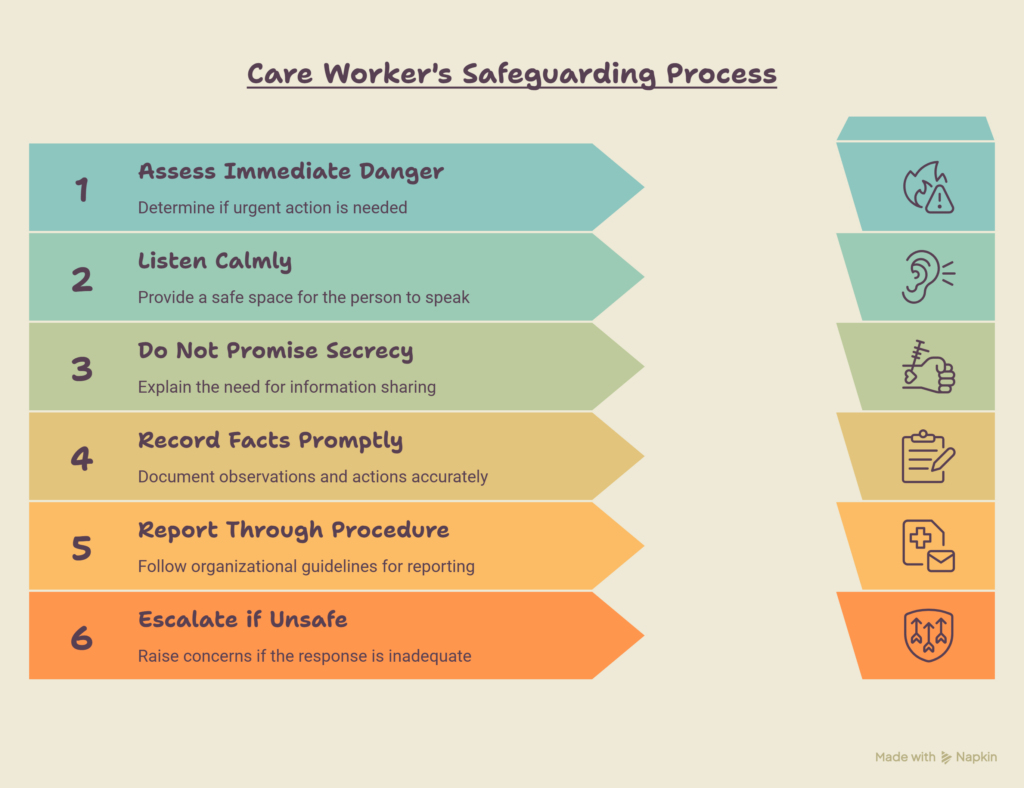
In practice, a care worker’s role is to take the concern seriously, address immediate danger, preserve accurate information and report through the correct route. Frontline staff do not need to prove abuse or investigate concerns themselves.
1. Respond to immediate danger
Firstly, if somebody is in immediate danger or requires urgent medical help, call 999. Make the environment as safe as possible without placing the person, yourself or others at greater risk. Preserve possible evidence and follow emergency procedures.
2. Listen calmly
If a person tells you something, give them time and take them seriously. Use their preferred communication method and consider whether they need an interpreter, communication aid or independent advocate.
Avoid disbelief, blame and unnecessary questioning. Do not use leading questions such as, “Did your carer do that?” A limited open prompt such as “Tell me what happened” may help clarify what the person is communicating, but detailed questioning should be left to the appropriate professionals.
3. Do not promise secrecy
Explain that you may need to share the concern with people who can help keep them or somebody else safe. Tell them what is likely to happen next as clearly as possible. Information should only be shared with those who need it for a legitimate safeguarding purpose.
4. Record the facts promptly
After responding, make a clear, dated and timed record as soon as possible. Include:
- what you saw, heard or were told;
- the person’s own words where possible;
- relevant observations, injuries or behavioural changes;
- who was present;
- what immediate action you took;
- whom you informed and when; and
- any reason for sharing information without consent.
Separate facts from opinions. Do not alter the record later without making the amendment clear. Never take photographs on a personal device.
5. Report through the correct procedure
Next, follow your employer’s safeguarding policy without delay. This commonly means contacting a line manager, safeguarding lead or named person. An adult concern may need to be referred to the local authority adult safeguarding team. A child concern will normally follow the local authority children’s social care route and local safeguarding arrangements.
If the concern involves the person you would normally report to, use the alternative route identified in the policy. Allegations about somebody who works with children may also need to be referred to the local authority designated officer, commonly known as the LADO, when the applicable criteria are met.
6. Do not investigate or confront
Do not interview witnesses, search belongings, contact the alleged source of harm or attempt to settle the matter yourself. This could increase risk, cause further distress or compromise a safeguarding or police enquiry.
7. Escalate if the response is unsafe
If you believe the concern has not been handled appropriately, follow the organisation’s escalation or whistleblowing procedure. Keep a factual record of the steps you took. Immediate danger should still be reported to the emergency services.
8. Continue respectful support
Safeguarding does not finish when a form is submitted. Continue to treat the person with dignity, maintain appropriate confidentiality, explain what you can and record further concerns. Do not speculate about outcomes or discuss the matter with people who do not need to know.
9. Strengthen Role-Relevant Care Knowledge
Care workers who want broader learning across safeguarding, communication, hygiene, infection control, health and safety and other care topics can review HF Online’s Mandatory Training for Care Assistants and Care Staff.
Online training can support knowledge, but it does not replace an employer’s induction, local safeguarding procedures, supervision, practical competency checks or role-specific training requirements.
What Safeguarding Laws and Guidance Apply in England?
Several laws and statutory guidance documents support safeguarding practice. Their relevance depends on whether the concern involves an adult or child, the care setting and the circumstances.
Legislation or guidance | Relevance to safeguarding |
Provides the statutory framework for adult care and support, including adult safeguarding duties in England | |
Explains adult safeguarding responsibilities, principles, enquiries and Making Safeguarding Personal | |
Provides the framework for assessing capacity and making decisions when a person lacks capacity for a specific matter | |
Establishes important duties concerning children in need and children suffering or likely to suffer significant harm | |
Strengthens arrangements for agencies to cooperate to safeguard and promote children’s welfare | |
Sets current statutory expectations for multi-agency safeguarding work concerning children in England | |
Includes fundamental standards relevant to safe care, dignity, consent and safeguarding in regulated services | |
Requires service users to be protected from abuse and improper treatment in CQC-regulated services | |
Provides the statutory definition of domestic abuse and recognises different forms of abusive behaviour | |
Addresses slavery, servitude, forced labour and human trafficking | |
Supports barring arrangements intended to prevent unsuitable people from carrying out regulated activity |
What is the role of the Disclosure and Barring Service?
The Disclosure and Barring Service, or DBS, supports safer recruitment by processing criminal record checks for eligible roles and maintaining the children’s and adults’ barred lists. It replaced the former Criminal Records Bureau and Independent Safeguarding Authority in 2012.
However, a DBS check is only one part of safer recruitment and safeguarding. Employers may also need identity checks, references, employment-history checks, suitable interview processes, induction, supervision and ongoing management of conduct and risk. The type of DBS check available depends on the role and legal eligibility.
Safeguarding Training and Employer Responsibilities
Training helps staff apply safeguarding policies and take safe action. It should reflect the worker’s responsibilities, the people they support and the risks within the service. A new care assistant, experienced practitioner, manager and designated safeguarding lead will not all need the same depth of learning.
The Care Quality Commission’s guidance on Regulation 13 says providers must ensure staff receive safeguarding training that is relevant and suitable for their role.
Useful safeguarding learning should cover:
- signs and types of abuse and neglect;
- adult and child safeguarding routes relevant to the service;
- responding to disclosures;
- consent, confidentiality and information sharing;
- mental capacity and advocacy where relevant;
- accurate recording, reporting and referral;
- allegations involving staff or volunteers;
- escalation and whistleblowing; and
- lessons from incidents, complaints and near misses.
Nevertheless, training alone is not enough. Staff also need accessible procedures, suitable supervision and confidence that concerns will be taken seriously.
Employers should make it easy to find:
- the safeguarding policy and reporting pathway;
- names and contact details for safeguarding leads;
- emergency and out-of-hours contacts;
- local authority adult and children’s safeguarding referral routes;
- procedures for allegations concerning staff or volunteers;
- escalation and whistleblowing arrangements;
- secure record-keeping and information-sharing rules; and
- training renewal and competency requirements.
Workers should understand these routes before an incident occurs. If the procedure is unclear, ask a manager or safeguarding lead during induction or supervision rather than waiting for a crisis.
Managers, team leaders and experienced care professionals who want to develop more advanced knowledge of safeguarding, professional responsibilities and care leadership can explore alternatively, the Health and Social Care Level 5 Diploma. This online course supports continuing professional development but should not be confused with an Ofqual-regulated occupational qualification.
Choosing the Right Health and Social Care Course
Ultimately, your most suitable learning route depends on your current responsibilities, experience and goals.
-
For a broad foundation in care
The Health and Social Care Level 3 Diploma is the best starting point for learners who want structured knowledge across safeguarding, communication, care planning, professional responsibilities, mental health, dementia awareness, infection prevention and wider care practice.
-
For broader care-staff refresher learning
The Mandatory Training for Care Assistants and Care Staff course is relevant to learners who want to refresh knowledge across several common care topics. Always compare the syllabus with your employer’s required training matrix because mandatory requirements vary by role and service.
-
For advanced health and social care learning
The Health and Social Care Level 5 Diploma is designed for learners seeking more advanced knowledge connected with professional responsibilities, safeguarding and senior care practice.
-
For work supporting children and families
The Family Support Worker Level 5 Diploma focuses on supporting children and families, including safeguarding, child development, communication, family challenges and multi-agency working.
-
For deeper child-safeguarding knowledge
The Safeguarding Children Level 3 Designated Lead DSL course covers child protection responsibilities, disclosures, exploitation, online risks, record-keeping and safeguarding coordination. Employers remain responsible for appointing DSLs and ensuring that their training meets the setting’s statutory and local requirements.
Final Thoughts: Why Safeguarding Matters in Health and Social Care
Safeguarding in health and social care works best when people notice early warning signs, listen without judgement and act before a concern is allowed to grow. Policies and reporting routes matter, but professionals also need curiosity, respectful communication, accurate records and confidence to speak up.
Most importantly, a care worker does not need to prove that abuse has occurred. Their responsibility is to recognise possible risk, respond safely, record the facts and report the concern through the correct procedure.
If you want to build safeguarding knowledge as part of a broader understanding of care, HF Online’s Health and Social Care Level 3 Diploma offers flexible online learning across safeguarding, person-centred care, communication, care planning, professional responsibilities, mental health, dementia and infection prevention.
View the Health and Social Care Level 3 Diploma
Online learning supports professional development, but employers still provide induction, supervision, practical checks and role-specific requirements.
Table of Contents

Frequently Asked Questions
What is safeguarding in health and social care?
Safeguarding is the work of preventing and responding to abuse, neglect and exploitation while supporting a person’s safety, dignity, rights, choices and wellbeing. It includes recognising concerns, listening, recording facts, reporting promptly and working with the appropriate professionals and agencies.
Why is safeguarding important in health and social care?
Safeguarding protects people from harm, upholds dignity and human rights, improves accountability and helps services respond before risks become more serious. It is especially important when illness, disability, communication needs, isolation or dependence make it more difficult for someone to protect themselves or report abuse.
What are the six principles of adult safeguarding?
The six principles are Empowerment, Prevention, Proportionality, Protection, Partnership and Accountability. They help make adult safeguarding person-centred, preventive, proportionate, protective, collaborative and transparent.
Is respect one of the six safeguarding principles?
No. Respect is fundamental to good care and should influence every safeguarding response, but it is not one of the six named principles. The principle sometimes replaced incorrectly with respect is Proportionality.
What are the ten types of abuse in adult safeguarding?
The ten categories are physical abuse, domestic abuse, sexual abuse, psychological abuse, financial or material abuse, modern slavery, discriminatory abuse, organisational abuse, neglect and acts of omission, and self-neglect.
What are the five Rs of safeguarding?
The “five Rs” are a training mnemonic, and the wording can vary between organisations. Common versions include Recognise, Respond, Report, Record and Refer. They are not a substitute for your employer’s safeguarding policy, which should define the exact action and reporting route required in your role.
What is a safeguarding concern?
A safeguarding concern is information suggesting that a person may be experiencing, or may be at risk of, abuse or neglect. It might arise from a disclosure, observation, injury, behavioural change, unsafe working practice or a pattern across several incidents.
Do I need proof before reporting a concern?
No. Frontline workers should not wait for proof or investigate the matter themselves. Record what you observed or were told and report it according to the employer’s procedure. The appropriate professionals will decide what enquiries or action are required.
What should I do if someone discloses abuse?
Listen calmly, take the person seriously and avoid leading questions. Do not promise secrecy. Explain that you need to tell somebody who can help, record the person’s own words as accurately as possible and report the concern without delay. Call 999 if anyone is in immediate danger.
Can safeguarding information be shared without consent?
Sometimes. Consent is particularly important in adult safeguarding, but information may need to be shared when a child or another person is at risk, a serious crime may have occurred, coercion is present, the adult lacks capacity for the relevant decision or another legal duty applies. Share only what is necessary and proportionate, and record the decision and reasons.
What is the difference between safeguarding and duty of care?
Duty of care is the responsibility to act with reasonable care and avoid causing foreseeable harm through your work. Safeguarding focuses specifically on preventing and responding to abuse and neglect. They overlap, but they are not identical. Read our guide to duty of care in health and social care for further information.
Who is responsible for safeguarding in a care setting?
Everyone has a responsibility to notice and report concerns. Managers and safeguarding leads have additional coordination duties, while local authorities, police, health services and other agencies have distinct statutory responsibilities. Workers should understand their own role and use the correct reporting route rather than assuming somebody else will act.
How often should safeguarding training be renewed?
There is no single renewal interval suitable for every role and service. Employers should determine refresher requirements using the worker’s responsibilities, relevant law and guidance, regulator expectations, local arrangements, risk and learning from incidents. Staff should follow their employer’s schedule and update their knowledge sooner when procedures or guidance change.