

Level 3 vs Level 5 Health and Social Care: Key Differences Explained
Are you comparing Level 3 vs Level 5 Health and Social Care and thinking the higher number must automatically be the better choice? That is where many learners get stuck. The right level depends on your current knowledge, responsibilities and career goal. A Health and Social Care Level 3 Diploma can strengthen care-focused knowledge, while a Health and Social Care Level 5 Diploma generally moves further towards leadership, management and service-level learning.
The career potential makes that decision important. Adult social care continues to face recruitment pressure. A July 2026 local-government workforce update reported a 6.2% vacancy rate in 2025/26, equal to around 96,000 vacancies on a typical day. Opportunities exist, but employers still need people with the right knowledge, experience, competence and role-specific training.
This guide explains what Levels 3 and 5 mean, how the learning and assessment can differ, whether you can move directly from Level 3 to Level 5, and what each route may mean for health and social care career progression. You will also learn the crucial difference between CPD training and regulated qualifications, plus what to check before paying for a course.
Compare the two routes below before you enrol, so the learning you choose matches the outcome you actually need.

What Do Health and Social Care Qualification Levels Actually Mean?
A health and social care qualification level tells you mainly how difficult the learning is, not how large the qualification is or what career it guarantees. Level 3 and Level 5 therefore represent different depths of learning. GOV.UK lists A levels, advanced apprenticeships and Level 3 diplomas at Level 3, while foundation degrees, HNDs, Diplomas of Higher Education and Level 5 diplomas sit at Level 5.
However, equivalent level does not mean identical qualification. A level 3 diploma in health and social care does not become an A level simply because both sit at Level 3. Likewise, health and social care level 5 does not become a foundation degree or HND. They may share a difficulty level while covering different subjects, learning outcomes and assessment requirements.
So, before comparing Level 3 and Level 5 courses, look beyond the number and check these four features:
-
Level: How difficult is the learning?
First, level shows the complexity of knowledge and skills that learners need to demonstrate. Higher levels normally demand deeper understanding and greater independence. Therefore, Level 5 involves more advanced learning than Level 3, but the level alone does not describe the qualification’s subject or size.
-
Size: How much learning does it contain?
Next, size tells you how much learning a qualification involves. Ofqual uses Total Qualification Time (TQT) to estimate the time a typical learner may need for teaching, independent study and assessment. Two qualifications can therefore sit at the same level but require very different amounts of study.
-
Purpose: What knowledge or competence should it demonstrate?
Meanwhile, purpose explains what the programme aims to develop. One Level 3 programme may focus on care knowledge, while another may assess occupational competence. Therefore, always check the learning outcomes, assessment requirements and intended progression route instead of assuming every qualification at the same level produces the same result.
-
Status: Is it regulated, CPD-based or another form of training?
Finally, status tells you what type of learning you are taking. Ofqual regulates recognised qualifications in England, while CPD courses serve professional learning purposes. Consequently, a course that uses “Level 3” or “Level 5” in its title does not automatically become a regulated qualification.
In short, compare level, size, purpose and official status together before deciding which health and social care route meets your goal.
Level 3 vs Level 5 Health and Social Care: What Are the Essential Differences?
The main difference between Level 3 vs Level 5 Health and Social Care lies in learning depth, responsibility and career stage. Health and social care level 3 usually strengthens knowledge for care delivery, senior support and day-to-day responsibilities. In contrast, level 5 health and social care develops broader leadership, management, decision-making and service-improvement knowledge. Therefore, your choice should reflect the responsibilities you want to take on next.
To understand the difference quickly, think of Level 3 as care-focused development and Level 5 as leadership-focused progression:
-
Level 3 Health and Social Care:
At Level 3, learners develop stronger knowledge of person-centred care, communication, safeguarding, dignity, health and safety, risk awareness and professional responsibilities. It can support care workers who want to progress towards senior or supervisory responsibilities.
-
Level 5 Health and Social Care:
By contrast, Level 5 develops more advanced knowledge of leadership, staff development, governance, quality assurance, resource management and service improvement. It generally suits experienced workers, Team Leaders, Deputy Managers and people preparing for management responsibilities.
Level 3 vs Level 5 Health and Social Care Comparison
|
Comparison Area |
Health and Social Care Level 3 |
Level 5 Health and Social Care |
|
Learning depth |
Develops intermediate knowledge of care principles and professional practice. |
Explores more advanced leadership, management and organisational concepts. |
|
Main focus |
Concentrates on delivering safe, person-centred and effective care. |
Focuses on leading teams, managing services and improving care quality. |
|
Responsibility |
Supports stronger day-to-day care responsibilities and senior care development. |
Prepares learners to understand wider decision-making and management responsibilities. |
|
Typical topics |
Safeguarding, communication, equality, dignity, wellbeing, risk and professional duties. |
Leadership, governance, staff development, quality assurance, resources and service improvement. |
|
Typical learner |
Care Workers, Support Workers and learners progressing towards senior roles. |
Experienced care professionals, Team Leaders, Deputy Managers and aspiring managers. |
|
Career direction |
Often supports progression towards Senior Care Worker or supervisory pathways. |
More closely aligns with management, deputy management and service-leadership development. |
|
Decision-making |
Focuses mainly on decisions affecting individual care and everyday practice. |
Considers decisions affecting staff, systems, quality and whole-service performance. |
Therefore, Level 3 asks, “How can I deliver better care?” Level 5 increasingly asks, “How can I help a team or service deliver better care consistently?”
Choose the level that matches your current experience, next career step and the amount of responsibility you want to develop.
Level 3 vs Level 5 Course Content and Skills: Care Practice vs Leadership and Management
The difference between Level 3 vs Level 5 Health and Social Care becomes clearer when you compare what each level teaches. Level 3 usually focuses on care practice, communication, safeguarding, wellbeing and professional responsibilities. In contrast, level 5 health and social care moves towards leadership, management, governance and service improvement. Therefore, Level 3 develops care-focused knowledge, while Level 5 builds the broader thinking needed to support teams and services.
To see how the learning changes, compare the main focus and skills developed at each level:
-
Level 3: Care Practice and Individual Support
Level 3 develops knowledge of person-centred care, communication, safeguarding, dignity, wellbeing, professional boundaries and risk. Learners strengthen their understanding of how care workers support individuals safely, respectfully and consistently within everyday care settings.
-
Level 5: Leadership and Management
Level 5 develops knowledge of leadership, staff supervision, governance, quality assurance, service improvement and resource management. Learners consider how managers guide teams, review performance, manage risks and maintain effective services across an organisation.
Level 3 vs Level 5 Course Content and Skills Comparison
|
Comparison Area |
Level 3 Health and Social Care |
Level 5 Health and Social Care |
|
Core focus |
Concentrates on supporting individuals and understanding good care practice. |
Focuses on leading people, managing services and improving organisational performance. |
|
Person-centred care |
Builds knowledge of dignity, choice, communication, wellbeing and individual needs. |
Examines how leaders embed person-centred approaches across teams and services. |
|
Safeguarding |
Develops awareness of recognising concerns, reporting risks and following safeguarding procedures. |
Considers how managers strengthen safeguarding systems, staff knowledge and organisational responses. |
|
Leadership skills |
May introduce teamwork, responsibility and senior-care expectations. |
Develops leadership, supervision, delegation, performance management and staff-development knowledge. |
|
Risk management |
Focuses on identifying and responding to risks affecting individual care. |
Examines day-to-day risks, governance controls and wider service-level decisions-making. |
|
Quality improvement |
Supports understanding of good standards and consistent care delivery. |
Explores quality assurance, monitoring, evaluation and service-improvement planning. |
|
Career focus |
More closely supports Care Workers and Senior Care Worker progression. |
Better aligns with Team Leader, Deputy Manager and care-management development. |
For example, a Level 3 learner may focus on how to recognise and report a safeguarding concern. Meanwhile, a Level 5 learner may also examine why safeguarding problems keep occurring, whether staff understand procedures and how managers can improve systems.
This shows the shift clearly: Level 3 concentrates more on delivering good care, while Level 5 looks at how leaders help entire teams deliver good care consistently.
Ultimately, choose Level 3 for stronger care knowledge and Level 5 when your next step involves leadership, management and service responsibility.
Level 3 Diploma in Adult Care vs Level 5 Diploma in Leadership and Management for Adult Care
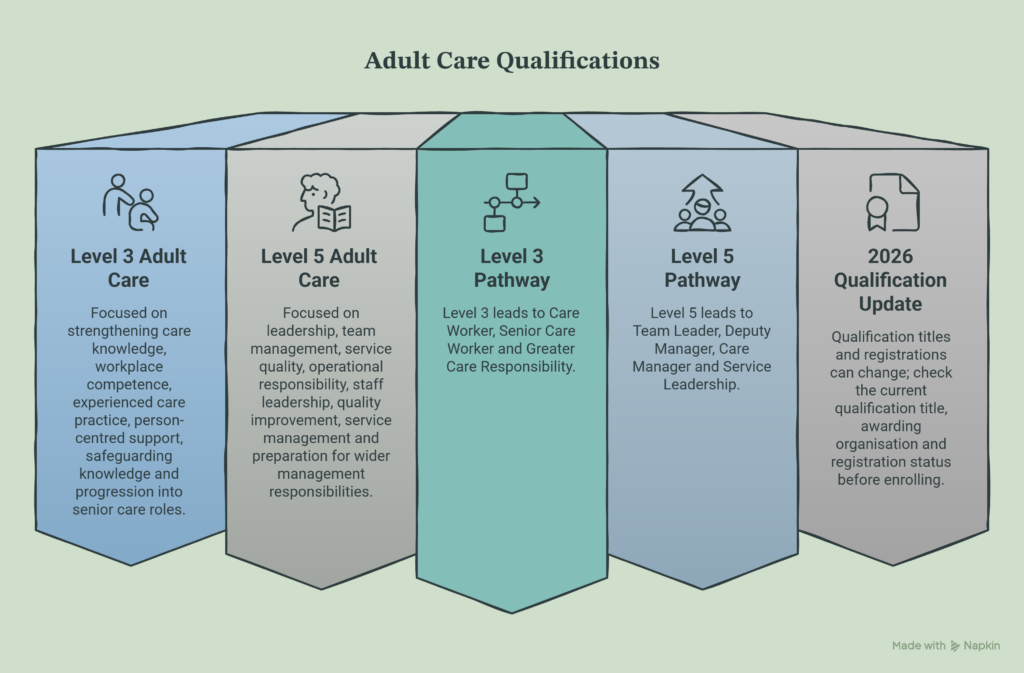
The Level 3 Diploma in Adult Care and Level 5 adult-care qualifications support different stages of career development. Level 3 concentrates more on care knowledge, competence and increasing responsibility, while Level 5 moves towards leading staff and managing adult-care services. Importantly, the qualification system changed in 2026. GOV.UK lists several older Level 3 and Level 5 registrations as closed from 31 March 2026, alongside newer qualifications for current learners.
Notably, the current government list includes newer Level 5 Diploma in Leading and Managing an Adult Care Service qualifications from several awarding organisations. The May 2026 update also added a new Level 3 Diploma in Adult Care qualifications. Therefore, always check the current title and qualification number rather than relying on an older course name.
In practical career terms, the two levels usually connect with different stages of responsibility:
-
Level 3: Care Worker → Senior Care Worker or greater care responsibility
Level 3 strengthens knowledge and skills relevant to more experienced care roles. For example, the National Careers Service identifies the Lead Adult Care Worker Level 3 Advanced Apprenticeship as one possible route towards senior care work and further progression.
-
Level 5: Team Leader → Deputy Manager → Care Manager or wider service leadership
By contrast, Level 5 focuses more strongly on managing teams, quality, operations and services. It can support experienced care professionals who want to develop leadership knowledge and prepare for greater management responsibility within adult social care.
Ultimately, check the exact qualification title, awarding organisation and current registration status before choosing a Level 3 or Level 5 pathway.
Entry Requirements and Progression: Can You Go From Level 3 Straight to Level 5?
Yes, you can sometimes progress from Level 3 straight to Level 5 Health and Social Care. The RQF describes qualification difficulty and does not create a universal rule that every learner must complete Level 4 first. However, each provider or awarding organisation can set its own entry conditions. Therefore, your previous qualifications, care experience, employment status, workplace access and assessment opportunities can all affect whether a specific Level 5 programme suits you.
Before choosing a Level 3 to Level 5 Health and Social Care progression route, check these five areas carefully:
-
Review previous qualifications and relevant care experience.
First, check whether your previous study and care experience meet the programme’s entry expectations. Also ask whether Recognition of Prior Learning applies, as providers may consider existing knowledge or experience when deciding entry rules or learning requirements.
-
Check employment and workplace requirements.
Next, confirm whether your current role gives you the responsibilities the qualification expects. Leadership-focused programmes may require evidence linked to supervising staff, managing services or making decisions, so job responsibilities can directly affect successful completion.
-
Confirm workplace access.
In addition, find out whether assessors need observations, witness statements or evidence from real workplace activities. If the programme assesses occupational competence, limited workplace access may prevent you from producing the evidence needed to meet qualification requirements.
-
Understand assessment requirements.
Then, ask exactly how the provider measures progress. Assignments, portfolios, observations and assessor discussions may all contribute. Knowing this early helps you judge whether your role, schedule and workplace opportunities can support the required assessment process.
-
Check English and maths requirements.
Finally, review any literacy, numeracy or programme-specific entry conditions before applying. Requirements can vary between providers and qualifications, so confirm what evidence you need rather than assuming every Level 5 Health and Social Care programme uses identical criteria.
Current government guidance confirms that awarding organisations and training providers set enrolment entry conditions for qualifications supported through the Learning and Development Support Scheme. You can check the GOV.UK Learning and Development Support Scheme guidance for current information.
If your aim centres on knowledge development rather than occupational competence, the Health and Social Care Level 3 Diploma can provide a CPD-focused route before higher-level study.
Always match the learning route to your career requirement, workplace responsibilities and assessment needs rather than choosing purely by qualification level.
Course, Diploma, CPD or Regulated Qualification: How Do You Know What You Are Studying?
Understanding the difference between a course, diploma, CPD certificate and regulated qualification can stop you from choosing training that does not meet your goal. Words such as “Level 3”, “Level 5”, “certificate” or “diploma” do not automatically prove regulated status. The GOV.UK Register of Regulated Qualifications allows learners to check whether a qualification receives official regulation and view detailed information about it. Therefore, always verify the programme before enrolling.
Before choosing any health and social care course, check these five details carefully:
-
Exact qualification title
First, check the complete official title rather than relying on marketing wording. Similar-sounding courses can have different purposes, levels and outcomes, so matching the exact title helps you identify the programme accurately.
-
Awarding organisation
Next, identify which organisation awards the qualification. You can also verify whether an awarding organisation holds official recognition. This check helps you distinguish recognised regulated qualifications from courses that providers develop independently.
-
Qualification number
Then, look for the unique qualification number. Government adult social care listings publish qualification numbers alongside titles and awarding organisations, making it easier to identify a specific qualification and avoid confusing it with similarly named programmes.
-
Regulated status
Most importantly, confirm whether the qualification appears on the official register. The GOV.UK Register of Regulated Qualifications lets you check regulated status and compare recognised qualifications in England and Northern Ireland.
-
Assessment requirements
Finally, examine how the programme measures achievement. A regulated occupational qualification may require assignments, observations, portfolios or workplace evidence, while a CPD course may assess knowledge through online tests or written activities.
By comparison, CPD mainly supports ongoing professional learning and knowledge development. However, completing CPD does not automatically demonstrate occupational competence or turn a programme into an RQF qualification.
Therefore, verify the title, awarding organisation, qualification number, regulated status and assessment method before choosing any health and social care programme.
How Are Level 3 and Level 5 Health and Social Care Studied and Assessed?
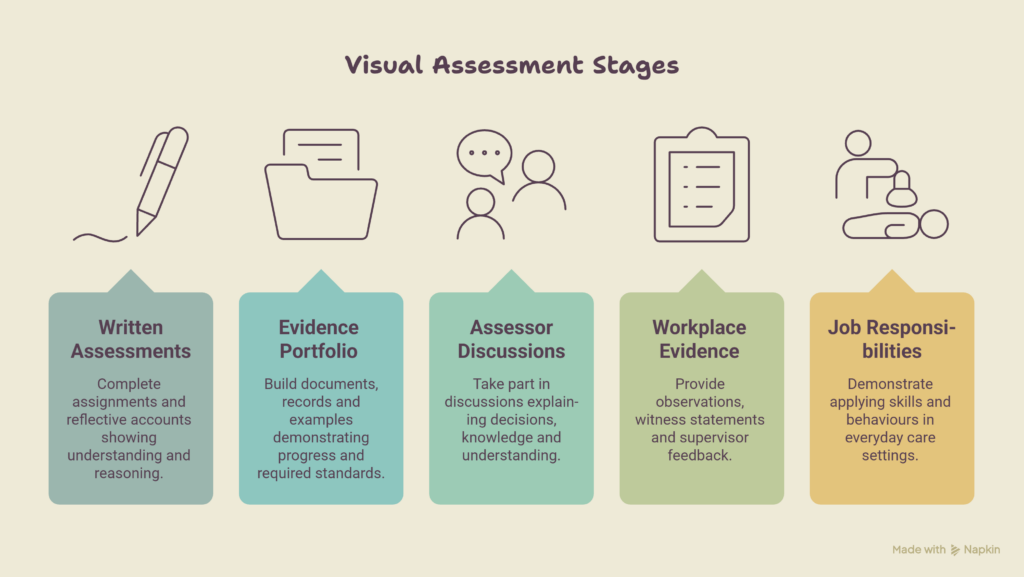
Importantly, assessment methods in health and social care vary because programmes measure different types of learning. For example, a knowledge-based online course may rely on quizzes, examinations or written assignments, while occupational qualifications can require learners to prove competence in real care settings. Assessment may therefore include portfolios, assessor discussions, observations and workplace evidence. Level 3 usually tests applied care knowledge, while Level 5 may demand deeper analysis, judgement and leadership thinking. Always check the exact assessment requirements before you enrol with confidence.
Depending on the qualification and its purpose, you may need to complete several different forms of assessment:
-
Complete written assessments
such as assignments and reflective accounts to show what you understand and how you apply key concepts. These tasks test knowledge, reasoning and your ability to explain care-related decisions clearly and accurately.
-
Build an evidence portfolio
using relevant documents, records and examples from learning or workplace activity. A portfolio can show progress over time and help assessors connect your knowledge with the standards or competencies required properly.
-
Take part in assessor discussions
where you explain your knowledge, decisions and understanding. Assessors may use these conversations to explore your reasoning, clarify portfolio evidence and confirm how well you understand specific care responsibilities clearly.
-
Provide workplace evidence
through witness statements, supervisor feedback or direct observation. This evidence helps demonstrate how you perform relevant duties in real settings and whether you can apply required knowledge, skills and behaviours consistently there.
-
Demonstrate real job responsibilities
by showing how you apply knowledge and skills during everyday work. In comparison, occupational programmes may require evidence from actual duties, especially when the qualification aims to assess workplace competence rather than knowledge.
Importantly, online study does not always mean online-only assessment. The National Careers Service senior care worker guidance explains that relevant Level 3 apprenticeships combine workplace training with study.
Before enrolling, ask four direct questions:
-
How will I be assessed?
Ask whether assessment includes quizzes, assignments, portfolios, discussions, observations or examinations, and confirm how each method contributes to completion overall.
-
Do I need workplace evidence?
Confirm whether assessors require observations, witness statements or job-based records, because occupational qualifications cannot always be completed through online study.
-
Who assesses my competence?
Check whether a tutor, workplace assessor, supervisor or independent assessor reviews your evidence, and ask which professional standards guide their judgement.
-
What happens if my current role cannot provide the required evidence?
Ask whether alternative evidence, changed duties or additional workplace access can meet assessment requirements.
Therefore, check assessment methods, workplace evidence and assessor requirements before choosing any Level 3 or Level 5 health and social care programme.
Level 3 vs Level 5 Jobs, Salaries and Health and Social Care Career Progression
A health and social care qualification can support career progression, but it cannot guarantee a particular job or salary. Level 3 learning often connects more closely with care delivery, support work and senior-care development, while level 5 health and social care can strengthen knowledge relevant to leadership and management. Employers also assess experience, competence, communication, supervision skills and role-specific requirements. Current National Careers Service figures show that earning potential generally increases as workers take on greater responsibility.
A typical health and social care career progression journey could look like:
Care Worker → Senior Care Worker → Team Leader → Deputy Manager → Care Manager → Service Leadership
Overall, this pathway shows how responsibilities can grow over time. However, progression does not always follow one fixed route. However, your experience, employer, qualifications, workplace competence and available vacancies can all influence your next step.
Level 3 vs Level 5 Health and Social Care Jobs and Salary Estimates
Job Role | Short Description | Estimated UK Salary |
Care Worker | Supports people with daily activities, personal care and independent living. Often provides an entry point into adult social care. | £20,000–£25,000 |
Residential Support Worker | Supports children or vulnerable adults in residential settings while promoting safety, wellbeing and independence. | £22,000–£30,000 |
Senior Care Worker | Provides care while supervising care assistants, supporting colleagues and taking greater responsibility for day-to-day care delivery. | £24,000–£29,000 |
Healthcare Assistant | Supports patients in hospitals and community settings with care tasks under appropriate professional direction. | £25,000–£27,000 |
Social Work Assistant | Helps people manage physical, emotional and social needs while supporting qualified social work teams. | £20,000–£28,000 |
Family Support Worker | Works with families and carers, offering practical support and helping improve family wellbeing and development. | £24,000–£36,000 |
Occupational Therapy Support Worker | Helps occupational therapists support people who want to regain or maintain independence in everyday activities. | £26,000–£31,000 |
Substance Misuse Outreach Worker | Supports people affected by drug or alcohol problems and connects them with appropriate treatment and support services. | £24,000–£37,000 |
Care Home Manager | Leads residential care services, manages staff and takes responsibility for service quality, operations and care standards. | £25,000–£55,000 |
Social Services Manager | Plans and co-ordinates social care services delivered by councils, charities and other organisations. | £35,000–£65,000 |
These salary ranges provide useful benchmarks rather than guaranteed earnings. For instance, location, employer, experience, working hours and additional responsibilities can change actual pay. Likewise, a Health and Social Care Level 3 Diploma or Health and Social Care Level 5 Diploma does not automatically qualify you for every role listed; some careers require specific regulated qualifications, professional registration or workplace competence.
Level 3 can support care-focused progression, while Level 5 can strengthen leadership development, but experience and role requirements still matter.
Does Level 5 Health and Social Care Qualify You to Become a Care Manager or Registered Manager?
No. A Level 5 course or certificate alone does not automatically qualify you to become a Care Manager or CQC Registered Manager. CQC expects Registered Managers to demonstrate suitable qualifications, competence, skills, experience and fitness for the regulated service. For home care, CQC states that a Level 5 Diploma in Leadership and Management or equivalent qualification can strengthen an application, but applicants must still meet wider registration requirements.
You can review the official requirements in the CQC guidance for registering as a new manager.
Therefore, anyone planning Registered Manager progression should consider these seven requirements alongside Level 5 health and social care learning:
Relevant management experience
First, build experience that shows you can manage people, priorities and service responsibilities effectively. CQC expects managers to demonstrate experience appropriate to the regulated service, so academic knowledge alone cannot replace relevant leadership and management experience.
Knowledge of the service
Next, understand the people the service supports, its daily operations and its risks. CQC expects managers to possess the knowledge needed for their regulated service and apply that understanding when making safe, appropriate management decisions.
Appropriate qualifications and training
In addition, choose qualifications that match your management responsibilities and service type. CQC specifically notes that a Level 5 Diploma in Leadership and Management, or an equivalent qualification, can strengthen an application to manage home-care services.
A suitable DBS check
In addition, new Registered Manager applicants currently need a Disclosure and Barring Service certificate issued within the previous 12 months. Consequently, applicants should prepare the required criminal-record documentation before starting the registration process.
Evidence of fitness and good character
Moreover, Registered Managers must demonstrate good character and the ability to perform their role properly. CQC considers qualities such as honesty, trustworthiness, reliability and respect when providers assess whether someone meets this requirement.
Understanding of official duties
Managers also need strong knowledge of relevant legislation, best practice and regulatory guidance. CQC expects Registered Managers to understand relevant requirements and recognise the consequences when services fail to act on their legal and official duties.
Proven management ability
Finally, you must show that you can manage the regulated service competently. CQC expects suitable skills, qualifications, knowledge and experience, while providers must assess and verify that managers can carry out their responsibilities effectively.
Therefore, Level 5 can strengthen management progression, but CQC registration ultimately depends on qualifications, experience, competence, suitability and regulatory knowledge.
Which Should You Choose: Level 3 or Level 5 Health and Social Care?
Choosing between Level 3 and Level 5 Health and Social Care depends on your experience, responsibilities and next career goal. Level 3 generally suits learners developing stronger care knowledge or preparing for senior-care responsibilities. By contrast, experienced workers moving towards leadership, management and service improvement may find Level 5 more suitable. Before enrolling, check whether the programme offers CPD learning or a regulated qualification, because the same “Level 3” or “Level 5” wording does not automatically lead to the same professional outcome.
Consider Level 3 If You Are:
Consider health and social care level 3 if you are new to structured care learning, already work in a care role or want to strengthen your health and social care knowledge. It can suit learners preparing for greater day-to-day responsibility, senior-care progression or further study. Your exact route should still reflect employer expectations and the qualification you need. If a role requires occupational competence, check that your chosen Level 3 programme includes appropriate regulated assessment and workplace requirements.
Consider Level 5 If You Are:
Consider level 5 health and social care if you already have care experience and want to develop leadership or management knowledge. It may suit Team Leaders, Deputy Managers and experienced workers preparing for broader responsibility involving staff, quality, risk or service improvement. However, a Level 5 course alone does not guarantee a management position. Check whether your target role requires a regulated qualification, workplace evidence, management experience or employer approval before treating Level 5 as your next progression step.
Before making your final choice, use these five checks to make sure the course matches both your learning needs and career plans:
What to Check | What You Should Confirm Before Enrolling |
Qualification type and status | Check whether the programme offers CPD learning or a regulated qualification. Search the Ofqual register, confirm the awarding organisation and make sure the qualification remains active rather than relying only on the course title. |
Qualification details and entry requirements | Verify the official qualification number, entry criteria and any experience requirements. Occupational qualifications may require employment, workplace access or responsibilities that allow assessors to evaluate real competence. |
Learning and assessment requirements | Ask how the provider assesses learners. Written assignments, portfolios, assessor discussions and workplace observations may serve different purposes. If occupational competence forms part of the qualification, confirm that your current role can provide enough suitable evidence. |
Employer and funding requirements | Check whether your employer recognises the qualification for the role you want. Eligible adult social care employers may also access financial support for specified learning through the government’s Learning and Development Support Scheme. |
Career value | Connect the programme to a clear next step, such as stronger professional knowledge, senior-care progression, management development, an apprenticeship or higher education. Check employer and university requirements separately because the course title alone cannot guarantee progression. |
For current funding and progression information, check the GOV.UK Care Workforce Pathway for Adult Social Care. The government confirms that the Learning and Development Support Scheme continues in the 2026/27 financial year for eligible adult social care employers and specified learning.
Ultimately, choose the level that matches your experience, required qualification status, career direction and the responsibilities you want to take next.
Final Thought: Choose the Level That Matches the Responsibility You Want
The real difference in Level 3 vs Level 5 Health and Social Care goes beyond difficulty. It is about the kind of responsibility you are preparing to take.
Level 3 generally keeps you closer to care practice, professional responsibilities and senior-care development. In comparison, Level 5 moves further towards leadership, management, quality improvement and decisions affecting teams or whole services.
But remember the most important lesson in this guide: a level number is not enough information.
Before enrolling, check what the programme actually is, who awards it, how assessment works and what employers expect. Ask whether it gives you CPD knowledge or a regulated occupational qualification.
Make that distinction first, and choosing between Health and Social Care Level 3 Diploma and Health and Social Care Level 5 Diploma becomes much simpler.
Table of Contents

Frequently Asked Questions
What Is the Difference Between Level 3 and Level 5 Health and Social Care?
Level 3 Health and Social Care usually focuses on developing care practice knowledge, person-centred support and frontline responsibilities. Level 5 moves towards leadership, management, service improvement and decision-making. The right choice depends on your current experience, career goals and the responsibilities you want to develop.
Is Level 5 Health and Social Care Higher Than Level 3?
Yes, Level 5 is a higher qualification level than Level 3 within the RQF framework. It generally involves more advanced learning, greater responsibility and stronger leadership focus. However, the level alone does not define the exact qualification type, size or career outcome.
What Is Level 3 Health and Social Care Equivalent To?
Level 3 qualifications are broadly comparable to A-level standard within the UK qualification framework. However, this does not mean every Level 3 Health and Social Care qualification is identical to an A level, as course content, assessment and qualification size can differ.
What Is Level 5 Health and Social Care Equivalent To?
Level 5 qualifications are comparable to higher education qualifications such as foundation degrees, Higher National Diplomas and Diplomas of Higher Education. However, Level 5 does not automatically mean a qualification is a university degree, as purpose and content vary.
Do You Need Level 3 Before Starting Level 5 Health and Social Care?
Not always. Some Level 5 programmes may accept learners with relevant care experience, existing knowledge or management responsibilities. However, Level 3 can provide a strong foundation for learners progressing from frontline care into leadership and management roles.
What Topics Are Covered in Level 3 and Level 5 Health and Social Care?
Level 3 commonly covers person-centred care, safeguarding, communication, wellbeing and supporting individuals. Level 5 includes leadership, management, governance, quality improvement, workforce development and service planning. The content becomes more focused on managing services and leading teams.
Can I Study Level 3 or Level 5 Health and Social Care Online?
Yes, many providers offer online learning options. However, some regulated vocational qualifications may require workplace evidence, portfolios or assessments based on practical experience. Always check whether the course is a knowledge-based programme or a competence-based qualification before enrolling.
What Jobs Can I Get With Level 3 and Level 5 Health and Social Care?
Level 3 can support progression towards roles such as senior care worker, support worker or lead care positions. Level 5 is more aligned with leadership roles such as deputy manager, care manager or service manager, depending on experience and employer requirements.
Is Level 5 Health and Social Care Enough to Become a Registered Manager?
A Level 5 qualification can support progression towards Registered Manager roles, but it is not the only requirement. Employers and regulators may also consider management experience, skills, competence and suitability for managing care services.
Should I Choose Level 3 or Level 5 Health and Social Care?
Choose Level 3 if you want to strengthen your care knowledge or progress from frontline roles. Choose Level 5 if you are moving towards leadership and management responsibilities. Your decision should depend on your experience, career pathway, qualification requirements and future goals.