

Health and Social Care Courses for Beginners: How to Choose the Right One
Have you ever looked at dozens of health and social care courses and wondered, “Which one is right for me?” That confusion can lead to wasted money, unsuitable training and a course that does not match your career plans. The answer is to start with your goal, experience and the recognition you need. A Health and Social Care Level 3 Diploma can help beginners build knowledge of safeguarding, communication, person-centred care and professional responsibilities before deciding their next career step.
The need for people with care knowledge remains strong. England’s adult social care workforce grew again in 2025/26, adding around 22,000 filled posts, yet the sector had about 96,000 vacancies on any given day. Skills for Care reports that the vacancy rate remained around three times higher than across the wider economy. That demand is why health and social care courses can be valuable for beginners who want to understand the sector and prepare for care opportunities.
In this guide, you will learn what Health and Social Care Courses for Beginners cover, the different UK course and qualification types, how Level 2 and Level 3 compare, what CPD and regulated qualifications mean, how online study differs from classroom learning, and what costs, assessments and career routes to expect.
Ready to choose with confidence? Start building your knowledge with the Health and Social Care Level 3 Diploma and take a clearer first step towards a future in care.

What Are Health and Social Care Courses for Beginners, and Who Are They For?
Health and Social Care Courses for Beginners introduce the knowledge, responsibilities and values used when supporting people in health and care environments. They help you understand how professionals communicate, protect people from harm, respect dignity, support choice and work within boundaries. You do not always need previous care experience to start. In fact, Skills for Care says people can enter social care without qualifications or previous work experience, although employers still decide the requirements for individual roles and provide role-specific induction and training.
Therefore, before choosing a course, it helps to understand exactly what beginner training provides and which learners can benefit from it most.
-
What are beginner health and social care courses?
These courses build a foundation in communication, safeguarding, duty of care, equality, person-centred support, confidentiality and professional conduct. Good training explains how these areas connect in everyday care, so you understand not only what workers do, but why safe decisions, accurate reporting and respectful behaviour matter.
-
Who are they for?
They suit school leavers, career changers, people returning to work, aspiring care assistants, support workers, volunteers and existing staff who want structured learning. Skills for Care specifically describes the Care Certificate standards as suitable for people who are new to care and for supporting induction into relevant health and social care roles.
However, a beginner course does not replace every employer requirement. Employers may also require induction, workplace assessment and role-specific competence. Beginner training gives you direction, but always matches the course to your career goal, employer expectations and required qualification level.
What Types of Health and Social Care Courses and Qualifications Are Available in the UK?
Health and social care courses in the UK range from beginner training and CPD programmes to regulated qualifications and apprenticeships. Each route serves a different purpose, so you should not judge a programme by words such as “certificate”, “diploma” or “Level 3” alone. Some courses build knowledge, while regulated qualifications follow formal requirements and may support specific employment or next career steps. GOV.UK advises learners to check regulated qualifications on the official register before choosing.
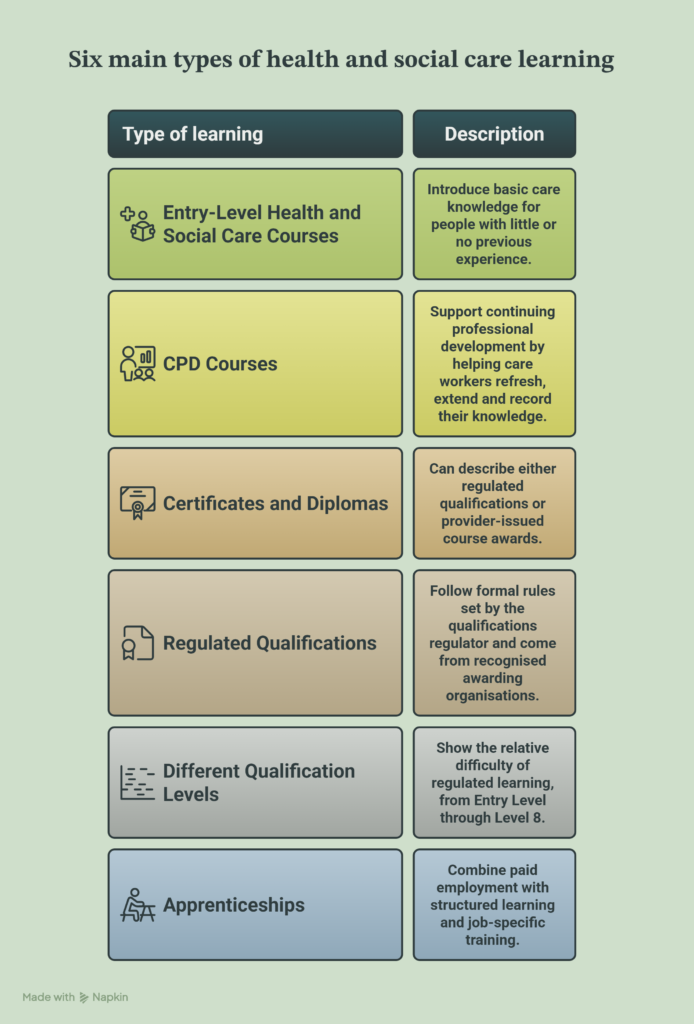
Understanding these six main types of health and social care learning will help you compare your options more accurately.
-
Entry-Level Health and Social Care Courses –
These courses introduce basic care knowledge for people with little or no previous experience. Learners usually study communication, safeguarding, dignity, equality, person-centred care and workplace responsibilities. They help you understand the sector before choosing employment, specialist training or a formal qualification with much greater confidence.
-
CPD Courses –
CPD courses support continuing professional development by helping care workers refresh, extend and record their knowledge. Topics may include safeguarding, dementia, mental health, infection prevention and leadership. They suit learners who want targeted development without necessarily completing a full regulated qualification throughout their career journey.
-
Certificates and Diplomas –
Certificates and diplomas can describe either regulated qualifications or provider-issued course awards, so the title alone does not prove official recognition. Before enrolling, check the awarding organisation, assessment requirements, qualification number, course purpose and whether the programme appears on the relevant qualifications register in advance.
-
Regulated Qualifications –
Regulated qualifications follow formal rules set by the qualifications regulator and come from recognised awarding organisations. In England and Northern Ireland, learners can use GOV.UK’s Register of Regulated Qualifications to confirm recognition, review qualification details and compare similar options before enrolling with much greater confidence.
-
Different Qualification Levels –
Qualification levels show the relative difficulty of regulated learning, from Entry Level through Level 8. A higher level normally means greater academic or job-related difficulty, but courses at the same level can differ in size, content and study time, so compare more than the number.
-
Apprenticeships –
Apprenticeships combine paid employment with structured learning and job-specific training. Apprentices work alongside experienced staff, receive time for study and develop occupational skills in real workplaces. Depending on the apprenticeship, learners may also gain an additional qualification while progressing through a care career over time.
Most importantly, choose health and social care qualifications by their purpose, recognition and career relevance, rather than relying only on titles or levels.
What Is the Best Health and Social Care Course for Your Starting Point and Career Goal?
The best health and social care course for beginners is the one that matches your experience, career goal and the requirements of the role you want. A higher course level does not automatically make a programme more suitable. If you are new to care, start with learning in communication, safeguarding, dignity, equality, person-centred support, duty of care and professional responsibilities. This foundation helps you understand safe, respectful care before specialist study.
After that, think about the job you want. Aspiring care assistants and support workers should look for beginner training that explains daily responsibilities, record keeping, safeguarding, independence and professional boundaries. Skills for Care confirms that people can enter social care without previous qualifications or experience, and many workers complete career-focused qualifications after starting work.
For example, if healthcare assistant work interests you, study job descriptions before choosing a course. Employers may expect induction, workplace competencies or role-specific training. Meanwhile, learners interested in dementia, autism, mental health, end-of-life care or communication can add specialist courses after building a care foundation.
For broader CPD learning, a Health and Social Care Level 3 Diploma can develop knowledge across common care topics. However, always check whether a course offers CPD learning or a regulated qualification rather than relying on “Level 3” alone.
Before enrolling, write down your target role, current knowledge gaps and any qualification employers request. Then compare courses against those three points. You can also check Skills for Care’s Getting Started guidance for current career-entry information.
Choose the course that closes your knowledge gap and moves you towards the next step in care.
Level 2 vs Level 3 Health and Social Care: Which Is Better for Beginners?
Level 2 usually offers a more accessible foundation, while Level 3 requires learners to handle greater depth and complexity. For regulated qualifications, Ofqual uses qualification levels to show relative demand, with higher levels representing more demanding learning. However, two qualifications at the same level can differ in content and size. Therefore, beginners should compare the actual course, assessment requirements and career relevance before choosing between Level 2 and Level 3.
In simple terms, the two levels serve different stages of learning:
-
Level 2 Health and Social Care:
Level 2 can suit beginners who want to strengthen their understanding of care principles before progressing. It generally sits at a lower level of demand than Level 3 and can provide a more manageable starting point.
-
Level 3 Health and Social Care:
In contrast, Level 3 involves a higher level of demand and may suit learners ready for more advanced study. However, always check entry, assessment and workplace requirements because individual qualifications and providers set different conditions.
Level 2 vs Level 3 Health and Social Care Comparison
|
Comparison Point |
Level 2 |
Level 3 |
|
Learning depth |
Builds knowledge at a lower level of demand. |
Develops learning at a higher level of demand. |
|
Best suited to |
Often suits beginners or learners building a stronger foundation. |
Often suits learners ready to study more complex material. |
|
Entry requirements |
Requirements depend on the provider and qualification. |
Providers may expect previous learning or other entry conditions. |
|
Assessment |
May involve assignments, tests, portfolios or workplace evidence, depending on the programme. |
May require more detailed assessment and evidence, depending on the qualification. |
|
Workplace evidence |
Some occupational qualifications require evidence from a care setting. |
Occupational programmes may also require observation or workplace evidence. |
|
Progression |
Can support progression towards further Level 3 learning where appropriate. |
Can support progression towards higher-level study or relevant career development. |
|
official recognition |
“Level 2” alone does not prove that Ofqual regulates the course. |
Likewise, “Level 3 Diploma” alone does not confirm regulated status. |
Most importantly, use the GOV.UK Register of Regulated Qualifications to check whether a qualification has official regulated status before enrolling. The register allows learners to verify recognition and compare similar qualifications.
Choose Level 2 or Level 3 according to your current knowledge, required learning depth and career goal—not the higher number alone.
CPD Health and Social Care Courses vs Regulated Qualifications: What Is the Difference?
Understanding the difference between CPD health and social care courses and regulated qualifications helps beginners choose training that matches their career goals. CPD learning focuses on developing knowledge, updating skills and supporting professional growth, while regulated qualifications follow formal requirements set through recognised awarding organisations. A certificate of completion can prove that you finished learning, but it does not automatically mean you gained a regulated qualification. Always check what recognition a course actually provides before enrolling.
To understand this difference more clearly, compare the purpose, assessment and recognition of each learning route:
-
CPD Health and Social Care Courses:
CPD courses support continuous professional development by helping learners improve knowledge in areas such as safeguarding, dementia, mental health and infection prevention. They can strengthen a CV and professional understanding, but they do not automatically provide a regulated qualification simply because they offer a certificate.
-
Regulated Qualifications:
In contrast, regulated qualifications follow formal standards and come from recognised awarding organisations operating within their approved scope. Learners can check regulated qualifications through official registers. Ofqual explains that recognised awarding organisations must meet specific conditions to offer regulated qualifications. (gov.uk)
CPD Health and Social Care Courses vs Regulated Qualifications Comparison
|
Comparison Point |
CPD Health and Social Care Courses |
Regulated Qualifications |
|
Main purpose |
Helps learners update knowledge, develop awareness and support professional development. |
Provides formally recognised learning that follows official rules. |
|
Recognition |
Recognition depends on the CPD provider or accrediting body. |
Recognition comes through approved awarding organisations and regulatory frameworks. |
|
Assessment |
Often uses quizzes, assignments or knowledge checks. |
May require structured assessments, portfolios, workplace evidence or observations. |
|
Career use |
Supports learning and demonstrates commitment to professional development. |
May meet specific qualification requirements for certain roles or next career steps. |
|
Awarding body |
A CPD provider or accreditation organisation may issue the certificate. |
A recognised awarding organisation awards the regulated qualification. |
|
Care Certificate difference |
Care Certificate standards provide recommended induction standards and are not accredited. |
Ofqual regulates the Level 2 Adult Social Care Certificate, and learners complete observational assessments as part of the qualification. (skillsforcare.org.uk) |
|
Assessment of competence |
May focus mainly on knowledge gained through study. |
Can require evidence that learners apply knowledge and skills appropriately. |
|
Best suited for |
Learners improving existing knowledge or exploring a subject area. |
Learners who need a formally recognised qualification for career development. |
The Care Certificate often creates confusion because many learners assume it works the same way as a qualification. However, Skills for Care explains that the Care Certificate standards are recommended and non-accredited, while the Level 2 Adult Social Care Certificate qualification is accredited and regulated by Ofqual. The Level 2 qualification builds on the same 16 standards and includes observational assessment.
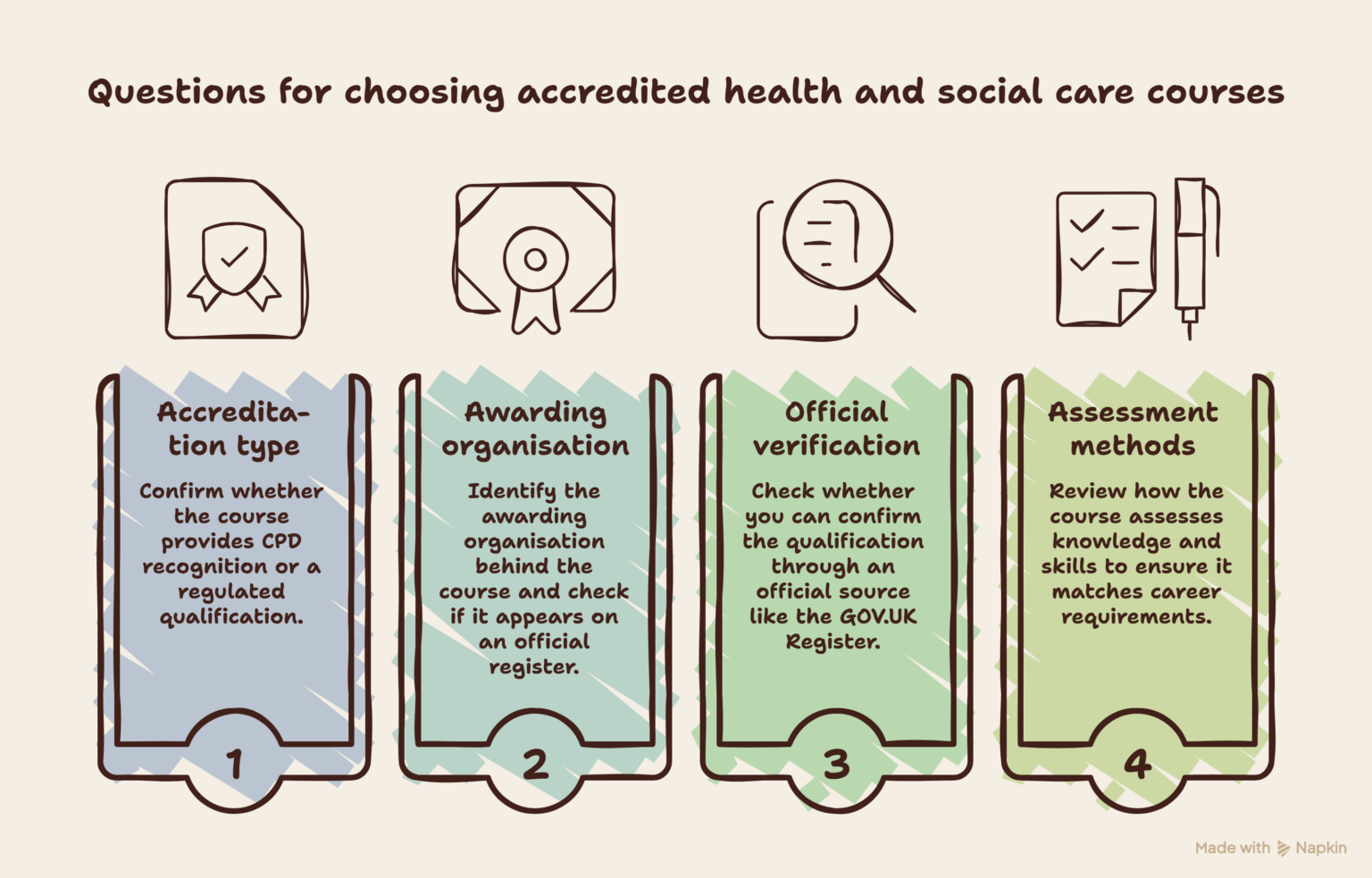
Therefore, before choosing accredited health and social care courses online, ask:
-
Is this CPD accreditation or regulatory recognition?
First, confirm whether the course provides CPD recognition or a regulated qualification. CPD shows professional learning and development, while regulated qualifications follow formal requirements and appear on official registers. These two options serve different purposes, so choose according to your career needs.
-
Who awards the qualification?
Next, identify the awarding organisation behind the course. A training provider delivers learning, but a recognised awarding organisation awards regulated qualifications. Always check whether the organisation appears on the relevant official register before assuming the certificate has formal recognition.
-
Can I verify it on an official register?
Furthermore, check whether you can confirm the qualification through an official source. The GOV.UK Register of Regulated Qualifications allows learners to search recognised qualifications, view details and compare similar options before enrolling.
-
Does the assessment match my career requirements?
Finally, review how the course assesses your knowledge and skills. Some roles require workplace evidence, observations or structured assessments, while others only need knowledge-based learning. Choose assessment methods that match the expectations of your intended career pathway.
Choose training based on its purpose, recognition and assessment method, because the right course supports your actual career pathway.
What Do You Learn on a Beginner Health and Social Care Course, and What Skills Will You Develop?
Beginner health and social care courses build the essential knowledge, behaviours and values needed to provide safe, respectful and person-centred support. These topics connect because safe care depends on how different skills work together. Safeguarding relies on careful observation and communication. Accurate record keeping helps teams share important information, while person-centred care requires professionals to listen, respect choices and understand individual needs. The Care Certificate standards, developed by Skills for Care, Skills for Health and NHS England, define the knowledge, skills and behaviours expected from specific health and social care roles and can support people who are new to care.
For this reason, a strong foundation course should connect learning with real care responsibilities. It should not only explain terms but help you understand how these skills influence everyday support.
Here are the key areas you will usually explore:
-
Communication and Teamwork
Firstly, effective communication helps care workers understand individual needs, share important information and build trust. Learners develop active listening skills, professional conversations, teamwork approaches and clear handover practices that support safer care and better collaboration between colleagues.
-
Duty of Care and Professional Practice
Next, learners understand their responsibilities, professional boundaries and accountability within care settings. This topic explains how workers make appropriate decisions, follow agreed procedures, recognise limitations and maintain professional behaviour while supporting the wellbeing and rights of the people they care for.
-
Safeguarding and Person-Centred Care
Furthermore, safeguarding teaches learners how to recognise risks, respond to concerns and protect vulnerable people from harm. Person-centred care focuses on respecting individual choices, preferences, dignity and independence rather than treating everyone in the same way.
-
Equality, Diversity, Privacy and Dignity
Additionally, learners explore how to provide inclusive support that respects personal identity, beliefs, backgrounds and individual circumstances. This knowledge helps care workers protect privacy, maintain dignity and ensure people receive support without discrimination or unfair treatment.
-
Health, Safety and Infection Prevention
Moreover, courses introduce workplace safety responsibilities, risk awareness and infection prevention practices. Learners understand how good hygiene, safe working methods and following procedures help reduce risks and protect both care workers and the people receiving support.
-
Confidentiality and Information Handling
Meanwhile, confidentiality training explains how workers protect personal information and handle records responsibly. Learners understand why secure information sharing matters, when information may need to be shared and how professional data handling supports trust in care relationships.
-
Mental Health, Observation and Record Keeping
Finally, learners develop awareness of mental wellbeing, recognise changes in behaviour or health and understand the importance of accurate records. Good observation and reporting help teams respond quickly, communicate effectively and provide appropriate ongoing support.
These topics work together. Safeguarding relies on careful observation. Accurate records strengthen communication. Person-centred care requires listening and respecting individual choices. Ultimately, the goal is not simply remembering terminology; it is understanding what safe, compassionate care looks like in practice.
For structured learning across these areas, the Care Certificate Course – Standards 1 to 16 can support knowledge development. However, completing online learning does not replace workplace assessment or employer sign-off required for demonstrating competence against Care Certificate standards.
Building these foundations helps beginners develop confidence, understand care responsibilities and prepare for future learning or career opportunities.
Health and Social Care Courses for Beginners Online or in the Classroom: Which Should You Choose?
Choosing between health and social care courses online and classroom learning depends on your lifestyle, learning preferences and career goals. For many learners, online courses provide flexibility for learners who need to study around work, family or other commitments. Classroom learning offers direct interaction, scheduled lessons and opportunities for discussion. However, neither option works best for everyone. The right choice depends on whether you need convenience, structured support or practical workplace assessment alongside your learning.
Before selecting your preferred learning method, understand how each option supports different types of learners.
-
Health and Social Care Courses for Beginners Online
Firstly, online learning allows beginners to study at their own pace using digital platforms, recorded lessons and flexible schedules. It suits career changers, busy workers and learners who want to explore care before making a larger commitment. Many online courses allow learners to revisit topics such as safeguarding, communication and person-centred care whenever needed.
-
Health and Social Care Courses for Beginners Online in the Classroom
Alternatively, classroom learning provides a structured environment with fixed timetables, face-to-face guidance and immediate opportunities to ask questions. Learners can discuss care scenarios, share experiences with others and receive direct support from tutors. This format may suit people who prefer guided study and regular interaction.
However, the learning format should always match the outcome you need. Consider these benefits when comparing online and classroom options:
- Flexible study around employment, childcare or personal commitments
- Ability to revisit lessons and review difficult topics
- Lower travel requirements and easier access for remote learners
- Self-paced learning that allows you to progress comfortably
- Opportunities to build foundational knowledge before entering care work
It is also important to understand that online theory does not automatically prove workplace competence. The Care Certificate standards, which define the knowledge, skills and behaviours expected in specific health and social care roles, require workers to demonstrate what they know and what they do through appropriate assessment.
Therefore, if a course connects to workplace assessment or regulated learning, check whether practical evidence or employer observation forms part of completion.
Choose online or classroom learning based on your career outcome, available time and the level of support you need to succeed.

Health and Social Care Course Requirements, Duration, Assessment and Costs Explained
Health and social care course requirements, duration, assessment methods and costs can vary significantly depending on the type of training you choose. Some beginner programmes offer flexible learning with minimal entry requirements, while regulated qualifications may require workplace access, formal assessments and specific evidence. Before enrolling, check what the course expects from you, how long completion may take, how you will be assessed and what the total cost includes.
Understanding these factors helps you choose training that fits your experience, available time and career goals. Consider these four areas before making your decision:
-
Course Requirements:
Start by checking the entry requirements before beginning your course. Many beginner CPD courses accept learners with no previous care experience and only require basic English skills and internet access. However, some regulated qualifications may require employment, workplace evidence or additional assessment conditions.
-
Course Duration:
Alongside this, consider how much time you can commit. Course length depends on the content, qualification type and learning format. A short awareness course may take only a few hours, while larger qualifications can take several months. For example, Skills for Care states that the regulated Level 2 Adult Social Care Certificate usually takes new learners around six to eight months to complete.
-
Assessment Methods:
Furthermore, understand how the provider checks your learning. Assessments may include online quizzes, written assignments, portfolios, professional discussions, workplace observations or evidence from your employer. Some care qualifications require learners to demonstrate both knowledge and practical ability in a workplace setting.
-
Course Costs and Funding Options:
Finally, compare the complete cost rather than only the advertised price. Check tuition fees, assessment charges, registration costs, certificate fees and possible resit charges. You may also find free health and social care courses, employer-funded training or supported learning schemes, but always confirm the course quality and recognition before enrolling.
For example, eligible employers in England can access support through the Adult Social Care Learning and Development Support Scheme for certain approved training and qualifications.
However, the cheapest option is not always the best option. A free course may provide useful knowledge, but it may not offer the assessment, recognition or career pathway you need.
Compare course outcomes first, then compare prices, because the right training should support your long-term career goals.
How to Choose a Good Health and Social Care Course: 10 Things to Check Before Enrolling
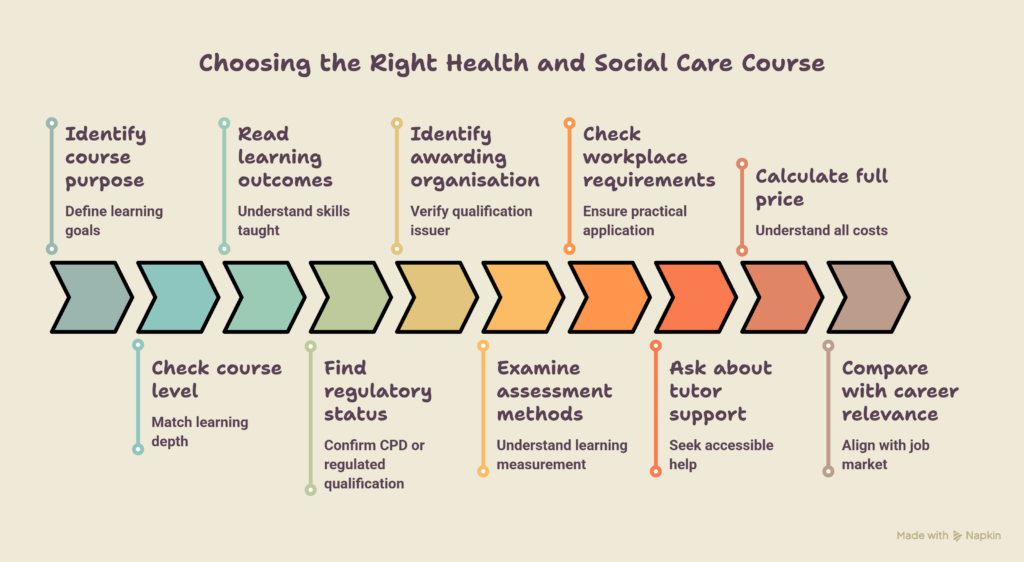
To choose a good health and social care course, check its purpose, level, learning outcomes, recognition, assessment and career relevance before paying. Course titles can sound similar while leading to very different outcomes. A CPD programme may strengthen professional knowledge, while a regulated qualification follows formal requirements and appears on the relevant qualifications register. Skills for Care also recommends checking provider quality, learner support, assessment methods and whether training reflects current legislation and good practice.
Before making a final decision, use these ten checks to separate useful training from a programme that may not meet your needs.
-
Purpose:
Begin by identifying what the course aims to achieve. Does it introduce health and social care, provide continuing professional development, prepare you for specialist learning or lead to a regulated qualification? Your answer should match the reason you want to study.
-
Course Level:
After that, review whether the learning depth suits your current knowledge. Do not automatically choose the highest level. A beginner may benefit more from foundation learning, while experienced workers may need advanced or role-specific study to support progression.
-
Learning Outcomes:
Then, read exactly what the course promises to teach. Strong learning outcomes should identify clear knowledge or skills, such as safeguarding, person-centred care, communication or duty of care, rather than relying on broad statements about becoming “job ready”.
-
official recognition:
Importantly, find out whether the programme offers CPD learning or an officially regulated qualification. For England and Northern Ireland, the GOV.UK Register of Regulated Qualifications lets you confirm official recognition and compare similar qualifications.
-
Awarding Organisation:
Likewise, identify who awards the qualification. GOV.UK provides a separate register where learners can check recognised awarding organisations in England and Northern Ireland. Never assume that a training provider and an awarding organisation perform the same function.
-
Assessment:
After that, examine how the provider measures learning. A programme may use quizzes, assignments, professional discussions, portfolios or workplace observations. Skills for Care stresses that assessment should measure knowledge or skills fairly, accurately and reliably.
-
Workplace Requirements:
In addition, check whether you need employment or placement access. Some occupational qualifications require direct observation and evidence of workplace competence. Training alone does not always demonstrate that someone can apply care knowledge safely in real situations.
-
Tutor Support:
Furthermore, ask what happens when you need help. Look for accessible tutors, useful feedback and clear assessment support. Skills for Care recommends providers that support and assess learners throughout their programme rather than simply supplying course materials.
-
Certificate and Costs:
Before paying, calculate the full price. Check tuition, registration, assessment, examination, resit and certificate charges. Also confirm exactly what certificate you receive, because a certificate of completion does not automatically mean you have gained a regulated qualification.
-
Career Relevance:
Finally, compare the course with actual vacancies for your target role. Review several job adverts and note recurring requirements for qualifications, experience and training. Then choose learning that addresses genuine employer expectations rather than relying entirely on marketing claims.
A useful shortcut is simple: find ten current vacancies for the role you want, record the requirements that appear repeatedly, and compare them with the course specification. That gives you evidence of what employers currently value.
Choose a course because its learning, recognition and assessment support your next career step—not because its title sounds impressive.
What Jobs Can Health and Social Care Courses Lead To, and How Can You Progress?
Health and social care courses can support pathways into care assistant, support worker, healthcare assistant, residential care and community support roles, while further qualifications can open routes into senior or regulated professions. Usually, beginners often start with introductory learning, employer induction and workplace training. From there, you can build specialist knowledge in safeguarding, dementia or mental health and progress towards higher-level qualifications. However, employers set their own entry requirements, and regulated roles such as social work require approved professional training and registration.
Health and Social Care Career Options
|
Job Role |
What the Role Involves |
Estimated UK Salary |
|
Care Assistant / Care Worker |
Supports people with personal care, daily activities, meals, independence, records and wellbeing in residential or home-care settings. |
£20,000–£25,000 |
|
Healthcare Assistant |
Supports patients in hospitals, clinics or community settings with personal care, observations and other duties under clinical supervision. |
£25,000–£27,000 |
|
Residential Support Worker |
Supports children or vulnerable adults living in residential care and helps protect their physical, emotional and social wellbeing. |
£22,000–£30,000 |
|
Community Support Worker / Social Work Assistant |
Helps people manage physical, emotional and social needs while supporting independence and connecting them with appropriate services. |
£20,000–£28,000 |
|
Senior Care Worker |
Provides care while supervising care assistants, supporting care planning and taking greater responsibility within the care team. |
£24,000–£29,000 |
|
Occupational Therapy Support Worker |
Helps people recovering from illness, surgery or health conditions develop independence under the direction of occupational therapy professionals. |
£26,000–£31,000 |
|
Health Trainer |
Supports people in making healthier lifestyle choices and improving areas such as wellbeing, activity, diet and long-term health habits. |
£24,000–£30,000 |
|
Nursing Associate |
Works alongside registered nurses in hospitals and community services. The Nursing and Midwifery Council requires approved training and registration for this regulated role. |
£26,000–£31,000 |
|
Social Worker |
Protects vulnerable children and adults, assesses needs and coordinates support. You need approved social work training and professional registration. |
£32,000–£48,000 |
|
Care Home Manager |
Leads residential care services, manages staff and helps maintain care quality, safety, budgets and operational standards. |
£25,000–£55,000 |
If support work interests you, the Support Worker Diploma & Care Assistant Certificate can help you build CPD knowledge across care, communication and safeguarding before progressing through further workplace learning or qualifications.
Start with the role that matches your interests, then build recognised qualifications, workplace competence and specialist knowledge as your career develops.
Final Thought: Choose the Course That Moves You Forward
Choosing between health and social care courses online, classroom programmes, CPD certificates and regulated qualifications becomes much easier when you stop asking, “Which course sounds best?” and start asking, “What do I need this course to help me do next?”
If you are new to care, begin by building strong knowledge of safeguarding, communication, dignity, person-centred support and professional responsibilities. Then check real job requirements and decide whether you need CPD learning, workplace training or a regulated qualification.
There is no single best route for everyone. There is, however, a right next step for you.
Choose a course you understand, verify what its certificate means and make every stage of your learning move you closer to the care career you want.
Table of Contents

Frequently Asked Questions
What Are Health and Social Care Courses for Beginners?
Health and social care courses for beginners introduce essential care principles, communication, safeguarding, person-centred practice and professional responsibilities. They suit school leavers, career changers, new care workers and adults returning to study. Course type, level and recognition should match your experience and future career goals.
What Is the Best Health and Social Care Course for a Complete Beginner?
A complete beginner may start with an introductory course, a Level 2 option, the Care Certificate, or relevant CPD training, depending on their goal. The best choice depends on whether you want general knowledge, workplace induction, a regulated qualification or preparation for further career study.
Can I Study Health and Social Care With No Previous Experience?
Yes. Many beginner health and social care courses accept learners without previous care experience. However, entry requirements vary. Some regulated qualifications or workplace-based programmes may require employment, placement access, English or maths requirements, or practical assessment, so always check the exact course specification before enrolling.
Is Level 2 or Level 3 Health and Social Care Better for Beginners?
Level 2 usually provides introductory learning, while Level 3 generally develops broader or deeper knowledge. However, course titles alone do not confirm regulatory status. Compare learning outcomes, entry requirements, assessment methods and progression routes, and check whether the qualification appears on the regulated qualifications register.
What Is the Difference Between CPD Health and Social Care Courses and Regulated Qualifications?
CPD courses support continuing professional development and can build specific knowledge, while regulated qualifications meet formal regulatory requirements and are awarded by recognised awarding organisations. A CPD certificate is not automatically equivalent to an Ofqual-regulated qualification, so check the course’s status, purpose and progression route.
What Is the Difference Between the Care Certificate and Level 2 Adult Social Care Certificate?
The Care Certificate is a set of 16 standards used to support induction for people new to care. The Level 2 Adult Social Care Certificate is an Ofqual-regulated qualification based on those standards, with deeper learning and formal assessment, including workplace observation for competency requirements.
Are Online Health and Social Care Courses Worth It for Beginners?
Online courses can suit beginners who need flexible, self-paced study. They may cover theory, professional knowledge and specialist topics effectively. However, some occupational qualifications require workplace observations or practical assessment. Check tutor support, assessment methods, accreditation, course access, certificate details and progression options before enrolling.
What Do You Learn on a Beginner Health and Social Care Course?
Beginner courses commonly cover communication, safeguarding, duty of care, equality, dignity, confidentiality, infection prevention, health and safety, person-centred care and record keeping. Good programmes should also develop transferable skills such as teamwork, observation, professionalism, empathy and clear communication relevant to health and social care roles.
How Can I Check If a Health and Social Care Course Is Accredited or Regulated?
Check whether the course is CPD accredited, formally regulated, or simply provides a completion certificate. For regulated qualifications in England, search the official Register of Regulated Qualifications. Also verify the awarding organisation, qualification level, assessment requirements, course outcomes and exactly what certificate you will receive.
What Jobs Can You Get After a Health and Social Care Course?
Health and social care courses can support roles such as care assistant, support worker, healthcare assistant, domiciliary care worker and community support worker. However, completing a course does not guarantee employment. Employers may require additional training, checks, experience, qualifications or workplace competency before hiring you.