

Healthcare assistant interview questions can turn a promising job opportunity into a nerve-racking hour if you walk in unsure of what the interviewer wants to hear. The good news? You do not need perfectly memorised answers. You need to understand the role, prepare genuine examples and show how your values, judgement and communication fit safe, compassionate care.
Most HCA interviews test your motivation, communication, teamwork, care values and response to realistic situations, so thoughtful preparation can help you answer with greater clarity and confidence.
Within the NHS, employers often use the broader term healthcare support worker (HCSW), while individual organisations may use titles such as healthcare assistant (HCA), clinical support worker or nursing assistant. NHS England’s healthcare support worker guide confirms that job titles and day-to-day duties can vary between settings. This guide covers common questions, NHS values, the 6 Cs, scenario questions, safeguarding and realistic sample answers you can adapt to your own experience.
Table of Contents
What to Expect in a Healthcare Assistant Interview
A healthcare assistant interview usually explores more than your work history. Employers want to understand how you communicate, why you want to work in care, how you respond when something goes wrong and whether your values support safe, respectful care.
NHS England highlights teamwork, communication, organisation, problem-solving and compassion as important qualities for healthcare support workers. It also notes that employers may use different HCSW job titles and responsibilities depending on the service.
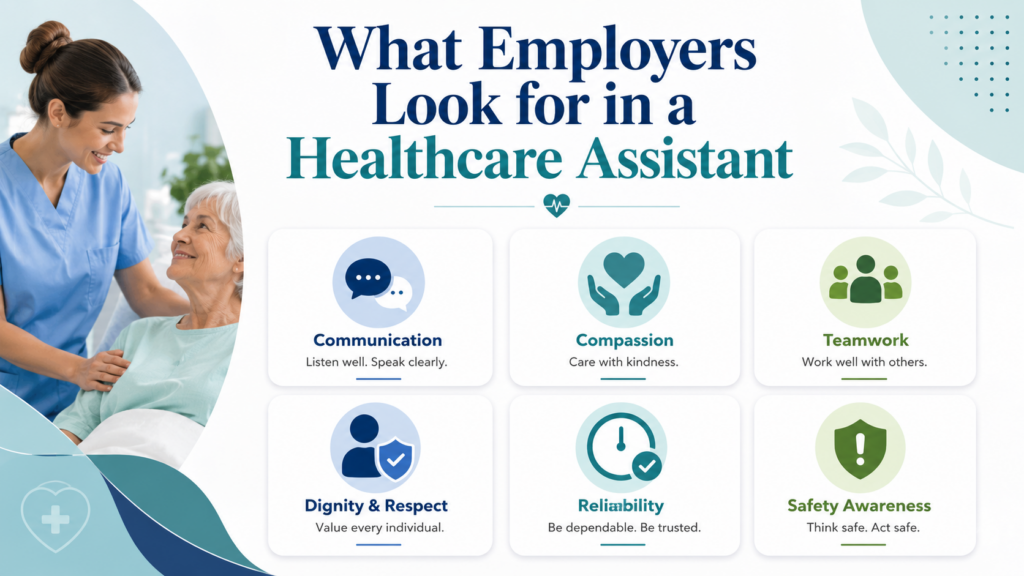
What Do Employers Look for in a Healthcare Assistant?
Recruiters often look for evidence that you can:
- Communicate clearly and listen carefully
- Treat people with dignity and respect
- Work reliably within a healthcare team
- Recognise your own responsibilities and limits
- Stay calm when priorities change
- Raise concerns when patient safety may suffer
- Show compassion without making assumptions about people
- Follow instructions, policies and agreed care plans
You do not need to sound clinical or use complicated terminology. Instead, explain how you would behave and support people safely.
For example, rather than saying, “I provide excellent person-centred care,” explain what that means: listening to the person, respecting their choices, protecting privacy and involving them in decisions within your role.
What Types of Interview Questions Might You Be Asked?
Most interviews combine several question types.
| Question type | What it explores | Example |
|---|---|---|
| Motivation | Why you want the role | “Why do you want to be a healthcare assistant?” |
| Experience | What you have learned previously | “Tell me about a time you worked in a team.” |
| Values | How you approach care | “What does dignity mean to you?” |
| Scenario | How you would respond | “What would you do if a patient refused care?” |
| Safety | Whether you recognise concerns | “What would you do if you suspected abuse?” |
Treat each question as an opportunity to show how you think, not simply how many healthcare terms you know.
Common Healthcare Assistant Interview Questions and Sample Answers

These questions appear frequently because they help employers assess your motivation, self-awareness, communication and understanding of the HCA role. Use the sample answers as frameworks. Replace the details with honest examples from your own experience.
Tell Me About Yourself
Keep your answer relevant to the role rather than giving your full life story. Briefly explain your experience, strengths and reason for applying.
Sample answer:
“I enjoy roles where I can support people directly and work as part of a team. My previous experience has strengthened my communication, patience and ability to stay organised. I now want to use those strengths in healthcare and continue developing my knowledge while supporting patients respectfully.”
Avoid repeating your CV word for word.
Why Do You Want to Be a Healthcare Assistant?
Employers want to hear genuine motivation alongside a realistic understanding of the work.
Sample answer:
“I want to become a healthcare assistant because I value work that makes a direct difference to people’s daily experience. I enjoy communicating with different people, supporting their independence and contributing to a team that provides safe, respectful care.”
Avoid relying only on “I like helping people.” Explain how that motivation connects with the role.
What Do You Understand About the Healthcare Assistant Role?
Show that HCAs support patients and work alongside registered healthcare professionals rather than acting independently beyond their responsibilities. NHS England describes HCSWs as team members who support registered professionals and help patients through treatment, recovery and long-term health needs.
Sample answer:
“I understand that the role can include supporting personal care, comfort, communication and everyday patient needs while observing changes and sharing relevant concerns with the appropriate healthcare professional.”
What Skills and Strengths Can You Bring to the Role?
Choose three or four strengths that you can support with evidence.
Useful examples include:
- Communication
- Empathy
- Reliability
- Teamwork
- Patience
- Organisation
- Observation
- Adaptability
Sample answer:
“My strongest qualities are communication, patience and reliability. I listen before responding, stay calm when situations become busy and make sure I complete responsibilities carefully.”
Why Should We Hire You as a Healthcare Assistant?
Connect your qualities directly to the employer’s needs rather than claiming that you are “the best candidate”.
Sample answer:
“I would bring a respectful attitude, willingness to learn and a strong sense of responsibility. I communicate well with different people, work constructively with colleagues and understand the importance of asking for guidance whenever something falls outside my role.”
How Do You Work Effectively as Part of a Healthcare Team?
Healthcare assistants often work alongside nurses, midwives and other healthcare professionals, so interviewers may test how you communicate and contribute to shared goals.
Sample answer:
“I communicate clearly, share relevant information promptly and respect each team member’s responsibilities. If I notice a concern, I raise it with the appropriate colleague rather than assuming someone else will deal with it.”
NHS Healthcare Assistant Interview Questions, Values and the 6 Cs

Many NHS healthcare assistant interviews assess values alongside skills, helping recruiters understand whether a candidate’s behaviour and approach to care reflect the NHS Constitution.
Before an NHS interview, read both the job description and the Trust’s own values. Then prepare examples that show how you have demonstrated similar behaviours.
Why Do You Want to Work for the NHS?
A strong answer should go beyond job security or career progression.
Sample answer:
“I want to work for the NHS because its focus on dignity, compassion, quality and working together matches how I believe people should receive care. I also value working within a team where everyone contributes to patient experience and safety.”
Keep the answer personal. Explain which values connect most strongly with your own behaviour.
What Are the NHS Constitution Values and the 6 Cs of Care?
The NHS Constitution for England sets out six core values: working together for patients, respect and dignity, commitment to quality of care, compassion, improving lives and everyone counts.
The 6 Cs of care provide another useful values framework:
| 6 C | What it means in an interview answer |
|---|---|
| Care | Put people’s needs at the centre |
| Compassion | Respond with empathy and kindness |
| Competence | Work within your skills and continue learning |
| Communication | Listen and share information clearly |
| Courage | Speak up when something concerns you |
| Commitment | Maintain consistent standards and keep improving |
NHS Professionals identifies these six principles as relevant to patient-facing health and social care staff.
How Can You Demonstrate NHS Values in Your Interview Answers?
Do not simply recite the values. Attach them to behaviour.
For example:
Respect and dignity: “I would explain what I am doing, protect the person’s privacy and involve them in choices.”
Working together: “I would share relevant concerns with the team promptly and listen to colleagues’ expertise.”
Compassion: “I would acknowledge the person’s distress and give them time to explain what they need.”
Specific examples make your understanding more convincing.
What Should You Expect From Band 2 and Band 3 HCA Interviews?
Always read the individual job description because organisations can structure support roles differently.
NHS Employers distinguishes the national profiles broadly: Band 2 healthcare support work focuses mainly on personal care, while Band 3 roles can include a limited range of clinical tasks under appropriate delegation or supervision.
Therefore, a Band 3 interview may explore broader responsibilities, experience and judgement. However, never assume duties from the band number alone. Prepare against the actual person specification and responsibilities listed for the vacancy.
Scenario and Competency-Based Interview Questions
Scenario questions test how you would approach real workplace situations. Interviewers usually care more about your judgement, communication and willingness to seek appropriate support than about a dramatic “perfect” response.
How Should You Use the STAR Method?
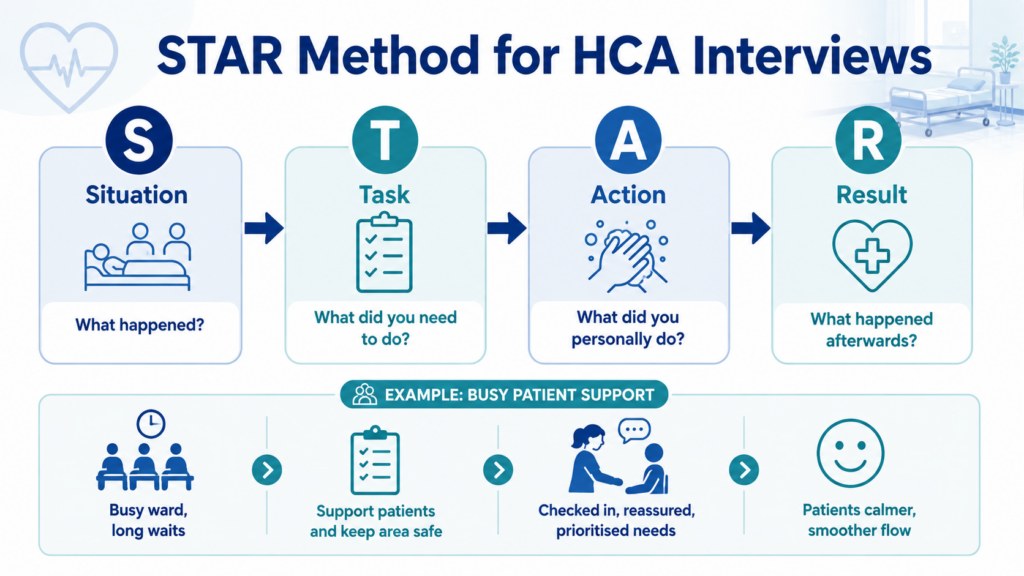
Use STAR — Situation, Task, Action, Result — when an interviewer asks about something you have already experienced.
For example:
Situation: A customer became distressed.
Task: I needed to understand the problem and keep the situation calm.
Action: I listened, clarified what they needed and contacted the appropriate colleague.
Result: We resolved the issue without further conflict.
Keep most of your answer focused on your action.
For hypothetical healthcare scenarios, explain what you would do rather than inventing past clinical experience.
What Would You Do If a Patient Refused Care?
Do not say you would force or pressure the person.
The NHS explains that an adult who has capacity can make a voluntary and informed decision to refuse treatment.
Sample answer:
“I would stay calm, listen to why the patient did not want the care and respect their choice. I would explain anything within my role, avoid pressure and report the refusal to the appropriate healthcare professional so the team could respond safely.”
How Would You Respond to an Upset, Confused or Challenging Patient?
Focus on calm communication and safety.
Sample answer:
“I would speak calmly, give the person space where appropriate and listen for what may have caused their distress. I would avoid arguing. If I felt concerned about their safety, behaviour or condition, I would seek support promptly.”
What Would You Do If You Noticed a Change in a Patient’s Condition?
Show observation and escalation rather than diagnosis.
Sample answer:
“I would note what I had observed and report the change promptly to the appropriate registered healthcare professional. I would follow local procedures and continue supporting the patient within my responsibilities.”
How Would You Prioritise When Several Patients Need Support?
Start with immediate risk.
You might explain that you would:
- Identify who needs urgent support
- Communicate with colleagues
- Ask for help when necessary
- Keep people informed where possible
- Reassess priorities as circumstances change
Do not suggest that you would handle every problem alone.
What Would You Do If You Made or Noticed a Mistake?
Patient safety comes first.
Sample answer:
“I would act promptly to reduce any immediate risk, inform the appropriate senior colleague and explain exactly what happened. I would follow the organisation’s reporting process and reflect on how I could help prevent the same problem happening again.”
NHS England links a positive patient-safety culture with staff feeling able to report errors, ask questions and raise concerns.
How Would You Handle Conflict With a Colleague?
Show professionalism rather than avoidance.
Sample answer:
“I would discuss the issue calmly and privately, focus on facts and keep patient care at the centre of the conversation. If we could not resolve an important safety concern, I would raise it through the appropriate route.”
Safeguarding, Dignity and Confidentiality Questions
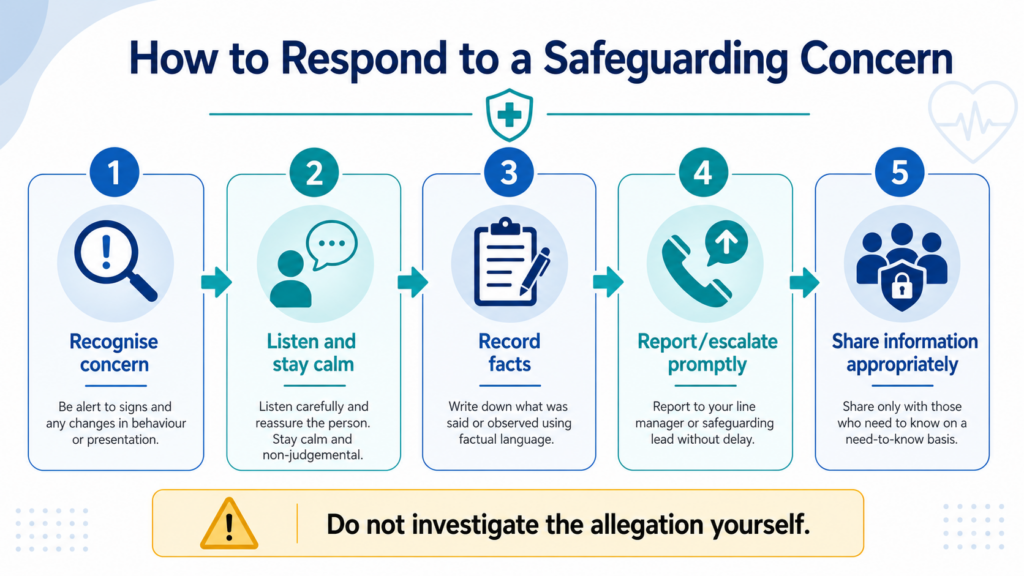
Healthcare assistants work close to patients, so interviewers may explore whether you understand the principles that protect people from harm, preserve dignity and safeguard personal information.
What Does Safeguarding Mean in Healthcare?
GOV.UK describes adult safeguarding as working with adults who have care and support needs to keep them safe from abuse or neglect. The Care Act framework also requires organisations and public services to work together where adults face safeguarding risks.
A strong interview answer might say:
“Safeguarding means recognising risks of abuse or neglect, taking concerns seriously and following the correct reporting process so the organisation can protect the person.”
Do not present safeguarding as something only managers handle. Frontline staff play an important role in recognising and reporting concerns.
What Would You Do If You Suspected Abuse or Neglect?
Your answer should show that you would act rather than investigate the allegation yourself.
You could explain that you would:
- Prioritise the person’s immediate safety
- Listen without leading or pressuring them
- Record factual information accurately
- Report the concern through the organisation’s safeguarding procedure
- Seek urgent support if someone faced immediate danger
- Maintain appropriate confidentiality
Avoid promising to keep a safeguarding disclosure secret. You may need to share relevant information with the people responsible for protecting the person.
How Would You Protect a Patient’s Dignity and Privacy?
The Care Quality Commission’s fundamental standards state that people receiving care should receive dignity, respect, privacy and support for independence.
Sample answer:
“I would knock before entering, explain what I planned to do, protect the person from unnecessary exposure, use their preferred name and involve them in choices wherever possible.”
Small actions often show dignity more convincingly than broad statements.
How Would You Maintain Patient Confidentiality?
Confidentiality does not mean never sharing information. It means handling information appropriately and sharing it only when a legitimate care, safety or legal reason requires it.
The Information Commissioner’s Office stresses that healthcare staff should access patient records only when they have a legitimate reason connected with their work.
Sample answer:
“I would only access information I need for my role, avoid discussing patients in inappropriate places and follow the organisation’s information-sharing procedures. If I felt unsure, I would ask the appropriate senior colleague before sharing information.”
What Does Person-Centred Care Mean to You?
Person-centred care starts with the individual rather than the routine.
CQC Regulation 9 expects providers to tailor care around each person’s assessed needs and preferences.
Sample answer:
“To me, person-centred care means listening to the individual, respecting their preferences and involving them in decisions rather than assuming that the same approach suits everyone. I would support their independence wherever possible while following their care plan and my responsibilities.”
Healthcare Assistant Interview Questions With No Experience
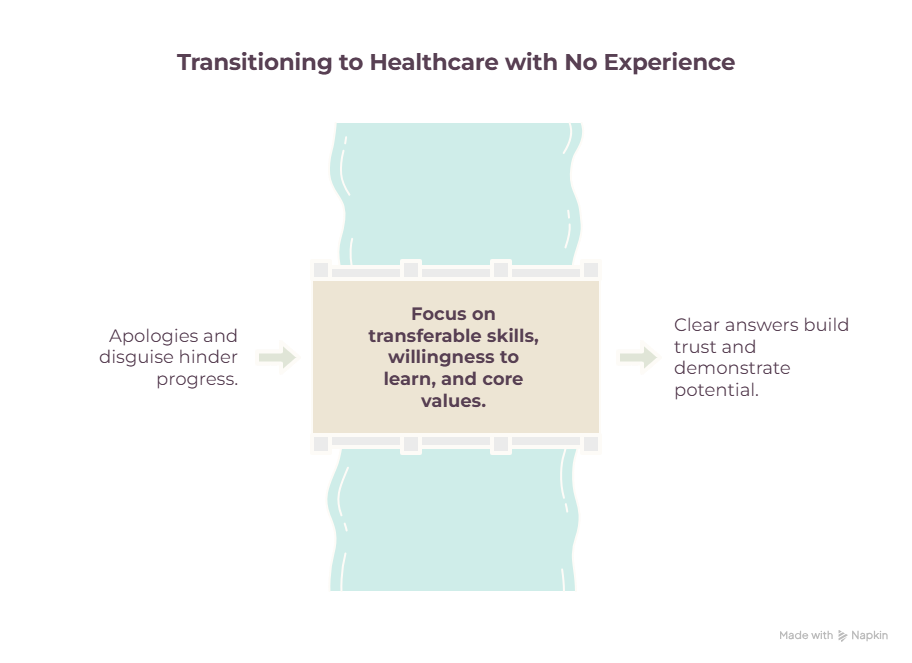
A lack of healthcare experience does not automatically rule you out of an HCA role. In fact, NHS England’s healthcare support worker guidance states that healthcare support worker roles do not have one universal set of entry requirements and places strong emphasis on personal skills and values. Individual employers can still set specific essential criteria for each vacancy, so always check the person specification carefully.
If you are new to care, your interview should show what you can already bring to the role and how willing you are to learn.
How Should You Answer When You Have No Healthcare Experience?
Do not apologise for your lack of experience or try to disguise it. A clear, confident answer works better.
Focus on:
- Why you want to enter healthcare
- Skills you have developed elsewhere
- Situations where you have supported or communicated with people
- Your willingness to learn
- Your understanding of dignity, safety and teamwork
- Times when you have stayed calm or acted responsibly
For example:
“I have not worked formally as a healthcare assistant yet, but my previous roles have taught me how to communicate with different people, remain patient under pressure and work responsibly within a team. I understand that healthcare requires compassion, reliability and a willingness to learn, and I am keen to develop those qualities further in this role.”
Never invent clinical experience. An interviewer can explore your answer further, and an exaggerated claim may undermine your credibility.
How Can You Use Transferable Skills From Work, Education or Volunteering?
Healthcare employers can value experience that comes from outside healthcare when it shows relevant behaviours.
| Previous experience | Transferable HCA skill |
|---|---|
| Retail or hospitality | Communication, patience and handling difficult situations |
| Childcare | Responsibility, observation and safeguarding awareness |
| Customer service | Listening, problem-solving and professionalism |
| Volunteering | Compassion, teamwork and community awareness |
| Education | Organisation, learning and meeting deadlines |
| Family responsibilities | Empathy and patience, where relevant |
NHS England specifically encourages candidates to think about examples from previous employment, volunteering and personal experience when preparing for healthcare support worker interviews.
The key lies in explaining the connection. Instead of saying, “I worked in retail”, explain how that work taught you to listen to upset customers, communicate calmly and ask a supervisor for support when you could not resolve an issue yourself.
Sample Healthcare Assistant Interview Answer for a Beginner
Question: Why should we consider you if you have no previous healthcare experience?
Sample answer:
“Previous roles have helped me develop strong communication, patience and teamwork skills, even though I am new to healthcare. Those experiences taught me to stay calm, listen carefully and support people who need clear information or reassurance. In an HCA role, I would protect dignity, follow instructions, raise concerns appropriately and continue developing my knowledge through feedback and training.”
Being new to healthcare does not mean you have nothing valuable to offer. A strong beginner answer should demonstrate transferable skills, self-awareness and a realistic understanding of the healthcare assistant role.
How to Prepare for a Healthcare Assistant Interview

Good preparation does not mean memorising dozens of healthcare assistant interview questions. It means understanding the vacancy well enough to connect your own experience with what the employer actually needs.
NHS Jobs interview guidance advises candidates to give clear, concise responses and support their answers with examples from their own experience.
Read the Job Description and Person Specification
Start with the vacancy itself.
Identify:
- Essential skills
- Required experience
- Main duties
- Employer values
- Working patterns
- Training requirements
- Behaviours the employer expects
The person specification tells you what the employer wants from the successful candidate, so use it as your interview preparation checklist. NHS Jobs confirms that person specifications set out the criteria applicants need to meet for individual vacancies.
If the person specification mentions communication, teamwork and dignity, prepare a real example for each one.
Research the Employer, NHS Trust or Care Organisation
Do not stop at the organisation’s homepage.
Look at its:
- Values
- Services
- Patient or service-user population
- Current priorities
- Location or department
- Approach to staff learning
If you apply to an NHS Trust, compare its local values with the wider NHS values discussed earlier.
Then prepare a simple answer to:
“Why do you want to work here?”
A specific answer will sound much stronger than: “Because it is a good organisation.”
Prepare Relevant Examples From Your Experience
Choose four or five examples that you can adapt to different questions.
Good examples might show:
Teamwork — you helped colleagues reach a shared goal.
Communication — you explained something clearly to someone who felt worried or confused.
Pressure — you organised competing priorities without losing focus.
Problem-solving — you noticed an issue and took appropriate action.
Compassion — you adapted your approach because somebody needed additional support.
One strong example can sometimes support several interview questions.
Practise Your Answers Without Memorising Them
Practise the idea, not every sentence.
If you memorise a complete script, an unexpected follow-up question can disrupt your flow. Instead, remember three or four key points and explain them naturally.
NHS Jobs recommends structuring answers around a small number of clear points and examples from your own experience.
Say your answers aloud before the interview. This helps you notice answers that sound too long, vague or unnatural.
Complete an Interview-Day Checklist
Before you leave, check:
- Interview time and location
- Travel route or video link
- Contact details
- Documents the employer requested
- Job description and person specification
- A few notes or questions for the panel
- Appropriate clothing
- Phone switched to silent
For an online interview, test your camera, microphone and internet connection in advance.
Most importantly, give yourself enough time. Rushing into the interview already stressed makes clear communication harder.
Healthcare Assistant Interview Tips and Mistakes to Avoid
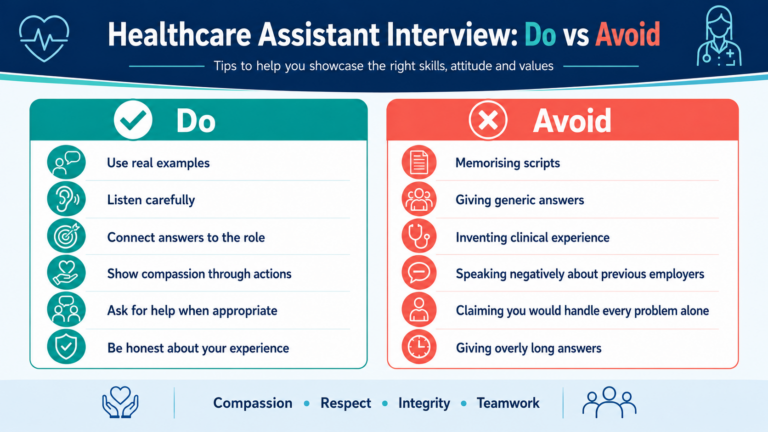
Preparation gets you to the interview; your communication during the interview shows the panel how you think.
You do not need flawless answers. Instead, aim for answers that feel specific, honest and relevant to the HCA role.
Keep Your Answers Specific and Relevant
Avoid giving five-minute answers when a focused one-minute response will do.
A useful pattern is:
Point → Example → Relevance to the HCA role
For example:
“I stay calm under pressure. In my previous customer-service role, I often managed several requests at once. I learned to identify the most urgent issue, communicate clearly and ask colleagues for support when necessary. I would use the same organised approach in healthcare while prioritising patient safety.”
NHS Jobs advises candidates to communicate clearly and concisely rather than assuming the panel already knows the details of their previous experience.
Show Compassion Without Giving Generic Answers
“I’m caring” tells the interviewer very little.
Show what caring behaviour looks like.
Instead of:
“I always treat patients with compassion.”
Try:
“I would listen without interrupting, acknowledge how the person feels and adapt my communication so they understand what is happening.”
Concrete behaviour makes your answer more credible.
Be Honest About Your Experience and Skills
Never claim that you can perform a clinical task simply because you think the panel wants to hear it.
A safer answer is:
“I would only carry out a task if I had the appropriate training, competence and authorisation. If I felt unsure, I would ask the appropriate colleague for guidance.”
This shows judgement rather than weakness.
Know When to Ask for Help or Escalate a Concern
Interviewers do not expect HCAs to solve every situation alone.
Show that you can recognise when a situation needs additional support.
You might escalate when:
- Someone’s condition changes
- You suspect abuse or neglect
- A task falls outside your competence
- A patient faces immediate risk
- You notice an error
- You cannot resolve a serious concern
The ability to speak up supports safer care. Skills for Care’s Code of Conduct sets expectations around the conduct, behaviour and attitudes of healthcare support workers and adult social care workers in England.
Listen Carefully and Answer the Question Being Asked
Do not start preparing your next answer while the interviewer still speaks.
Listen for words such as:
“Tell me about a time…” → give a real example.
“What would you do if…” → explain your approach.
“What does this mean to you?” → define it, then connect it to behaviour.
If you do not understand a question, ask the interviewer to repeat or clarify it. That approach works better than guessing what they meant.
Questions to Ask at the End of a Healthcare Assistant Interview
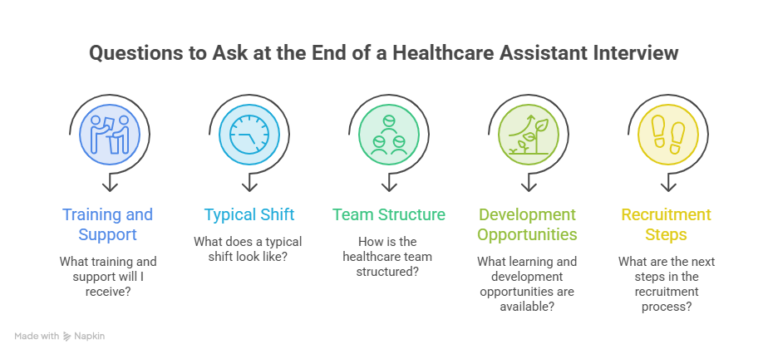
When the interviewer asks, “Do you have any questions for us?”, use the opportunity to understand the role rather than asking something only for the sake of speaking.
Choose two or three questions that matter to you. You do not need to ask everything below.
What Training and Support Will I Receive?
This works particularly well for people entering healthcare.
You could ask:
“What induction, training and support do new healthcare assistants receive when they start?”
The answer can help you understand how the employer supports new staff and develops competence.
What Does a Typical Shift Look Like?
Job descriptions list responsibilities, but this question helps you understand how those responsibilities work in practice.
You might ask:
“Could you tell me what a typical shift looks like for an HCA in this team?”
Listen for information about workload, teamwork, shift patterns and the patient group.
How Is the Healthcare Team Structured?
An HCA rarely works in isolation.
Ask:
“Who would I work most closely with in this role, and who would I normally report concerns to?”
This question can help you understand supervision and team relationships.
What Learning and Development Opportunities Are Available?
Ask about development rather than immediately asking about promotion.
For example:
“What opportunities would I have to develop my knowledge and skills once I settle into the role?”
This shows interest in learning while keeping your focus on performing the current job well.
What Are the Next Steps in the Recruitment Process?
This makes a useful final question:
“Could you explain the next steps in the recruitment process and when candidates are likely to receive an update?”
That gives you practical information without forcing you to guess when the employer will make a decision.
Final Takeaway: Prepare Your Experiences, Not a Script
Strong healthcare assistant interview questions and sample answers can help you prepare, but your own examples will make the biggest difference.
Understand the role. Learn the employer’s values. Prepare examples that demonstrate communication, teamwork, compassion and responsible judgement. Most importantly, explain what you did, learned or would do rather than trying to reproduce a model answer word for word.
An HCA interview does not require you to know everything. It gives you the chance to show that you can listen, learn, work safely with others and treat people with dignity and respect.
Prepare the experiences behind your answers, and you will have something far more useful than a memorised script.
Frequently Asked Questions
What Should I Wear to a Healthcare Assistant Interview?
Choose clean, smart and professional clothing that allows you to feel comfortable and confident.
You usually do not need an elaborate formal outfit. Aim for a neat appearance and avoid anything that could distract you during the interview.
If the employer invites you to an assessment that involves practical or simulation activities, check the invitation for specific clothing instructions. Current NHS recruitment processes can vary, and some healthcare support worker recruitment events include scenario or simulation assessments alongside interviews.
How Long Does a Healthcare Assistant Interview Usually Last?
No single duration applies to every HCA interview.
Employers choose different recruitment formats depending on the role. Some use a panel interview, while others add scenarios, assessments or simulation exercises. Current NHS Jobs adverts demonstrate this variation across healthcare support worker recruitment.
Check your interview invitation for timing information and allow extra time so you do not need to rush.
Do I Need the Care Certificate Before Applying for an HCA Role?
Not necessarily.
NHS England states that healthcare support worker roles do not have one universal set of entry requirements. Meanwhile, Skills for Care explains that employers can use the 2025 Care Certificate standards with people who are new to care and as part of induction.
An individual vacancy may still ask for particular qualifications, experience or training. Therefore, always check the job description rather than assuming every HCA post follows the same requirements.
How Many Questions Might I Be Asked in an HCA Interview?
Employers do not follow one universal number of questions.
The interview format can depend on the organisation, role, band and recruitment process. Some employers may also include scenario exercises or other assessments.
Prepare for the topics, rather than trying to predict an exact number. Motivation, teamwork, communication, values and scenario-based judgement deserve particular attention.
Can I Take Notes Into a Healthcare Assistant Interview?
Ask the employer if you feel unsure about its interview rules.
Short prompts can help you remember questions you want to ask or examples you prepared, but avoid reading complete answers from a page. Maintain eye contact and engage with the panel.
NHS Jobs’ interview advice encourages candidates to engage with the whole interview panel and give clear, concise responses.
What Questions Are Asked in a Healthcare Assistant Interview?
Healthcare assistant interviews often include questions about your motivation, communication, teamwork, patient dignity, safeguarding, confidentiality and ability to handle challenging situations. NHS employers may also ask about NHS values and scenario-based situations. You might need to explain what you would do if a patient refused care, became distressed or showed a change in their condition.
How Do I Introduce Myself in a Healthcare Assistant Interview?
Start with a short introduction that focuses on your experience, relevant strengths and motivation for the role. Mention qualities such as communication, compassion, reliability or teamwork and connect them to healthcare. Keep your answer professional and concise rather than describing your whole personal history. If you are new to healthcare, highlight transferable skills and your willingness to learn.
What Should I Bring to a Healthcare Assistant Interview?
Follow your interview invitation first because requirements vary.
A useful checklist includes:
- Interview confirmation
- Any identification the employer specifically requests
- Qualification evidence if requested
- Job description and person specification
- A pen
- A short list of questions for the interviewer
- Any documents named in your invitation
Do not assume every employer wants the same documents. Check before travelling if the invitation leaves anything unclear.
How Soon Might I Hear Back After an NHS Healthcare Assistant Interview?
NHS employers do not use one universal response time.
The panel may need to complete all scheduled interviews before making a decision, and different recruitment processes take different amounts of time. NHS Jobs lets candidates manage their applications online, while individual employers remain responsible for vacancy-specific recruitment decisions and communications.
Before you leave, ask when the employer expects to contact candidates. If that date passes without an update, follow the contact instructions provided by the employer.