

A palliative care course can help care workers build the knowledge needed to support people living with serious or life-limiting conditions with greater sensitivity, dignity and understanding. Imagine supporting a resident whose health has started to decline while their family struggles with uncertainty about what comes next. Knowing how to communicate, recognise changing needs and respect the person’s wishes can make those difficult moments easier to manage.
Put simply, palliative care training introduces the principles behind compassionate, person-centred support. Depending on the course, learning may cover palliative and end-of-life care, holistic assessment, communication, advance care planning, comfort and symptom awareness, bereavement, legal responsibilities and multidisciplinary working. UK government guidance describes palliative care as an approach that aims to improve quality of life while addressing physical, psychological, social and spiritual concerns.
However, choosing a course involves more than scanning a list of modules. You also need to understand what a CPD certificate in palliative care represents, how palliative care differs from end-of-life care and whether the training matches your learning or career goals. This guide explains those points clearly before looking at who can benefit from training, how online courses work and how to compare different learning routes.
What Is a Palliative Care Course?
A palliative care course is structured training that develops knowledge of how health and social care services support people with serious, progressive or life-limiting conditions. It can help learners understand comfort, dignity, communication, individual wishes, family needs and the responsibilities of different people involved in care.
The exact depth varies. A short CPD palliative care course may focus on awareness and professional learning, while broader health and social care programmes may cover palliative care alongside safeguarding, communication, care planning and other subjects.
Most importantly, completing a course does not automatically authorise someone to carry out clinical tasks. Workers must still follow their job description, employer policies, training, assessed competence and professional boundaries.
What Does Palliative Care Mean?
Palliative care focuses on helping a person live as well and comfortably as possible while they experience a serious or life-limiting illness. It looks beyond a diagnosis and considers the whole person.
That can involve attention to:
Physical comfort and symptoms
Emotional wellbeing
Psychological needs
Social circumstances
Cultural preferences
Spiritual needs
Communication and choice
Support for family members and carers
UK government information describes palliative care as an approach that can address physical, psychosocial and spiritual problems while aiming to improve quality of life for both individuals and their families.
For a care worker, this means good support involves more than completing routine tasks. Listening carefully, noticing changes, protecting dignity and reporting concerns appropriately may all form part of the wider care process.
Palliative Care vs End-of-Life Care
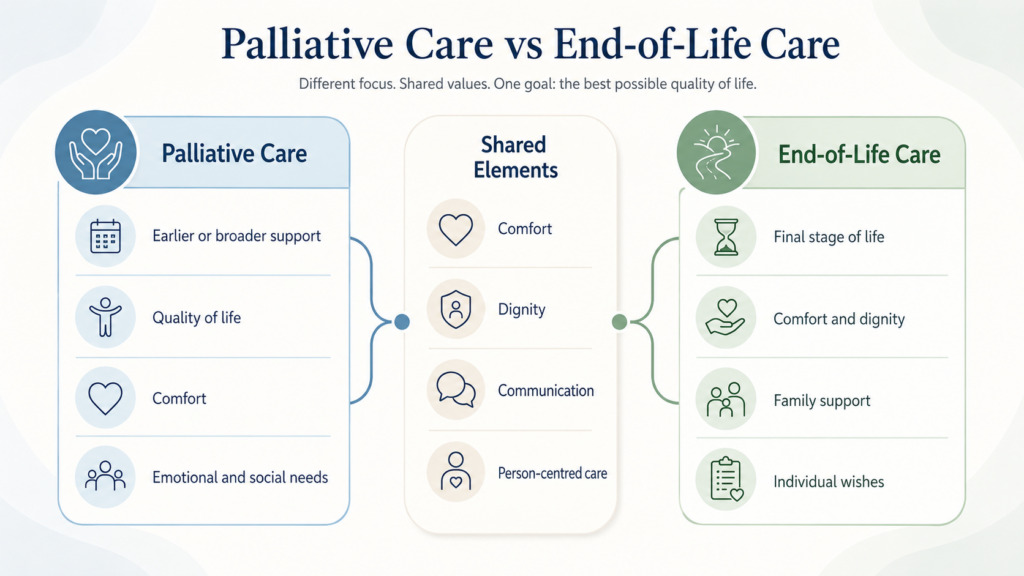
Palliative care and end-of-life care overlap, but they do not mean exactly the same thing.
Palliative care can begin earlier during a life-limiting illness and may continue alongside other treatment or support. End-of-life care focuses more specifically on the period when someone approaches the end of their life. In England, government information commonly uses the term end-of-life care for care during the final year of life.
This distinction matters because people sometimes assume that receiving palliative care means death is immediately approaching. That is not necessarily the case.
Both approaches can prioritise:
Comfort
Dignity
Individual preferences
Communication
Emotional support
Family involvement
Coordinated care
Understanding the difference also helps learners use the terms more accurately when communicating with colleagues, individuals and families.
What Does a Palliative Care Course Include?
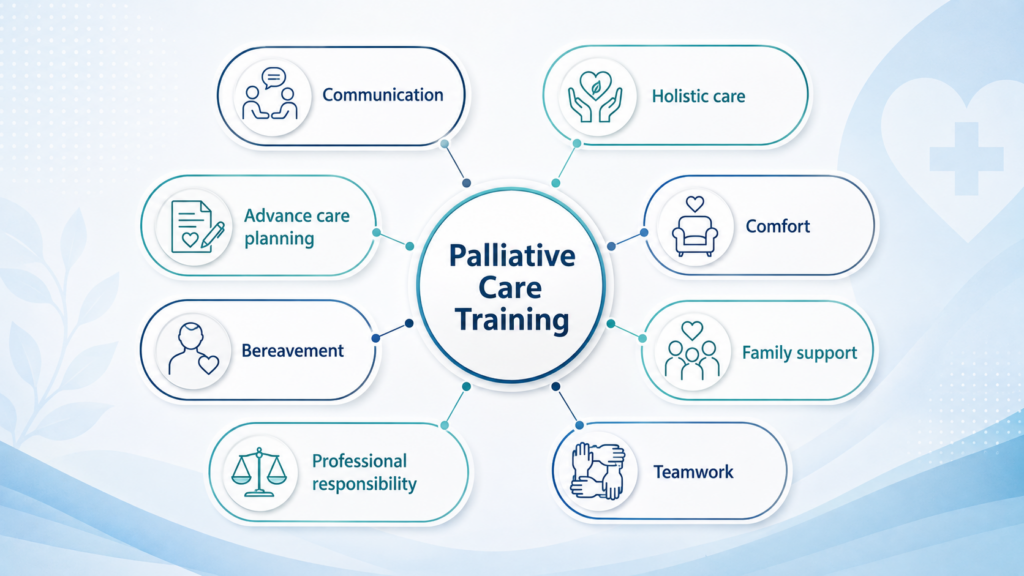
A good palliative care course online should explain not only what palliative care means but how its main principles connect. Course content varies by provider, level and purpose, so learners should always check the curriculum before enrolling.
Common learning areas include the following.
Understanding Palliative and End-of-Life Care
Training usually starts with the principles and purpose of palliative care. Learners may explore how needs change during serious illness, how palliative support can differ from end-of-life care and why care should reflect the individual’s priorities rather than follow a one-size-fits-all approach.
This foundation makes later subjects such as advance care planning and bereavement easier to understand.
Holistic Assessment and Individual Needs
Palliative care looks at the person as a whole.
Therefore, training may introduce learners to different areas that can affect wellbeing, including physical discomfort, emotional distress, social relationships, communication needs, cultural background and spiritual concerns.
The aim is not to turn care workers into clinicians. Instead, awareness helps them recognise that someone’s needs may extend beyond what is immediately visible and that concerns may require appropriate reporting or referral.
Communication With Individuals and Families
Communication can become particularly sensitive when people face uncertainty, deterioration or loss.
A palliative care course may therefore explore:
Active listening
Compassionate communication
Respecting personal choices
Responding to difficult conversations
Communicating with relatives and carers
Sharing information within professional boundaries
Knowing when to involve another professional
Sometimes the most helpful response is not having an immediate answer. It is listening carefully, acknowledging the person’s concerns and knowing when to seek appropriate support.
Advance Care Planning
Advance care planning helps people discuss and record wishes and priorities for future care.
Learning may introduce the purpose of these conversations and the importance of involving the individual wherever possible. UK government policy continues to emphasise better access to advance care planning and coordinated multidisciplinary support within palliative and end-of-life services.
For care workers, the important point is role awareness. They may need to understand a person’s recorded preferences and communicate relevant observations, while decisions about treatment remain with the appropriate person or professional.
Comfort, Symptoms and Quality of Life
People receiving palliative care may experience pain, breathlessness, fatigue, nausea, anxiety or other forms of discomfort.
Training can help learners understand why comfort and quality of life matter and why changes should receive appropriate attention.
However, awareness training does not qualify someone to diagnose symptoms, change medicines or perform tasks beyond their competence. Care workers should follow the person’s care plan and report concerns through the correct channels.
Care at the End of Life and Care After Death
When someone approaches the end of life, dignity remains central.
Course content may introduce changes that can occur as a person’s condition deteriorates, sensitive communication, privacy, comfort, individual wishes and appropriate responsibilities around care after death.
The person’s values, culture, beliefs and preferences can also influence how they and their family wish to approach this stage.
Bereavement and Emotional Support
Palliative care can affect relatives, friends, carers and staff as well as the person receiving support.
For this reason, some courses cover grief, loss and bereavement. Learners can develop awareness of different responses to loss and understand the importance of compassionate communication without assuming that everyone grieves in the same way.
They should also recognise when someone may need support beyond their own role.
Legal, Ethical and Professional Responsibilities
Care workers need clear boundaries, especially when decisions involve consent, confidentiality, mental capacity, care preferences or treatment.
A palliative care course may introduce these issues so learners can understand why following care plans, organisational procedures and appropriate escalation routes matters.
Training should build awareness rather than encourage workers to make decisions outside their responsibilities.
Working With the Wider Care Team
Palliative care often involves several people rather than one professional working alone.
Depending on the individual’s needs, support may involve care workers, healthcare assistants, nurses, doctors, social care professionals, specialist palliative care teams, hospices and family members.
Good communication helps these people work towards the same priorities. Recent UK government discussion of palliative and end-of-life care has also highlighted multidisciplinary working and better continuity of care.
Develop Your Palliative and End-of-Life Care Knowledge
If these learning areas relate to your current role or professional goals, the Palliative & End-of-Life Care Training from HF Online provides structured online learning covering palliative care principles, different care settings, professional responsibilities, governance and wider approaches to end-of-life services.
Use the course curriculum and learning outcomes to decide whether its coverage matches the knowledge you want to develop.
What Does a CPD Certificate in Palliative Care Mean?
A CPD certificate in palliative care provides evidence that you completed a particular programme of continuing professional development. It can help you record your learning, demonstrate ongoing development and show that you have spent time building knowledge in a relevant care topic.
However, the words certificate, CPD and qualification do not automatically mean the same thing. Understanding this distinction can prevent confusion when comparing palliative care training online.
What Is CPD?
CPD stands for Continuing Professional Development.
It describes ongoing learning that helps people develop or refresh knowledge and skills connected with their work or professional development.
CPD can take different forms, including:
Online courses
Workshops
Formal training
Professional reading
Conferences
Reflective learning
Employer-led development
Government guidance for social work employers, for example, recognises CPD as an important way for practitioners to maintain and develop their knowledge and professional practice.
However, CPD requirements differ between professions. Learners should therefore check any requirements set by their employer, regulator or professional body.
What Does a CPD Certificate Show?
A CPD certificate can show that you completed the learning and assessment requirements specified by the particular training provider.
You may use it as evidence within:
A CPD record
A professional development portfolio
An appraisal discussion
Training records
A CV or job application, where relevant
However, employers decide what training they require for a specific position. A certificate should never replace workplace competency checks or role-specific requirements when these apply.
Is a CPD Certificate the Same as a Regulated Qualification?
No. A CPD certificate should not automatically be treated as a regulated qualification.
In England and Northern Ireland, learners can use the official Register of Regulated Qualifications to check whether a qualification has formal regulated status. The register allows users to verify recognised qualifications and compare their details.
This distinction matters when comparing palliative care qualifications UK searches with CPD courses.
A CPD course may support:
Professional learning
Knowledge development
Refresher training
Awareness of a specialist subject
Evidence of ongoing development
A regulated qualification follows a separate formal framework and has defined requirements set through an awarding organisation and regulator.
Therefore, always check what a course actually provides rather than relying on words such as certificate, diploma or level in a title.
Can You Put a Palliative Care CPD Certificate on Your CV?
Yes, you can usually list relevant completed CPD training on your CV, particularly when it relates closely to the role you want.
For example, someone applying for a healthcare assistant or care-support position could include relevant palliative care training under headings such as Professional Development, Training or Additional Learning.
Keep the wording accurate. State the course title, provider and completion details without presenting CPD training as a regulated qualification if it is not one.
Most importantly, a certificate works best when you can explain what you learned. During an interview, an employer may care more about how you understand dignity, communication, boundaries and person-centred support than the certificate title alone.
Understanding what a palliative care course covers and what its CPD certificate represents gives you a clearer basis for comparing training. The next question is how this knowledge can support care workers in real situations, who can benefit most from the training and which learning route makes sense for different professional goals.

Why Does Palliative Care Training Matter for Care Workers?
Palliative care training matters because care workers may support people whose physical, emotional and communication needs change significantly during serious illness. Understanding dignity, person-centred support, professional boundaries and appropriate escalation can help staff respond more thoughtfully while staying within their role.
Even when a care worker does not provide clinical treatment, their day-to-day contact with an individual can place them in a valuable position to notice changes, listen to concerns and communicate relevant information to the wider care team.
Supporting Dignity and Person-Centred Care
Dignity remains important at every stage of care.
For someone receiving palliative or end-of-life support, this can mean respecting how they want to be addressed, protecting their privacy, involving them in everyday choices and recognising personal preferences around food, clothing, visitors, culture or spiritual beliefs.
A palliative care course can help learners understand why the person’s wishes should remain central whenever possible.
Person-centred care also means avoiding assumptions. Two people with similar conditions may have very different priorities, fears and preferences.
Communicating During Sensitive Situations
Conversations about declining health, discomfort, uncertainty or death can be difficult for individuals, relatives and staff.
Training can help care workers understand the value of:
Listening without interrupting
Using clear and respectful language
Allowing people time to respond
Avoiding promises they cannot keep
Recognising emotional cues
Knowing when another professional should become involved
For example, a resident may ask a care assistant whether they are dying. The worker should not invent an answer or make a clinical judgement. Instead, they can listen compassionately, acknowledge the concern and follow the appropriate process for involving a suitable member of the care team.
This combination of empathy and professional boundaries is an important part of good care.
Recognising and Reporting Concerns
Care workers often spend significant time with the people they support. As a result, they may notice changes that others do not see immediately.
These might include:
Changes in appetite
New discomfort
Increased confusion
Difficulty communicating
Changes in breathing
Greater tiredness
Emotional distress
Changes in mobility
New anxiety or withdrawal
Recognising a change does not mean diagnosing its cause.
Instead, the care worker should observe carefully, record information where required and report concerns through the correct organisational or clinical route.
A good palliative care training course should make this distinction clear. Knowledge supports awareness, but it does not replace clinical assessment.
Supporting Families and Those Close to the Person
Palliative care can affect an entire family.
Relatives may feel frightened, tired, uncertain or overwhelmed. Some may have questions about what is happening, while others may struggle simply to process the situation.
Care workers can support families by communicating respectfully, listening within appropriate boundaries and directing questions to the correct professional when necessary.
They should also remember that families can have different beliefs, expectations and ways of coping.
Compassionate support does not mean taking responsibility for every problem. Sometimes the most appropriate action is to recognise when specialist, clinical, spiritual or bereavement support may be needed.
Understanding Professional Boundaries
Knowing what not to do can be just as important as knowing how to help.
Palliative care may involve complex decisions about medicines, treatment, mental capacity, consent, nutrition, resuscitation or future care preferences. Care workers should understand which decisions sit within their own responsibilities and which require another professional.
A CPD course can strengthen awareness of these boundaries, but employers still need to determine what an individual worker is trained, authorised and competent to do.
This protects both the person receiving care and the worker supporting them.
Working With the Wider Care Team
Palliative care frequently depends on coordinated support.
A person’s care may involve:
Care assistants
Healthcare assistants
Registered nurses
GPs
Specialist palliative care professionals
Hospice teams
Social care professionals
Pharmacists
Family members
Other relevant services
No single worker sees every part of the person’s experience.
Therefore, clear communication and accurate reporting help the team understand changing needs and respond consistently.
This is one reason palliative care training for care workers can be valuable even when their role is not clinical. They need enough knowledge to understand the wider care process and contribute appropriately.

Who Should Take a Palliative Care Course?
A palliative care course can suit both new and experienced health and social care learners who want to understand how to support people living with serious or life-limiting conditions.
However, the right course depends on why you are studying.
Someone looking for introductory CPD learning may need a different programme from someone seeking broader health and social care knowledge or role-focused career preparation.
Healthcare Assistants
Healthcare assistants may work with people whose conditions change over time.
Palliative care learning can help them understand dignity, communication, comfort, changing needs and the importance of following care plans and clinical direction.
Care Assistants
Care assistants working in residential or nursing settings may support people receiving palliative or end-of-life care as part of their everyday duties.
Relevant learning can help them understand how person-centred care, observation, communication and family support connect during these situations.
Support Workers
Support workers may assist people living with long-term illness, disability or complex support needs.
A CPD palliative care course can broaden their understanding of what palliative care involves and when specialist or clinical support may become relevant.
Care Home Staff
People working in care homes may encounter residents whose conditions gradually deteriorate.
Training can help staff understand sensitive communication, dignity, comfort, family involvement and the importance of reporting changes.
Domiciliary Care Workers
Home care workers can support people who wish to remain in familiar surroundings while receiving care.
This means they may need to understand how to respect personal wishes, observe changes, communicate with relatives and follow agreed care arrangements.
Hospice Support Staff
Hospice environments often involve specialist palliative and end-of-life services.
Support staff who are not clinically qualified can still benefit from understanding the principles, language and expectations surrounding compassionate care.
Existing Health and Social Care Workers
Experienced workers may use palliative care training as CPD to refresh or broaden existing knowledge.
For example, someone moving into a different care setting may want to improve their understanding of:
Advance care planning
Bereavement
Communication
Holistic needs
Professional responsibilities
Working with specialist teams
People Considering a Career in Care
Some learners take a palliative care course online before applying for care-sector roles because they want to understand the subject and decide whether this type of work interests them.
A course can support that exploration, but learners should still check the actual qualifications, experience and competency requirements for any role they want to pursue.
Is Palliative Care Training Suitable for Beginners?
Yes, some palliative care courses are suitable for beginners, but learners should check the stated entry requirements and course level before enrolling.
A beginner-friendly course may introduce:
Core palliative care principles
Person-centred support
Communication
Dignity
Professional responsibilities
End-of-life awareness
Beginners should be cautious about course titles that appear to promise professional status or clinical competence without explaining the actual learning outcome.
A good course description should tell you clearly what you will learn and what the certificate represents.
Is Palliative Care Training Useful for Existing Care Workers?
Yes. Existing care workers can use palliative care training to update, reinforce or extend relevant knowledge.
Even experienced staff may benefit from revisiting subjects such as communication, changing care needs, professional boundaries and bereavement.
However, CPD should complement workplace training and employer requirements rather than replace them.
How Does an Online Palliative Care Course Work?
An online palliative care course usually allows learners to study digital lessons or modules remotely, complete assessments and receive a certificate after meeting the provider’s completion requirements.
The exact format varies between providers, so learners should compare course access, assessment, support and certification before paying.
Online and Self-Paced Learning
Many online palliative care courses in the UK use self-paced study.
This means learners can usually access course materials from a laptop, tablet or other compatible device and work through the content around existing commitments.
This format may appeal to:
Full-time care workers
Shift workers
Parents and carers
Career changers
People studying alongside another course
Self-paced does not necessarily mean unlimited access, though. Always check how long your enrolment remains active.
Course Modules and Learning Materials
Online training can include:
Written lessons
Digital learning modules
Knowledge checks
Case-based examples
Downloadable resources
Quizzes
Assessments
Some courses may also include video, audio or tutor support.
The quality of the curriculum matters more than the number of modules. Ten short modules do not automatically provide better learning than six well-developed ones.
Look at whether the topics match what you actually want to understand.
Assessment and Course Completion
Assessment methods vary.
A course may use:
Multiple-choice questions
Online quizzes
End-of-module assessments
Written assignments
Knowledge checks
Some short CPD courses use relatively simple online assessments, while larger programmes may require more detailed work.
Before enrolling, check:
What the assessment involves
Whether there is a pass mark
Whether reassessment is available
Whether the certificate depends on passing
Whether additional certificate fees apply
These details can affect both cost and learner experience.
Receiving Your CPD Certificate
After completing an eligible course and meeting its requirements, the provider may issue a digital or printed certificate.
Check the course page carefully for:
Certificate format
Additional fees
Delivery options
Provider name
Accreditation or CPD claims
How long access remains available
Remember that a palliative care certificate proves whatever the specific provider states it proves. The certificate title alone does not determine whether it is a regulated qualification.
How Long Does a Palliative Care Course Take?
There is no single standard duration for a palliative care course.
A short awareness or CPD programme may take only a few hours, while a larger course can require substantially more study.
Duration often depends on:
Number of modules
Depth of content
Assessment requirements
Whether study is self-paced
Course level
Whether the programme covers palliative care alone or broader health and social care topics
Rather than choosing the shortest option automatically, compare the curriculum against your purpose.
If you need basic awareness, a concise course may be enough. If you want broader professional learning, a more detailed programme may be more appropriate.
How Are Online Palliative Care Courses Assessed?
Most online courses use some form of digital assessment, but the format varies by provider.
A learner may need to complete quizzes after each module or pass a final assessment before receiving their certificate.
Others may include assignments or longer written tasks.
Assessment is worth checking before enrolment because it tells you something about the depth of the programme. It also prevents surprises if you expected a quick quiz but discover that the course requires more substantial written work.
Palliative Care Course vs Palliative Care Worker Course: Which One Do You Need?
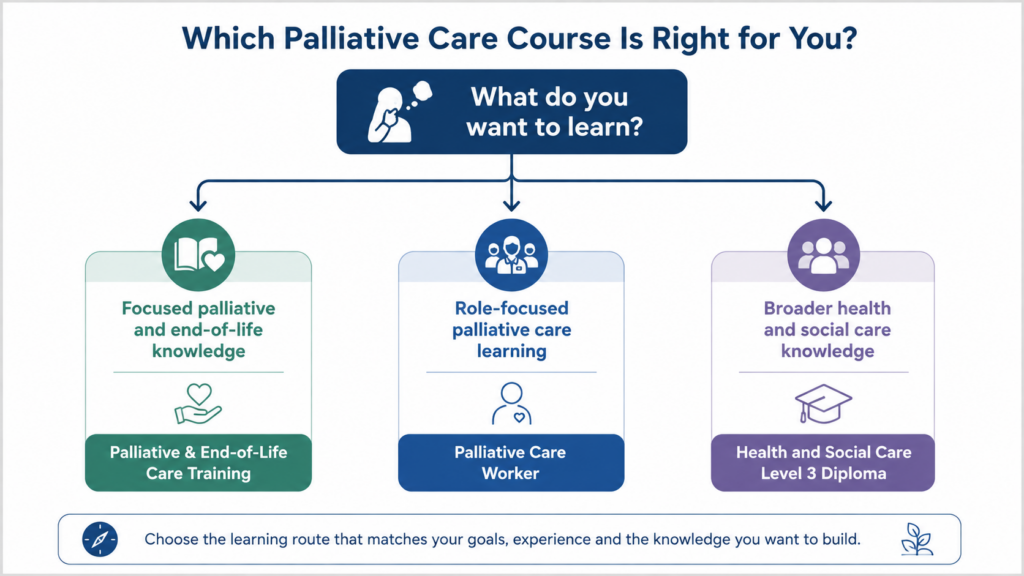
Choose a palliative care course based on the outcome you actually want, not simply the course title.
Some learners want focused awareness of palliative and end-of-life care. Others want learning centred on the palliative care worker role. Another group may need broader health and social care knowledge that covers much more than one specialist subject.
Matching the course to the goal can prevent wasted time and money.
I Want to Understand Palliative and End-of-Life Care
If your main goal is to understand the principles behind palliative and end-of-life care, a focused course may be the most relevant starting point.
This type of programme may cover:
Palliative care principles
Different care settings
Communication
End-of-life needs
Professional responsibilities
Service coordination
Quality and governance
HF Online’s Palliative & End-of-Life Care Training is designed around this focused learning route.
This may suit learners who already work in health or social care as well as people looking to broaden their understanding of this specialist area.
I Want Learning Focused on the Palliative Care Worker Role
Some learners are less interested in a general overview and want training organised around the knowledge associated with working in palliative care environments.
In that case, a role-focused course can make more sense.
The Palliative Care Worker course from HF Online focuses on areas such as stages of illness, holistic assessment, advance care planning, end-of-life support, care after death and professional responsibilities.
This type of learning can help learners explore what the role involves and understand the principles that may be relevant in palliative care settings.
However, completing an online course does not automatically make someone occupationally competent or qualified for every palliative care worker position. Employers may require additional qualifications, experience, workplace training or competency assessment.
I Want Broader Health and Social Care Knowledge
Palliative care is only one part of the health and social care sector.
If your goal is to build broader knowledge across care practice, communication, safeguarding and other core areas, a wider programme may suit you better.
HF Online’s Health and Social Care Level 3 Diploma provides a broader learning route rather than focusing solely on palliative care.
This may be more relevant for learners who want to develop knowledge across several areas of health and social care before deciding whether to specialise further.
How to Choose Between the Three Routes
Ask yourself three questions.
Do I mainly want to understand palliative and end-of-life care?
Choose focused palliative and end-of-life training.
Do I specifically want to explore the palliative care worker role?
Consider a role-focused palliative care worker course.
Do I need broader knowledge across health and social care?
A wider health and social care programme may fit better.
There is no universally “best” course.
The best option is the one whose curriculum, certificate type, learning depth and intended outcome match what you genuinely need.
Once you have identified the right learning route, the next step is to consider how palliative care knowledge connects with employment, what qualifications different care roles may require and what to check before choosing a provider. Part 3 will also compare the available HF Online pathways in more detail, provide a practical palliative care learning checklist and answer the most common questions learners ask before enrolling.
Can a Palliative Care Course Help With a Career in Care?
A palliative care course can support career development by helping you build relevant knowledge, but a CPD certificate does not automatically qualify you for a particular care role. Employers may also consider experience, regulated qualifications, workplace training, competency assessments and role-specific requirements.
For someone already working in care, palliative care training can strengthen understanding of areas such as communication, dignity, holistic support, advance care planning and professional boundaries. For a career changer, it can also provide useful insight into what supporting people with life-limiting conditions may involve.
The key is to treat CPD learning as part of your professional development rather than as a guaranteed route into employment.
What Does a Palliative Care Assistant Do?
A palliative care assistant or healthcare support worker may help people with serious or life-limiting conditions while working under agreed care plans and appropriate professional supervision.
Depending on the setting and employer, responsibilities may include:
Supporting personal care and comfort
Helping with eating and drinking where appropriate
Listening and communicating sensitively
Supporting dignity and individual preferences
Observing and reporting changes
Providing emotional reassurance
Supporting relatives within professional boundaries
Keeping relevant care records
Working alongside nurses and other professionals
The exact responsibilities vary between workplaces.
Someone working in a care home may have a different role from a person supporting patients in a hospice, hospital or community setting.
Therefore, learning about palliative care can improve your understanding of the environment, but you should always check the requirements of the specific job you want.
What Qualifications Do You Need to Work in Palliative Care?
There is no single qualification required for every palliative care role.
Requirements depend on the job.
A care assistant, support worker, registered nurse, doctor and specialist palliative care professional all follow different education, training and competency pathways.
Employers may look for a combination of:
Relevant care experience
Health and social care learning
Employer-provided training
Safeguarding knowledge
Communication skills
Care Certificate learning where applicable
Role-specific competence
Relevant regulated qualifications for particular positions
Before enrolling in any programme, check current job descriptions for the role you are considering and compare their requirements with what the course actually provides.
This is particularly important when searching for palliative care qualifications in the UK, because a CPD course and a regulated qualification serve different purposes.
Can a CPD Course Make You a Palliative Care Nurse?
No. Completing a CPD palliative care course does not make you a registered nurse.
Nursing is a regulated profession in the UK, and people must complete an approved nursing education route and meet the relevant registration requirements.
However, someone already working as a nurse may complete palliative care CPD as part of ongoing professional learning.
Likewise, healthcare assistants and care workers may use relevant training to broaden their understanding without presenting themselves as nurses or specialist clinicians.
Clear distinctions like this matter when comparing course providers. Good training should explain what learning can support without promising a professional status that the course itself cannot provide.
What Should You Look for Before Choosing a Palliative Care Course?
Before choosing a palliative care course, compare the curriculum, certificate type, assessment, provider information and intended learning outcome. A course that suits one learner may be completely unsuitable for another.
Price matters, but it should not be the only factor.
Check the Course Content
Start with the curriculum.
A useful programme may cover topics such as:
Palliative and end-of-life care principles
Person-centred support
Communication
Holistic needs
Advance care planning
Comfort and symptom awareness
Bereavement
Family support
Professional responsibilities
Legal and ethical considerations
Look beyond the number of modules.
The real question is whether those modules answer what you need to learn.
Check the Learning Outcomes
Good learning outcomes should explain what you are expected to understand by the end of the programme.
Be cautious of vague statements such as:
“Become an expert.”
“Get qualified instantly.”
“Guaranteed job.”
Instead, look for realistic outcomes based around knowledge, understanding and professional awareness.
Check What the Certificate Actually Represents
The phrase palliative care certificate can refer to different types of learning.
Check whether the programme provides:
A CPD certificate
A provider-issued certificate
A regulated qualification
An accredited programme
A completion certificate
Do not assume these terms are interchangeable.
If a course is advertised as CPD, it should be presented as continuing professional development rather than automatically as a regulated occupational qualification.
Check the Assessment Method
Find out how your learning will be assessed.
Questions worth asking include:
Will I complete quizzes?
Is there a final assessment?
Are written assignments required?
What is the pass mark?
Can I retake an assessment?
Is the certificate included?
Knowing this beforehand can help you choose a course that matches your preferred way of learning.
Check Course Access and Flexibility
Online study can be useful for people working shifts or managing other commitments.
However, providers can differ significantly.
Check:
How long you can access the course
Whether you can study at your own pace
Which devices you can use
Whether tutor support is available
Whether learning materials remain accessible after completion
A flexible course is only useful if its access conditions fit your schedule.
Check the Provider
Before paying, review who provides the course and whether the website clearly explains:
Course objectives
Curriculum
Assessment
Certification
Pricing
Contact information
Refund or cancellation terms
Accreditation claims
Transparent information makes it easier to make an informed decision.
Check Employer Requirements
If you are taking training for a current or future job, ask your employer what they require.
An employer may have its own:
Mandatory training
Workplace competency checks
Approved providers
Induction requirements
Professional standards
A CPD certificate can support learning, but it should not be assumed to replace employer-specific requirements.
Questions to Ask Before Enrolling
Before choosing any online palliative care course, ask:
What exactly will I learn?
Who is the course designed for?
Is it beginner-friendly?
What type of certificate will I receive?
Is the programme CPD or a regulated qualification?
How will I be assessed?
How long will I have access?
Are there additional certificate fees?
Does this course match my career goal?
Would my employer require anything else?
If a provider cannot answer these questions clearly, consider comparing other options.
Which HF Online Palliative Care Learning Route Is Right for You?
HF Online offers several learning routes connected with palliative care and health and social care. The most suitable option depends on whether you want focused subject knowledge, role-focused learning, broader care-sector development or additional career guidance.
For Focused Palliative and End-of-Life Care Learning
The Palliative & End-of-Life Care Training may suit learners who primarily want to develop their understanding of palliative and end-of-life care.
It can be relevant if your goal is to explore areas such as:
Palliative care principles
End-of-life support
Different care environments
Professional responsibilities
Service delivery
Quality and governance
This is the most directly aligned learning route for readers who came to this guide searching for a palliative care course with CPD certificate.
For Role-Focused Palliative Care Learning
The Palliative Care Worker course takes a more role-focused approach.
It may suit learners who want to explore subjects connected with supporting people through different stages of serious illness.
Learning areas include topics such as:
Stages of illness
Holistic assessment
Advance care planning
End-of-life support
Care after death
Legal considerations
Professional responsibilities
This can provide a useful introduction to knowledge associated with palliative care work while allowing learners to study online.
For Broader Health and Social Care Knowledge
If you want to develop knowledge beyond palliative care alone, consider the Health and Social Care Level 3 Diploma.
A broader programme may be more relevant if you want to explore several areas of care before focusing on one particular field.
For example, wider health and social care learning can support understanding of areas such as:
Communication
Safeguarding
Person-centred care
Professional responsibilities
Health and wellbeing
Care planning
Workplace awareness
This can make sense for learners who are still deciding which part of the care sector interests them most.
For a More Career-Focused Learning Route
Learners who want subject learning combined with additional career-focused support can also explore the Palliative Care Worker Job Ready Programme with Career Guidance.
This type of programme is intended for people who want to connect their learning with wider preparation for the employment process.
However, career guidance should be viewed separately from employer requirements. No course can guarantee a job, and learners should still review vacancies, required experience and qualification criteria for the roles they intend to pursue.
Which Option Should You Choose?
A simple way to narrow the choice is to start with your main goal.
Want focused palliative and end-of-life learning?
Consider Palliative & End-of-Life Care Training.
Want learning centred on the palliative care worker role?
Consider the Palliative Care Worker course.
Want broader health and social care knowledge?
Consider the Health and Social Care Level 3 Diploma.
Want palliative care learning with additional career-focused guidance?
Explore the Palliative Care Worker Job Ready Programme.
The course title matters less than whether its learning outcomes match what you actually need.
Palliative Care Learning Checklist
Before completing or choosing palliative care training, check whether your learning helps you understand the following core areas.
Palliative Care Principles
Can you explain the purpose of palliative care and how it supports quality of life?
Palliative Care vs End-of-Life Care
Do you understand why the two approaches overlap without always meaning exactly the same thing?
Person-Centred Support
Can you explain why individual wishes, dignity and preferences should guide care?
Holistic Needs
Do you understand that someone’s needs may be physical, emotional, psychological, social, cultural or spiritual?
Communication
Can you recognise the importance of listening, clear language and sensitive conversations?
Advance Care Planning
Do you understand the basic purpose of planning ahead for future care preferences?
Comfort and Symptom Awareness
Can you recognise why changes in comfort or wellbeing should be observed and reported appropriately?
Family Support
Do you understand how serious illness can affect relatives and those close to the person?
Bereavement
Can you recognise that grief varies between individuals and that some people may need additional support?
Legal and Ethical Responsibilities
Do you understand why consent, confidentiality, dignity and professional boundaries matter?
Working Within Your Role
Can you recognise when a concern needs to be passed to another member of the care team?
Teamwork
Do you understand why communication between carers, healthcare professionals, families and specialist services can support more coordinated care?
A good course should leave learners able to explain these principles rather than simply recognise terminology in a quiz.
Final Takeaway: Is a Palliative Care Course Worth Taking?
A palliative care course can be worthwhile if you want to understand how compassionate, person-centred support applies to people living with serious or life-limiting conditions. It can be particularly useful for care workers, healthcare assistants, support staff and learners who want to strengthen their knowledge of communication, dignity, holistic needs, end-of-life support and professional responsibilities.
The important part is choosing the right type of training.
A CPD certificate can demonstrate completed professional learning, but it should not be confused with a regulated qualification or treated as a guarantee of employment. Before enrolling, compare the curriculum, learning outcomes, certificate, assessment and any requirements connected with your current or intended role.
If your goal is focused learning, explore HF Online’s Palliative & End-of-Life Care Training.
Alternatively, if you want learning centred more closely on the role itself, the Palliative Care Worker course provides another route for developing relevant knowledge online.
Choose the learning pathway that matches where you are now — and, more importantly, where you want your health and social care knowledge to take you next.

Table of Contents

Frequently Asked Questions
What Is a Palliative Care Course?
A palliative care course provides structured learning about supporting people with serious or life-limiting conditions. Depending on the programme, it may cover communication, dignity, holistic needs, advance care planning, end-of-life support, bereavement and professional responsibilities. Course depth, assessment and certificate type vary between providers.
What Does a Palliative Care Course Cover?
Most palliative care courses cover the principles of palliative and end-of-life support, person-centred care, communication, comfort, individual needs and professional responsibilities. More detailed programmes may also include advance care planning, bereavement, care after death, legal considerations, teamwork and service delivery.
Is a Palliative Care Course Suitable for Care Assistants?
Yes. Palliative care training can be relevant to care assistants who support people with serious or life-limiting conditions. It can strengthen knowledge of communication, dignity, observation, family support and role boundaries. However, workers must still follow their employer’s policies, care plans and competency requirements.
What Is the Difference Between Palliative Care and End-of-Life Care Training?
Palliative care learning can cover support throughout a serious or life-limiting illness, while end-of-life training focuses more specifically on care as someone approaches the end of life. The topics often overlap, particularly around comfort, communication, dignity, family support and individual preferences.
What Does a CPD Certificate in Palliative Care Mean?
A CPD certificate records completion of continuing professional development in palliative care. It can provide evidence of relevant learning for a CPD record, CV, appraisal or training portfolio. However, a CPD certificate should not automatically be presented as a regulated professional qualification.
Is a CPD Palliative Care Course a Regulated Qualification?
Not necessarily. CPD courses and regulated qualifications are different forms of learning. A CPD course supports ongoing professional development, while a regulated qualification follows formal requirements set within a recognised qualification framework. Always check the exact status of the programme before enrolling.
Can I Take a Palliative Care Course Online?
Yes. Many providers offer online palliative care training that can be completed remotely. Online courses may include digital modules, quizzes, assessments and certificates. Before enrolling, check course access, assessment requirements, learner support, certificate costs and whether the programme meets your particular learning goal.
How Long Does a Palliative Care Course Take?
Course length varies considerably. Short CPD programmes may take several hours, while more detailed courses require longer study. Duration depends on the number of modules, course depth, assessment method and whether learning is self-paced. Compare the curriculum rather than choosing a programme based only on speed.
What Qualifications Do You Need to Work in Palliative Care?
Requirements depend on the job. Care assistants, support workers, nurses and specialist professionals follow different pathways. Some roles may require experience, employer training or regulated qualifications. Check current vacancy requirements and do not assume that one CPD certificate meets the requirements for every palliative care position.
Can a Palliative Care Course Help Me Become a Palliative Care Worker?
A palliative care course can help you build relevant knowledge and understand the role, but it does not guarantee employment. Employers may also require care experience, wider health and social care training, workplace competence or specific qualifications. Use the course as one part of your wider career preparation.