

A medicine can have the right name on the box and still reach the wrong person. A rushed round, two residents with similar names or one unchecked MAR entry can turn an ordinary medication task into a safety incident. That is why the 6 rights of medication administration matter.
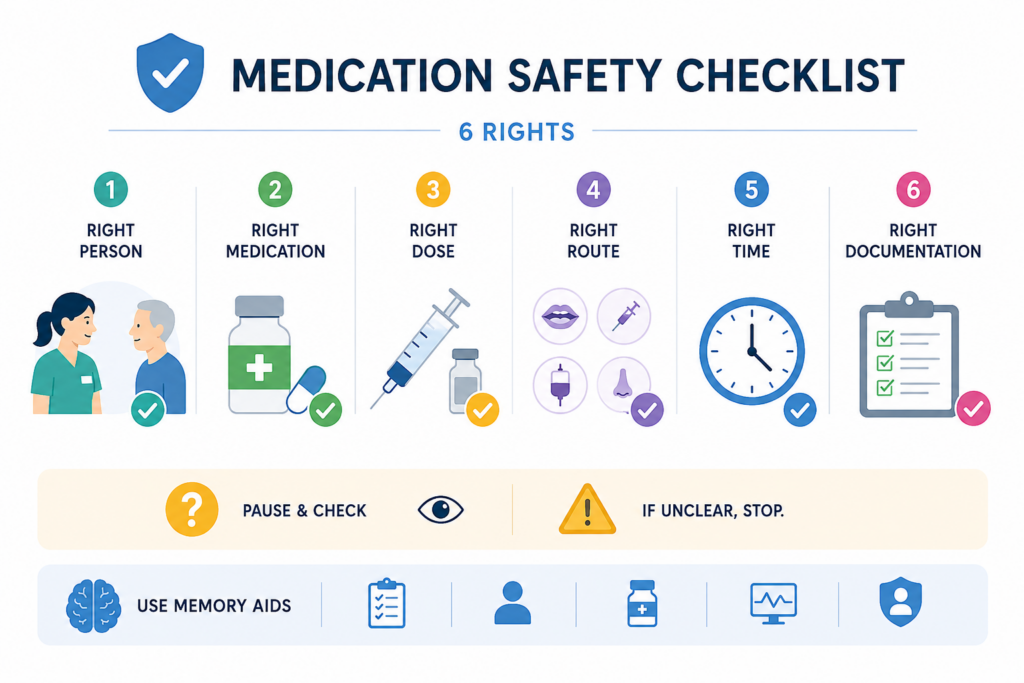
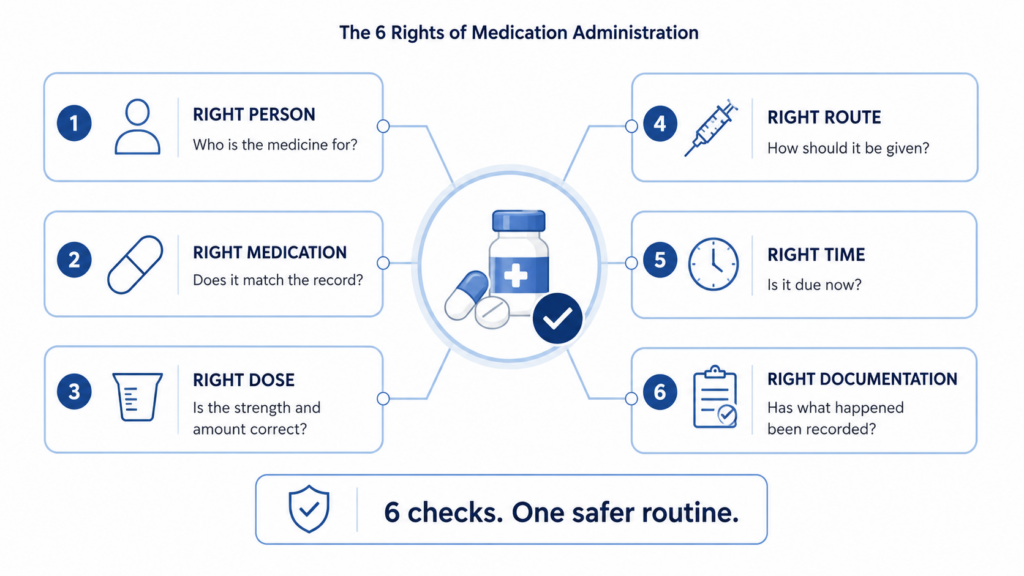
The six rights are right person, right medication, right dose, right route, right time and right documentation. Together, they provide a structured way to check key details before and after giving medicine. They support safer practice, but they do not replace training, competency, local procedures or professional judgement.
The stakes make these checks worth understanding. NHS England states that medication-related incidents account for around 10% of reported patient safety incidents. (NHS England)
This guide explains what each medication right means through realistic care examples. It also covers MAR charts, medication refusal, common errors, near misses and the relevance of medication safety knowledge to care careers.
Table of Contents
What Are the 6 Rights of Medication Administration?
| Six Rights | What to Check |
|---|---|
| Right person | Confirm who should receive the medicine. |
| Right medication | Check the medicine against the current medication record or authorised instructions. |
| Right dose | Confirm the correct strength and amount. |
| Right route | Check how the medicine should be given. |
| Right time | Confirm when the medicine is due. |
| Right documentation | Record what happened accurately. |
The 6 Rights of Medication Administration Explained
Each medication right focuses on a different point where something can go wrong. The examples below show what each check means in everyday health and social care.
1. Right Person – Confirm Who the Medicine Is For
Two residents can have similar names, similar routines or even similar medication. Familiarity therefore cannot replace identification.
The right person means confirming that the medicine belongs to the individual who should receive it. Staff should follow their organisation’s identification procedure and check the relevant details against the medication record.
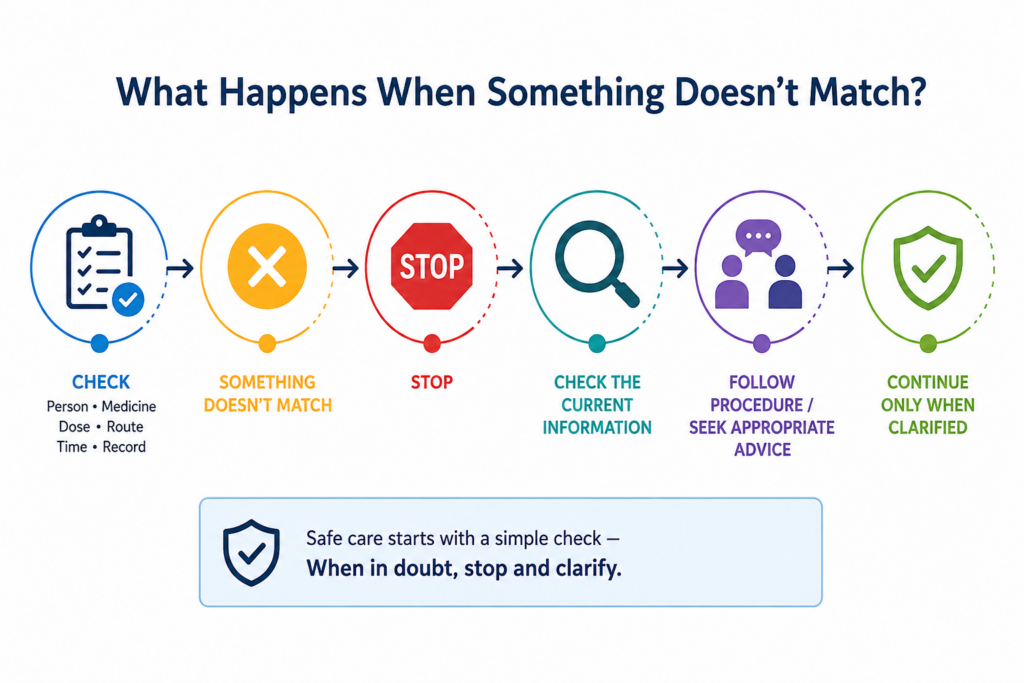
For example, a care worker prepares medication for Margaret Green but notices that the date of birth on the MAR does not match the person in front of them. Instead of assuming someone entered the wrong information, the worker stops and checks.
That single decision can prevent two problems: one person receiving medicine intended for somebody else and the correct person missing their dose.
The key principle is straightforward:
Never guess when identifying information does not match.
Stop the process, follow the appropriate procedure and clarify the discrepancy before continuing.
2. Right Medication – Check the Medicine Against the Record
A familiar packet does not prove that you have the correct medicine.
The right medication means checking the medicine against the person’s current medication record or authorised instructions rather than relying on colour, packaging or memory.
Imagine a regular pharmacy delivery arrives and one medicine suddenly looks different. A worker may assume that the manufacturer simply changed the packaging. That assumption creates unnecessary risk.
Instead, the worker should check the medicine details and resolve anything that does not match before administration.
Changes to prescriptions, packaging and medicine strengths can all make routine medication rounds less predictable than they appear. The safest habit is therefore:
Read and check rather than recognise and assume.
If the medicine name, strength, label or other relevant information conflicts with the current record, staff should stop and follow their organisation’s procedure for obtaining clarification.
3. Right Dose – Confirm the Correct Strength and Amount
The medicine can be correct while the amount remains wrong.
The right dose means checking that the prescribed strength and quantity match the person’s current instructions.
For example, someone may previously have taken one tablet of a particular strength. After a medication review, the prescription changes. A worker who relies on the old routine instead of checking the current record could give the wrong dose.
Liquid medicines can require particular care because staff need to consider both the medicine strength and the prescribed amount. Staff should use appropriate measuring equipment and follow their training rather than estimating.
The useful question is not:
“Is this what they normally take?”
It is:
“Does this exact strength and amount match the current instructions?”
If the dose remains unclear, staff should stop and seek appropriate advice rather than independently altering, calculating or interpreting an uncertain instruction.
4. Right Route – Check How the Medicine Should Be Given
Not every medicine enters the body in the same way.
The right route means checking how the medicine should be administered. Routes can include oral medicines, inhaled treatments, creams, eye or ear preparations, patches and other prescribed methods.
For example, a person may receive tablets alongside a topical medicine during the same medication round. Treating both medicines as though they follow the same process would create an obvious risk.
Difficulty swallowing can also cause confusion. Crushing a tablet might appear helpful, but staff should not automatically crush, split or alter medicines because the formulation and instructions may make that unsafe or unsuitable.
The key question is:
“How should this medicine be given according to the current instructions?”
If the route appears unclear or inconsistent with the medicine or record, staff should stop and seek appropriate advice rather than improvising.
5. Right Time – Check When the Medicine Should Be Given
Busy care environments can make timing surprisingly easy to overlook.
The right time means checking when the medicine is due and following its prescribed timing or frequency instructions.
Consider a worker who notices that an earlier dose appears to have been missed. Giving it immediately may seem sensible, but that could create another problem if the next scheduled dose approaches.
NICE recognises missed and delayed doses as medicines-related problems that social care services need to manage appropriately. (Nice)
Staff should therefore avoid deciding independently how to “catch up” a missed dose.
The practical check is:
“Is this medicine due now according to the current instructions?”
Timing may also involve instructions relating to meals or specific administration times. CQC advises services to make sure medicine records include relevant timing requirements, including medicines that need to be taken in relation to food. (Care Quality Commission)
When timing remains unclear, staff should pause and seek appropriate guidance.
6. Right Documentation – Record Medication Accurately
Medication safety does not end when the person takes the medicine.
The right documentation means recording accurately what happened after administration according to the organisation’s procedure.
Imagine a worker gives a medicine but gets interrupted before completing the MAR. The next worker sees a blank entry and cannot tell whether the person missed the dose or received it without documentation.
That uncertainty can create a risk of either omission or duplicate administration.
CQC states that adult social care providers must maintain secure, accurate and up-to-date medicines records. (Care Quality Commission)
Records should reflect what actually happened, including relevant information when a medicine was not administered according to local procedures.
Right documentation therefore means more than simply signing a MAR.
It means creating a clear record that the next person can rely on.
Never document an administration before it happens or fill a gap based on what you assume happened.
Why Are the 6 Rights of Medication Administration Important?
The 6 rights of medication administration matter because they turn medication administration into a deliberate checking process rather than an automatic routine.
That distinction matters. Repetition can make familiar tasks feel safe even when something has changed: a prescription, medicine strength, administration time or person’s circumstances.
How the 6 Rights Help Reduce Medication Errors
Each right targets a different potential failure point.
Checking the person can catch an identification mistake. Checking the medication and dose can reveal a selection or strength problem. Route and time checks can identify administration issues. Documentation helps create an accurate record for the people who provide care next.
The framework therefore creates several opportunities to notice something that does not look right before proceeding.
It does not guarantee that an error will never happen. Safe medicines management also relies on accurate prescribing, communication, competent staff, reliable systems, current records and appropriate escalation.
NHS England describes medication safety management as an approach that aims to reduce both error and harm, and it stresses the importance of learning from incidents. (NHS England)
Why Consistent Medication Checks Matter in Care Settings
Familiarity can become a hidden risk.
A worker may support the same person and see the same medicines every day. That routine can encourage assumptions such as, “She always takes two of these.”
The six rights interrupt that thinking.
They encourage staff to check the current information each time, helping them notice changes rather than relying on yesterday’s routine.
MAR Charts and the 6 Rights of Medication Administration
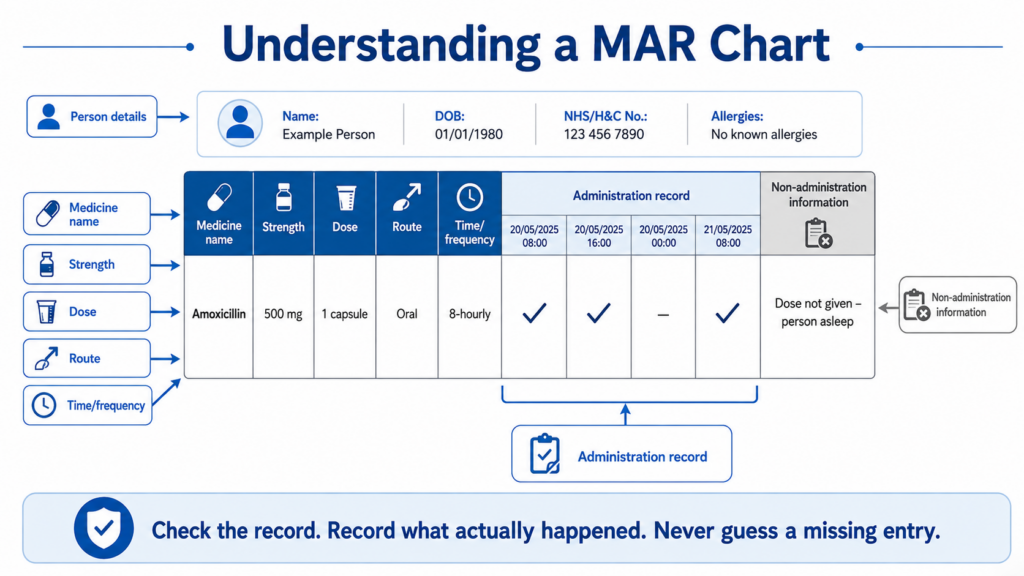
A Medication Administration Record (MAR) helps staff see the information they need to support and record medicine administration. In adult social care, accurate medication records also support continuity between workers, shifts and services.
The MAR does not replace the six rights. Instead, it provides important information that staff can use while completing medication checks.
What a MAR Chart Records
Depending on the setting and system, a MAR can contain information such as the person’s details, medicine, strength, dose, route, frequency and administration times. It also provides a place to record administration and relevant non-administration information.
A clear record answers a basic but safety-critical question:
What should happen with this medicine, and what has already happened?
CQC has highlighted examples of medication errors involving unsigned MAR charts, missing reasons for omitted doses, incorrect non-administration codes and unclear records. (CQC)
How MAR Records Support Safe Medication Administration
MAR records help connect medication rounds across time.
When staff record administration accurately, the next worker can see what happened rather than relying on memory or verbal assumptions. Records can also help services identify recurring omissions, refusals or other issues that require review.
But staff should never treat the MAR as a box-ticking exercise. If the record, medicine label or current instructions appear inconsistent, they should stop, follow local procedures and seek appropriate clarification rather than choosing which information seems most likely to be correct.
Medication Refusal, Consent and Mental Capacity
The six rights focus on safe checks, but a correct medicine does not remove a person’s right to make decisions about their care. Consent remains central to medication support.
NICE says health and social care practitioners should involve people in decisions about their medicines and take account of their views, preferences and circumstances.
What to Do When Someone Refuses Medication
Imagine a resident normally accepts their evening medicine but suddenly says, “No, I don’t want that today.”
The worker should not pressure, threaten or secretly persuade the person into taking it. Instead, they should listen and try to understand the reason. The person may feel unwell, experience side effects, struggle to swallow or simply choose not to take the medicine.
Staff should follow the person’s care plan and their organisation’s medication procedure, record the refusal correctly and seek appropriate advice when required.
Refusal does not automatically mean that a worker has made a medication error. However, ignoring or recording it inaccurately can create safety concerns.
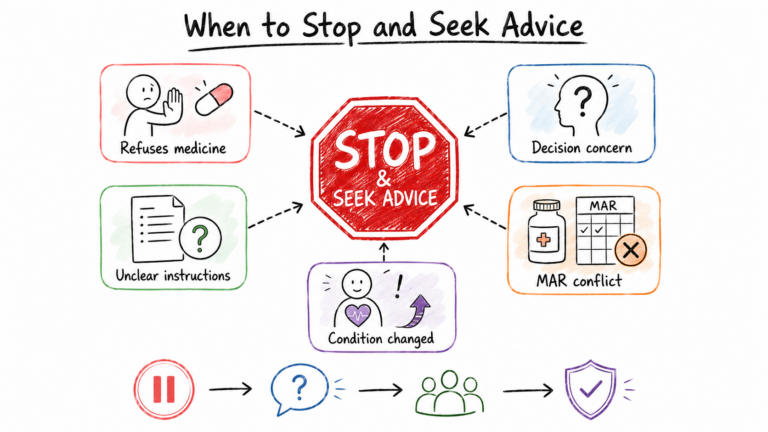
When to Stop and Seek Advice
Staff should stop and seek appropriate guidance when uncertainty could affect safe medication support. Examples include:
- The person refuses an important medicine.
- Their ability to make the particular decision raises a genuine concern.
- The instructions appear unclear.
- The medicine and MAR information conflict.
- The person’s condition has changed significantly.
Mental capacity requires careful handling. Under the Mental Capacity Act 2005, adults should not automatically lose the right to decide simply because others consider their decision unwise. Capacity relates to the particular decision at the particular time.
The safest principle is simple: respect choice, recognise uncertainty and escalate appropriately rather than making decisions outside your responsibilities.
Common Medication Errors: Real Care Scenarios
Medication errors do not always begin with dramatic mistakes. A distraction, assumption or incomplete record can create the conditions for an error.
Realistic scenarios make the 6 rights of medication administration easier to apply because they show where routine checks can break down.
Scenario 1: A Missed or Delayed Dose
A care worker starts the evening medication round and notices that the MAR contains no clear record for an earlier scheduled dose.
The immediate temptation might be to give the medicine now. That could create risk because the worker does not yet know whether someone administered the earlier dose without recording it.
The worker should pause the administration, establish what happened and follow the service’s medication procedure. Depending on the medicine and circumstances, staff may need advice from an appropriate healthcare professional.
NICE includes missed and delayed doses within medicines-related problems that services should identify and report appropriately.
The lesson is important: a blank record does not automatically prove that nobody gave the medicine.
Scenario 2: The Wrong Medicine, Dose or Person
Two residents have similar surnames. During a busy morning round, a worker picks up the wrong medication pack but notices that the first name does not match the MAR.
That moment represents a near miss, not a reason to rush ahead because no medicine has reached the wrong person yet.
The worker should stop, follow the appropriate reporting procedure and consider what contributed to the near miss. Similar names, storage arrangements, interruptions or poor identification processes may all require attention.
The six rights work particularly well here because the right-person and right-medication checks create opportunities to catch the mistake before administration.
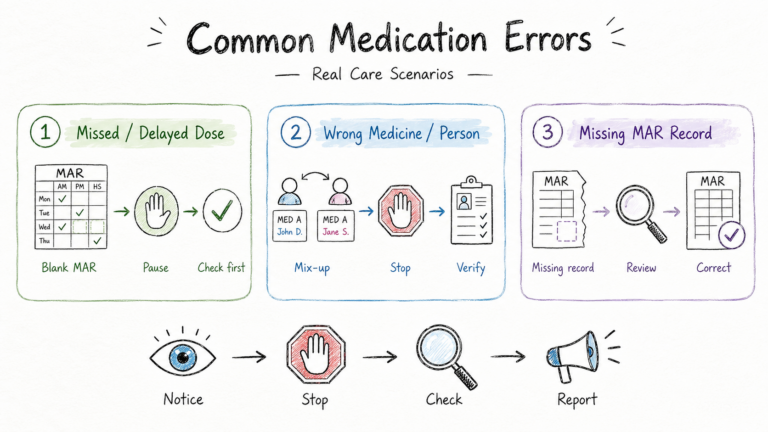
Scenario 3: Missing or Incorrect MAR Documentation
A worker supports someone with their medication but forgets to complete the MAR. Later, another member of staff sees the blank entry.
The problem now extends beyond paperwork. The second worker cannot immediately tell whether the person missed the medicine or received it without documentation.
CQC guidance states that medicines administration records should remain accurate and up to date, and staff should record administration as soon as possible afterwards.
Staff should never fill a gap by guessing what probably happened. They need to follow the organisation’s procedure for investigating and correcting medication-record problems.
What to Do After a Medication Error or Near Miss
When an error occurs, protecting the person comes first.
Staff should assess the immediate situation within their competence, report the incident promptly and obtain appropriate clinical or emergency advice where necessary. They should then make an accurate record and follow the organisation’s incident-reporting process.
Do not hide an error or alter records to make them appear correct.
A near miss also deserves attention. If someone nearly receives another resident’s medicine, the fact that the final check prevented administration does not remove the underlying risk.
NICE recommends that social care providers have robust processes for identifying, reporting, reviewing and learning from medicines-related problems.
The purpose of reporting should extend beyond identifying who made the mistake. Teams need to ask why the safeguards failed or nearly failed.
Did an interruption contribute? Were two medicines stored too closely together? Did unclear documentation create confusion? Did staff need additional support?
Learning from those answers can help prevent the same circumstances from causing future harm.

Why Medication Administration Knowledge Matters for Care Careers
Medication knowledge matters in many care roles because supporting people with medicines can form part of safe, person-centred care. However, a job title alone does not automatically authorise someone to administer medication.
The person’s role, training, assessed competence, employer procedures and the type of medication support all matter.
Care Roles Where Medication Knowledge May Be Relevant
Medication awareness may support people working in roles such as:
- care assistants
- support workers
- senior care workers
- healthcare assistants
- home care workers
- residential care staff
Responsibilities differ between services. One worker may remind someone to take their own medicine, while another may administer medicines after receiving appropriate training and competency assessment.
Understanding the six rights can still help staff recognise discrepancies, understand MAR records and know when something requires escalation.
Training, Competency and Working Within Your Responsibilities
Knowing the six rights and being competent to administer medicines are not the same thing.
CQC states that providers should ensure staff who administer medicines receive appropriate training and demonstrate competence. Providers should also review staff competence regularly.
That distinction matters for anyone considering a care career.
Learning can build medication-safety knowledge, but workers should only undertake responsibilities that their employer has authorised and for which they have the required training and competence.
How Medication Safety Knowledge Supports Professional Development
Strong medication knowledge can support wider care skills, including accurate record keeping, communication, risk awareness and person-centred decision-making.
For someone developing a career in health and social care, learning about medication administration can also make terminology such as MAR, PRN, route, dose, refusal and escalation easier to understand.
CPD learning can support that professional development, but a CPD course does not automatically confer workplace competence or permission to administer medicines. Employers remain responsible for ensuring that staff who undertake medication responsibilities meet the appropriate requirements.
Medication Administration Safety Checklist
Before and after medication administration, staff should follow their training, current records and local procedures. This quick checklist summarises the six-right framework:
✓ Right person — Have I confirmed who the medicine is for?
✓ Right medication — Does the medicine match the current record or authorised instructions?
✓ Right dose — Have I confirmed the correct strength and amount?
✓ Right route — Am I using the specified route?
✓ Right time — Is the medicine due now according to the current instructions?
✓ Right documentation — Have I accurately recorded what actually happened?
One additional question can strengthen every check:
Does anything look unclear, different or wrong?
If it does, stop. Do not guess, improvise or rely on memory. Follow the organisation’s medicines procedure and seek appropriate advice.
The checklist provides a memory aid, not a complete medication-administration procedure. Staff still need to consider factors such as allergies, consent, individual care plans, medicine-specific instructions, monitoring requirements and their own scope of responsibility.
Final Takeaway: Six Checks, Safer Medication Support
The 6 rights of medication administration turn six simple questions into a useful safety routine: Is this the right person, medication, dose, route and time — and have I documented what happened correctly?
Their value comes from consistency. A medicine round may feel familiar after hundreds of repetitions, but people’s prescriptions, circumstances and needs can change. Checking current information rather than relying on memory gives staff another opportunity to notice a problem before it reaches the person.
Safe medication support also extends beyond six checks. Consent, accurate MAR records, clear communication, competent staff and prompt escalation all contribute to safer care. When something does not match, stopping and checking is safer than making an assumption.
For care professionals and learners, understanding these principles can strengthen medication-safety awareness and support more confident conversations about medicines, records and risk. The goal is not simply to memorise six rights. It is to understand why each check exists and when uncertainty requires action.
Frequently Asked Questions
What Is the Most Important of the 6 Rights of Medication Administration?
No single medication right should replace the others because each check addresses a different safety risk. Confirming the right person cannot compensate for giving the wrong dose, just as accurate documentation cannot make an incorrect medicine safe. Staff should treat the six rights as a connected checking framework and follow all relevant medication procedures.
Is the Right to Refuse One of the 6 Rights of Medication Administration?
Some medication-safety frameworks include the right to refuse as an additional right, while the six-right model used in this guide includes right documentation. Regardless of how a framework numbers the rights, staff must respect consent and handle medication refusal appropriately. They should listen to the person, follow the care plan and local procedure, document the refusal correctly and seek advice when necessary.
What Should You Do If the Medication Label and MAR Chart Do Not Match?
Stop and resolve the discrepancy before administering the medicine.Do not choose whichever information appears more familiar. Follow your organisation’s medication procedure and contact the appropriate person or healthcare professional for clarification. Accurate records and clear instructions need to support safe administration.
Can Tablets Be Crushed If Someone Has Difficulty Swallowing?
Do not crush a tablet simply because someone finds it difficult to swallow.Crushing can change how some medicines work and may create safety or legal concerns. Staff should follow the person’s medication plan and obtain appropriate professional advice. NICE advises care services to seek advice from a pharmacist or other appropriate healthcare professional when people experience difficulty taking medicines in their prescribed form.
What Does PRN Mean on a MAR Chart?
PRN refers to medicine that someone takes when required rather than automatically at every scheduled medication round. Staff need clear instructions explaining when the person may receive the medicine, the appropriate dose and other relevant limits or monitoring requirements. They should record administration according to their service’s procedure and the person’s medication plan.