Compassionate Care in a Cozy Room.png

Pressure Ulcer Prevention: Risk Factors, Stages and Care Responsibilities

Pressure ulcer prevention depends on recognising risks early, checking skin changes and taking appropriate action. Learn the stages of pressure ulcers, common risk factors, prevention methods and the responsibilities care workers have for recording, reporting and escalating concerns.

User Icon Alexender Smith
Calendar Icon August 17, 2026

Pressure ulcer prevention often starts with one small observation: skin that looks different, feels unusually warm or causes new discomfort. That change can matter quickly. The NHS explains that pressure ulcers can sometimes appear within a few hours and may progress into deeper tissue damage if nobody acts early. NHS pressure ulcer guidance also highlights pain, colour changes and unusual skin texture as important warning signs.

Pressure ulcer prevention means recognising risk early, checking vulnerable skin, reducing prolonged pressure, supporting safe movement and following an individual care plan before damage progresses.

For care workers, early recognition forms an important part of safer, person-centred care. This guide explains pressure ulcer risk factors, common pressure areas, early skin changes, stages and categories, risk assessment tools and prevention planning. It also shows where care workers support prevention and when they need to report or escalate concerns.

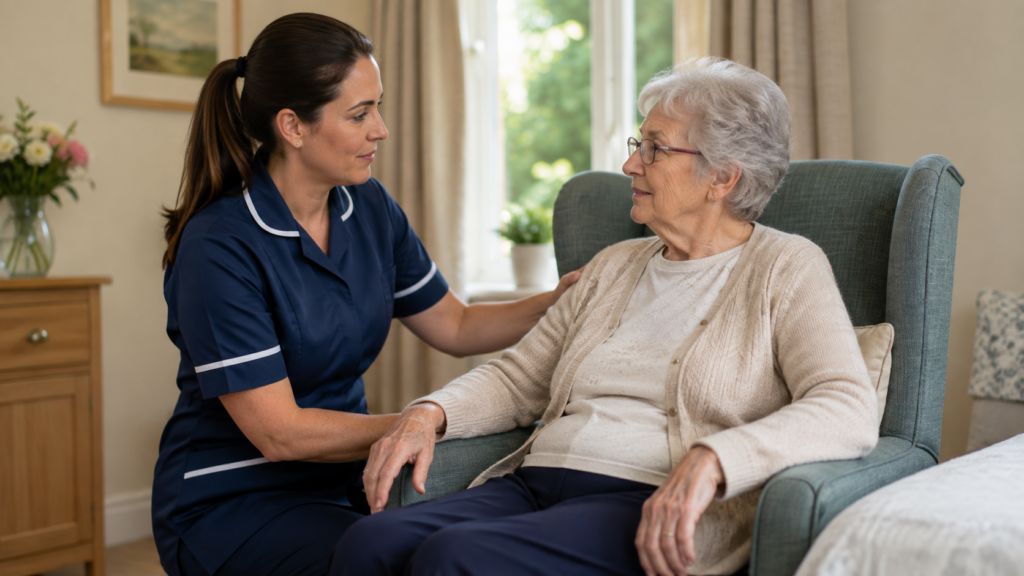
Care-worker-supporting-pressure-ulcer-prevention-in-a-UK-care-setting.

Table of Contents

What Are Pressure Ulcers and Why Does Prevention Matter?

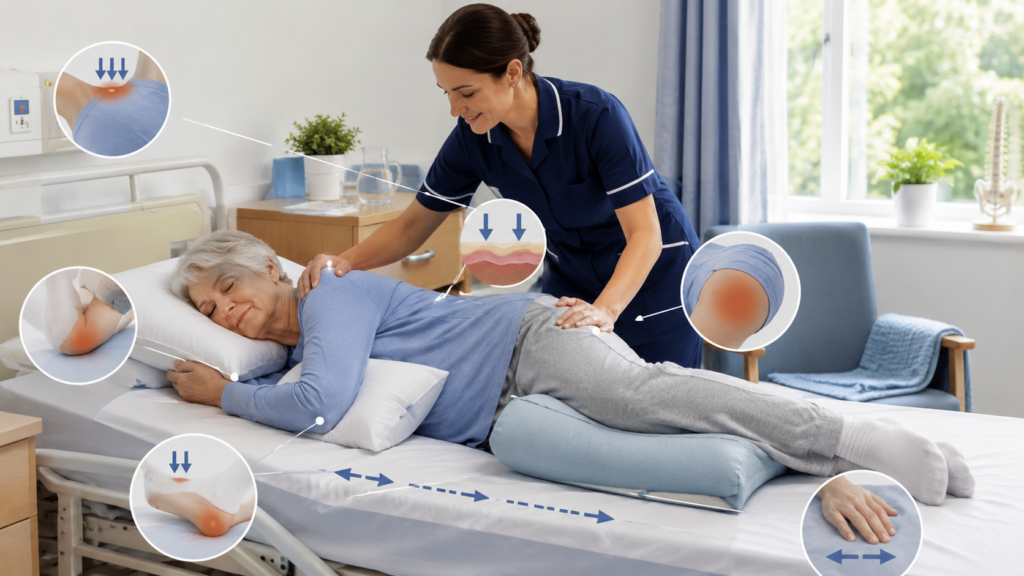
Pressure-Care-Positioning-Guide.

Pressure ulcers damage the skin and underlying tissue when prolonged pressure, or pressure combined with shear, places tissue under sustained stress. They often develop over bony areas, although medical devices and other objects can also create damaging pressure. Oxford Health NHS Foundation Trust uses the same pressure-and-shear definition in its current tissue viability guidance.

How Pressure Damage Develops

Three physical forces can affect vulnerable skin:

  • Pressure: Body weight or equipment presses tissue against another surface for too long.
  • Shear: Deeper tissues move while the skin stays in place, such as when someone slides down a bed.
  • Friction: Repeated rubbing can damage the skin surface and make it less able to tolerate pressure.

Pressure and shear play the central role in pressure-ulcer development. Friction can add further surface damage and increase skin vulnerability.

Prevention matters because visible skin changes do not always show the full extent of tissue stress. NICE tells healthcare professionals to consider pain, colour changes, heat, firmness and moisture when they assess vulnerable skin.

Pressure Ulcer, Pressure Sore and Bedsore: Are They the Same?

People often use pressure ulcer, pressure sore and bedsore for the same pressure-related injury. NICE and the NHS recognise these terms, although UK health and care professionals commonly use “pressure ulcer” or “pressure damage”.

The word “bedsore” can mislead readers because pressure damage can affect people in beds, chairs, wheelchairs or anywhere that sustained pressure affects vulnerable tissue.

Pressure Ulcer Risk Factors and Common Pressure Areas

Pressure ulcers can affect anyone, but certain changes in health, movement or skin condition can increase risk significantly. NICE asks health professionals to assess individual risk rather than relying on one factor alone.

Who Is Most at Risk?

Risk Factor Why It Can Increase Risk
Limited mobility The person may stay in one position for too long
Reduced sensation The person may not feel pain or pressure clearly
Previous pressure ulcer Previous damage can indicate higher future risk
Poor nutrition Skin and tissue may cope less effectively with stress
Incontinence or moisture Moisture can weaken the skin barrier
Poor circulation Tissue may receive less oxygen and nutrients
Serious illness or surgery Health changes can reduce movement and tissue tolerance
Cognitive impairment The person may struggle to identify or communicate discomfort


NICE specifically highlights limited mobility, loss of sensation, nutritional deficiency, previous pressure ulcers, difficulty repositioning and cognitive impairment when clinicians assess risk. It also recommends reassessment when surgery, illness, mobility or another clinical change alters a person’s condition.

Common Body Areas and Medical Device-Related Pressure
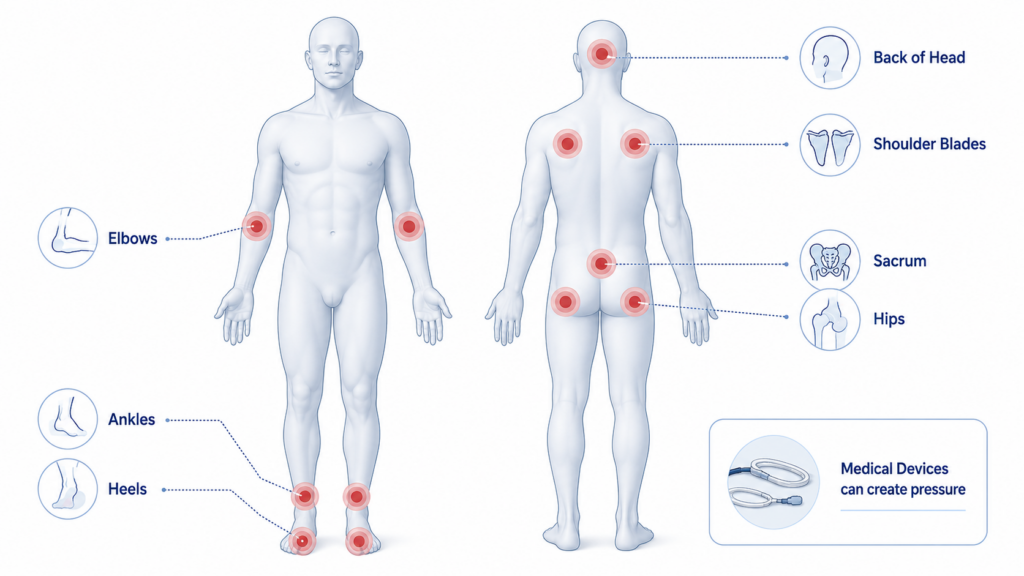
 common body areas and medical related pressure.

Pressure ulcers commonly affect areas where bone sits close to the skin, including:

  • Heels
  • Sacrum and tailbone
  • Hips
  • Elbows
  • Ankles
  • Shoulder blades
  • Back of the head

The person’s position determines which areas face the greatest pressure.

Care workers should also notice pressure around equipment. Oxygen masks, tubing, casts, splints, tight footwear and other devices can place sustained pressure on small areas of skin. GOV.UK guidance classifies damage from device pressure as medical device-related pressure ulcers.

This matters because a worker who only checks traditional bony pressure points could miss damage beneath or beside a device.
Early Signs and Skin Changes to Watch For

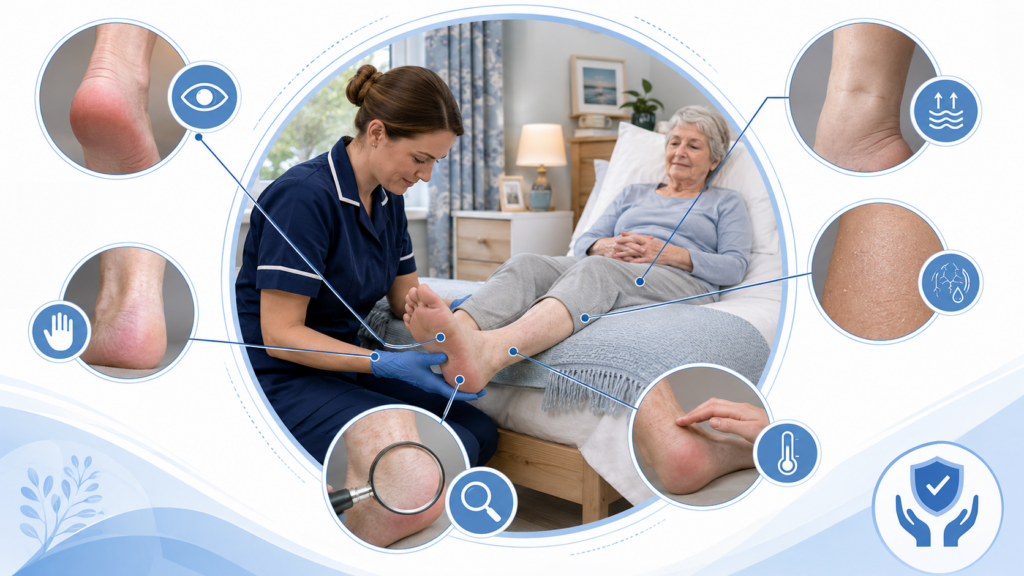
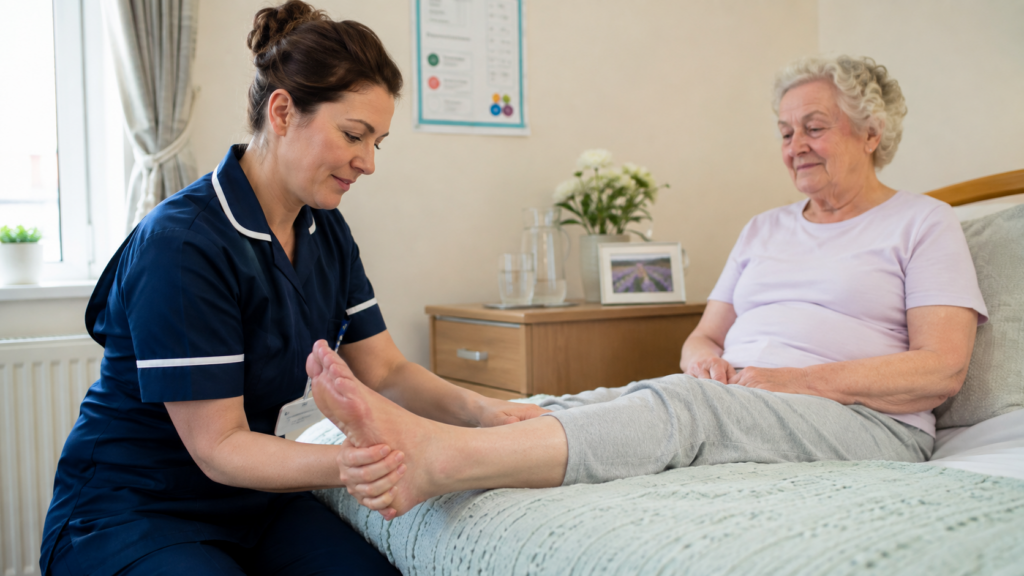
Early pressure damage may appear before the skin breaks. Care workers therefore need to notice changes in colour, temperature, texture, sensation and comfort rather than waiting for an open wound.

The NHS lists persistent discolouration, warmth, sponginess, hardness, pain and itching among possible symptoms. It also warns that pressure ulcers can sometimes develop within hours.

What Early Pressure Damage Looks and Feels Like

Change What You Notice
Colour Skin looks different from the person’s normal tone
Temperature An area feels warmer or cooler than nearby skin
Texture Skin feels unusually firm, soft or boggy
Sensation The person reports pain, soreness, burning or numbness
Shape Swelling or a raised area appears
Surface A blister, crack or open area develops
 

Care workers should compare new findings with the person’s usual skin and report unexpected changes through the appropriate workplace route. Trained healthcare professionals should carry out clinical skin and wound assessment when concerns arise. NICE specifically recommends trained professional skin assessment for adults at high risk.

Recognising Pressure Damage on Darker Skin

Care workers should not rely on visible redness. On black or brown skin, early pressure damage may appear purple, blue or simply different from the person’s normal skin tone. Temperature, texture, firmness, swelling and pain can provide additional clues.

NICE specifically warns that non-blanching skin changes may present as discolouration on darker skin tones. The NHS also advises people to look for purple or blue changes on black or brown skin.

Pressure Damage vs Moisture-Associated Skin Damage

Skin can suffer damage from both pressure and excess moisture, but the causes differ.

Sustained pressure and shear can cause pressure ulcers. In contrast, prolonged contact with urine, faeces, perspiration or other moisture can contribute to moisture-associated skin damage. Both types of damage can also affect the same area at the same time.

Current GOV.UK safeguarding guidance tells services to record combined pressure-and-moisture damage as a pressure ulcer while recording moisture-only skin damage separately.

Care workers should not diagnose the cause themselves. Instead, they should observe the skin change, record relevant information and report the concern so an appropriately skilled professional can assess it.

Start learning today and develop your infection control skills online.
Aseptic technique is one part of maintaining safe healthcare environments. Continue developing your understanding of infection prevention, contamination control, hygiene practices and safe care procedures with our Prevention and Control of Infection in Health Care Settings Course.

Pressure Ulcer Stages and Categories Explained

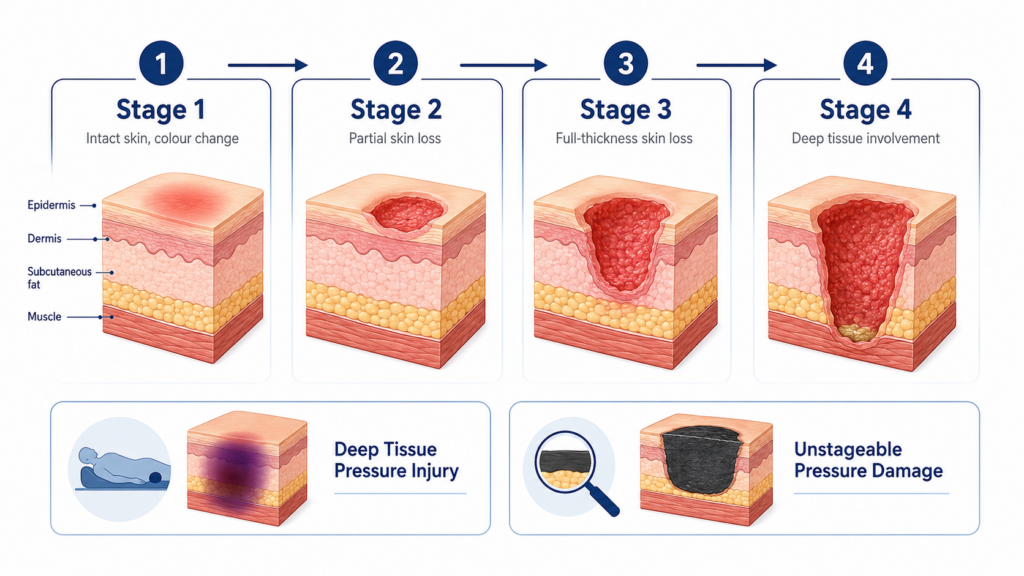
Pressure ulcer stages from stage 1 to stage

Healthcare professionals use recognised categories to describe the depth of pressure damage. GOV.UK guidance lists four main stages, alongside suspected deep tissue injury and unstageable pressure damage.

Care workers benefit from understanding these broad differences because they show why early reporting matters. However, workers should only categorise pressure ulcers when their training, competence and workplace procedures allow them to do so.

Stage 1 (Category 1) Pressure Ulcer

Stage 1 keeps the skin intact but causes persistent colour change. The area may also feel warmer, cooler, firmer or softer, and the person may report pain or tenderness.

A care worker should report these changes promptly rather than waiting for the skin to break.

Stage 2 (Category 2) Pressure Ulcer

Stage 2 causes partial-thickness skin loss and may appear as a shallow open wound or blister. Other conditions, including skin tears and moisture damage, can look similar.

Care workers should protect the area from avoidable pressure and seek appropriate assessment according to the care plan and local procedures.

Stage 3 (Category 3) Pressure Ulcer

Stage 3 extends through the full thickness of the skin into deeper tissue. Fat may become visible, but bone, muscle and tendon remain unexposed.

The depth can vary according to the body area, so workers should never judge severity from wound size alone.

Stage 4 (Category 4) Pressure Ulcer

Stage 4 reaches deeper structures and may expose muscle, tendon or bone. This level of tissue loss requires prompt clinical management.

Care workers should escalate any suspected severe pressure damage immediately through the appropriate clinical route.

Deep Tissue Pressure Injury and Unstageable Pressure Damage

Deep tissue pressure injury can produce dark red, maroon or purple discolouration or a blood-filled blister while deeper tissue carries significant damage.

Slough or eschar can sometimes conceal the full depth of tissue loss, which prevents an immediate depth assessment. GOV.UK includes suspected deep tissue injury and unstageable pressure damage within its recognised pressure-ulcer classifications.

For care workers, the safest principle remains straightforward: notice the change, reduce avoidable pressure where the care plan allows, record what you observe and escalate the concern.

Pressure Ulcer Risk Assessment and Prevention Planning

Risk assessment helps health and care teams identify who may develop pressure damage and which prevention measures they need.

NICE recommends clinical judgement and, where appropriate, a validated risk-assessment scale. It names Waterlow, Braden and Norton as examples for adults. NICE also recommends reassessment when a person’s clinical condition changes.

Waterlow, Braden and PURPOSE-T

Tool What It Supports
Waterlow Reviews several factors associated with pressure-ulcer risk
Braden Considers areas such as mobility, activity, moisture and sensory perception
PURPOSE-T Supports structured pressure-ulcer risk assessment and prevention planning
 

Organisations do not all use the same assessment tool. Staff should therefore follow the tool, policy and procedure that their employer requires.

Oxford Health NHS Foundation Trust states that its revised pressure-damage policy took effect on 1 April 2026 and replaced the Braden tool with PURPOSE-T within that Trust. Its current tissue viability resources also link PURPOSE-T with the National Wound Care Strategy Programme clinical pathway.

This example shows why care workers should follow local policy rather than assume that every UK service uses the same assessment system.

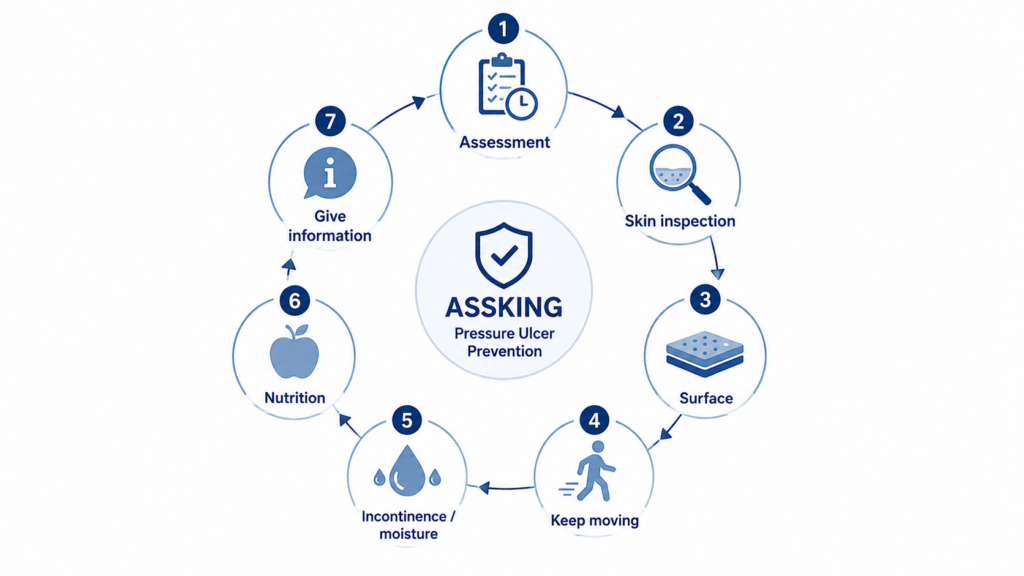
SSKIN and aSSKINg

Many NHS services use SSKIN to organise key prevention actions:

  • Surface – use the right support surface.
  • Skin – check vulnerable skin.
  • Keep moving – reduce prolonged pressure.
  • Incontinence/moisture – protect skin from excess moisture.
  • Nutrition/hydration – support food and fluid needs.

Current NHS services also use the broader ASSKING/aSSKINg approach. This adds Assessment and Giving information around the familiar prevention actions. Humber Health Partnership currently describes the framework as Assessment, Skin inspection, Surface selection, Keep moving, Incontinence management, Nutrition and Giving information.

Oxford Health also links the National Wound Care Strategy Programme aSSKINg framework within its current pressure-ulcer resources.

How Risk Assessment Shapes the Care Plan

A risk score should lead to action rather than sit in a record.

NICE recommends an individualised care plan for people at high risk. The plan should consider skin findings, mobility, pressure relief, other health conditions and the person’s preferences.

For care workers, this means following the agreed prevention plan consistently while watching for changes. If mobility, skin condition, continence, appetite, comfort or general health changes, workers should record and report that change so the wider team can review the plan.

How to Prevent Pressure Ulcers in Care Settings

Effective pressure ulcer prevention combines movement, pressure redistribution, skin care, continence support, nutrition and regular observation. No single action removes every risk, so care workers need to follow the person’s individual care plan and respond when their condition changes.

Repositioning and Pressure Redistribution
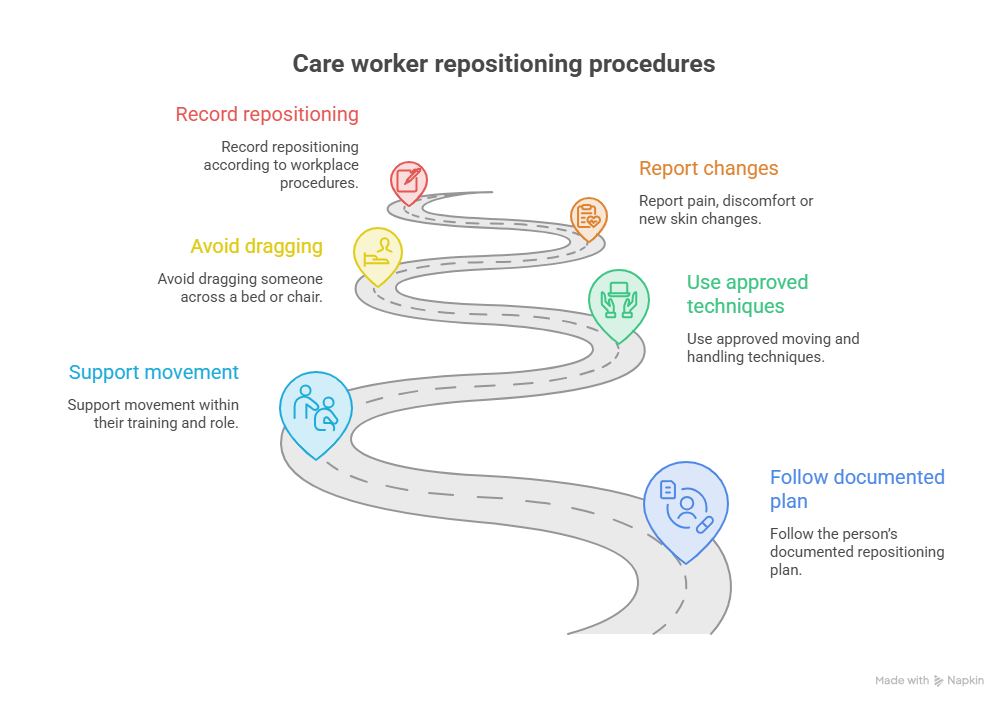
Changing position reduces the time that vulnerable tissue remains under pressure. However, one fixed turning schedule does not suit everyone.

NICE pressure ulcer guidance recommends frequent position changes and sets minimum intervals of six hours for adults at risk and four hours for adults at high risk. NICE also stresses that professionals should tailor the frequency to the person’s needs and document it.

Care workers should:

  • Follow the person’s documented repositioning plan.
  • Support movement within their training and role.
  • Use approved moving and handling techniques.
  • Avoid dragging someone across a bed or chair.
  • Report pain, discomfort or new skin changes.
  • Record repositioning according to workplace procedures.

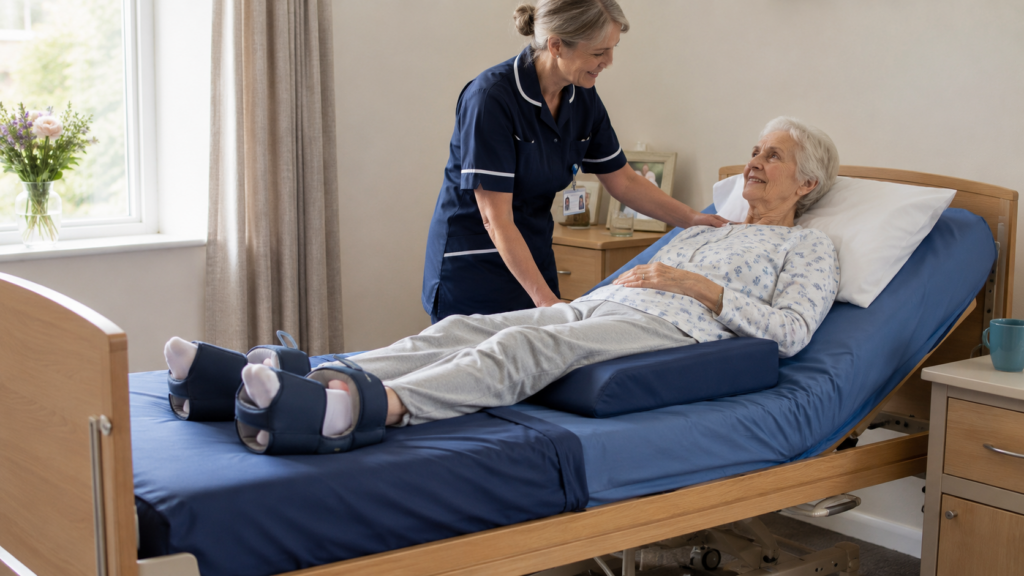
Mattresses, Cushions and Heel Protection

Pressure-redistributing equipment can reduce pressure, but it cannot replace movement, skin checks or other preventative care.

NICE recommends high-specification foam mattresses for adults in secondary care and for people at high risk in primary or community care. It also recommends suitable cushions for people who sit for long periods and individual strategies for heel pressure relief.

Equipment Check Why It Matters
Correct equipment The support must match the person’s individual needs
Correct position Poor positioning can create additional pressure points
Working condition Damaged equipment may not provide suitable support
Care-plan instructions Staff need to use equipment as the plan directs


Skin Care, Continence, Nutrition and Hydration

Care workers should keep vulnerable skin clean and follow continence plans promptly when moisture creates additional risk. NICE also recommends barrier preparations for some people at high risk of moisture lesions or incontinence-associated dermatitis.

Workers should support agreed food and fluid needs and report poor intake or sudden changes. NICE advises against providing nutritional supplements solely to prevent pressure ulcers when someone already receives adequate nutrition.

Common Prevention Mistakes to Avoid

Care workers should avoid:

  • Massaging or rubbing red or discoloured pressure areas.
  • Applying the same repositioning schedule to everyone.
  • Assuming a specialist mattress removes other risks.
  • Ignoring pressure from masks, tubing, footwear or other devices.
  • Waiting for skin to break before reporting a concern.

NICE specifically advises against skin massage or rubbing as a pressure ulcer prevention measure.

Good prevention depends on individualised care, regular observation and timely communication.
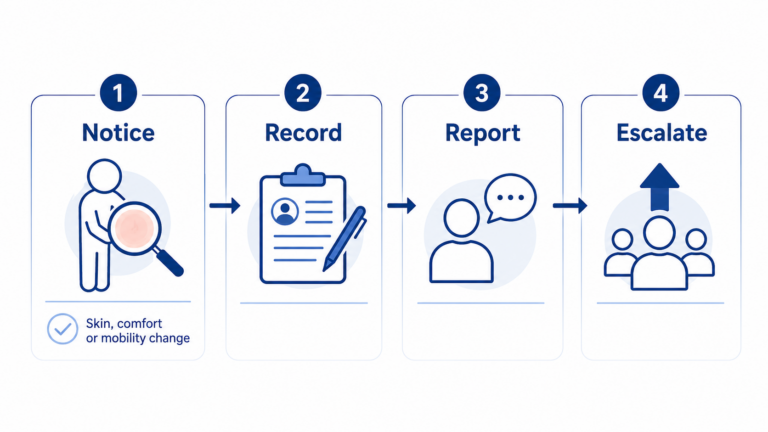
Care Worker Responsibilities for Pressure Ulcer Prevention

Care workers often notice day-to-day changes because they regularly support movement, personal care, meals and comfort. Their role can therefore contribute significantly to prevention, observation, accurate recording and timely escalation.

The current Version 4 of the National Occupational Standard SFHCHS5: Undertake Agreed Pressure Area Care is listed by UK Standards as approved in 2026. The standard requires relevant workers to follow care plans and risk assessments, identify changes in skin condition, use pressure-relieving aids appropriately, report changes and complete relevant documentation.

Record and Report Skin Changes

Workers should document what they actually observe rather than trying to diagnose the cause.

Useful information can include:

  • Where the skin change appears
  • How the area looks and feels
  • Whether the person reports pain or discomfort
  • When staff first noticed the change
  • Recent changes in mobility, continence or general health
  • Whether equipment may place pressure on the area

Clear records help the wider team understand when a change began and whether the prevention plan needs review.

Escalate Concerns and Seek Appropriate Clinical Support

Care workers should report new pressure damage, unexplained pain, worsening discolouration or problems with pressure-relieving equipment through the correct workplace route.

Depending on the care setting, that route may involve a senior care worker, nurse, community nurse, GP, clinical lead or tissue viability professional.

Workers should also escalate concerns when they notice a change that exceeds their responsibilities or competence. The current SFHCHS5 standard specifically requires workers to understand how to report matters beyond their role and stresses the importance of escalating pressure-area concerns.

Work Within Your Role, Competence and Care Plan

Care workers should follow the person’s agreed plan and use equipment according to instructions. They should also seek support whenever a task or decision falls outside their competence.

SFHCHS5 places clear emphasis on understanding the limits of individual competence, following the care plan and risk assessment, reporting skin changes and completing required documentation.

Appropriately trained healthcare professionals should make clinical decisions about wound assessment, categorisation and treatment.

When Prevention Is Refused or Safeguarding Concerns Arise

Person-centred care respects choice as well as safety. Sometimes a person may refuse repositioning, skin checks, equipment or another prevention measure. Staff need to understand the reason and respond without coercion.

What If Someone Refuses Repositioning or Skin Checks?

A person with capacity can make a decision that carries risk. Care workers should listen, explain relevant information within their role and report the refusal so the team can consider appropriate alternatives.

For example, someone may refuse to move because repositioning causes pain. Rather than repeatedly asking them to turn, the team may need to review pain management, equipment or positioning options.

The current GOV.UK safeguarding protocol for pressure ulcers advises professionals to check that the person understands prevention advice and the possible consequences of declining it. The guidance also recommends exploring compromises or alternatives and revisiting the conversation when appropriate.

Care workers should:

  • Listen to the person’s concerns.
  • Avoid forcing care.
  • Explain relevant information within their role.
  • Record the refusal accurately.
  • Report it through the appropriate route.
  • Follow any revised care instructions.

If staff have concerns about someone’s ability to make a particular decision, they should follow organisational procedures and seek appropriate professional support rather than making their own clinical or legal judgement.

When Can Pressure Damage Become a Safeguarding Concern?

A pressure ulcer does not automatically prove neglect or abuse.

The Department of Health and Social Care explains that teams should primarily address pressure-ulcer harm through appropriate clinical management. However, concerns involving neglect, abuse, deliberate obstruction of care, poor practice or serious failures to act may also require consideration through safeguarding procedures.

Care workers should report concerns rather than decide the safeguarding outcome themselves. Relevant clinicians, managers and safeguarding professionals can then consider the circumstances and decide what action the situation requires.

Pressure Ulcer Prevention Checklist for Care Workers

A simple checklist can help workers remember important actions during everyday care. It should support — not replace — the person’s individual risk assessment and care plan.

Check What to Do
Risk Know the person’s current risk factors and prevention plan
Skin Notice changes in colour, temperature, texture or integrity
Movement Follow the agreed repositioning and mobility plan
Surface Check prescribed mattresses, cushions and other aids
Devices Watch areas beneath masks, tubing, splints or other equipment
Moisture Follow continence and skin-care arrangements
Nutrition Support agreed food and fluid intake and report concerns
Comfort Ask about pain, burning, soreness, tingling or numbness
Record Document relevant care and observations accurately
Escalate Report new or worsening concerns promptly

The current Version 4 of SFHCHS5 reinforces many of these responsibilities. It covers following the care plan and risk assessment, recognising changes in skin condition, using pressure-relieving aids appropriately, completing documentation and escalating concerns.

Risk can also change. Illness, surgery, reduced mobility or another clinical change may increase vulnerability even when earlier assessments identified a lower level of risk. NICE therefore recommends reassessment when a person’s clinical circumstances change.

A checklist works best when workers combine it with observation and communication. A small change in comfort, appetite, mobility or skin condition may provide an early sign that the current prevention plan needs review.

Final Takeaway: Recognise Risk, Prevent Damage and Escalate Concerns Early

Pressure ulcer prevention works best when care workers recognise changing risk, follow individual care plans and communicate concerns quickly.

Prevention involves much more than repositioning. Workers also need to consider skin condition, pressure-relieving equipment, moisture, nutrition, mobility, medical devices, comfort and changes in general health.

Most importantly, care workers should not wait for an open wound before taking concerns seriously. Changes in colour, temperature, texture, pain or mobility can all signal increasing risk.

A practical principle can guide everyday care:

Notice the change record what you observe report it promptly escalate when further support is needed.

This approach helps care teams respond earlier, protect skin integrity and provide safer, more person-centred care.

Ready to Strengthen Your Infection Prevention Knowledge?
Learn essential medication safety principles, record keeping and administration practices with HF Online’s Control and Administration of Medication course.

Frequently Asked Questions

No. Good prevention can reduce risk, but it cannot prevent every pressure ulcer. GOV.UK recognises that some pressure ulcers may still develop despite appropriate prevention and recommends individual risk assessment, care planning and review.

Yes. Pressure can damage deeper tissue while the skin remains intact. Early signs may include pain, persistent colour changes, unusual temperature, firmness or changes in sensation. Care workers should report concerning changes rather than wait for an open wound.

Yes. Pressure damage can sometimes develop within a short period, particularly when illness, immobility or other risk factors reduce tissue tolerance. Early observation therefore matters because visible skin breakdown may not show the full extent of deeper damage.

No. Pressure-relieving mattresses can form an important part of prevention, but they do not replace repositioning, skin observation, continence care, appropriate nutrition or individual care planning. Effective prevention uses several measures together.

Care workers should work within their training, competence and workplace procedures. They can play an important role in recognising and reporting concerning skin changes, but appropriately trained professionals should make clinical assessments and decisions that require clinical expertise.

August 17, 2026

Recent Blogs

top