

Health and Social Care Level 3 Online Course: Your 2026 Guide
Thinking about working in care, but unsure where to start? Or already supporting others and wishing you understood more about the decisions you make each day? TheHealth and Social Care Level 3 Diploma brings safeguarding, communication, person-centred care and other essential subjects together in a flexible online course you can study around your life.
It is designed for people who want to understand care more deeply. You might be preparing to apply for your first role, refreshing what you have learnt on the job or exploring how to support a relative more confidently. The course gives you a structured way to build that knowledge, with 12 months’ access, weekday tutor support and an online assessment.
The work matters. England’s adult social care sector employs around 1.5 million people who support individuals in homes, communities and residential settings, according to the government’s care workforce pathway. If you are considering joining them, this guide explains what you will study, how the course works and what to check before enrolling.

What is the Health and Social Care Level 3 Diploma?
The Academy for Health and Fitness Health and Social Care Level 3 Diploma is an online, CPD-accredited course covering the knowledge behind safe, respectful care. It introduces subjects such as safeguarding, dignity, individual needs, communication, care planning, infection prevention and professional responsibilities.
You study at your own pace, using an internet-enabled device. There are no scheduled classroom sessions, so you can fit lessons around shifts, childcare or whatever else your week involves. The published lesson duration is approximately 12 hours and 53 minutes; you have 12 months’ access to complete the course and revisit topics.
Rather than treating each subject as an isolated definition, the course brings them together. A conversation with someone you support can involve their preferences, communication needs, privacy and safety all at once. Understanding how those pieces fit helps you see why good care takes thought as well as kindness.
Why do learners choose this Level 3 care course?
It is easy to say that care is about helping people. In practice, you may need to notice a change in someone’s wellbeing, listen when they find it difficult to explain themselves, follow a care plan and know when to report a concern. Those situations can feel daunting when you are starting out.
The course helps you learn the principles behind such responsibilities. For a beginner, it can make the language in job adverts and workplace conversations less unfamiliar. For an existing care worker, it offers a chance to revisit important subjects and identify gaps in your knowledge. If you support someone at home, the lessons can help you understand concepts that often come up when talking with care professionals.
Here is what the course currently offers:
- Flexible online study: learn at your own pace, with 12 months’ access to the materials.
- A broad care curriculum: explore safeguarding, communication, person-centred care, infection prevention, mental health and care planning.
- A clear assessment: complete an online multiple-choice exam with a 60% pass mark.
- Support when you need guidance: course-related tutor support is available on weekdays.
- A record of learning: after passing, you can choose to order a CPD-accredited certificate.
- More to explore: the current offer adds four related care courses to the main diploma.
The appeal is being able to start now, learn around your existing responsibilities and discover which areas of care interest you most. See the curriculum and current enrolment offer before making your decision.
What will you learn in the Health and Social Care Level 3 course?
The syllabus covers a wide range of subjects. These are some of the most useful connections to understand as you work through it.
-
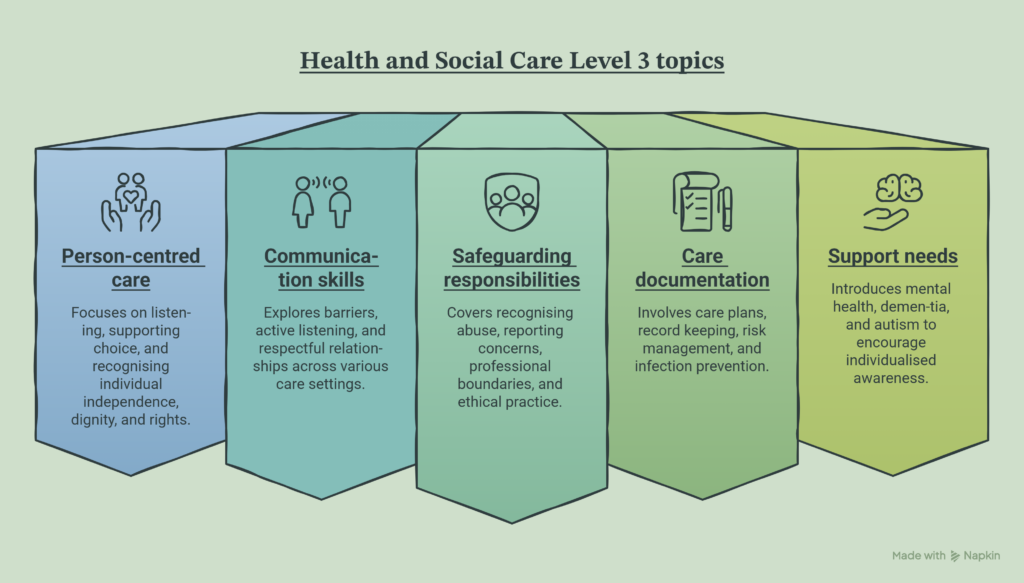
Person-centred care, dignity and independence
A person’s needs matter, but so do their preferences. Person-centred care asks you to listen, support choice and recognise what someone can do for themselves. Imagine helping a person get ready for the day: allowing time for them to choose their clothes or manage part of the routine independently can be as important as finishing the task.
The course examines dignity, rights, equality and individual support needs, giving you a clearer understanding of why care should adapt to the person.
-
Communication and professional relationships
Someone may need more time to answer, a quieter place to speak or information explained in a different way. The course explores communication barriers, listening and respectful relationships. You will consider how to reduce misunderstandings and why a person’s words, behaviour and non-verbal signals can all matter.
These ideas apply across care homes, supported living, community services and healthcare support settings. They also help you think about how to speak with colleagues and share information appropriately.
-
Safeguarding and your responsibilities
Safeguarding includes recognising possible abuse or neglect and knowing why concerns must be recorded and reported through the right channels. You will also study professional boundaries, ethical practice and the responsibilities involved in supporting vulnerable people.
Online learning can help you understand these principles. In a workplace, you should always follow your organisation’s policies and ask for guidance when you are unsure how to respond.
-
Care plans, records and safer practice
A care plan can tell a team about someone’s needs, preferences and agreed support. Good records help colleagues understand what has happened and what may need attention. Related course topics include risk, health and safety, infection prevention and hygiene.
These subjects connect in everyday care. Noticing a change is useful; recording and communicating it correctly can help the right person act on it.
-
Mental health, dementia and different support needs
People do not all experience illness, disability or distress in the same way. The course introduces mental health, dementia, autism and other needs so that you can approach unfamiliar situations with greater awareness. Learning about a condition should make you more curious about the individual, not lead you to assume that everyone wants the same support.
The full Health and Social Care Level 3 curriculum shows the individual modules and learning outcomes. Read it alongside your goals: which topics will help you most right now?
Who is the course for, and do you need experience?
You do not need previous professional care experience or a specific academic qualification to enrol. The course is designed to be accessible to beginners while remaining useful to people who want to refresh their knowledge.
It may be a good fit if you are:
- Exploring work as a care assistant, support worker or healthcare assistant.
- Returning to care after time away or considering a career change.
- Already working in care and looking to update your knowledge or record CPD.
- Volunteering in a care or community setting.
- Supporting a relative and wanting to understand care principles more clearly.
You need to be at least 16, have basic English literacy and be able to access the internet on a computer, tablet or smartphone. You do not need to have your whole career planned before you begin. A course like this can help you find out whether care interests you and which subjects you want to study further.
If you are taking a course because a particular employer has requested training, compare its requirements with the course contents before buying.
How do the online lessons, assessment and tutor support work?
You can work through the lessons whenever it suits you. The listed running time is approximately 12 hours and 53 minutes, but your total study time may be longer if you take notes, revisit a topic or complete additional activities. You have 12 months’ access, so there is room to work at a steady pace.
The required assessment is an automated multiple-choice exam completed online. A score of 60% or higher is needed to pass and become eligible to order your CPD-accredited certificate. The course also provides assignment questions to help you practise what you have learnt; submitted work can receive tutor feedback. Tutor support is available on weekdays for course-related questions.
A simple routine can help: set aside two or three short study sessions each week. After a topic, try explaining its main idea in your own words. If you cannot yet explain why person-centred care or safeguarding matters, revisit the lesson and write down what still feels unclear. That is a more useful way to prepare for the assessment than memorising terms without context.
What is included with enrolment?
When you enrol on the Health and Social Care Level 3 Diploma, you may receive additional learning resources alongside the main course. These extra courses can help you explore related care topics and strengthen your overall understanding.
Here are the courses included in the current offer:
- Care Certificate Course – Standards 1 to 16
- Observation Skills for Carers
- Care Planning and Record Keeping | Health & Safety Online Course
- Safeguarding Vulnerable Adults Training
Together, these make five courses in the current offer. They complement the main diploma: for example, you can learn about recognising a change in wellbeing, keeping clear records and understanding safeguarding concerns through related lessons.
The Care Certificate course teaches about the standards. If you work for a care provider, ask what induction and workplace assessment it requires separately. Gift courses and promotions can change, so confirm what is included today before you enrol.
How much does the Level 3 Diploma cost, and is the certificate included?
The main course is currently advertised at £25 excluding VAT.
The certificate is optional and has a separate charge after you pass the assessment:
| Certificate option | Currently listed price |
|---|---|
| Digital CPD-accredited certificate | £10 |
| Printed CPD-accredited certificate | £29 |
The course page also lists an optional QLS-endorsed Level 3 certificate. Check its current price and terms if you are interested in that option. Review the live course page and checkout for the final amount payable, including VAT where applicable, because offers can change.
Think about the value as well as the price. Will you use the subjects you learn? Does the access period suit your schedule? Would the certificate help you keep a record of your development? Those answers matter more than a headline discount.
Can this course help you take a step towards care work?
If an interviewer asks what person-centred care means, “I want to help people” may be a sincere answer, but you will want to say more. You might talk about listening to someone’s preferences, respecting their dignity and recognising what they can do independently. Studying these subjects can help you prepare for those conversations.
The Level 3 course covers knowledge relevant to people considering roles such as care assistant, support worker, healthcare assistant, community support worker or residential care worker. It can also help existing workers recognise areas where they would like more training.
| Job Role | Short Description | Estimated Salary a Year |
|---|---|---|
| Care Assistant | Supports individuals with personal care, daily activities, mobility and wellbeing. Care assistants often work in care homes, supported living settings or people’s homes. | £20,000–£25,000 |
| Support Worker | Helps individuals with daily routines, independence, emotional wellbeing and accessing community activities. Roles can include supporting adults with disabilities, mental health needs or additional support requirements. | £22,000–£30,000 |
| Healthcare Assistant | Provides practical support to patients and healthcare teams, including personal care, monitoring wellbeing and assisting with daily healthcare activities under supervision. | £25,000–£27,000 |
| Community Support Worker | Supports people within their own homes or local communities by helping them maintain independence, access services and manage everyday tasks. | £22,000–£30,000 |
| Residential Care Worker | Provides care and support for individuals living in residential settings, helping with routines, safety, communication and quality of life. | £22,000–£30,000 |
Employers set their own requirements for experience, checks and workplace training. The National Careers Service care worker profile explains possible routes into care work. Compare that guidance with current vacancies in the setting where you hope to work. Use your course learning to strengthen your understanding and show genuine interest in the role.
What could you study after Level 3?
As you learn more about care, you may discover that certain topics appeal to you: supporting people with more complex needs, helping colleagues or understanding how services are managed. You can choose further study when it meets a clear goal.
- Firstly, the Health and Social Care Level 4 Diploma lets you explore more advanced care topics and professional responsibilities.
- Moreover, the Health and Social Care Level 5 Diploma may interest you if you want to learn more about leadership, supervision and care management.
- Finally, the Level 7 Diploma in Health and Social Care Management offers a later opportunity to explore strategic management subjects.
You do not need to purchase courses in numerical order. Read each syllabus and choose the subjects that match your experience and plans. If an employer has a particular requirement for a role, check it directly.
Seven questions worth asking before you enrol
Before enrolling in the Health and Social Care course, taking time to review the details can help you make a confident choice. The right questions reveal whether the course matches your learning goals, schedule and expectations.
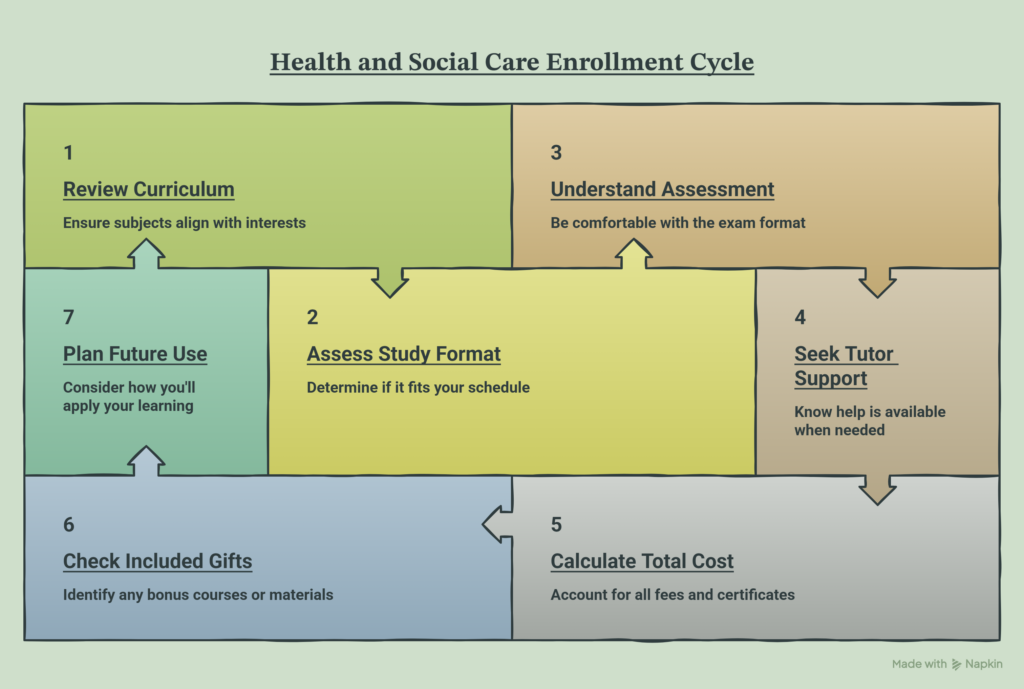
Here are seven questions worth asking before you enrol:
1. Does the curriculum cover the subjects I care about? Read the modules instead of relying only on the course title.
2. Will the study format work with my week? Picture when you could fit in two or three short sessions.
3. How will I be assessed? Be comfortable with the online multiple-choice exam and its 60% pass mark.
4. Can I get help if I get stuck? Know that course-related tutor support is available on weekdays.
5. What will I pay in total? Account for VAT where applicable and any certificate you choose to order.
6. What is included with enrolment today? Check the four advertised gift courses when you visit the course page.
7. How will I use what I learn? You might explore a role, refresh your knowledge or identify a topic for further development.
If those answers fit what you are looking for, explore the Health and Social Care Level 3 Diploma and decide whether it is the right time to start.
Final Thoughts:Ready to take your next step in care?
You do not need to know exactly where your care career will lead. You can start by learning how dignity, safety and good communication shape the support people receive. The Health and Social Care Level 3 Diploma gives you a flexible way to build that understanding, whether you are new to care or returning to the subjects that matter in your current role.
Take a look at the modules and picture how you would fit study into your week. If the course answers the questions you have today, you can begin learning at your own pace.
View the Health and Social Care Level 3 Diploma and current offer
Table of Contents

Frequently Asked Questions
Is the Health and Social Care Level 3 Diploma suitable for beginners?
Yes. The course lists no specific academic prerequisites or previous care experience. You must be at least 16, have basic English literacy and be able to access the online learning materials.
How long does the course take?
The listed lessons run for approximately 12 hours and 53 minutes. You have 12 months’ access, giving you time to make notes, repeat lessons and prepare for the assessment at your own pace.
Can I study while working shifts?
Yes. There are no scheduled classroom sessions for this self-paced online course. You can study whenever you have time during the access period. Tutor support is listed for weekdays.
Is the assessment online?
Yes. You complete an automated online multiple-choice exam and need at least 60% to pass. The course also includes assignment questions you can use to reinforce your learning.
Do I receive a free certificate?
The CPD-accredited certificate is optional and is not included in the advertised £25 course price. After passing, you can currently order a digital copy for £10 or a printed copy for £29. Check the live page for up-to-date charges.
What does CPD accreditation mean here?
CPD stands for continuing professional development. The course is designed to help you develop and record care knowledge. After passing, you can choose a CPD-accredited certificate from the Academy for Health and Fitness as evidence of the learning you completed.
Will taking the course guarantee me a care job?
No course can guarantee a job. This one can help you understand important care principles and prepare to discuss them, while employers decide the experience, checks and workplace training required for each position.