

Medication management in health and social care can unravel with one missed line on a MAR chart. In a 2026 enforcement case, CQC found that one person had missed ten doses of prescribed medicine because the service failed to manage medicines safely. That is not an abstract compliance problem. It shows how a weakness in everyday systems can reach the person receiving care. (CQC)
Medication management in health and social care means managing medicines safely from assessment and storage through administration, recording, review and disposal while protecting each person’s choices and wellbeing. (Nice)
This guide focuses on the points where things most often become unsafe: interruptions, unclear instructions, administration mistakes, contaminated equipment, incomplete MAR records and poor handovers. More importantly, it explains what care workers can notice, check and do before those weaknesses cause harm.

Table of Contents
What Is Medication Management in Health and Social Care?
Medication management covers the whole system around a person’s medicines. It includes identifying what support they need, handling medicines correctly, keeping reliable records, communicating changes and reviewing whether the support still meets their needs. NICE expects social care services to help people take and look after medicines safely while supporting independence wherever possible. (Nice)
What Medication Management Includes
Think beyond the medicine round. Good management may involve:
- Ordering and receiving medicines
- Checking current instructions
- Secure storage
- Supporting or administering doses
- Recording what happened
- Monitoring concerns
- Reviewing medicine support
- Arranging safe disposal
Different workers may handle different parts of that journey depending on their role, training and the person’s care plan.
Medication Management vs Medication Administration
These terms sound similar, but they do not mean the same thing.
| Medication Management | Medication Administration |
|---|---|
| Covers the wider medicines system | Covers giving or supporting a dose |
| Includes storage, records and reviews | Focuses on the administration event |
| Includes communication and disposal | Requires the correct administration checks |
| Continues before and after a dose | Forms one part of medication management |
NICE guidance covers both the wider management process and specific administration requirements. (Nice)
Why Safe Medication Management Matters
A worker can give the right tablet at the right time and still face an unsafe situation if the MAR contains an old dose or nobody communicates a hospital prescription change.
That is why medication safety relies on more than individual memory.
The safest question is not only “Did I give the medicine correctly?” but also “Can I trust the information and system around this medicine?”

Why Medication Errors Happen and How to Prevent Them
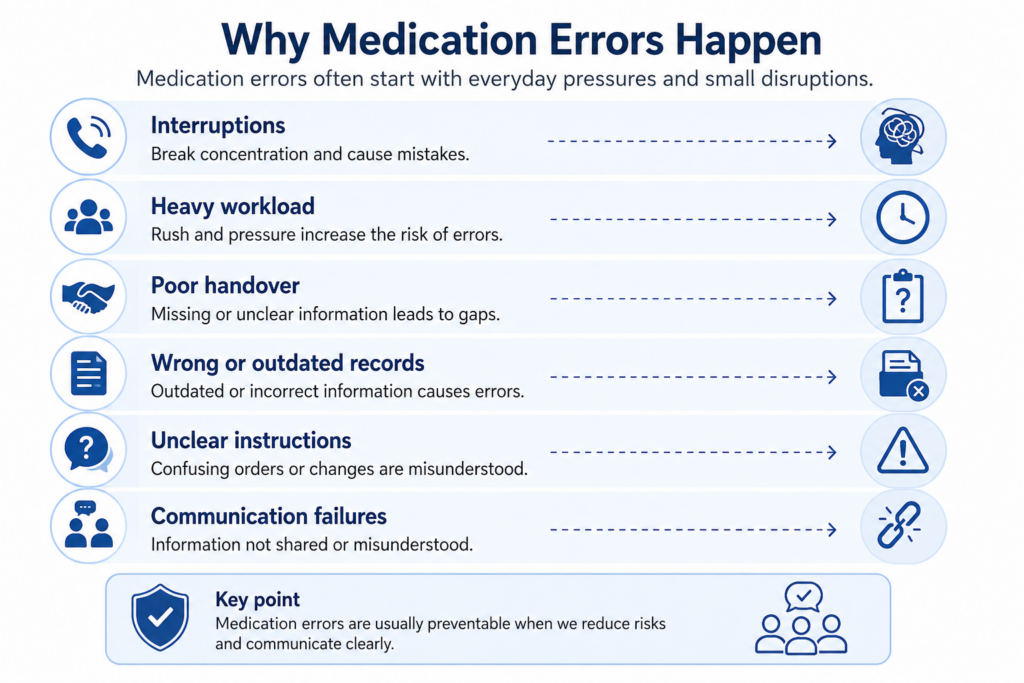
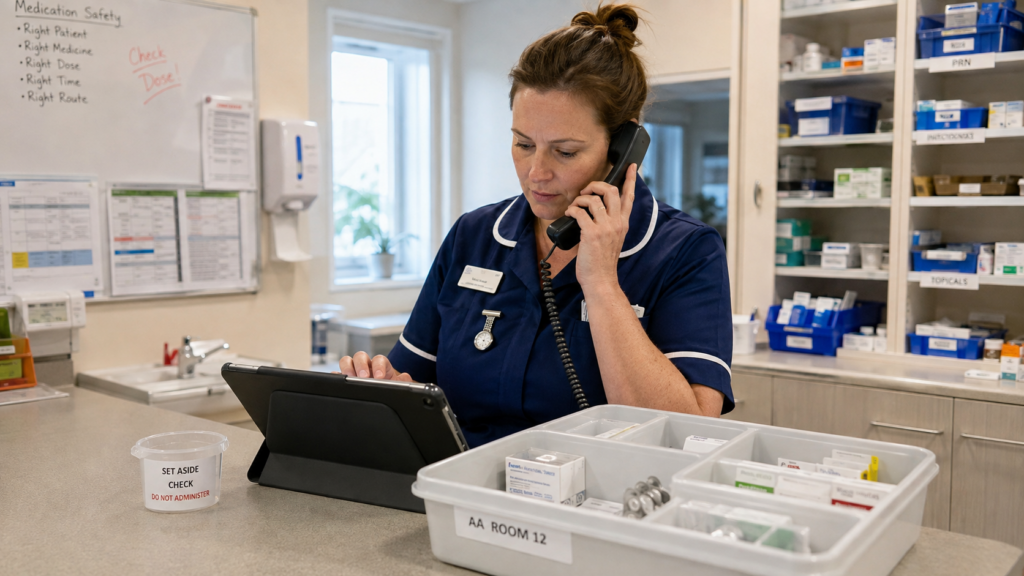
The phone rings halfway through a medicine round. Another resident calls for urgent help. A colleague interrupts with a question. Ten minutes later, the worker returns and has to remember where they stopped.
Medication errors often begin with ordinary moments like these.
England sees an estimated 237 million medication errors each year, according to a government patient-safety review. The same review estimated that around 92 million occur in care homes. (GOV.UK)
Common Medication Errors in Care Settings
A medication error can involve:
- The wrong person or medicine
- The wrong dose, route or time
- A missed dose
- An additional dose
- An incorrect or outdated record
- A prescription change that staff did not communicate clearly
Errors can also enter the process before the medicine round through prescribing, dispensing or inaccurate transcription. A 2026 CQC medicines-management case found that a provider failed to identify medicines that staff had incorrectly transcribed onto a MAR. (CQC)
Human Factors: Interruptions, Workload and Communication
Not every error starts because somebody lacks knowledge.
Interruptions break concentration. Heavy workload encourages rushing. Weak handovers force workers to fill information gaps. Similar routines can also encourage assumption: “This is what the person normally takes.”
That last thought should trigger a check, not confidence.
Practical Ways to Reduce Medication Errors
Teams can make medicine rounds safer when they reduce avoidable interruptions, use current records, clarify unclear instructions and communicate changes immediately.
Staff should also report near misses. A near miss shows where the system nearly failed without waiting for someone to suffer harm.
How to Administer and Support Medication Safely
A resident usually receives two tablets with breakfast. Today, the MAR lists one.
What should the worker do?
Stop and check. Never use yesterday’s routine to fill today’s information gap.
Essential Medication Safety Checks
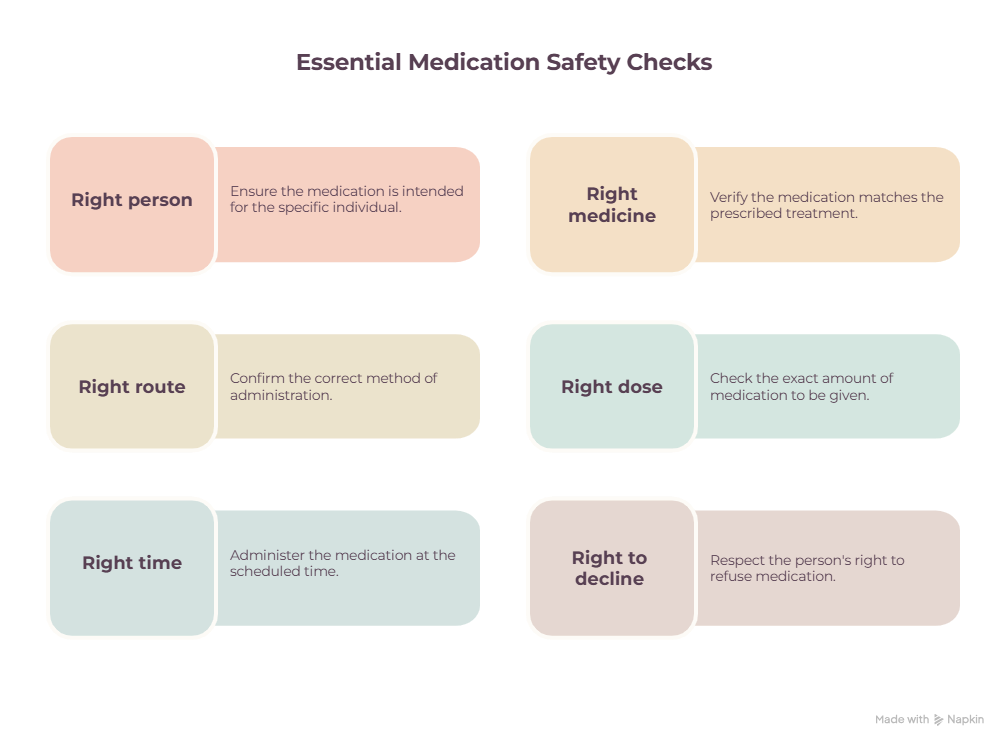
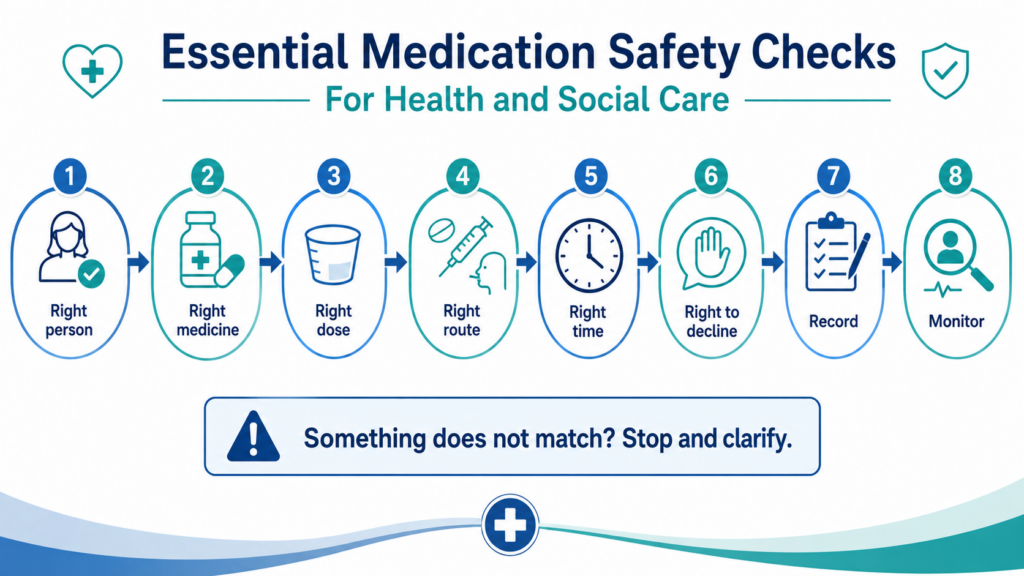
NICE tells social care providers to include six core rights in their medicines procedures:
- Right person
- Right medicine
- Right route
- Right dose
- Right time
- Person’s right to decline
Workers should also check whether the person has already taken the medicine before they provide support. (Nice)
These checks work best when staff treat them as decisions rather than a memorised chant. If one element does not match, do not continue until you understand why.
PRN, Controlled and Higher-Risk Medicines
PRN medicines need particularly clear instructions. Staff need to know why the person may need the medicine, when they can give it, the permitted dose and any relevant limits.
Controlled drugs may require additional storage and record-keeping controls. CQC requires care homes to maintain accurate records of the receipt, administration and disposal of relevant controlled drugs. (CQC)
Consent, Refusal and Mental Capacity
A care worker should never treat refusal as disobedience.
People have a right to take part in decisions about their medicines. Staff should listen, record relevant concerns and follow the care plan or escalation procedure when someone declines medication. NICE places the person’s right to decline within its six administration rights. (Nice)
Training, Competency and Working Within Your Role
Workers should only take on medicine-support tasks that match their training, assessed competence and responsibilities. CQC expects services to assess competency and keep records of those assessments. (CQC)
Safe practice includes knowing when not to proceed.
How Infection Prevention Protects Medication and Patient Safety
A worker can select the correct medicine, confirm the correct dose and still create risk through unclean hands or contaminated equipment.
That is where medication safety and infection prevention meet.
Hand Hygiene During Medication-Related Care
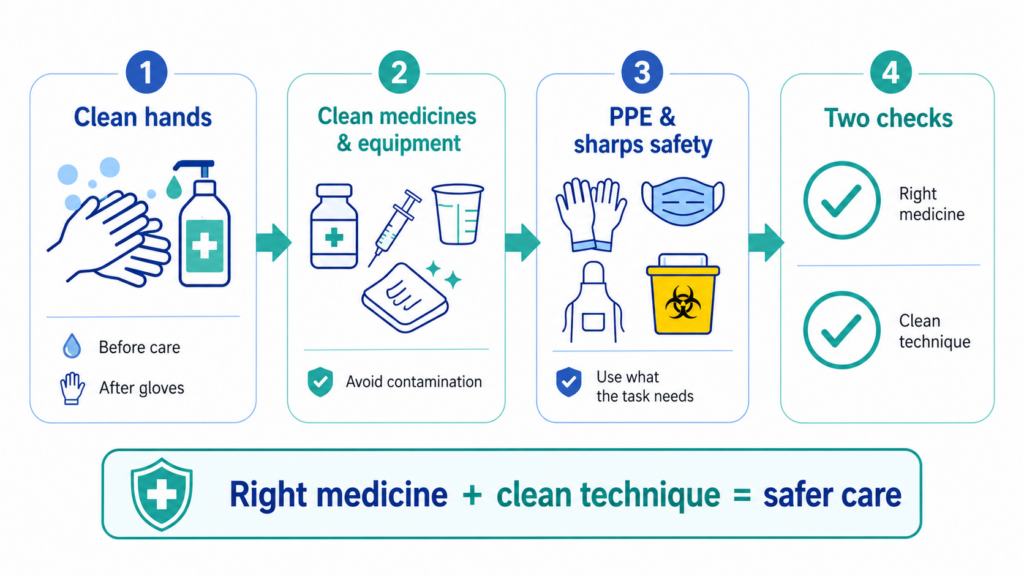
Government guidance tells adult social care workers to clean their hands before clean or aseptic procedures and at other appropriate points during care. Hand hygiene helps stop pathogens moving between people, surfaces and care activities. (GOV.UK)
Gloves do not replace this step. Staff still need appropriate hand hygiene after removing them. (GOV.UK)
Preventing Contamination of Medicines and Equipment
Think about what staff touch during medication-related care:
- Medicine containers
- Oral syringes
- Measuring devices
- Topical products
- Reusable equipment
- Work surfaces
If contaminated hands or equipment move between tasks, they can also move microorganisms.
Government guidance places hand hygiene, PPE, safe care-equipment management, waste handling and sharps safety within standard infection-control precautions. (GOV.UK)
PPE, Sharps and Safe Equipment Use
Staff should choose PPE according to the task and exposure risk rather than use gloves automatically for every medicine round.
Sharps require particular care. Workers should use the appropriate sharps container and handle used sharps in a way that reduces injury and infection risk. Standard infection-control guidance specifically includes safe management of sharps among its precautions. (GOV.UK)
Where Infection and Medication Risks Overlap
Consider a topical medicine applied to damaged skin or medication that requires a needle.
The worker now needs two safety checks at once:
Is the medicine correct?
And:
Can I complete this task without introducing contamination or exposure?
A correct dose cannot make contaminated equipment safe. Clean technique cannot make the wrong medicine safe.
That connection gives medication management its wider patient-safety meaning.
MAR Charts, Records, Storage and Safe Handover
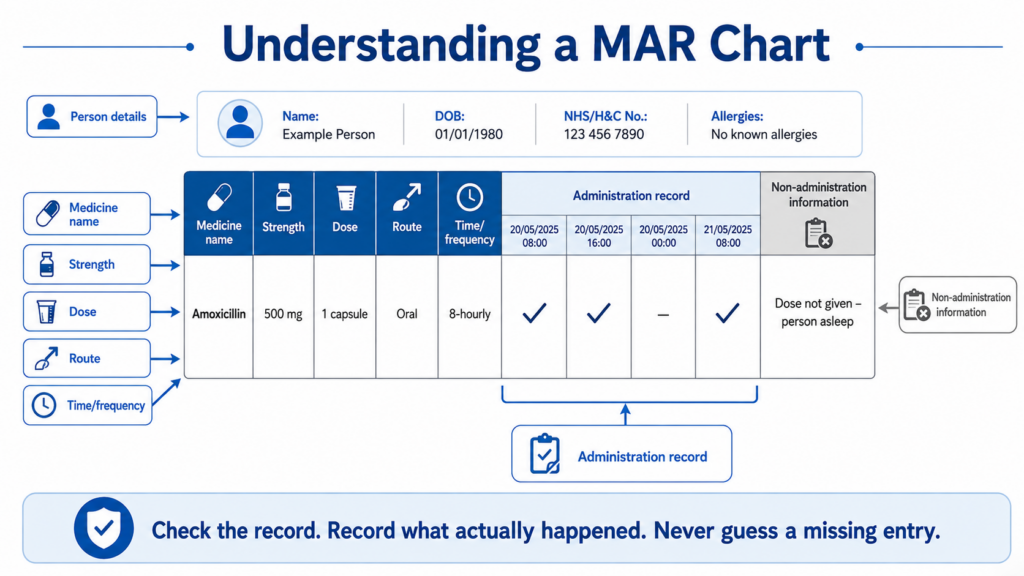
A blank box on a MAR chart creates a simple but dangerous question:
Did nobody give the medicine, did the person refuse it, or did somebody give it and forget to record it?
Good records stop the next worker from having to guess.
MAR and eMAR Records
A Medication Administration Record documents the medicine support a person receives. Services may use paper MAR charts or electronic systems.
CQC requires adult social care providers to keep medicines records secure, accurate and up to date. It links these requirements directly to safe care and good governance. (CQC)
Record what actually happened. Never turn an assumption into a signature.
Common Documentation Problems
Risk increases when records contain:
- Missing entries
- Outdated doses
- Unclear codes
- Incomplete instructions
- Incorrect transcription
- Unexplained medicine changes
CQC has documented real cases where incorrectly transcribed medicines reached the MAR because providers failed to check current prescriptions properly. (CQC)
When information conflicts, stop and resolve the discrepancy rather than choosing whichever instruction looks familiar.
Safe Storage and Disposal
Staff need storage arrangements that keep medicines secure and reduce unauthorised access or mix-ups. Controlled drugs can require additional storage and recording controls depending on their schedule. (CQC)
Medication Reconciliation and Care Transitions
Hospital discharge can create several changes at once: a new medicine, a stopped medicine and a changed dose.
CQC defines medicines reconciliation as checking and accurately listing a person’s current medicines when they enter a service or when treatment changes. (CQC)
Do not assume the old MAR still reflects the current prescription.
Communication During Handover
A useful handover highlights what the next worker needs to act on: new or stopped medicines, dose changes, refusals, recent concerns and unresolved discrepancies.
The next shift should receive clarity, not clues.
What Should You Do After a Medication Error or Near Miss?
You discover that someone received the wrong dose. Your first thought should not be, “Who made the mistake?” It should be, “Is the person safe right now?”
Immediate Actions to Protect the Person
Check what happened, assess the person and follow your service’s medication-error procedure immediately. Seek appropriate clinical advice when the error could affect the person’s health. If someone becomes seriously unwell, use the appropriate urgent or emergency pathway.
Do not try to “fix” the error yourself by changing, skipping or adding another dose unless an authorised healthcare professional gives clear instructions.
Reporting and Recording What Happened
Tell the appropriate manager or medicines lead promptly. Record the facts: what medicine the incident involved, what happened, when it happened, what you observed and what action the team took.
CQC requires providers to notify it when a medicines incident also meets one of its statutory notification criteria; it does not require a CQC notification for every medicines error. (CQC)
Medication Errors, Near Misses and Adverse Drug Reactions
| Term | What It Means | Simple Example |
|---|---|---|
| Medication error | Something goes wrong during the medicines process. | Someone receives the wrong dose. |
| Near miss | Staff catch a mistake before it reaches the person. | A worker spots the wrong medicine before administration. |
| Adverse drug reaction (ADR) | Someone experiences a suspected harmful reaction to a medicine. | A person develops an unexpected reaction after taking it correctly. |
The MHRA’s Yellow Card scheme collects reports of suspected adverse drug reactions and other medicine-safety concerns. (GOV.UK)
Learning From Incidents and Preventing Recurrence
“Be more careful next time” does not solve the cause.
NICE tells providers to identify, report, review and learn from medicines-related problems. (Nice)
Ask what contributed: an interruption, unclear instructions, workload, poor handover, confusing records or a weak procedure?
A near miss gives the team a warning before the same weakness causes harm.
UK Rules and Guidance for Medication Management
Care workers do not need to memorise pages of legislation. However, they do need to understand the rules that guide everyday medication decisions and know where their own responsibilities begin and end.
CQC Regulation 12: Safe Care and Treatment
In England, CQC Regulation 12 requires providers to assess risks, manage medicines safely and protect people from avoidable harm. Importantly, the regulation also covers infection prevention and control, which links medication safety directly with wider patient safety.
In practice, providers must consider risks such as allergies, contraindications and unsafe medicine use when they plan and deliver care. Staff therefore need accurate information before they support or administer medication.
NICE Guidance on Managing Medicines
Alongside CQC requirements, NICE NG67 provides guidance for adults who receive social care in the community. It covers medicines-support assessments, record keeping, administration, communication, medication problems, staff competency and support for independence.
Meanwhile, NICE SC1 focuses specifically on medicines management in care homes. It covers prescribing, handling, administration and the wider systems that support safe medicine use.
Together, these frameworks answer an important practical question:
What should a safe medication-management system look like before something goes wrong?
Organisational Policies and Staff Responsibilities
National guidance sets the standard, but each care provider must turn those expectations into clear workplace procedures. Staff should know what they can do, what they must record and who they should contact when something changes.
A useful medicines policy should explain:
- Who can support or administer medicines
- How managers assess staff competency
- How workers record medication support
- Who staff contact when instructions change
- How the service handles errors and near misses
- How staff store and dispose of medicines safely
For example, if a worker notices an unexpected change in dose, the policy should tell them who to contact and whether they need to pause administration. As a result, staff do not have to make safety-critical decisions from memory.
Clear procedures also help new workers understand where their responsibilities begin and end.
How Good Governance Improves Medication Safety
Managers need to check whether medication procedures actually work during everyday care. Therefore, good governance involves more than writing a medicines policy and filing it away.
For instance, managers may review MAR records, investigate medication incidents, check staff competency and look for repeated errors. In addition, they should act when audits reveal missing records, unclear procedures or recurring communication problems.
CQC expects adult social care providers to maintain appropriate medicines governance and ensure that workers receive suitable training and competency assessment.
Regular review helps managers answer three important questions:
Are staff following the agreed procedure?
Do records show what actually happened?
Are the same medication problems happening repeatedly?
If the answer reveals a weakness, managers should address the underlying cause rather than wait for another incident.
A medicines policy protects people only when staff understand it, managers monitor it and everyday practice matches what the policy says.
Medication Safety Checklist for Care Workers
Use this checklist as a quick pause point, not as a replacement for the person’s current prescription, MAR/eMAR, care plan or your organisation’s medicines policy.
Before and during medication support:
- Confirm the correct person.
- Check the medicine, dose, route and time.
- Check current instructions and known allergies.
- Confirm whether the person has already taken the dose.
- Respect consent and the person’s right to decline.
- Clean your hands at the appropriate time.
- Use clean, suitable equipment.
- Follow specific instructions for PRN and higher-risk medicines.
- Stop when the label, MAR or instruction does not make sense.
- Record what happened promptly and accurately.
- Monitor concerns or unexpected effects.
- Report errors and near misses through the correct process.
NICE includes the right person, medicine, route, dose, time and right to decline within its core administration checks for social care. It also expects services to maintain accurate records and act on medicines-related problems. (Nice)
Why Medication Safety Knowledge Matters for Care Careers
Medication safety knowledge matters across many health and social care roles because workers may support medicines, check records, report concerns or communicate changes. However, responsibilities vary between settings, so staff must understand the medicine task and the limits of their role.
Roles Where Medication Knowledge Is Relevant
Care assistants, healthcare assistants, support workers, domiciliary care workers, senior carers and care team leaders may all encounter medication as part of care. For example, one worker may prompt a person to take their medicine, while another may complete MAR records or report a concern.
A job title alone does not authorise someone to administer medicines. Instead, workers must follow their employer’s procedures and only complete tasks that match their training and assessed competence.
How Medication Knowledge Supports Career Development
As workers take on greater responsibility, they may need knowledge of medication records, consent, medication errors, infection prevention and risk management. Senior staff may also review records, support colleagues or raise concerns when they notice unsafe practice.
Therefore, good medication knowledge supports safer decisions, communication and professional judgement. It can also help workers understand why procedures matter rather than simply following them mechanically.
CPD, Training and Workplace Competence
CPD learning can strengthen knowledge and confidence, especially for workers who want to understand medication safety. However, a CPD certificate does not replace workplace competency assessment, professional registration or a regulated qualification when a role requires one.
HF Online’s Medication Administration Level 4 course covers consent, medication checks, record keeping, storage and disposal. It can support professional development, but learners should always apply that knowledge within their role, training and authority.
That balance protects people and professionals at work.

Final Takeaway: Safer Medication Management Means Safer Care
Medication management in health and social care works best when staff notice small inconsistencies before they become serious problems.
Check the person and medicine. Keep infection risks under control. Record what actually happened. Communicate changes clearly. Report errors and near misses instead of hiding them. Most importantly, stop when the information does not make sense.
NICE places safe medicines support, accurate information and learning from medication problems at the centre of good social care practice, while CQC links safe medicines management directly with preventing avoidable harm. (Nice)
Medication safety does not depend on perfect memory. It depends on strong systems, alert workers and a culture where people speak up early.
Check carefully. Work within your competence. If something looks wrong, stop and ask.
Those habits protect the person receiving care and strengthen the professional judgement that safe health and social care demands.
Frequently Asked Questions
Can Medicines Be Crushed or Mixed With Food?
Not automatically. Some medicines lose their intended release properties or become unsafe when staff crush them. NHS Specialist Pharmacy Service advises checking the specific medicine first; modified-release and gastro-resistant products can create particular problems. (SPS – Specialist Pharmacy Service)
What Should You Do If Medicine Is Dropped or Contaminated?
Do not give it when you cannot confirm its safety. Separate it from usable medicines and follow your organisation’s disposal and replacement procedure. CQC expects every care setting to maintain a written process for surplus, unwanted and expired medicines. (CQC)
Can Care Workers Give Over-the-Counter or Homely Remedy Medicines?
A care home can use homely remedies when its medicines policy sets out a safe process for them. NICE expects the policy to cover non-prescription medicines and over-the-counter products used for minor ailments. (Nice)
Does Medication Administration Always Require a Second Person or Signature?
No. The rule depends on the setting and procedure. For example, CQC states that home-care staff face no legal requirement for a second worker to witness and sign controlled-drug administration or support. (CQC)
Can Staff Act on a Verbal Change to a Medicine or Dose?
A prescriber may communicate an urgent change verbally, but staff should follow a robust local process and obtain written confirmation as soon as possible. NICE specifically addresses verbal medicine changes in social care guidance. (Nice)
Never change a dose because someone simply remembers hearing a different instruction.