

Medication errors in care settings can begin with one small moment: a rushed handover, an outdated MAR entry or a medicine selected while someone interrupts the medication round. The mistake may take seconds, but the consequences can last much longer. A UK government patient-safety review cites approximately 92 million medication errors in care homes due to incorrect administration, showing why clear systems, accurate records and careful checks matter.
Medication errors happen when something goes wrong while staff prescribe, dispense, prepare, administer, monitor or provide advice about medicines. Staff can reduce these errors by checking information carefully, communicating changes clearly, working within their competency and acting promptly when they spot a problem.
This guide explains the common causes of medication errors, the mistakes care workers may encounter and the factors that increase risk. It also covers practical prevention, realistic care scenarios and the immediate steps staff should take when an error occurs. Part 2 then explains reporting, CQC notification, safeguarding, duty of candour, incident records and learning from mistakes.
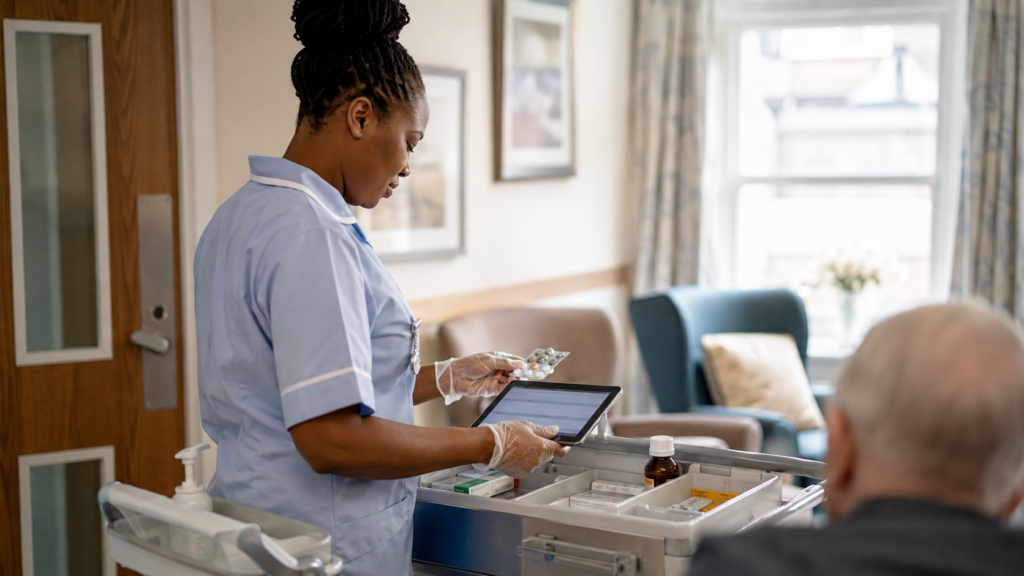
Table of Contents
What Are Medication Errors in Care Settings?
Medication errors in care settings happen when someone makes a mistake during any stage of the medicines process. An error can occur before a care worker even opens a medicine packet. A prescriber might issue an incorrect instruction, staff may work from outdated information, or someone may make a mistake while preparing, administering, recording or monitoring a medicine.
Medication errors do not depend on whether the person experiences harm. Gloucestershire County Council’s medication policy uses the recognised definition of a medication error as an error involving prescribing, dispensing, preparing, administering, monitoring or medicine advice, regardless of whether harm occurs.
What Counts as a Medication Error?
Common examples include:
- Missing a prescribed dose
- Giving an additional dose
- Giving too much or too little medicine
- Selecting the wrong medicine
- Giving medicine to the wrong person
- Using the wrong route
- Giving medicine at the wrong time or interval
- Following an outdated instruction
- Making an inaccurate MAR entry
Medication Error vs Near Miss vs Adverse Drug Reaction
These three terms describe different events:
| Term | What It Means | Example |
|---|---|---|
| Medication error | Someone makes a mistake during the medicines process | A worker gives 10 mg when the current instruction says 5 mg |
| Near miss | Staff catch a potential mistake before it causes harm | A worker spots the wrong medicine before giving it |
| Adverse drug reaction | A medicine causes an unwanted or harmful reaction | A person develops a reaction after taking the correct medicine correctly |
CQC distinguishes adverse drug reactions from medication errors and describes a near miss as an event that causes no harm but has the potential to do so.
Near misses matter because they can expose a weak safety barrier before someone experiences harm.
Common Types of Medication Errors in Care Settings
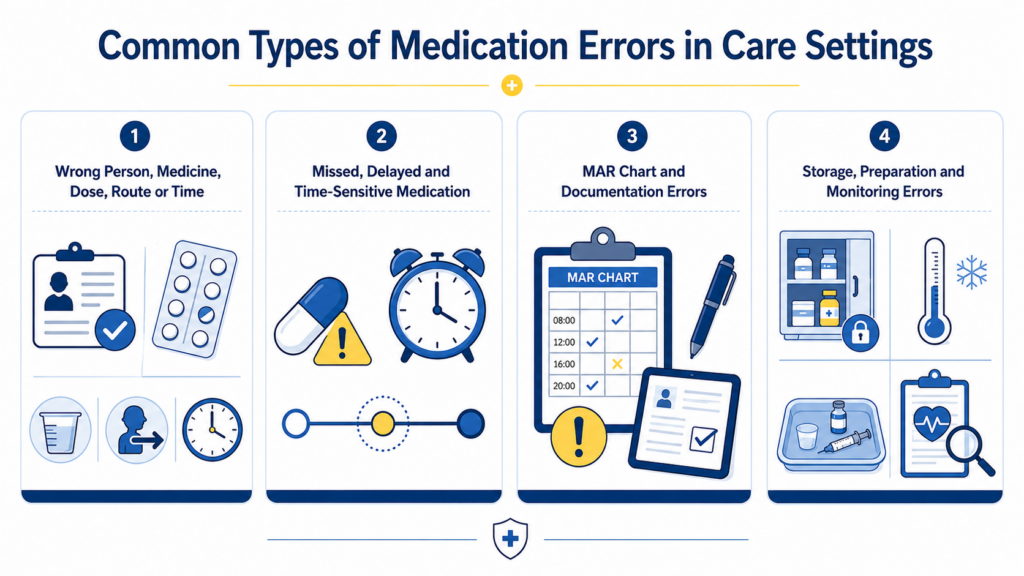
Common medication errors involve more than giving someone the wrong tablet. Mistakes can involve the person, medicine, dose, timing, route, records, preparation, storage or follow-up.
Wrong Person, Medicine, Dose, Route or Time
A worker may select medicine for the wrong person, choose the wrong product, misread the prescribed dose or use a route that does not match the current instructions.
Timing can also affect medicine safety. Some medicines require specific intervals, while others need close coordination with food or other treatment. Staff should always follow the current prescribing instructions and care plan.
Missed, Delayed and Time-Sensitive Medication
A missed dose can occur when someone overlooks a MAR entry, medicine stock runs out or staff misunderstand whether another worker already gave the medicine.
A delay can create greater concern when timing plays an important role in treatment.
MAR Chart and Documentation Errors
A MAR should give staff a clear record of what the person needs and what staff have already administered. CQC requires social care providers to maintain secure, accurate and up-to-date medicines records for each person who receives medicines support.
Common recording problems include:
- Missing entries
- Incorrect doses
- Unclear codes
- Signing too early
- Failing to record a refusal
- Leaving outdated instructions on the MAR
Storage, Preparation and Monitoring Errors
Staff can also create risk when they store medicines incorrectly, use expired stock, prepare a medicine against its instructions or miss required monitoring.
Think of medication safety as a pathway rather than a single task. A mistake can enter that pathway at any stage, and later checks need to catch it before it reaches the person.
What Causes Medication Errors in Care Settings?
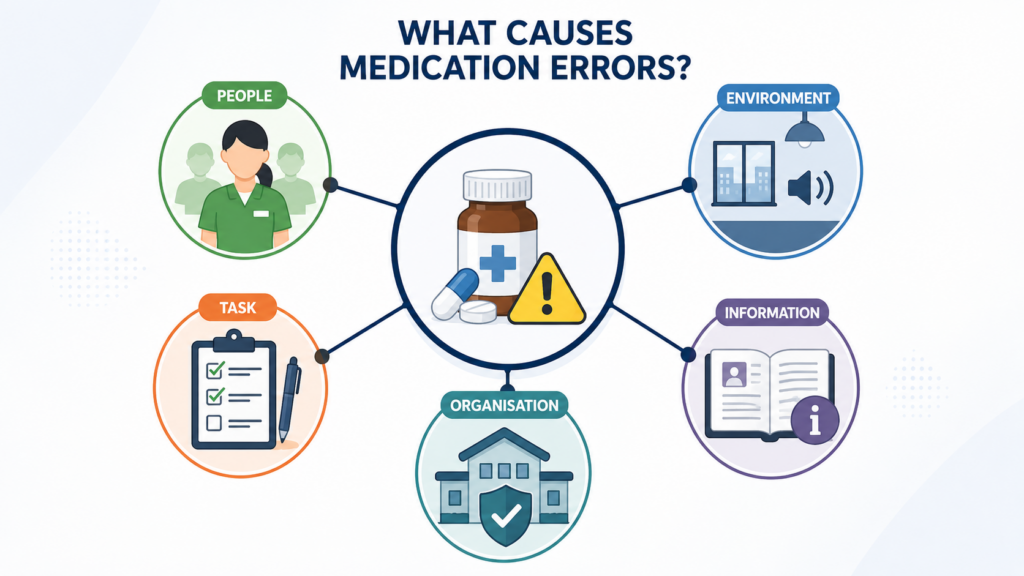
Medication errors rarely come from one careless action. Human, environmental, communication and organisational factors often combine before the final mistake occurs.
Interruptions, Distractions and Workload Pressure
A telephone call, another resident needing help or several competing tasks can break concentration. Staff may also face fatigue, time pressure or demanding workloads.
These pressures do not excuse unsafe practice, but organisations need to understand them if they want to prevent the same type of incident from happening again.
Communication, Records and Care Transitions
Poor communication can turn a correct treatment decision into an unsafe medication error.
For example, a doctor may change a medicine during a hospital stay, but the care service may still hold the previous instructions. CQC advises services to reconcile medicines when people move between services, compare current medicines with discharge information and resolve discrepancies.
Look-alike and sound-alike medicine names can create another risk. The MHRA warns healthcare professionals to take particular care with medicines whose names can cause confusion.
Look Beyond the Final Mistake
A useful review asks broader questions:
| Contributory Factor | Question to Ask |
|---|---|
| People | Did fatigue, workload or lack of experience influence the situation? |
| Environment | Did noise or interruptions affect concentration? |
| Task | Did staff have enough time and clear instructions? |
| Information | Did the MAR, medicine label and current instructions agree? |
| Organisation | Did staffing, communication or procedures create additional risk? |
This systems-based approach helps services identify why the safety barriers failed, rather than stopping at “a worker made a mistake”.
Why Medication Errors Matter in Health and Social Care
Medication errors matter because the same mistake can produce very different consequences depending on the medicine, dose, person and circumstances.
A UK government patient-safety review cites approximately 237 million medication errors each year in England. The scale shows that medicine safety does not depend on one profession or one stage of care; risk can arise during prescribing, dispensing, administration and wider medicine use.
How Can Medication Errors Affect a Person?
A medication error may:
- Interrupt treatment
- Reduce the effectiveness of treatment
- Cause unwanted symptoms
- Worsen an existing condition
- Require additional monitoring
- Require clinical assessment or treatment
- Cause anxiety or distress
- Reduce trust in the care service
- Cause serious harm in higher-risk circumstances
Staff should never decide on their own that an error looks too minor to matter. The medicine involved, the dose, the person’s health and the circumstances all influence the level of risk.
Who May Face Greater Medication-Related Risk?
Some people need particularly careful medication support. CQC highlights risks for older people, people with reduced mental capacity, people with sensory or mobility impairments and people who rely on others to support them with medicines.
Complexity can also increase when someone takes several medicines or moves between different health and social care services.
Key takeaway: Treat the person and the circumstances as the priority. Do not judge the seriousness of an error from the mistake alone.
Examples of Medication Errors in Care Settings
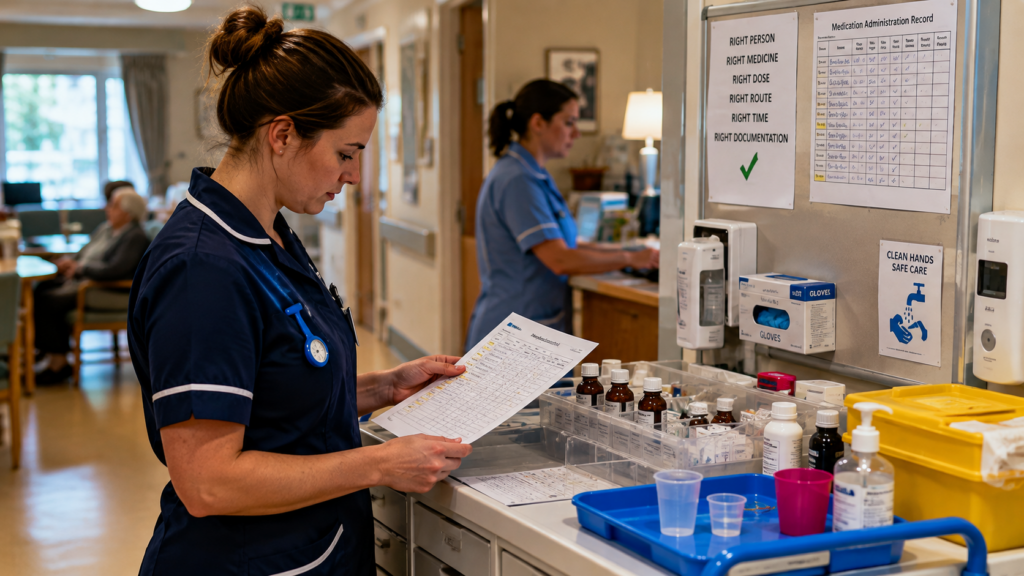
Realistic medication error examples show how several small problems can combine during everyday care.
Scenario 1: A Missed or Delayed Dose
During the morning medication round, Maya leaves briefly to respond to an urgent concern. Later, she notices that Mr Khan’s medicine still shows as outstanding. She does not simply give the dose late. She checks the information and seeks the appropriate advice.
Scenario 2: Medicine Given to the Wrong Person
Two residents have similar names. Daniel realises immediately after administration that he selected medicine for the wrong resident. He reports the mistake straight away and seeks clinical advice rather than waiting for symptoms.
Scenario 3: An Incorrect MAR Chart Entry
Ella marks a dose as complete. Another worker later finds the medicine still in its packaging. The incorrect MAR now creates another risk because someone may trust the record and make the wrong decision.
Scenario 4: An Outdated Record After Hospital Discharge
A resident returns from hospital after a clinician changes her medicine dose. The care notes contain the change, but the MAR still shows the previous dose. Medicines reconciliation should identify and resolve discrepancies when people move between services.
What Can a Real CQC Safety Incident Teach Us?
CQC describes a case where a provider’s systems failed to identify missed medication for between 30 and 33 days. The man later died from a pulmonary thromboembolism.
The case highlights two separate safety questions:
How can we prevent the original mistake?
How quickly can our systems detect it if prevention fails?
Strong medication safety needs both prevention and detection.
How to Prevent Medication Errors in Care Settings
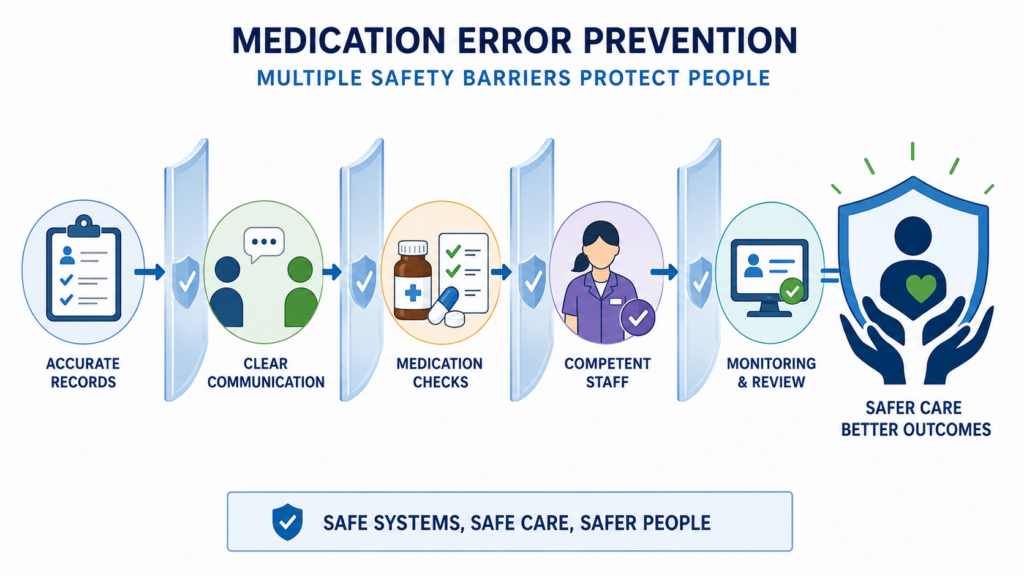
Preventing medication errors requires more than telling staff to “be careful”. Care services need several safety barriers to work together: reliable information, clear communication, competent staff, accurate records and sensible working conditions.
Practical Medication Error Prevention
| Safety Measure | How It Reduces Risk |
|---|---|
| Use consistent medication checks | Staff verify the person, medicine, dose, route, time and current instructions |
| Keep MAR records current | Staff avoid decisions based on outdated or missing information |
| Reduce unnecessary interruptions | Staff can concentrate on medicines tasks |
| Reconcile medicines after transitions | Teams identify discrepancies after admission, discharge or treatment changes |
| Manage stock and storage carefully | Teams reduce missing, expired or incorrectly stored medicines |
| Check staff competency | Employers confirm that staff can carry out their medicines responsibilities safely |
CQC requires providers to maintain accurate medicines records, while its guidance tells services to review medicines carefully when people move between care settings.
Can eMAR and Digital Technology Reduce Medication Errors?
Electronic MAR systems can support medicine records, prompts, notes and monitoring. CQC lists information about the person, medicines support and note-taking among common eMAR functions.
Digital technology still needs careful human oversight. CQC inspections have found services where eMAR systems contained errors or failed to prevent continuing administration mistakes.
Safety principle: Use eMAR as another safety barrier, not as an autopilot system.
Staff should question conflicting information, communicate medicine changes clearly and follow the organisation’s current medication procedures.
What Should You Do Immediately After a Medication Error?
When a medication error happens, protect the person first and investigate the causes afterwards. Staff need to act quickly, stay factual and follow the organisation’s medication and incident procedures.
What Should You Not Do After a Medication Error?
- Do not hide the mistake.
- Do not wait for symptoms before seeking advice.
- Do not alter a MAR or eMAR entry to conceal what happened.
- Do not guess what clinical action the person needs.
- Do not blame another worker before anyone reviews the facts.
- Do not ignore a near miss simply because nobody experienced harm.
How Should Care Staff Report Medication Errors?
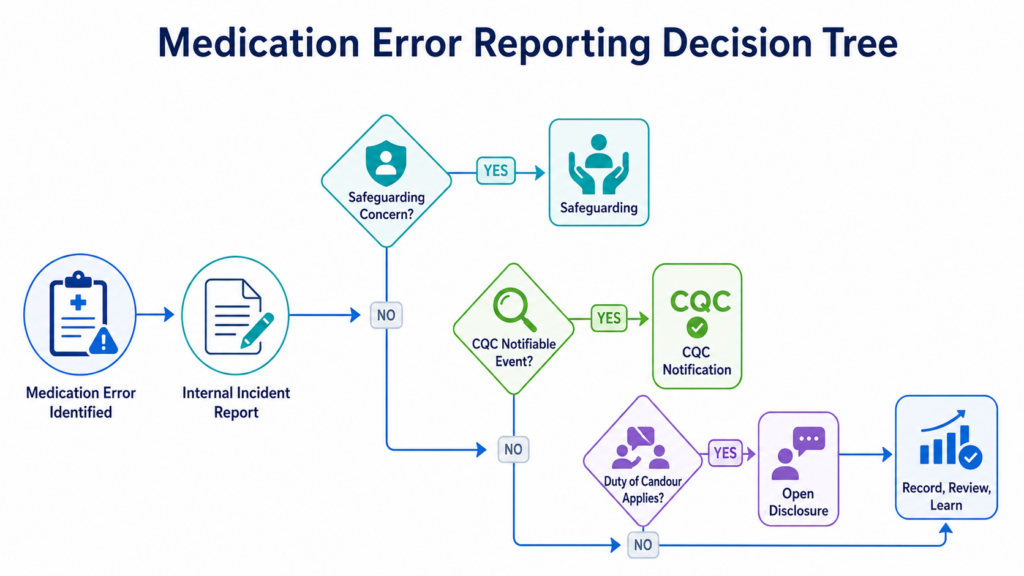
Care staff should report medication errors through their organisation’s incident procedure as soon as they have protected the person and sought appropriate clinical advice. Managers can then assess the incident, arrange follow-up and decide whether they need to escalate the concern.
Importantly, a medication error does not automatically require a CQC notification. CQC tells providers to notify it when a medicines error causes another notifiable event, such as death, serious injury, abuse or alleged abuse, or an incident involving the police.
| Reporting Route | When Staff or Providers Should Consider It |
|---|---|
| Internal incident reporting | Staff follow the provider’s medication and incident procedures |
| Safeguarding | Managers consider safeguarding when abuse, neglect, repeated failures or serious unsafe practice may have contributed |
| CQC notification | The registered provider notifies CQC when the incident meets a statutory notification requirement |
| Duty of candour | The registered person follows the Regulation 20 process when the event meets the definition of a notifiable safety incident |
When Does a Medication Error Become a Safeguarding Concern?
One medication error does not automatically amount to abuse or neglect. Managers should consider the circumstances, harm, repeated incidents, staff actions and wider systems before deciding how to escalate the concern. CQC’s safeguarding regulation requires providers to protect people from abuse and improper treatment.
Duty of Candour After a Medication Error
The duty of candour requires CQC-regulated providers to act openly and transparently with people who receive care. When an incident meets Regulation 20’s definition of a notifiable safety incident, the registered person must start the formal process as soon as reasonably practicable, explain what happened and provide the required apology and follow-up.
Reporting principle: Record the incident internally, assess whether safeguarding or statutory notification applies, and never assume that one reporting route automatically covers every responsibility.
What Should Staff Record After a Medication Error?
A strong medication incident record should allow someone who was not present to understand what happened, what staff observed, what action they took and what advice they received.
CQC requires adult social care providers to maintain secure, accurate and up-to-date medicines records. Care workers should also record each occasion when they provide medicines support.
What Information Should Staff Include?
Record the relevant facts, such as:
- The person involved
- The medicine and dose
- The date and time
- What staff discovered
- What the person received or missed
- The person’s condition
- Who staff contacted
- What advice they received
- What action they took
- Which managers or professionals they informed
- Any monitoring or follow-up instructions
Staff should also complete the relevant MAR or eMAR entry and the organisation’s incident documentation according to local procedures.
Write Facts, Not Assumptions
| Clear, Factual Record | Avoid |
|---|---|
| “The MAR showed no entry for the 08:00 dose.” | “Someone forgot the medicine.” |
| “Mrs Ali reported dizziness at 10:15.” | “The medication error caused her dizziness.” |
| “The pharmacist advised staff to monitor her.” | “She looked fine, so the mistake was harmless.” |
| “Staff informed the manager at 10:25.” | “Management knew what happened.” |
CQC identifies inaccurate records, unclear records, missing administration entries and signing for medicines that staff have not administered as medicines-management errors.
A factual record protects the person receiving care and gives managers reliable information for the later incident review.
Learning From Medication Errors and Near Misses
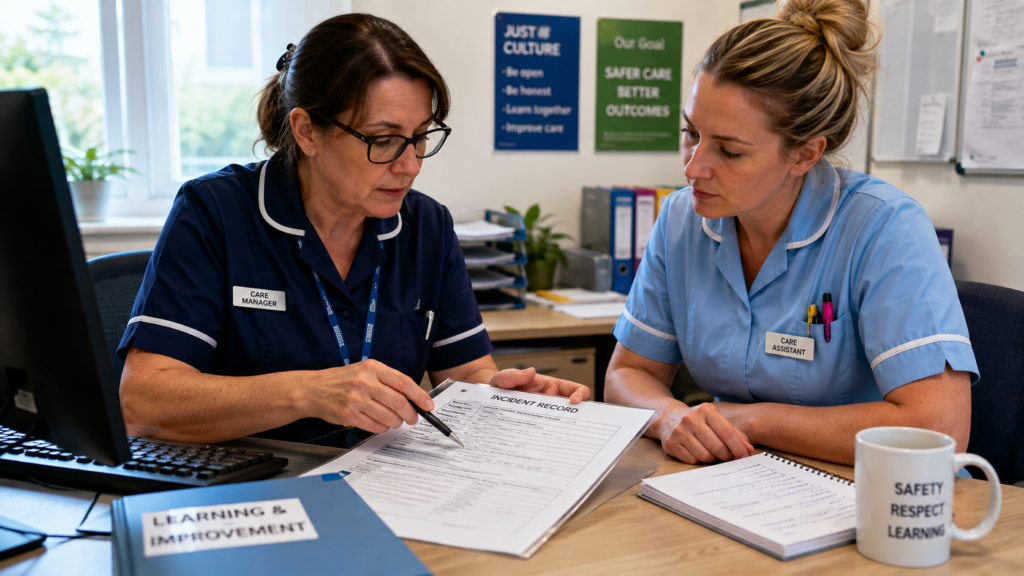
Reporting tells an organisation what happened. Learning asks a more important question: why did it happen, and what needs to change?
A worker may make the final error, but several earlier problems may have shaped the situation. An outdated MAR, poor hospital handover, interruption, unclear procedure or weak checking system may all contribute.
CQC’s current adult social care safety-learning resources use real incidents to show how weaknesses in medicines systems can lead to harm. In one 2026 example, a provider failed to identify incorrect transcription of prescribed medicines onto a MAR and failed to check whether staff followed its medicines policy.
Look Beyond Individual Blame
A useful review asks:
- What happened before the error?
- Did staff have clear and current information?
- Did interruptions or workload influence the situation?
- Did communication fail?
- Did the worker have suitable training and competency?
- Did the procedure give staff enough protection?
- Could another worker make the same mistake under similar conditions?
Looking beyond the final action does not remove accountability. It helps managers identify both individual and system factors.
Turn Learning Into Safer Practice
A simple improvement cycle works well:
Identify what happened → examine contributory factors → agree actions → check whether the changes work
A service might improve handovers, update MAR procedures, review staffing arrangements, strengthen audits or reassess staff competency.
Near misses also deserve attention. CQC defines a near miss as an event that causes no harm but has the potential to do so.
A near miss gives a care team a warning without the harm. The value comes from acting on that warning.
Medication Error Prevention Checklist for Care Workers
Medication safety works best when care workers use consistent checks and speak up whenever information does not look right.
Before Supporting or Administering Medication
- Check the correct person.
- Check the current medicine.
- Confirm the dose, route and timing.
- Compare the medicine with the current MAR or eMAR.
- Look for recent prescription or discharge changes.
- Check relevant expiry and storage information.
- Clarify conflicting instructions before continuing.
- Reduce avoidable distractions where possible.
During and After Medication Support
- Follow the current care plan and medicines procedure.
- Record the action promptly and accurately.
- Never sign for a medicine before completing the required task.
- Follow any monitoring instructions.
- Raise unexpected concerns promptly.
If an Error or Near Miss Occurs
- Protect the person.
- Seek appropriate clinical advice.
- Inform the responsible senior worker.
- Record the facts.
- Complete the organisation’s incident process.
- Follow any monitoring instructions.
- Escalate safeguarding concerns when necessary.
- Help the organisation review what happened.
Why Medication Safety Knowledge Matters for Care Careers
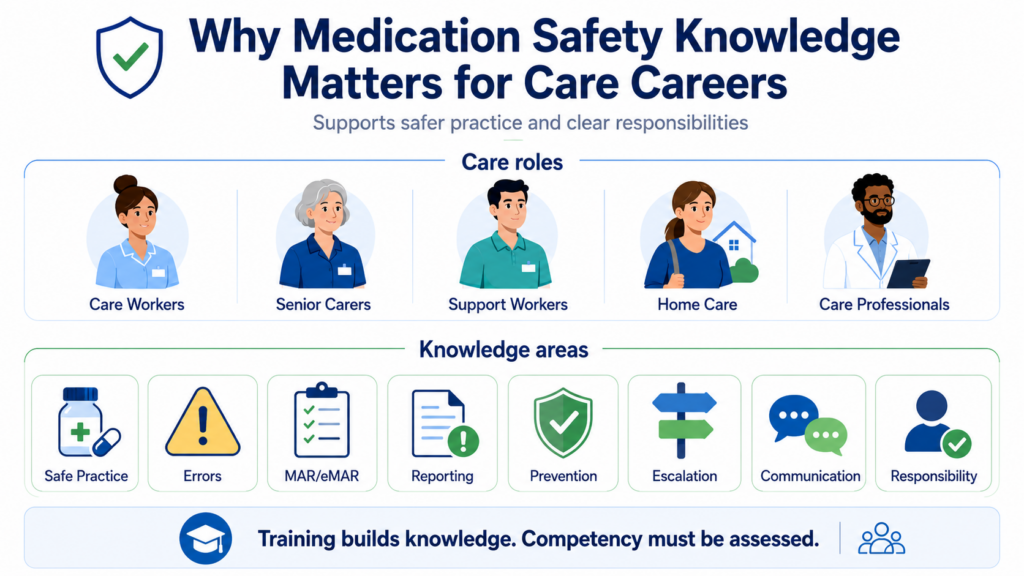
Medication safety knowledge helps care workers recognise risks, respond to incidents and communicate concerns clearly. Staff in residential care, domiciliary care, supported living and similar settings may work with MAR records, missed doses, medication changes or reporting procedures.
The exact responsibilities depend on the worker’s role, employer and assessed competency. Understanding medication safety does not give someone automatic authority to administer medicines, but it can help them recognise when something looks wrong and when they need to seek advice.
Training, Competency and CPD Development
| Learning Area | Why It Matters |
|---|---|
| Medication errors | Helps staff recognise common mistakes and risks |
| MAR and eMAR records | Supports clearer and more accurate documentation |
| Incident reporting | Helps staff understand when and how to raise concerns |
| Error prevention | Builds awareness of checks that can reduce risk |
| Escalation procedures | Helps staff know when to seek further support |
| Monitoring | Encourages staff to notice and report relevant changes |
CQC expects providers to make sure staff have suitable knowledge, skills and competence for their medicines responsibilities. Employers should assess competency before staff carry out medication duties and review training needs when incidents or changes in practice make this necessary.
CPD learning can therefore strengthen medication-safety knowledge, while workplace competency assessments determine what tasks an employee can safely perform.
The key professional habit is simple: check the information, recognise risk, work within your responsibilities and ask for help when something does not look right.
Final Takeaway: Report, Learn and Prevent Medication Errors
Medication errors in care settings need more than a quick correction. Safe care depends on recognising the problem, protecting the person, seeking appropriate advice, recording the facts and reporting the incident through the correct route.
Strong care teams also ask what happened before the final mistake. They examine communication, records, workload, competency, medicine changes and organisational systems. CQC continues to use medicines-related safety incidents to show providers how failures in checking, recording and monitoring can expose people to avoidable risk.
Frequently Asked Questions
What Is the Most Common Medication Error in Care Settings?
No single error leads in every service. Common incidents include missed doses, incorrect doses, wrong medicines, timing mistakes and inaccurate medication records. Providers should review their own incident patterns.
What Should a Care Worker Do If They Make a Medication Error?
Act immediately. Protect the person, seek appropriate clinical advice, tell the responsible senior worker, record the facts and follow the organisation’s incident procedure.
Should Staff Report All Medication Errors?
Staff should follow their provider’s reporting procedure. Recording and reviewing medication errors and near misses helps services identify risks and improve safety.
Does Every Medication Error Create a Safeguarding Concern?
No, not automatically. Managers should consider harm, neglect, repeated failures, unsafe practice and the circumstances surrounding the incident.
What Is a Medication Near Miss?
A near miss causes no harm but could have done so. Staff should still use it as an opportunity to identify and correct safety weaknesses.
What Does Duty of Candour Mean After a Medication Error?
Providers must act openly and transparently. When an incident meets the Regulation 20 threshold, the registered person must follow the formal duty-of-candour process.
Can an Employer Discipline a Care Worker for a Medication Error?
An employer can investigate the incident. Before disciplinary action, employers should follow their disciplinary procedure, explain the concerns and give the worker an opportunity to respond.
Who Reports Medication Errors in a Care Home?
Care staff report internally according to provider policy. The registered person handles any required CQC notification or wider regulatory escalation.
When Must a Provider Notify CQC About a Medication Error?
Not simply because an error occurred. The provider must notify CQC when the medication error causes a separately notifiable event, such as death, serious injury, abuse or police involvement.