

Level 2 vs Level 3 Health and Social Care: Which Should You Choose?
Level 2 vs Level 3 Health and Social Care can feel confusing when both courses appear to cover care, safeguarding, communication and professional responsibilities. So which should you choose? If you are building your knowledge from the beginning, a Health and Social Care Level 2 Diploma may provide a useful foundation. For learners who already understand care principles or want deeper professional development, a Health and Social Care Level 3 Diploma may suit the next step better. Therefore, check the course type and regulatory status before assuming that every course carrying a Level 2 or Level 3 title is a regulated qualification.
Demand for people with care knowledge remains significant. England had around 1.69 million adult social care posts in 2025/26, including about 96,000 vacancies. Skills for Care also estimates that the sector could need another 410,000 posts by 2040 to keep pace with population changes.
In this guide, you will see how health and social care Level 2 differs from health and social care Level 3, what their qualification levels mean, what you may study and what employers may expect. We will also explain diplomas, CPD courses, regulated qualifications, entry requirements, online study, jobs, salaries, UCAS points and progression towards Levels 4 and 5.
Ready to make a choice? Start by matching the level, course type and assessment method to the outcome you actually need.

What Do Health and Social Care Qualification Levels Actually Mean?
A qualification level mainly tells you about difficulty, not simply how long a course lasts or how valuable it is.
The regulated qualification framework runs from Entry Level to Level 8. GOV.UK explains that the higher the level, the greater the difficulty. Level 2 includes qualifications such as GCSEs at grades 4–9, while Level 3 includes A levels and various vocational qualifications. Levels 4 and 5 sit above Level 3 and include qualifications such as higher national certificates, foundation degrees and certain diplomas.
However, this creates an important trap.
For this reason, two health and social care qualifications described as Level 3 do not automatically contain the same amount of learning, assessment or workplace evidence. Level tells you about challenges. Qualification size tells you how much learning is involved. The qualification type tells you what you actually complete.
Therefore, before choosing between health and social care qualifications, compare these four points:
-
The qualification level:
First, check the level because it indicates the difficulty and complexity of the learning. Level 2 usually develops foundational knowledge, while Level 3 demands more advanced understanding. However, the level alone does not tell you the course size, purpose or how the course is assessed.
-
The total size or learning hours:
Next, check how much learning the qualification contains. Two Level 3 qualifications can cover different amounts of material. Ofqual’s framework separates level from size, so compare guided learning, qualification time and credit values where the qualification specification provides them.
-
The assessment requirements:
Then, find out how the provider measures achievement. A course may use assignments, examinations, observation or workplace evidence, depending on its purpose. This matters in health and social care because knowledge-based learning and ability to perform the role can involve very different forms of assessment.
-
Whether the qualification appears on the regulated qualifications register:
Finally, verify its status through the GOV.UK Register of Regulated Qualifications. The register shows whether a qualification is regulated and provides details. This check helps you separate officially regulated qualifications from courses that use similar-sounding titles.
In short, the right qualification depends on its level, size, assessment and whether it is regulated —not simply the number in its title.
Level 2 vs Level 3 Health and Social Care: What Are the Key Differences?
The main difference between Level 2 and Level 3 Health and Social Care comes down to learning depth, complexity and progression. Level 2 usually builds essential knowledge for beginners, while Level 3 develops that knowledge further and may suit learners with prior study or care experience. However, the exact content, assessment and workplace requirements depend on the specific course or qualification. Therefore, always compare the full course details before choosing your level.
To make the distinction clearer, start with what each level usually represents:
-
Level 2 Health and Social Care:
Level 2 focuses on core care knowledge, including communication, safeguarding, duty of care, equality and health and safety. It often suits beginners who want to build confidence before progressing to more advanced study.
-
Level 3 Health and Social Care:
Level 3 develops a deeper understanding of care responsibilities, decision-making and professional practice. It may suit experienced learners or people seeking progression, although specific entry, assessment and workplace requirements vary between qualifications.
Level 2 vs Level 3 Health and Social Care Comparison
|
Comparison Point |
Level 2 Health and Social Care |
Level 3 Health and Social Care |
|
Difficulty |
Builds foundational knowledge and introduces essential care principles. |
Covers more complex ideas and expects deeper understanding. |
|
Learning depth |
Focuses on recognising and explaining core care concepts. |
Explores analysis, professional judgement and wider responsibilities. |
|
Typical learner |
Often suits beginners or learners starting a care pathway. |
May suit learners with existing knowledge, experience or progression goals. |
|
Course content |
Commonly includes communication, safeguarding, equality and safety. |
May cover advanced safeguarding, care planning, risk and professional responsibility. |
|
Assessment |
May include quizzes, assignments or knowledge-based tasks. |
May involve detailed assignments, observations or workplace evidence, depending on the qualification. |
|
Responsibility |
Supports understanding of everyday care duties. |
May connect more closely with senior, lead or supervisory responsibilities. |
|
Career progression |
Can support progression towards Level 3 learning. |
Can support movement towards Levels 4 and 5 or more responsible care roles. |
Ultimately, choose Level 2 or Level 3 according to your current knowledge, career goal and the exact qualification requirements.
Level 2 Diploma vs Level 3 Diploma in Health and Social Care: What Is the Difference?
A Level 2 diploma in health and social care usually develops foundation-level care knowledge, while a Level 3 diploma in health and social care generally covers more complex learning and responsibility. However, the word “diploma” does not automatically confirm Ofqual regulation, workplace competence or a particular qualification size. Therefore, compare the awarding organisation, assessment model, regulatory status and progression route before deciding which health and social care diploma matches your career goals best.
To understand the difference more clearly, first consider what each diploma level generally represents:
Level 2 Diploma in Health and Social Care:
Level 2 learning usually introduces essential care principles, including safeguarding, communication and person-centred support. For example, it can suit beginners building core knowledge, although exact assessment, workplace requirements and regulatory status depend on the specific qualification.
Level 3 Diploma in Health and Social Care:
Level 3 normally develops greater depth, analysis and professional responsibility. In addition, it can support more advanced learning or career progression, but learners should check entry requirements, workplace assessment, awarding organisation and regulatory status before enrolling.
Level 2 Diploma vs Level 3 Diploma in Health and Social Care Comparison
Comparison Point | Level 2 Diploma | Level 3 Diploma |
Qualification level | Builds knowledge at Level 2 difficulty and usually establishes core care concepts. | Develops learning at Level 3 difficulty with greater complexity and depth. |
Typical learner | Often suits beginners or people developing an initial understanding of care. | Often suits learners with previous study, experience or stronger progression goals. |
Learning depth | Focuses more heavily on essential principles and everyday care responsibilities. | Explores more detailed professional responsibilities, decision-making and care practice. |
Qualification size | Varies between qualifications, so learners must check total qualification time and credits. | Also varies; Level 3 does not automatically mean a larger qualification. |
Assessment | May include assignments, tests, observations or workplace evidence. | May require more detailed assessment and occupational evidence, depending on the qualification. |
Workplace requirements | Some occupational qualifications require access to a suitable care setting. | Competence-based Level 3 routes may require workplace observation and evidence. |
Progression | Can support progression towards suitable Level 3 learning. | May support progression towards Level 4, Level 5 or more responsibility at work. |
Regulatory status | Check the exact title and awarding organisation before assuming regulation. | Likewise, “Level 3 Diploma” alone does not prove Ofqual-regulated status. |
Ultimately, compare the exact diploma, not just its level, because regulation, assessment, workplace evidence and progression determine its real suitability.
Level 2 and Level 3 Health and Social Care Entry Requirements: Can You Skip Level 2?
Yes, you can sometimes start Level 3 without first completing level 2 in health and social care. No single entry rule covers every health and social care course. The exact qualification, awarding organisation, training provider, funding route and assessment requirements determine whether you can apply. In addition, some occupational qualifications also require learners to show that you can perform the required tasks in a care setting. Therefore, before applying, check the provider’s entry criteria and confirm whether your existing qualifications, care experience and workplace access meet the programme requirements.
When checking Health and Social Care Level 2 and Level 3 entry requirements, consider these five areas before enrolling:
Check entry qualifications and prior learning:
First, review any qualifications, training or relevant learning you already have. Recognition of Prior Learning may allow providers to recognise knowledge or previous achievement that meets parts of a qualification, although awarding organisations set rules on how providers can apply RPL.
Assess English and maths ability:
Next, check whether the provider sets English or maths requirements. Strong literacy and numeracy help learners understand care terminology, follow written guidance, interpret information and complete assessments. However, exact requirements vary, so always check the specific programme rather than assuming universal grades.
Consider age and employment status:
Additionally, check whether age, employment or funding conditions affect entry. Some funded programmes apply eligibility rules to particular groups. For example, Skills for Care states that eligible non-regulated care staff must be over 19 for certain Level 2 qualification funding arrangements.
Review relevant care knowledge and experience:
Then, consider what you already know about safeguarding, communication, person-centred care and professional responsibilities. Relevant experience can strengthen your foundation for higher-level study, but providers may still set specific entry criteria according to the qualification and intended career purpose.
Confirm access to a suitable care workplace:
Finally, ask whether the qualification requires observation or workplace evidence. Skills for Care applies assessment principles to current adult social care qualifications, including the Level 3 Diploma in Adult Care, so occupational assessment may require evidence of competence rather than knowledge alone.
For current qualification pathways, check the official Skills for Care qualifications guidance.
Ultimately, progression from Level 2 to Level 3 Health and Social Care can help, but your chosen qualification determines the actual entry route.

What Do You Learn at Level 2 vs Level 3 Health and Social Care?
A Level 2 Health and Social Care course usually develops core knowledge about safe, respectful and person-centred care, while Level 3 learning normally explores similar areas in greater depth. For example, learners may study communication, safeguarding, duty of care, equality, health and safety, risk and record keeping. However, exact content varies between qualifications. Skills for Care’s current Level 2 and Level 3 adult care frameworks show how learning can progress from essential knowledge towards greater professional judgement, responsibility and occupational competence.
To understand that progression, compare how these ten important learning areas can develop across Level 2 Health and Social Care and Level 3 Health and Social Care:
Communication:
First, learners develop clear, respectful communication skills and understand confidentiality. At greater depth, they examine communication barriers, individual preferences and information handling, helping them communicate appropriately with people, colleagues and other professionals across different care situations.
Safeguarding:
Next, learners explore how to recognise abuse, neglect and unsafe practice and understand reporting procedures. More advanced learning strengthens awareness of safeguarding responsibilities, responding to concerns and following agreed procedures while protecting an individual’s rights and wellbeing.
Duty of care:
Learners also examine their responsibility to support people safely and respectfully. As their knowledge develops, they consider conflicts, complaints, mistakes and difficult decisions, while understanding when they should seek guidance rather than work beyond their responsibilities.
Person-centred support:
In addition, learners study how individual choices, needs, values and preferences should influence care. Greater depth encourages them to consider active participation, independence, consent and changing needs instead of applying the same approach to everyone they support.
Equality and diversity:
Learners build awareness of equality, inclusion and discrimination and consider how personal values can affect care. Later learning can develop their ability to challenge unfair treatment, respect cultural differences and promote inclusive approaches within everyday practice.
Health and safety:
Similarly, learners examine infection prevention, moving and handling, emergency procedures and workplace hazards. Higher-level learning may require greater understanding of organisational responsibilities, safe systems of work and how workers contribute to maintaining safer care environments.
Professional responsibilities:
Furthermore, learners explore boundaries, accountability, agreed ways of working and continuing development. As responsibility increases, they may examine how professional decisions affect others, when to escalate concerns and how policies, legislation and codes influence their role.
Risk:
Learners first develop awareness of common hazards and why risk assessments matter. At greater depth, they examine how workers balance safety with independence, respond to changing circumstances and contribute relevant information to risk-management decisions.
Care needs:
Learners consider how physical, emotional, social and communication needs can differ between individuals. More detailed learning encourages them to recognise changing needs, understand the purpose of care planning and contribute appropriately within their role and competence.
Record keeping:
Finally, learners develop knowledge of accurate, timely and confidential records. Greater depth strengthens their understanding of accountability, information sharing and secure documentation, including why clear records support continuity, communication and safer decision-making across care teams.
For further context, the Skills for Care Care Certificate standards outline 16 current standards covering the knowledge, skills and behaviours expected within relevant health and social care roles. Skills for Care also explains that the Level 2 Adult Social Care Certificate qualification builds, deepens and consolidates learning from those standards.
Learners seeking flexible knowledge development can also explore the Health and Social Care Level 2 Diploma, while checking separately whether their career requires a regulated occupational qualification.
Ultimately, Level 2 builds essential care knowledge, while Level 3 can deepen understanding, judgement and responsibility within an appropriate qualification pathway.
CPD Course, Award, Certificate or Diploma: Which Health and Social Care Qualification Are You Actually Choosing?
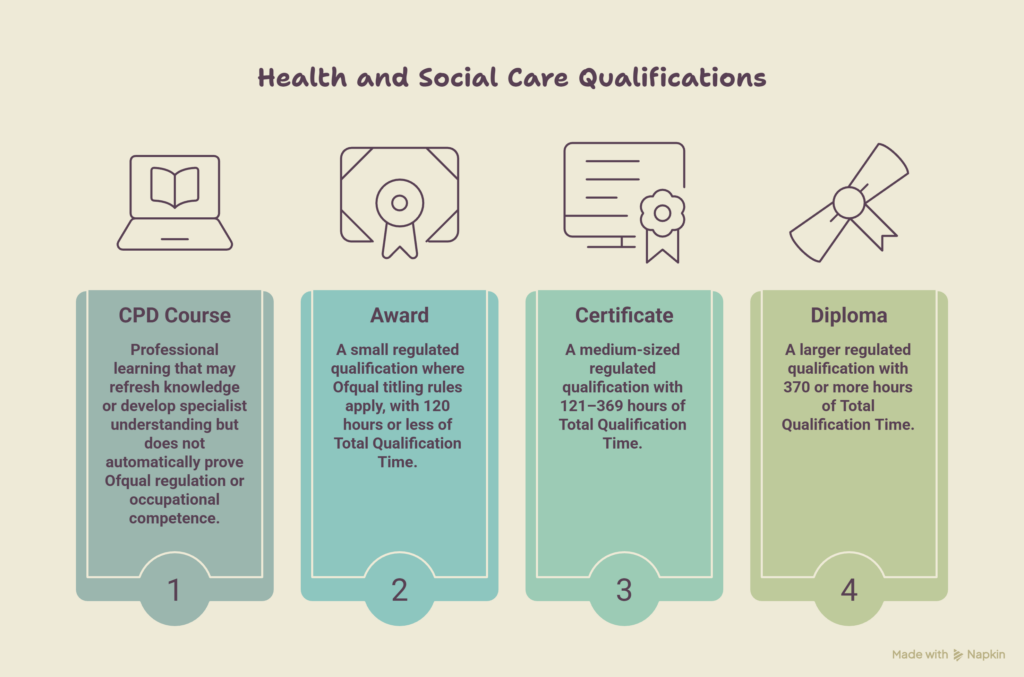
A CPD course, Award, Certificate and Diploma can all support health and social care learning, but they do not automatically carry the same regulatory status, size or assessment requirements. However, CPD mainly supports continuing professional development, while regulated Awards, Certificates and Diplomas follow Ofqual requirements when they appear on the official register. Ofqual also uses Award, Certificate and Diploma to indicate different qualification sizes. Therefore, always check the exact course title, awarding organisation, assessment method and regulatory status before you enrol.
So, before choosing health and social care training, understand what each course or qualification type actually means:
CPD Course:
A CPD course supports knowledge and skills development in health and social care. It may help workers refresh knowledge or explore specialist topics, but the term CPD alone does not prove Ofqual regulation, occupational competence or that employers will accept it as a required qualification.
Award:
An Award is a small regulated qualification when Ofqual’s titling guidance applies. Ofqual uses the term for qualifications with 120 hours or less of Total Qualification Time. In health and social care, always check its level, content, assessment and intended progression carefully before choosing it.
Certificate:
A Certificate represents a medium-sized regulated qualification under Ofqual’s standard titling guidance, with 121 to 369 hours of Total Qualification Time. However, its size does not determine its level. Check carefully whether the qualification develops knowledge, assesses occupational competence or supports a specific next study or career step.
Diploma:
A Diploma represents a large regulated qualification under Ofqual’s titling guidance, normally with 370 or more hours of Total Qualification Time. Still, the word “Diploma” in a course title does not by itself prove regulation, so verify the exact qualification and awarding organisation before enrolling.
Before paying for any course, search its exact title and awarding organisation on the GOV.UK Register of Regulated Qualifications, which lets you confirm regulatory status and compare qualifications.
Ultimately, choose health and social care training by its purpose, regulation, assessment and employer relevance—not by an impressive course title alone.
Level 2 Adult Social Care Certificate, Care Certificate and Level 3 Diploma in Adult Care Explained
The Care Certificate, Level 2 Adult Social Care Certificate and Level 3 Diploma in Adult Care support different stages of adult social care development. For example, the Care Certificate sets out 16 standards for relevant health and care workers, while the Level 2 qualification builds on those standards through deeper learning and formal assessment. Meanwhile, the Level 3 Diploma develops occupational knowledge and competence at a higher level. Understanding these differences helps you choose training that matches your current role, experience and career progression goals.
To make the differences clear, look at the purpose and assessment requirements of each route:
Care Certificate:
First, the Care Certificate sets out 16 standards covering essential knowledge, skills and behaviours for relevant health and social care workers. Learners must demonstrate what they know and what they can do, but completing the standards does not itself award an Ofqual-regulated qualification.
Level 2 Adult Social Care Certificate:
Next, this Ofqual-regulated qualification builds on the same 16 Care Certificate standards and deepens learning through formal assessment. It provides transferable evidence of achievement and can support workers who need structured development at the beginning of their adult social care career.
Level 3 Diploma in Adult Care:
Finally, this higher-level occupational qualification develops and confirms competence for people working in adult care. Skills for Care includes it within its current qualification pathway, alongside Level 2, Level 4 and Level 5 options that can support continued career development.
If you want introductory knowledge around the standards before considering an occupational route, a Care Certificate Course – Standards 1 to 16 can support CPD learning. It should not be confused with completing the regulated Level 2 Adult Social Care Certificate qualification. For current requirements and approved pathways, check the official Skills for Care qualifications guidance.
Ultimately, choose between these routes by checking your role, required competence, assessment needs and next step in adult social care.
Online Level 2 vs Level 3 Health and Social Care: Duration, Assessment and Work Placement Requirements
Online Level 2 vs Level 3 Health and Social Care courses can offer flexible study, but delivery method does not determine qualification requirements. Level 2 usually develops basic/core knowledge , while Level 3 explores greater depth and responsibility. For example, some CPD courses stay fully online, whereas occupational qualifications may require workplace observation and evidence of competence. Therefore, learners should compare duration, assessment, workplace access and regulatory status before choosing a course that matches their career goal.
First, understanding what “online” means at each level helps you avoid choosing a course that cannot meet your study or career needs:
Online Level 2 Health and Social Care:
Level 2 usually develops essential care knowledge through structured learning and assessment. However, the regulated Level 2 Adult Social Care Certificate also requires assessment through workplace observation and typically takes a new learner around six to eight months.
Online Level 3 Health and Social Care:
Level 3 develops knowledge and occupational competence at greater depth. However, learners may complete theory online, while Skills for Care’s current Level 3 Diploma criteria include skill-based units that require assessment under adult social care assessment principles.
Online Level 2 vs Level 3 Health and Social Care Comparison
Comparison Point | Online Level 2 | Online Level 3 |
Learning level | Builds essential knowledge and strengthens understanding of core care principles. | Develops more complex knowledge, judgement and occupational responsibilities. |
Online study | Providers may deliver lessons, reading, videos and knowledge tasks digitally. | Providers may also deliver theory online, although occupational assessment can extend beyond online study. |
Typical duration | The regulated Level 2 Adult Social Care Certificate usually takes new learners around six to eight months. | Duration depends on the exact Level 3 qualification, provider, learner progress and assessment requirements. |
Assessment | May include assignments and knowledge assessment; regulated occupational routes can require observation. | May include assignments, professional discussion, workplace evidence and competency assessment, depending on the qualification. |
Work placement or employment | Knowledge-based CPD courses may not require workplace access. Occupational qualifications can require evidence from practice. | Competence-based Level 3 routes may require learners to work in, or access, an appropriate care environment. |
Best suited to | Learners developing foundational care knowledge or beginning a progression pathway. | Learners seeking deeper development or progression towards greater workplace responsibility. |
Regulatory status | Check whether the exact course is CPD-based or an Ofqual-regulated qualification. | Likewise, “Level 3 online” alone does not confirm regulated status or occupational competence. |
Ultimately, choose an online Level 2 or Level 3 Health and Social Care course by its assessment, workplace requirements and career purpose.
Health and Social Care Level 2 vs Level 3 Jobs, Salaries and Career Progression
Health and Social Care Level 2 jobs often include entry and support roles, while suitable Health and Social Care Level 3 learning may support progression towards senior or more responsible positions. However, no Level 2 or Level 3 course guarantees employment. Employers consider the exact qualification, experience, workplace competence and role requirements. Current National Careers Service salary ranges also show that earnings vary considerably according to responsibility, experience, employer and setting, so treat these figures as useful estimates rather than guaranteed salaries.
Job Role | What the Role Involves | Typical UK Salary Estimate |
Care Assistant / Care Worker | Supports people with personal care, daily routines, mobility and independence in homes or residential settings. | £20,000–£25,000 |
Healthcare Assistant | Supports patients with personal care, observations and everyday healthcare needs under appropriate clinical supervision. | £25,000–£27,000 |
Residential Support Worker | Supports children or vulnerable adults with their physical, emotional and everyday needs in residential services. | £22,000–£30,000 |
Community Support Worker | Helps people manage physical, emotional and social needs while promoting independence within their community. | £20,000–£28,000 |
Senior Care Assistant / Senior Care Worker | Delivers care while helping supervise staff, coordinate support and take greater responsibility for day-to-day care. | £24,000–£29,000 |
Family Support Worker | Works with families and carers to address challenges, access support and improve wellbeing and development. | £24,000–£36,000 |
Physiotherapy Assistant | Supports physiotherapists and helps patients follow treatment activities designed to improve movement and manage physical conditions. | £25,000–£31,000 |
Maternity Support Worker | Supports midwives in caring for women and babies before, during and after childbirth within healthcare services. | £25,000–£31,000 |
Emergency Care Assistant | Works alongside paramedics to support patients during accidents, emergencies and ambulance journeys. | £26,000–£31,000 |
Care Home Manager | Leads residential care services, manages staff, oversees quality and safety, and coordinates day-to-day service delivery. | £25,000–£55,000 |
Importantly, these roles do not form one automatic Health and Social Care career progression ladder. For example, some positions require additional occupational qualifications, employer training, registration or relevant experience. A possible development pathway may move from Level 2 → Level 3 → Level 4 → Level 5 → specialist, supervisory or management development, but individual career routes vary.
Ultimately, Level 2 can support entry routes, while Level 3 may strengthen progression towards greater responsibility, depending on employer requirements.
What Is Level 3 Health and Social Care Equivalent To? A Levels, UCAS Points and University Progression
A regulated Level 3 Health and Social Care qualification sits at the same qualification level as A levels, but that does not make every Level 3 course equal in size, content or UCAS value. GOV.UK confirms that qualifications at the same level can cover different amounts of learning. In addition, UCAS awards Tariff points only to eligible Level 3 qualifications, while Level 2 qualifications do not receive them. However, universities set their own entry requirements, so always check your exact qualification before applying.
Therefore, if university or professional progression matters to you, consider these four questions before choosing a Health and Social Care Level 2 or Level 3 course:
Does Level 2 give UCAS points?
Generally, no. UCAS states that Tariff points apply to Level 3 or equivalent qualifications rather than Level 2 qualifications such as GCSEs. Level 2 can still support progression, but learners normally need suitable Level 3 study for university entry routes.
Can Level 3 give UCAS points?
Yes, eligible Level 3 qualifications can receive UCAS Tariff points. However, not every Level 3 qualification carries them. UCAS explains that many, but not all, qualifications have Tariff values, so check your exact qualification and grade before calculating points.
Can Level 3 lead to university?
Potentially, yes. Universities accept many Level 3 qualifications, but each institution controls its own admissions criteria. Consequently, check the required qualification, subjects, grades or UCAS points for your chosen degree rather than assuming any Level 3 course guarantees entry.
Can Level 3 lead to nursing or social work?
A suitable Level 3 qualification may support an application. Nursing courses commonly require A levels or equivalent Level 3 study, while social work requirements vary by university. Both routes can also require GCSEs and additional admission checks.
For accurate points, use the official UCAS Tariff calculator and enter the exact qualification rather than relying on the words “Level 3”.
Ultimately, check the exact Level 3 qualification, UCAS value and university requirements before treating it as a route into higher education.
Which Health and Social Care Level Should I Choose? Level 2 or Level 3 Decision Guide
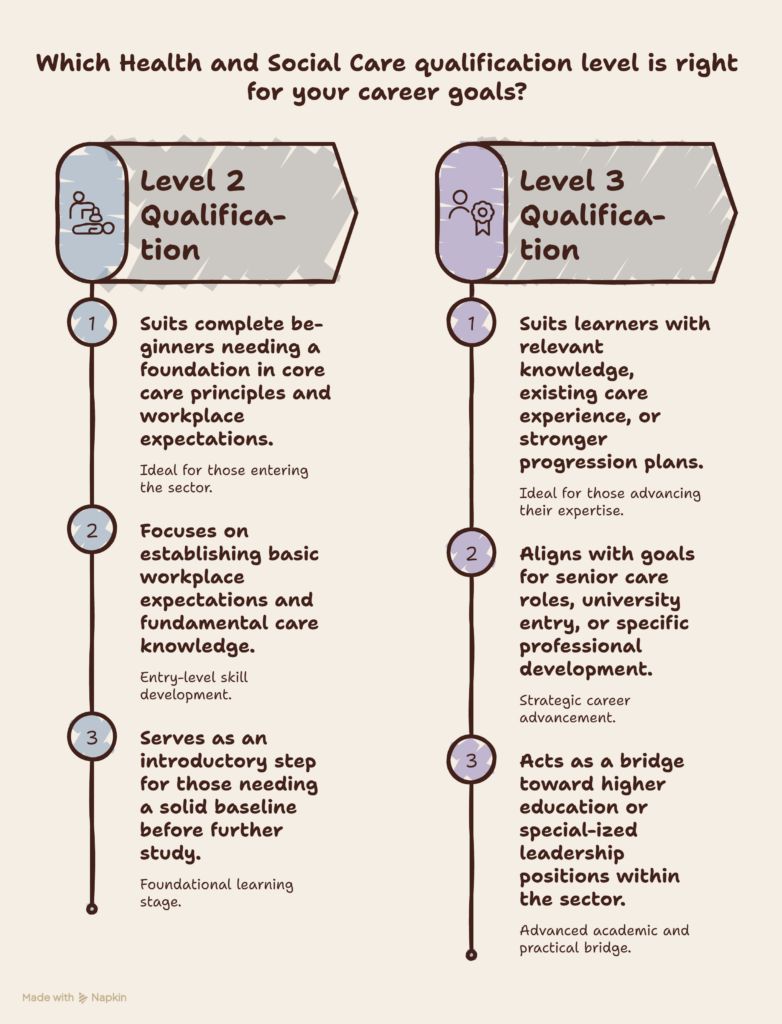
Choosing between Health and Social Care Level 2 or Level 3 starts with your current experience and your next goal. Level 2 can provide a useful foundation for beginners, while Level 3 may suit learners who already have relevant knowledge, workplace experience or stronger progression plans. However, course titles alone cannot tell you what employers or universities require. Check the exact qualification, regulatory status, assessment method and entry criteria so your chosen route supports the outcome you actually need best.
Therefore, ask what you want the course to help you achieve, then use the following situations to guide your choice:
Completely new to care →
Consider Level 2 learning first. It can introduce core care principles, professional responsibilities and workplace expectations, giving beginners a foundation before they compare more demanding Level 3 study or qualifications.
Career changer →
Compare beginner-friendly Level 2 routes with suitable Level 3 entry requirements. Previous qualifications, transferable skills and relevant experience may affect your options, so ask providers what evidence they expect before you apply.
Already working in care →
Review whether Level 3 matches your duties, competence and development plan. Skills for Care lists the Level 3 Diploma in Adult Care within its current qualification pathway for adult care.
Want a senior care role →
Check the qualification, experience and competence your employer expects for the position. Greater responsibility may require workplace evidence, assessment and leadership development rather than simply completing a Level 3 course.
Want university →
Choose an eligible Level 3 qualification that meets your chosen degree’s entry requirements. Universities set their own criteria and may specify particular qualifications, subjects, grades, GCSEs or minimum UCAS Tariff point requirements.
Want professional development only →
A relevant CPD course may help you refresh knowledge, explore specialist subjects or support continuing development. First decide whether you need learning for development or a regulated qualification for progression.
Need a qualification for employment →
Read the job specification before enrolling. Confirm the qualification level, awarding organisation and regulatory status the employer requests, then use the official register to check whether it is regulated.
For current adult social care routes, review the official Skills for Care qualifications guidance.
Ultimately, choose the level that matches your starting point, required outcome and evidence needs—not simply the highest number available.
Final Thought: Choose the Level That Moves You Forward
Choosing between Level 2 vs Level 3 Health and Social Care is not about picking the highest number. It is about choosing learning that matches your experience, career plans and the requirements of the role you want.
Start with Level 2 if you need stronger foundations. Consider Level 3 when you are ready for deeper learning or your progression route requires it. Above all, separate CPD learning from regulated qualifications and verify occupational requirements before enrolling.
Health and social care offers many routes forward. You do not need to plan your entire career today. Instead, focus on choosing the next credible step.
Table of Contents

Frequently Asked Questions
What is the difference between Level 2 and Level 3 Health and Social Care?
Level 2 usually provides foundational health and social care knowledge, while Level 3 involves deeper study and may support progression towards greater responsibility or higher study. However, qualifications at the same level can differ in size, content, assessment and purpose, so compare exact course details.
Should I choose Level 2 or Level 3 Health and Social Care?
Level 2 may suit beginners, career changers or learners building core care knowledge before progressing further. Level 3 may suit people with relevant experience, previous study or stronger progression goals. The right choice depends on entry requirements, career plans, assessment demands and recognised qualification status.
Can I do Level 3 Health and Social Care without Level 2?
Not always. Some Level 3 Health and Social Care courses accept learners without a Level 2 qualification, particularly where they have relevant experience. Entry requirements vary between providers and qualifications, so check the exact course specification before applying rather than assuming Level 2 is compulsory.
What is Level 3 Health and Social Care equivalent to?
Level 3 qualifications sit at the same qualification level as A levels in England, Wales and Northern Ireland. However, being at the same level does not mean every Level 3 qualification has the same size, study hours, content or UCAS Tariff value as A level.
What jobs can you get with Level 2 Health and Social Care?
Level 2 Health and Social Care learning can support knowledge relevant to roles such as care assistant, support worker or care worker. However, completing a course does not automatically qualify you for a job. Employers may require experience, workplace competence, safeguarding checks or regulated qualifications.
What jobs can you get with Level 3 Health and Social Care?
Level 3 Health and Social Care learning may support progression towards senior care, lead support or supervisory responsibilities, depending on the qualification and your experience. Current adult social care pathways include the Level 3 Diploma in Adult Care, while employers set their own role requirements.
Can you study Level 2 or Level 3 Health and Social Care online?
Yes, many health and social care courses offer online learning, but delivery depends on the qualification. Knowledge-based study may be completed remotely, whereas occupational qualifications can require workplace assessment, observations or competence evidence. Check whether your Level 2 or Level 3 course includes workplace requirements.
Is a CPD Health and Social Care course the same as a regulated qualification?
A CPD course supports continuing professional learning, while a regulated qualification is formally recognised within the qualifications system. A course described as Level 2 or Level 3 should not automatically be assumed regulated. Check its title, awarding organisation and status on the official qualifications register.
What is the Level 2 Adult Social Care Certificate?
The Level 2 Adult Social Care Certificate is a qualification developed for adult social care in England. It is based on Care Certificate standards but is not the same thing. Skills for Care says the qualification complements induction arrangements and provides transferable evidence of learning.
Does Level 3 Health and Social Care give UCAS points?
Eligible Level 3 qualifications can carry UCAS Tariff points, whereas Level 2 qualifications do not receive Tariff points. The exact number depends on the qualification and grade. Universities set their entry requirements, so check the UCAS Tariff calculator and your chosen university course before applying.