


A care worker notices that a resident who is usually sociable has become quiet and anxious. Later, while supporting them with their evening routine, the worker sees an unexplained bruise. A colleague dismisses it as “probably nothing”, but the resident appears uncomfortable whenever that colleague enters the room. Should the worker wait for proof, mention it casually at handover or make a formal report?
Reporting and escalating concerns in care means recognising a possible risk, protecting the person from immediate harm, recording factual information and passing it to someone with authority to respond. If the first report does not lead to suitable action, the worker may need to raise the matter at a higher level or use an external reporting route.
This guide explains how to report safeguarding concerns and wider care-quality issues, who should receive the report, when escalation is necessary and what to do if management fails to respond. It focuses on care practice in England because the Care Act 2014, Care Quality Commission regulations and statutory safeguarding guidance discussed below apply primarily to England.
Quick Answer: How Do You Report and Escalate Concerns in Care?
A care worker should first consider whether anyone is in immediate danger. They should then record what they directly observed, heard or were told and report the concern through the organisation’s approved route. If the person remains at risk, the response is delayed or the matter is dismissed, the concern should be escalated.
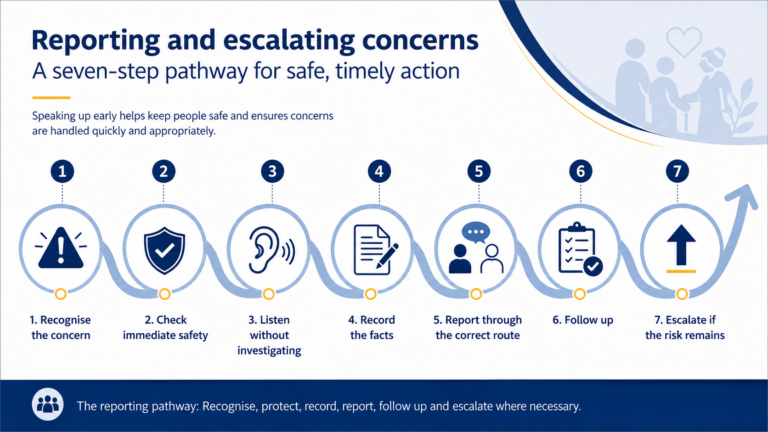
The usual process is:
- Recognise the concern.
- Protect the person from immediate harm.
- Record factual information.
- Report it to the appropriate manager or safeguarding lead.
- Follow the organisation’s policy.
- Check that the concern has been acknowledged.
- Escalate internally or externally if the risk remains.
This process does not mean that frontline workers should investigate allegations themselves. Their role is to identify, document and communicate concerns so that authorised professionals can assess what action is required.
Your Legal and Professional Duty to Raise Concerns

Care workers do not act alone when they report a concern. Their organisation, managers, safeguarding leads and local authorities operate within a wider legal and regulatory framework designed to protect people from abuse, neglect and avoidable harm.
The exact responsibility of an individual worker depends on their role, employer, professional code and organisational policy. However, regulated providers must have effective systems for delivering safe care, preventing abuse and responding when allegations or evidence of abuse arise.
Care Act 2014 and Adult Safeguarding
Section 42 of the Care Act 2014 requires a local authority to make, or arrange, enquiries where it has reasonable cause to suspect that an adult:
- Has needs for care and support
- Is experiencing, or is at risk of, abuse or neglect
- Cannot protect themselves from that abuse, neglect or risk because of those needs
The purpose of the enquiry is to decide whether action is needed and, if so, what should be done and by whom. The adult does not need to be receiving council-funded care for the section 42 criteria to apply. (Legislation.gov.uk)
This does not mean every concern automatically becomes a formal section 42 enquiry. Local authorities assess the information against the statutory criteria. A concern may still require another form of support or investigation even where the section 42 threshold is not met. (GOV.UK)
For frontline staff, the practical lesson is straightforward: do not wait until you can prove abuse. Report the concern so that the appropriate authority can assess the risk and decide what should happen next.
CQC Regulation 12: Safe Care and Treatment
CQC Regulation 12 is intended to prevent unsafe care, avoidable harm and unnecessary risk. It requires providers to assess risks to people’s health and safety and ensure that staff have the competence, skills and experience needed to provide safe care. (Care Quality Commission)
This regulation is relevant to concerns such as:
- Medication errors
- Unsafe moving and handling
- Poor infection prevention
- Defective equipment
- Incomplete risk assessments
- Failure to follow care plans
- Insufficiently trained staff
A concern does not have to involve deliberate abuse before it becomes serious. Repeated missed medicines, incorrect transfers or unsafe infection-control practices may indicate a failure to provide safe care and treatment.
CQC Regulation 13: Safeguarding from Abuse and Improper Treatment
Regulation 13 requires providers to protect people from abuse and improper treatment. It covers neglect, discrimination, degrading treatment and inappropriate or unlawful restraint, as well as other forms of abuse. Providers must establish and operate systems that prevent abuse and respond effectively when allegations or evidence arise. (Care Quality Commission)
CQC’s fundamental standards also state that people receiving care must not suffer abuse or improper treatment, including neglect, degrading treatment or unnecessary restrictions on their freedom. (Care Quality Commission)
For care workers, this means an informal conversation may not be enough where a serious concern exists. The matter should enter the organisation’s formal reporting or safeguarding process so that there is a clear record and accountable response.
Working Together to Safeguard Children
Where a setting supports children, young people or families, workers must follow child safeguarding procedures. Working Together to Safeguard Children 2026 is the current statutory guidance for multi-agency work in England and applies to organisations and agencies with functions relating to children. It sets expectations for providing help, support and protection through coordinated working. (GOV.UK)
A worker who is concerned about a child should follow the service’s designated safeguarding route without conducting a personal investigation. Where a child may be in immediate danger, urgent action should not be delayed while waiting for an ordinary meeting or internal review.
Whistleblowing Protection
Whistleblowing law may protect workers who report certain types of wrongdoing that affect others or the public interest. Government guidance explains that this can include criminal offences, health and safety dangers, breaches of legal obligations and attempts to conceal wrongdoing. (GOV.UK)
Whistleblowing is not the same as raising every workplace complaint. A personal grievance about treatment at work usually follows a grievance process, while whistleblowing concerns wider wrongdoing. The distinction becomes important when serious risks are being ignored, concealed or caused by senior managers.
What This Means for Frontline Staff
Frontline workers are not usually responsible for deciding whether an allegation is substantiated, whether a section 42 enquiry should begin or whether a criminal offence has occurred. Their responsibility is to respond within their competence and role.
That normally means:
- Protecting the person from immediate danger
- Listening without asking leading questions
- Recording what was seen, heard or disclosed
- Reporting through the correct route
- Preserving confidentiality
- Escalating when the first response is inadequate
Key takeaway: A worker does not need proof before raising a genuine concern. The report allows managers, safeguarding professionals or external authorities to assess the evidence and decide what action is proportionate.
Which Care Concerns Require Action?

A reportable concern is any issue that could compromise a person’s safety, health, dignity, rights or quality of care. Some concerns clearly involve safeguarding. Others relate to medication, staffing, professional conduct, confidentiality or unsafe systems.
Workers should not judge seriousness only by whether harm has already occurred. Near misses, repeated omissions and emerging patterns may reveal risks before someone is injured. Safeguarding concerns may involve physical, emotional, sexual or financial abuse, neglect, discriminatory abuse, domestic abuse, organisational abuse or self-neglect. The signs are not always obvious. A worker may notice unexplained injuries, fear around a particular person, sudden withdrawal, missing possessions, poor hygiene or a disclosure that someone feels unsafe. One observation may have an innocent explanation, but the worker should consider the wider context and any emerging pattern. For example, an older resident may appear anxious after family visits and mention that their bank card is being used without explanation. The worker should record what was said and follow the safeguarding route rather than confronting the family member or examining the person’s finances without authority. Medication concerns include more than administering the wrong medicine. They may involve missed doses, incomplete medicine administration records, medicines given at the wrong time, failure to monitor side effects or unsafe storage. One unsigned record may require clarification. Several unsigned records across multiple shifts may indicate a wider medicines-management problem. Because Regulation 12 focuses on preventing avoidable harm, repeated near misses should not be dismissed merely because no injury has yet occurred. (Care Quality Commission) The worker should follow the employer’s medication and incident-reporting procedures, seek clinical advice where required and escalate recurring failures that are not being controlled. Broken hoists, wet floors, damaged beds, blocked fire exits and poor infection-control practices may all require reporting. The appropriate response depends on the seriousness and immediacy of the risk. A faulty mobility aid should be taken out of use according to procedure and reported. A colleague repeatedly moving a person without the equipment or staffing specified in the care plan may indicate a more serious practice concern. The fact that nobody has yet been injured does not make the situation safe. Reporting near misses allows the provider to correct hazards before harm occurs. Some concerns develop through omission rather than a dramatic incident. A person may repeatedly miss meals, remain in unchanged clothing, wait too long for continence support or be excluded from decisions about their routine. These patterns may affect dignity and wellbeing even when they are not immediately recognised as abuse. CQC standards require care to be safe, appropriate and person-centred, and providers must have enough suitably qualified and competent staff to meet people’s needs. (Care Quality Commission) A worker should report the factual pattern and its effect on the person rather than normalising poor care because the service is busy. Concerns about staff conduct may include humiliating language, discriminatory treatment, sexualised comments, inappropriate relationships, retaliation against people who complain or unauthorised use of personal information. Not every disagreement between colleagues is a safeguarding matter. The key question is whether the behaviour affects a person receiving care, creates a safety risk, breaches professional responsibilities or suggests wider wrongdoing. Where the concern involves a manager or senior colleague, the normal reporting route may not be suitable. The worker should use the alternative escalation or whistleblowing contact identified in organisational policy. Where a child is involved, workers should report unexplained injuries, concerning disclosures, marked behavioural changes, neglect indicators or information suggesting that the child may be unsafe. The worker should listen, take the child seriously and avoid promising secrecy. They should record the child’s own words and contact the designated safeguarding lead or other named safeguarding person without unnecessary delay. The worker should not repeatedly question the child to obtain a fuller account. Detailed enquiries belong to appropriately trained safeguarding professionals working through the relevant multi-agency arrangements. (GOV.UK) Key takeaway: Report what you know, not what you can prove. Give authorised professionals enough accurate information to assess the situation. A clear reporting process helps workers act consistently when situations are stressful or uncertain. Organisational policies may use different forms, job titles or referral routes, but the central principles remain similar. Begin by identifying what has caused concern. This may be a direct observation, a disclosure, a change in behaviour, an unsafe instruction or a pattern seen across several shifts. Ask yourself: These questions are not an investigation. They help the worker decide how quickly to act and which reporting route may be appropriate. Safety comes before paperwork. Where someone is seriously injured, in immediate danger or at risk of a continuing assault, seek urgent support and follow emergency procedures. This might involve calling emergency services, obtaining clinical assistance, moving someone away from immediate danger where it is safe and lawful to do so, or asking an appropriate senior colleague to attend. Workers should stay within their role and competence. They should not place themselves or others in additional danger, use inappropriate restraint or take actions that could compromise evidence. When a person discloses abuse or unsafe treatment, listen calmly and take them seriously. Allow them to speak in their own way, but do not ask questions designed to test, challenge or expand the account. Open prompts such as “Tell me what happened” may sometimes be appropriate, depending on organisational guidance. Leading questions such as “Did that member of staff hit you?” can influence the account and should be avoided. Do not promise that the information will remain secret. Explain that you may need to share it with people who can help keep them safe. A suitable response might be: “Thank you for telling me. I am taking this seriously. I may need to share this with the safeguarding lead so that we can help keep you safe.” Write the record as soon as possible after immediate safety needs have been addressed. Include the date, time, location, people present, what you observed and what the person said. Use direct quotations for important statements. Separate observation from interpretation. Less useful: More useful: The second entry does not decide what happened. It provides factual information that others can assess. Most concerns should be reported to the person identified in the organisation’s policy. Depending on the matter, this may be a line manager, nurse, registered manager, safeguarding lead, clinical lead or health and safety representative. Serious safeguarding concerns should not be left as informal handover comments. Complete the required incident, safeguarding or electronic reporting process and make sure the concern reaches the appropriate decision-maker. Where the usual manager is implicated, absent or unwilling to act, use the alternative route named in the policy. Safeguarding confidentiality is not the same as secrecy. Information should be shared with people who need it to protect the person, assess the concern or meet legal responsibilities. Do not discuss the allegation with uninvolved colleagues, friends or family members. Do not access records without a legitimate reason. Record what information was shared, with whom and why. For child safeguarding, official guidance emphasises appropriate information-sharing between practitioners and agencies where this supports help, protection and welfare. (GOV.UK) After reporting, establish that the concern has entered the correct process. This does not mean demanding confidential details about an investigation. A reasonable follow-up may confirm: Who received the report If no meaningful response occurs and the risk remains, move to the escalation process. The correct recipient depends on the type and urgency of the concern. Workers should know their organisation’s named safeguarding contacts before an incident occurs. Internal reporting is usually the starting point because the provider has immediate responsibility for the service, staff and people receiving care. The route may include: The worker should use the route most appropriate to the concern. Reporting to someone without authority to act may cause unnecessary delay. Local authority safeguarding teams may become involved where an adult with care and support needs may be experiencing abuse or neglect. The local authority decides whether the statutory section 42 criteria are met and what enquiry or other response is appropriate. (Legislation.gov.uk) Workers should follow local and organisational referral arrangements. Where internal routes are obstructing necessary safeguarding action, direct contact may be appropriate, particularly where someone remains at risk. The CQC regulates health and adult social care services in England. It is not an emergency service and does not replace local safeguarding or police procedures. Information given to the CQC may help it assess whether a registered provider is meeting fundamental standards. This can be relevant where unsafe or abusive practice reflects a wider provider failure, particularly if internal reporting has not resulted in suitable action. CQC regulations require providers to prevent abuse and deliver safe care. (Care Quality Commission) Not all safeguarding concerns must be reported to the police. Police involvement may be appropriate where a crime is suspected, evidence needs to be protected or someone is in immediate danger. Examples may include assault, sexual offences, theft, fraud, coercive behaviour or wilful neglect. Workers should follow emergency procedures and avoid actions that could increase risk or contaminate evidence. Where the concern involves the conduct or competence of a regulated professional, a professional regulator may become relevant. Whether and when a referral should be made depends on the circumstances, employer process and regulator’s criteria. Frontline workers should normally report internally first unless that route is unsafe, compromised or inappropriate. Key takeaway: Know the internal route, but do not allow organisational hierarchy to become a barrier when someone remains unsafe.
Type of concern
What it may look like in practice
Safeguarding
Abuse, neglect, exploitation, coercion or inappropriate restraint
Medication
Missed doses, incorrect administration or unreliable records
Health and safety
Faulty equipment, unsafe transfers or infection risks
Quality of care
Unmet personal care, poor nutrition or ignored care plans
Professional conduct
Bullying, discrimination or inappropriate boundaries
Information governance
Improper access to records or unauthorised disclosure
Staffing and competence
Unsafe staffing levels or staff working beyond competence
Organisational culture
Concealed incidents, falsified records or pressure not to report
Safeguarding Concerns
Medication and Clinical Safety Concerns
Unsafe Care and Environmental Risks
Poor Quality of Care
Professional Conduct and Boundaries
Concerns About a Child
Myth and Reality
Myth
Reality
You need proof before reporting
A reasonable, genuine concern should be raised
Only abuse needs reporting
Unsafe care, medication failures and poor conduct may also require action
No injury means there is no concern
Near misses and repeated omissions can reveal serious risk
Only managers can raise concerns
Frontline staff may be the first people to identify danger
Every safeguarding concern goes to the police
The response depends on the risk, circumstances and suspected offence
How to Report Concerns: A Step-by-Step Process
Step 1: Recognise and Clarify the Immediate Concern
Step 2: Protect the Person from Immediate Harm
Situation
Immediate priority
Serious injury or acute illness
Obtain urgent medical help
Immediate threat of violence
Follow emergency and safety procedures
Suspected crime with continuing danger
Contact emergency services as appropriate
No immediate danger but ongoing concern
Record and report promptly
Child may be at immediate risk
Follow urgent child safeguarding procedures
Step 3: Listen Without Investigating
Step 4: Record the Facts Promptly
“The resident was abused by the night worker.”
“At 20:15, the resident said, ‘I do not want the night worker in my room because he hurts my arm.’ The resident was crying and had a dark mark approximately 4 cm long on the upper left arm.”Step 5: Use the Correct Internal Reporting Route
Step 6: Preserve Confidentiality
Step 7: Confirm the Concern Has Been Acknowledged
Whether immediate risks were addressed
Whether the matter was referred onward
Whether you have further responsibilities
Whether additional observations should be recordedWho Should Receive the Report?
Concern
Likely first reporting route
Medication error
Nurse, senior carer or registered manager
Suspected adult abuse or neglect
Safeguarding lead or registered manager
Concern about a child
Designated safeguarding lead
Unsafe equipment
Manager and relevant safety or maintenance lead
Breach of confidentiality
Registered manager or information governance lead
Serious misconduct by a manager
Senior management or whistleblowing contact
Immediate danger or suspected serious crime
Emergency services, alongside internal procedures
Internal Reporting Routes
Local Authority Safeguarding Teams
Care Quality Commission
Police and Emergency Services
Professional Regulators
When Does a Concern Need Escalating?
A concern needs escalating when the first report has not produced a suitable response, the person remains at risk, the issue is worsening or the normal reporting route is compromised.
Escalation does not automatically mean contacting an external body. It may begin by moving the concern to a more senior manager, safeguarding lead or alternative internal contact.
Signs That Further Action Is Needed
Escalation may be necessary where:
- A serious concern is dismissed without assessment
- The same unsafe practice continues
- Records appear to be altered or concealed
- The person remains exposed to suspected abuse
- Management delays action without a clear safety plan
- The manager receiving the report is implicated
- Staff are pressured not to raise concerns
- New information increases the level of risk
The central question is:
Has the original response made the person safer?
If not, further action may be required.
Scenario: Repeated Medication Failures
A support worker reports several unsigned medication records. The manager describes them as minor administrative omissions. Three days later, another person misses an important dose.
The worker now has evidence of a continuing pattern and an unresolved safety risk. The concern should be recorded again and escalated to a more senior or clinically responsible person. If the provider still fails to respond, an external route may need to be considered.
Regulation 12 requires providers to prevent avoidable harm and manage risks to people’s health and safety. Repeated medication failures therefore require more than informal reassurance. (Care Quality Commission)
Scenario: Suspected Financial Abuse
A resident tells a care worker that a relative takes their bank card and refuses to explain withdrawals. The worker reports this to a supervisor, but no safeguarding referral or risk assessment follows. The withdrawals continue.
The worker should not confront the relative or conduct their own financial investigation. They should escalate through the organisation’s safeguarding route and, where necessary, contact the relevant local authority team.
Scenario: Unsafe Staffing
A worker repeatedly reports that staffing levels make it impossible to follow two-person moving-and-handling plans. Managers ask staff to “do their best”, and unsafe transfers continue.
This is not simply a workplace inconvenience. It may place both people receiving care and staff at risk. CQC staffing requirements state that providers must deploy enough suitably qualified, competent and experienced staff to meet care needs. (Care Quality Commission)
The worker should document specific incidents and consequences rather than making only a general complaint about staffing pressure.
What to Do When Management Fails to Respond
When a manager ignores or dismisses a concern, the worker should move to the next appropriate reporting level. They should remain factual, keep records and avoid turning the issue into a personal dispute.
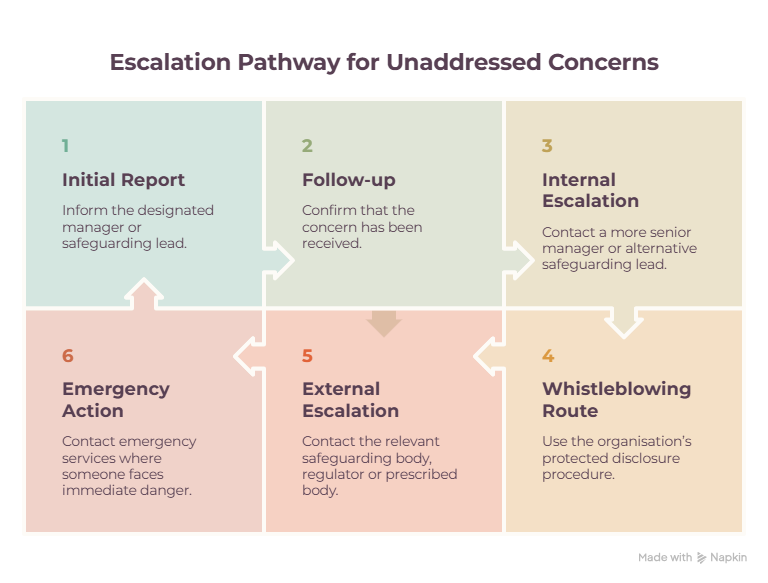
A practical escalation pathway is:
| Stage | Action |
|---|---|
| Initial report | Inform the designated manager or safeguarding lead |
| Follow-up | Confirm that the concern has been received |
| Internal escalation | Contact a more senior manager or alternative safeguarding lead |
| Whistleblowing route | Use the organisation’s protected disclosure procedure |
| External escalation | Contact the relevant safeguarding body, regulator or prescribed body |
| Emergency action | Contact emergency services where someone faces immediate danger |
Escalate Internally
Explain when the concern was first reported, who received it, what evidence was provided and why the risk remains.
A clear escalation statement might read:
“I reported this concern to the shift manager on 4 August at 14:30. The unsafe transfer practice has continued on three further occasions. The care plan requires two staff and a hoist, so I remain concerned that the resident and staff are at risk of injury.”
This is stronger than saying that management “does not care”. It provides dates, facts and a clear explanation of the unresolved risk.
Use the Whistleblowing Procedure Where Appropriate
Government guidance states that workers can usually report wrongdoing to their employer through a whistleblowing policy. Where reporting to the employer is unsuitable, workers may be able to seek legal advice or contact an appropriate prescribed person or body. (GOV.UK)
Whistleblowing may be relevant where:
Serious wrongdoing affects others or the public interest
Managers are involved in the wrongdoing
Records are being falsified
Safety concerns are repeatedly concealed
Workers are threatened for speaking up
Normal procedures have failed
The worker should choose the correct route for the type of wrongdoing. Protection can depend on what is disclosed and to whom it is reported.
Escalate Externally When Necessary
External escalation may involve the local authority safeguarding team, the CQC, police, emergency services or a professional regulator. The correct body depends on the nature of the concern.
Workers should avoid sending confidential information widely or contacting unrelated organisations in the hope that someone will act. They should follow approved routes, disclose only relevant information and keep a record of the action taken.
Do Not Abandon the Concern Because a Manager Has Been Told
A manager’s awareness does not automatically mean the worker’s responsibility has ended. Where the worker can see that the person remains at risk and no suitable action has followed, the concern may need to be escalated.
That does not require the worker to interfere with a formal investigation or demand confidential updates. It means taking reasonable steps to ensure that the unresolved danger reaches someone able to act.
Reporting Concerns vs Whistleblowing
Reporting a concern and whistleblowing both involve speaking up, but they serve different purposes. Reporting is usually part of normal care practice. Whistleblowing is more likely to apply when serious wrongdoing affects other people or the public interest, especially where ordinary workplace procedures have failed or are unsafe to use.
A care worker may report a missed medicine, an unexplained injury, unsafe equipment or a disclosure of abuse through the organisation’s usual incident or safeguarding process. Whistleblowing may become relevant if management conceals repeated medication failures, falsifies records, ignores serious safeguarding risks or pressures staff to remain silent.
What Counts as Whistleblowing?
A whistleblowing disclosure must normally concern a type of wrongdoing recognised by law and be made in the public interest. Current government guidance identifies matters such as criminal offences, breaches of legal obligations, health and safety dangers and attempts to conceal wrongdoing. The worker must also use an appropriate reporting channel if they wish to rely on statutory protection. (GOV.UK)
This means a disagreement about rotas, pay or an individual employment dispute will not automatically qualify as whistleblowing. Those issues may be genuine workplace grievances, but they generally follow a different process.
By contrast, a manager instructing staff to alter medicine records after repeated missed doses could amount to serious wrongdoing. The issue affects the safety of people receiving care, involves potential concealment and goes beyond a private disagreement between employee and employer.
Who Can a Worker Tell?
The first route is often the employer. Government guidance states that workers can report concerns through an organisation’s whistleblowing policy, where one exists. If reporting internally is unsuitable, other options may include obtaining legal advice or contacting an appropriate prescribed person or body. (GOV.UK)
The relevant external body depends on the subject of the disclosure. Workers should not send confidential care information to several organisations without first checking which body has authority to receive the concern.
A sound whistleblowing report should explain:
What wrongdoing is suspected
Why the worker believes it affects others or the public interest
What facts or records support the concern
Which internal reports have already been made
Why the normal process has failed or is unsuitable
Whether anyone remains at immediate risk
These details are best presented as a concise factual account rather than a long emotional statement.
Confidentiality and Anonymous Reporting
Confidentiality and anonymity are not identical.
A confidential disclosure means the person receiving the concern knows the worker’s identity but limits who else receives that information. An anonymous disclosure does not identify the worker.
Government guidance for employers describes confidentiality as good practice and says information should generally be shared only with people who need to know, such as relevant senior managers or human resources staff. Anonymous reporting may sometimes be possible, but it can make clarification and investigation more difficult. (GOV.UK)
Workers should therefore check the organisation’s whistleblowing policy to understand how identity, confidentiality and feedback are handled.
Scenario: Falsified Medication Records
Several care workers report that medicines have repeatedly been missed. A manager later tells staff to sign the records retrospectively so that the administration sheets appear complete.
This is not simply a documentation error. It may conceal an unresolved safety risk and undermine the accuracy of care records. CQC guidance requires providers to maintain accurate, complete and secure records, while medicines records must remain accurate and up to date. (Care Quality Commission)
The workers should preserve factual information, avoid altering records themselves and use the organisation’s whistleblowing route. If the manager controls that process or the issue remains concealed, an appropriate external disclosure route may be necessary.
Key takeaway: Ordinary concerns should normally enter the standard reporting process. Whistleblowing is more likely to apply when serious wrongdoing, concealment or systemic failure makes the normal process ineffective.
How to Record Concerns Correctly

A concern record may later be reviewed by managers, safeguarding professionals, regulators, healthcare staff or the police. It should therefore be timely, factual, accurate and clear enough for another authorised person to understand without relying on the writer’s memory.
CQC Regulation 17 requires providers to maintain secure, accurate, complete and detailed records about people using the service and the management of regulated activities. Good records also help services identify patterns, review risks and improve care. (Care Quality Commission)
What Should the Record Include?
A strong concern record usually identifies:
- The date, time and location
- The person affected
- Who was present or involved
- What the worker directly saw or heard
- The person’s own words where relevant
- Visible injuries, environmental risks or behavioural changes
- Immediate action taken
- Who received the report and when
- Any later follow-up or escalation
A short checklist is useful here because these are the details most likely to be forgotten during a stressful incident.
The record should distinguish between three types of information:
Observation: What the worker directly saw, heard or noticed.
Disclosure: What another person said happened.
Professional action: What the worker did in response.
Keeping these separate reduces the risk that assumptions are presented as facts.
Facts, Not Conclusions
Consider these two entries:
Unhelpful entry:
“The resident’s son is stealing from her.”
Factual entry:
“At 10:20, Mrs A stated, ‘My son took my bank card yesterday and will not tell me how much he withdrew.’ Mrs A appeared tearful and said she did not want him contacted while she was present.”
The first statement reaches a conclusion that the worker is not authorised to establish. The second records the person’s words, emotional presentation and relevant circumstances.
| Avoid | Record instead |
|---|---|
| “The carer was aggressive.” | “The carer shouted, ‘Sit down now’, while standing close to the resident.” |
| “The resident was neglected.” | “At 14:00, the resident remained in wet clothing. The care record showed no personal care entry since 07:30.” |
| “Medicines were handled badly.” | “The 20:00 dose remained in the blister pack and the administration record was unsigned.” |
| “The child looked abused.” | “The child had two dark marks on the upper arm and said, ‘I do not want to go home.’” |
The wording should be neutral, but neutrality does not mean minimising the seriousness of what occurred. It means describing the concern precisely enough for others to assess it.
Record the Person’s Own Words
Where someone discloses abuse or unsafe treatment, use direct quotation marks for the important part of the disclosure whenever possible.
A note such as “possible abuse discussed” loses crucial detail. A better record might state:
“The resident said, ‘He comes into my room at night and grips my wrist when I tell him to leave.’”
The worker should not rewrite the account into technical safeguarding language or ask repeated questions to obtain a more complete story. Their role is to preserve the initial disclosure accurately and pass it through the correct route.
Describe Injuries Carefully
Workers should follow organisational policy when recording visible injuries. They should note the location, approximate size, colour and appearance without claiming how the injury occurred unless they directly witnessed it or are recording the person’s explanation.
For example:
“A dark purple mark approximately 3 cm across was visible on the outer right forearm. The resident stated, ‘It happened when someone pulled me yesterday.’”
Body maps or photographs should only be used where policy, consent and lawful authority permit. Workers should not use personal phones to photograph injuries or documents.
Correcting Errors in Records
Records should not be secretly changed or overwritten. If a mistake is made, the correction should follow the employer’s approved process and preserve an audit trail.
Where a record is written after a delay, the worker should clearly state both the time of the incident and the time the note was completed. This helps reviewers understand the sequence of events.
In electronic systems, workers should use their own login and never allow another person to make an entry under their identity.
Confidentiality and Information Sharing
Concern records contain sensitive information and should only be accessible to people with a legitimate role in responding to the issue.
Confidentiality should not become a reason to withhold necessary safeguarding information. The correct approach is to share relevant information through authorised routes, with people who need it, and to document the reason for sharing.
Government safeguarding advice emphasises that appropriate information-sharing can be necessary to protect children, young people and families. (GOV.UK)
Workers should avoid discussing concerns in corridors, staff group chats or informal social settings. Even where names are omitted, other details may identify the person.
A Practical Concern-Recording Model
A simple factual structure can help workers organise their notes:
What happened?
Describe the observation, disclosure or incident.
When and where?
Record the exact date, time and location.
Who was involved?
Identify the person affected and anyone present.
What was said?
Use direct quotations where possible.
What action was taken?
State how immediate safety was addressed and who received the report.
What happened next?
Record follow-up instructions or escalation.
Key takeaway: A good record does not try to solve the case. It preserves clear information so that authorised people can assess the risk and act.
Real Care Scenarios and the Correct Response

Practical scenarios help distinguish between an ordinary care issue, a safeguarding concern and a situation requiring escalation. The correct response will always depend on the person’s immediate safety, organisational policy and the specific facts.
Scenario 1: A Resident Discloses Physical Abuse
During personal care, a resident tells a care assistant:
“I do not want the night worker in my room. He grabs my arms when I call for help.”
The resident appears frightened and asks the care assistant not to tell anyone.
Correct response
The care assistant should listen calmly, take the disclosure seriously and explain that the information must be shared with people who can help protect the resident. They should not promise secrecy.
The worker should record the resident’s exact words, emotional presentation and any visible injuries. The matter should then be reported immediately through the service’s safeguarding route.
The accused staff member should not be confronted by the care assistant. Nor should the worker question other residents to see whether similar incidents occurred. Those actions could increase risk or interfere with an authorised enquiry.
Scenario 2: A Medication Near Miss Reveals a Pattern
A support worker finds that an evening medicine remains in its blister pack, although the record has been signed. They then discover two similar discrepancies from the previous week.
Correct response
The immediate clinical risk should be assessed according to the medication policy, with advice from the responsible nurse, manager or healthcare professional where required.
The worker should document the discrepancy, report it and explain that it appears to be part of a pattern rather than an isolated entry error.
CQC guidance states that adult social care providers must maintain secure, accurate and up-to-date medicines records to meet safe-care and governance requirements. (Care Quality Commission)
If management treats the issue as paperwork only and the discrepancies continue, escalation is warranted because the risk remains uncontrolled.
Scenario 3: Poor Care Develops into Possible Neglect
A domiciliary care worker repeatedly finds that a person has not eaten, is wearing unchanged clothing and has not received support recorded in their care plan.
One missed task might have several explanations. The repeated pattern suggests that the person’s assessed needs may not be met.
Correct response
The worker should document each observation separately, including dates and the effect on the person. The concern should be reported through the provider’s management and safeguarding route.
If the person has care and support needs, is experiencing or at risk of neglect and cannot protect themselves because of those needs, the concern may meet the Care Act section 42 criteria for a local authority safeguarding enquiry. The local authority, not the frontline worker, decides whether the statutory threshold is met. (GOV.UK)
Scenario 4: Unsafe Moving and Handling Continues
A care plan requires two trained workers and a hoist for transfers. Due to staffing pressure, one member of staff repeatedly transfers the person alone.
No injury has yet occurred.
Correct response
The absence of injury does not remove the risk. The worker who observes the unsafe transfer should report the specific incident, refer to the care-plan requirement and record any explanation provided.
If the practice continues, the issue should be escalated. Regulation 12 requires risks to people’s health and safety to be assessed and mitigated, while Regulation 18 requires enough suitably qualified, competent and experienced staff to meet regulatory requirements. (Care Quality Commission)
The worker should not participate in a transfer they believe is unsafe without first seeking appropriate support and following emergency or management procedures.
Scenario 5: A Child Makes a Concerning Disclosure
A worker in a family-support setting notices that a child has become unusually quiet. The child later says:
“I am scared to go home because someone hurts me when they are angry.”
Correct response
The worker should listen, avoid leading questions and explain that the information may need to be shared to help keep the child safe.
The disclosure should be recorded in the child’s own words and reported without unnecessary delay to the designated safeguarding lead or appropriate child-protection route.
The worker should not contact the alleged perpetrator or repeatedly question the child. Government safeguarding guidance emphasises coordinated multi-agency action and appropriate information-sharing where a child may need help or protection. (GOV.UK)
Scenario 6: A Manager Conceals Serious Incidents
Several staff members report repeated falls caused by an unresolved environmental hazard. A manager tells them not to complete incident forms because “too many reports will attract attention”.
Correct response
The workers should not comply with instructions to conceal incidents. Accurate reporting is essential for risk management, service governance and regulatory accountability.
The concern should be escalated to senior management or the organisation’s whistleblowing contact. If the concealment continues, an appropriate external disclosure may be necessary.
CQC Regulation 17 requires accurate records and effective systems for assessing and improving the quality and safety of services. (Care Quality Commission)
Common Reporting Mistakes
Reporting failures often arise from uncertainty, poor workplace culture or misunderstanding rather than deliberate neglect. Recognising the most common mistakes helps workers respond more safely.
Waiting for Proof
A worker does not need to establish that abuse, neglect or misconduct definitely occurred before making a report.
Waiting for proof may delay protection and allow risks to continue. The worker should report the facts supporting their concern and allow the appropriate safeguarding or management process to assess them.
Investigating Personally
Repeatedly questioning the person, confronting the alleged perpetrator, examining private records without authority or interviewing witnesses can interfere with a formal enquiry.
Workers should gather only enough information to understand the immediate concern and decide how urgently it must be reported.
Treating an Informal Conversation as a Formal Report
Mentioning a concern during handover may not place it into the organisation’s formal reporting system.
Where a safeguarding, medication or serious safety issue exists, the worker should complete the required record and confirm that the correct person has received it.
Using Vague Language
Entries such as “service user upset” or “safeguarding issue reported” lack the detail needed to assess risk.
State what happened, what the person said, who was involved and what action followed.
Writing Accusations Instead of Evidence
Calling someone abusive, dishonest or dangerous may weaken the reliability of the record if the worker has not established those conclusions.
Specific behaviour is more useful:
“The staff member shouted at the resident and blocked the doorway for approximately two minutes.”
Assuming Someone Else Will Report It
When several staff members witness the same event, each may assume that another person completed the report.
Workers should follow policy and confirm that the concern was formally recorded. Shared awareness is not the same as accountable reporting.
Ignoring Low-Level Patterns
One late meal, missed signature or poor interaction may be corrected quickly. Repeated incidents may indicate a wider system failure.
Good reporting considers patterns as well as individual events.
Failing to Follow Up
Once a concern has been reported, workers should remain aware of whether the risk continues. They are not entitled to every confidential detail of an enquiry, but they should escalate where there is no evidence that immediate safety has been addressed.
Sharing Information Too Widely
Discussing concerns with uninvolved colleagues can breach confidentiality and cause further harm.
Information should be shared only through approved routes and with people who need it to protect the individual or fulfil professional responsibilities.
Recording Too Much Irrelevant Information
A lengthy record is not automatically a good record. Unrelated history, speculation and personal frustration can hide the central concern.
The best record is concise enough to follow but detailed enough to support action.
Why Reporting Skills Matter in Health and Social Care
Reporting and escalation skills are not just workplace procedures; they are essential behaviours that help protect people, improve care quality and support professional accountability.
Frontline care workers often notice changes before managers, inspectors or family members do. They may identify when a resident becomes withdrawn, when medicines repeatedly go unsigned, when care plans are not followed or when unsafe practices become routine.
The ability to recognise these warning signs, record concerns accurately and follow the correct escalation process helps create safer care environments.
Protecting People Before Harm Escalates
Early reporting allows organisations to identify risks before they develop into more serious problems.
A faulty hoist, repeated missed medication or declining standard of care may appear like isolated incidents. However, when workers record and report patterns, managers can identify wider risks and take appropriate action.
This is why accurate governance records matter. The CQC expects providers to use information from records, incidents and feedback to monitor quality and improve services.
Supporting Dignity and Person-Centred Care
Not every concern involves visible harm. Issues such as ignoring a person’s choices, rushing personal care or failing to consider communication needs can affect dignity, independence and wellbeing.
By raising concerns appropriately, care professionals help ensure person-centred care is reflected in daily practice rather than only written within care plans.
Building Professional Confidence
New care workers may worry about raising concerns because they fear making mistakes or creating conflict.
Understanding the reporting process helps professionals focus on facts rather than assumptions.
A confident professional approach is based on:
“This is what I observed.”
“This is what the person told me.”
“This is who I informed.”
“This is why I believe the risk remains.”
This creates clear communication between frontline workers, managers and safeguarding professionals.
Strengthening Organisational Accountability
A strong care culture encourages staff to speak up, respond to concerns and learn from incidents.
Reporting systems are not simply administrative requirements. They help organisations identify weaknesses, improve procedures and maintain safer standards of care.
Because reporting, safeguarding and record-keeping are part of everyday care practice, these skills are valuable across many health and social care careers.
Employers value professionals who can recognise risks, communicate concerns clearly and maintain accurate records.
Career Relevance
Care Assistant
Supports daily care needs and identifies concerns related to wellbeing, safety and personal care.
Average salary: £22,000 – £27,000
Healthcare Assistant
Supports healthcare teams by observing patients, recording information and reporting changes in health or wellbeing.
Average salary: £23,000 – £29,000
Support Worker
Supports individuals with disabilities, mental health needs or additional care requirements while recognising safeguarding risks.
Average salary: £23,000 – £30,000
Senior Care Worker / Care Coordinator
Supports care teams, monitors service quality and helps ensure concerns are managed correctly.
Average salary: £26,000 – £35,000
Registered Care Manager
Oversees care services, safeguarding procedures, staff teams and quality improvement.
Average salary: £35,000 – £50,000
Salary ranges are approximate UK averages and may vary depending on experience, location, employer and role responsibilities.
Developing knowledge of reporting and escalation supports transferable professional skills, including safeguarding awareness, communication, risk management, confidentiality and accurate record-keeping.
These skills are relevant across residential care, domiciliary care, supported living, community care and healthcare environments.
Understanding reporting responsibilities does not replace workplace experience, employer training or regulated qualifications required for specific roles. However, it provides valuable knowledge that supports professional development and safer care practice.