
How to choose the right course for your career sounds simple—until hundreds of options all promise better skills, stronger prospects and useful certificates. The real challenge is not finding a course. It is finding one that genuinely matches what you want to achieve.
Your decision should start with your career goal, not a course title or discount. For example, one career may require a specific qualification or professional registration. Another may call for stronger subject knowledge, updated skills or focused professional learning. So, before you enrol, you need to understand what your target role expects.
That matters in the current UK labour market. Skills England reports that employers struggle to fill more than a quarter of vacancies because applicants lack the skills they need.
This guide shows you how to define your goal, check employer requirements, compare learning options and choose a course with greater confidence.
Table of Contents
Start With Your Career Goal Before Choosing a Course
A clear career goal gives you something practical to measure every course against. Without one, course titles, certificates and marketing claims can easily distract you.
Define What You Want to Achieve
First, ask yourself one simple question:
What do I want to achieve after completing this course?
Your answer might include:
- Exploring a new career before making a bigger commitment
- Building knowledge for an entry-level role
- Strengthening skills you already use at work
- Preparing for greater responsibility
- Updating knowledge that your role now requires
- Developing knowledge in a specialist subject
- Working towards a career with specific qualification requirements
Try to make your goal specific.
For example, “I want a better career” gives you very little direction. In contrast, “I want to understand safeguarding because I plan to work in social care” gives you a clear reason for choosing relevant training.
The National Careers Service can also help you explore occupations, entry routes, skills and progression opportunities before you commit to learning.
Identify Your Existing Skills and Knowledge Gaps
Next, look at what you already know.
You may have useful skills from work, education, volunteering or everyday responsibilities. Career changers, in particular, often carry transferable skills into a new sector.
Use this quick check:
| Ask Yourself | Why It Matters |
|---|---|
| What can I already do confidently? | Helps you avoid unnecessary learning |
| What does my target role require? | Shows you what employers value |
| Which skills can I transfer? | Helps you use previous experience |
| What knowledge do I still lack? | Gives you clear course criteria |
| What should I improve next? | Helps you prioritise learning |
If you struggle to identify your strengths, the National Careers Service skills assessment can help you explore your interests and abilities.
So, do not search for the most impressive course.
Search for the learning that closes the right gap.
Check What Employers Actually Require
Your interests matter, but employers also decide what they expect from applicants. For that reason, you should check current job requirements before you choose training.
Skills England continues to identify skills shortages across key UK occupations. Therefore, matching your learning to real employer needs can help you make a more informed decision.
Use the Three Job Ad Test
Start by finding three current job adverts for the role you want.
Where possible, choose vacancies from different employers. Then check each advert for:
- Essential qualifications
- Desirable qualifications
- Professional registration
- Required experience
- Technical skills
- Digital skills
- Certificates or training
- Communication skills
- Leadership or management skills
- Specialist knowledge
Next, compare the adverts and look for repeated requirements.
If all three employers ask for the same qualification or registration, you have probably found an important entry requirement.
However, if only one employer lists a skill as desirable, you may have more flexibility.
You can also use National Careers Service job profiles to check typical duties, entry routes, skills and progression options across hundreds of careers.
Separate Essential Requirements From Desirable Skills
After that, separate essential requirements from desirable ones.
Essential requirements usually tell you what an employer expects applicants to have.
Desirable requirements can strengthen your application, although an employer may still consider candidates without them.
This difference matters when you compare courses.
For example, a short online course may help you build useful subject knowledge. Yet it cannot replace a degree, licence, regulated qualification or professional registration when a job specifically requires one.
So, use a simple rule:
Check the job first. Choose the learning second.
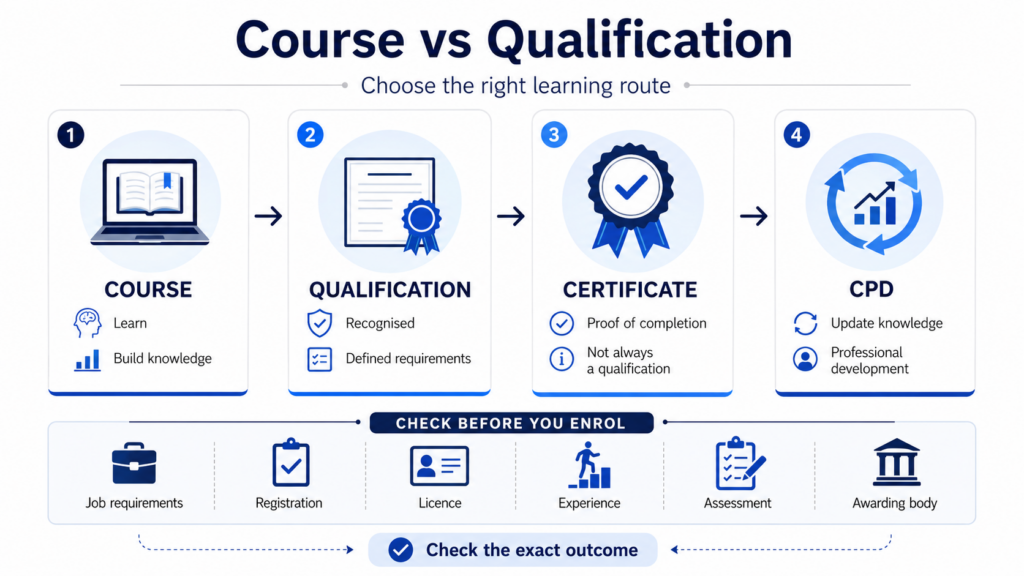
Course vs Qualification: Which Learning Route Do You Need?
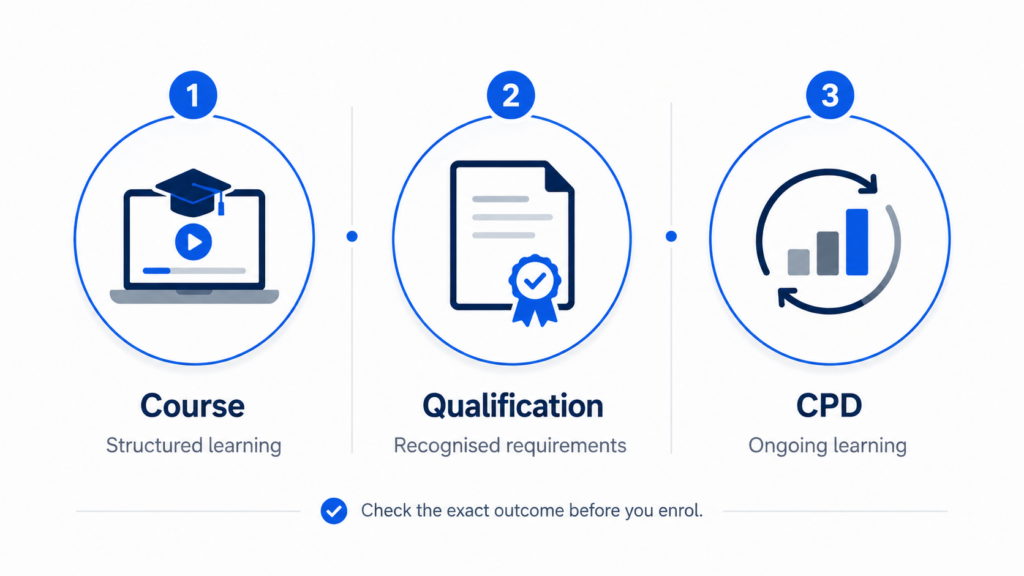
People often use course, qualification and certificate as though they mean the same thing. They do not.
For this reason, understanding the difference can stop you from paying for learning that cannot provide the outcome your career requires.
What Is the Difference Between a Course and a Qualification?
A course gives you structured learning around a subject. It may help you build knowledge, update existing skills, explore a new field or support professional development.
A qualification, on the other hand, follows defined requirements from an awarding organisation or another recognised body.
If you want to check a regulated qualification in England or Northern Ireland, use the Register of Regulated Qualifications.
GOV.UK also explains qualification levels, from Entry Level through Level 8. The level indicates the difficulty of the learning. However, it does not automatically tell you the course size, subject coverage or career outcome.
So, do not choose a course because of the level number alone.
Certificate, CPD and Regulated Qualifications Explained
A certificate records an achievement or course completion. However, the word certificate alone does not tell you whether a regulator recognises the learning as a formal qualification.
For example, a provider may give you a certificate after you complete an online course. That certificate can show learning, but you should not assume that it carries the same status as a regulated qualification.
CPD, or continuing professional development, helps people maintain, update or extend professional knowledge.
CPD learning can support:
- Ongoing professional development
- Refresher learning
- Specialist subject knowledge
- Awareness of changing workplace expectations
If a provider claims that a course leads to a regulated qualification, check the qualification and awarding organisation separately through GOV.UK.
That extra check only takes a few minutes, but it can prevent confusion later.
When a Specific Qualification or Registration May Be Required
Some professions set formal entry requirements. Therefore, you should always check those requirements before you rely on a short course.
A role may require:
- A particular qualification
- Professional registration
- A licence
- Workplace experience
- Practical assessment
- Employer-led competency checks
Do not assume that a short course replaces any of these requirements.
Instead, ask:
Does this job require an exact qualification or registration, or do I mainly need additional knowledge and professional learning?
Once you know the answer, you can compare suitable learning options more confidently.
Ready to build knowledge that supports your next career step? Explore HF Online’s full range of online courses and compare learning options that match your interests, knowledge gaps and professional goals. Choose learning because it fits your plan, not simply because the course title sounds appealing.
How to Compare Courses Before You Enrol
Once you know what type of learning you need, compare courses on substance rather than marketing.
Two programmes can share a similar title yet offer different content, assessments, study formats and outcomes. So, compare the details before you pay.
Check the Course Content and Learning Outcomes
First, read the curriculum.
Look beyond broad promises such as “advance your career” or “become an expert”. Instead, check whether the actual topics match your goal.
Ask:
- What topics will I study?
- Does the curriculum address my knowledge gaps?
- Does it relate to skills employers request?
- Does the provider explain the learning outcomes clearly?
- Will I spend time learning things I already know?
- Can I connect the content to my career goal?
For example, if employers repeatedly ask for safeguarding knowledge, but the course barely covers safeguarding, it may not give you the learning you need.
A clear curriculum should help you understand what you will study before you enrol.
Review Entry Requirements and Assessment
Next, check whether the provider expects previous knowledge, work experience or particular qualifications.
Then review the assessment method.
Courses may use:
- Multiple-choice quizzes
- Written assignments
- Examinations
- Case studies
- Projects
- Other knowledge-based assessments
The right assessment depends on your learning goal.
Also, do not rely on a level number alone. GOV.UK explains that qualifications at the same level can still differ in size and subject coverage.
Therefore, compare the full course details rather than one headline feature.
Check Accreditation, Recognition and Provider Credibility
Before you enrol, check what the provider actually promises.
Ask:
Who provides the course?
Who awards or accredits it?
What will you receive after completion?
Does the provider call it a regulated qualification?
Can you verify that claim independently?
If a provider says that an organisation awards a regulated qualification, use the GOV.UK regulated awarding organisation service to check the organisation.
Also, look for clear information about fees, assessment, access and course outcomes.
A credible provider should help you understand both what the course offers and what it does not offer.
Compare Study Format, Time and Cost
Finally, check whether the course fits your life.
The best course on paper will not help much if you cannot realistically finish it.
Use this comparison:
| Factor | What to Check |
|---|---|
| Study format | Online, classroom, live or self-paced |
| Duration | Total learning time |
| Weekly commitment | How much time you need to set aside |
| Access | How long you can use the learning materials |
| Assessment | What you need to complete or pass |
| Cost | Course price and any additional charges |
| Outcome | Knowledge, certificate, qualification or another result |
The National Careers Service course finder can help learners in England compare different training and study options.
A lower price does not automatically mean better value. At the same time, a higher price does not guarantee better quality.
Which Learning Route Fits Your Career Stage?
Your career stage should influence the type of learning you choose. A beginner may need broad foundation knowledge, while an experienced worker may benefit more from focused professional development courses.
So, match the learning to where you are now and where you want to go next.
Starting Your Career
If you want to enter a new sector, first learn how that sector works. Research common roles, everyday responsibilities, employer expectations and possible progression routes.
Introductory learning can help you explore a subject before you make a bigger commitment. However, always check whether your target role also requires experience, a particular qualification or professional registration.
For example, if health and social care interests you, the Care Certificate Course – Standards 1 to 16 can help you build knowledge around important care topics. You should then compare that learning with the exact requirements of the job you want.
Career Change: Courses and Qualifications to Consider
A career change does not always mean starting again.
First, identify the skills you can carry into your new field. Communication, organisation, leadership, customer service, digital confidence and problem-solving can support many different careers.
Next, identify what your target career requires that you do not yet have.
| Your Situation | Learning to Consider |
|---|---|
| Exploring a new sector | Introductory or foundation learning |
| Missing subject knowledge | Specialist short course |
| Employer asks for a qualification | Relevant recognised qualification |
| Updating existing knowledge | CPD or professional learning |
| Entering a regulated profession | Required qualification, registration or licence |
For instance, someone considering a move into care may use the Health and Social Care Level 3 Diploma to develop broader subject knowledge. At the same time, they should check what qualifications, experience or registration their target employers expect.
Career Progression: Courses and Skills for Your Next Step
If you already work in a sector, compare your current role with the position you want next.
Look at the skills and knowledge that separate the two roles. You may need stronger leadership knowledge, specialist expertise, digital skills or a deeper understanding of workplace responsibilities.
For example, care workers who want to build higher-level knowledge could compare the Health and Social Care Level 5 Diploma with the requirements of their target position.
Building or Updating Professional Knowledge
You do not need to change jobs for learning to have value.
New responsibilities, workplace expectations and sector developments can create fresh knowledge gaps. Therefore, focused learning can help when the subject connects directly to your work.
For example, Mental Health Awareness Training may support your professional learning when mental health knowledge relates to your role or responsibilities.
Choose focused learning when you can clearly explain what you want to understand better and why it matters to your work.
How Should a Changing Job Market Influence Your Course Choice?
The job market changes, so your learning decisions should consider more than today’s job title.
Skills England’s 2026 annual skills report explains that AI and technological change continue to reshape skills across jobs and sectors. It also highlights communication, critical thinking and analytical ability among the cross-cutting skills workers need as workplaces adopt AI.
Prioritise Transferable and Career-Relevant Skills
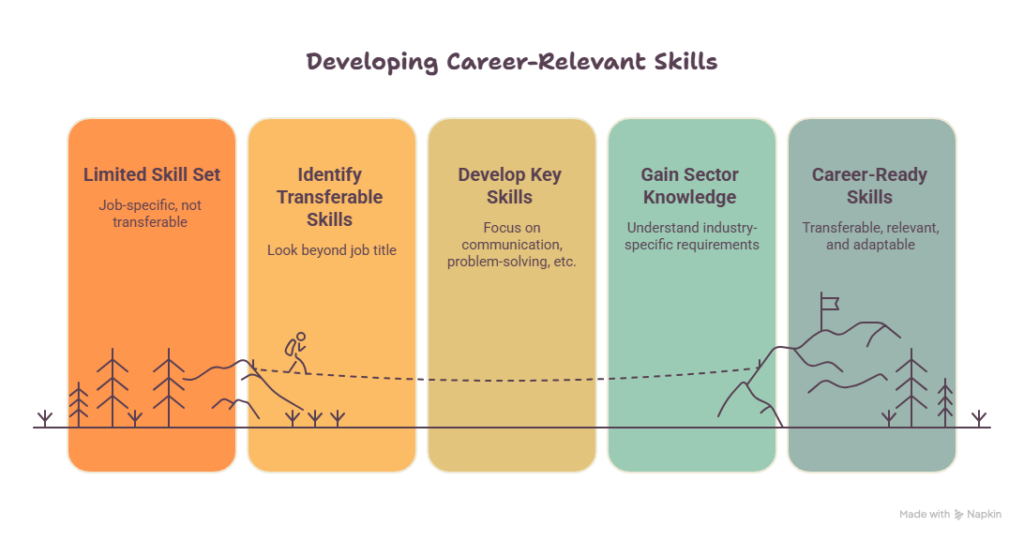
First, look beyond one job title.
Depending on your career, useful skills may include:
- Communication
- Organisation
- Problem-solving
- Digital confidence
- Critical thinking
- Leadership
- Data awareness
- Teamwork
- Sector-specific knowledge
- Responsible use of new technology
These skills can support you across different roles. They can also help you adapt when employers introduce new systems or responsibilities.
Check How Role and Skill Requirements Are Changing
Next, repeat the Three Job Ad Test from time to time.
Check what employers ask for now. For example, look for new software, technical knowledge, certificates, digital responsibilities or specialist skills that appear repeatedly.
Skills England’s sector assessments specifically examine current and future skills demand and connect training pathways with occupations.
You do not need to predict every workplace change.
Instead, choose learning that can remain relevant as your role develops.
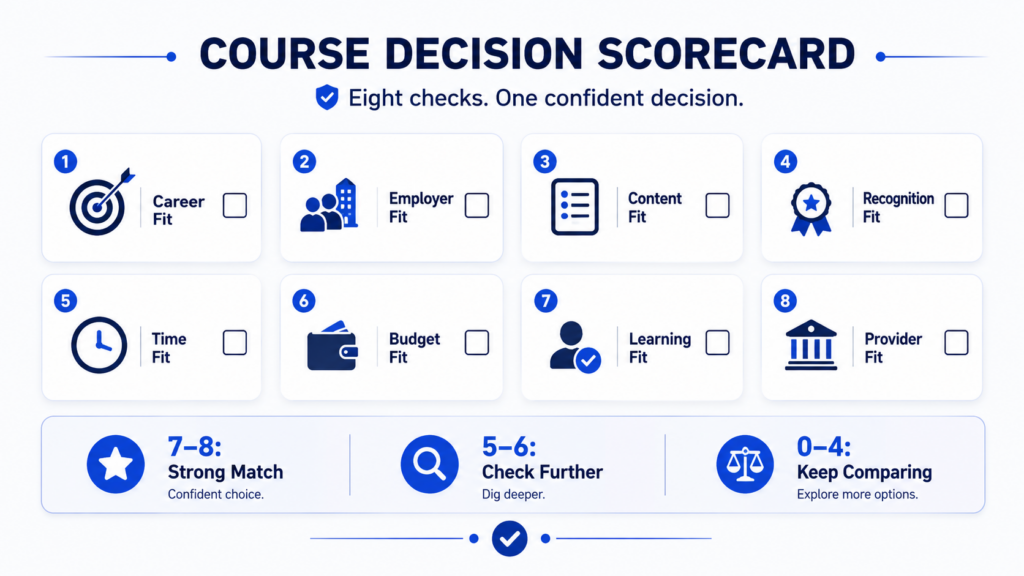
The Course Decision Scorecard: Is This Course Right for You?
You have now considered your career goal, employer expectations and learning options. So, use that information to make a more structured decision.
Give the course one point for every “yes”.
| Decision Check | Ask Yourself |
|---|---|
| Career fit | Does this course support the goal I have defined? |
| Employer fit | Does it address knowledge or skills employers request? |
| Content fit | Does the curriculum cover my genuine gaps? |
| Recognition fit | Do I understand exactly what certificate, qualification or accreditation it offers? |
| Time fit | Can I realistically complete the course? |
| Budget fit | Does the cost make sense for my goal? |
| Learning fit | Does the study method suit me? |
| Provider fit | Does the provider give clear and credible information? |
Now add your score.
7–8 points: The course looks like a strong match. Check the final details before you enrol.
5–6 points: The course may suit you. However, investigate the areas where you answered no before you decide.
0–4 points: Keep comparing. Another course, qualification or learning route may suit your goal better.
Do not treat the score as a guarantee of career success. Instead, use it as a practical filter that keeps your needs at the centre of the decision.
Know what you need now? If healthcare or care work fits your career direction, explore HF Online’s Health and Social Care courses and compare course content, learning outcomes and levels with the goals you identified in your scorecard.
When Should You Not Enrol on a Course Yet?
Sometimes the best decision involves waiting before you enrol.
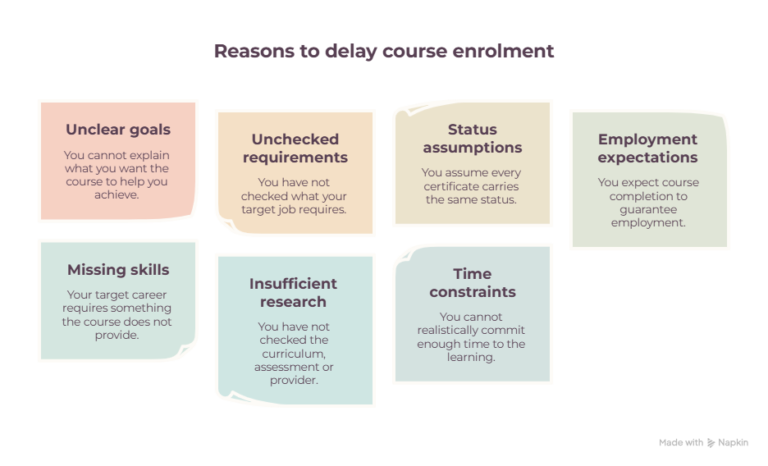
Hold off if:
- You cannot explain what you want the course to help you achieve.
- You have not checked what your target job requires.
- You assume every certificate carries the same status.
- You expect course completion to guarantee employment.
- Your target career requires something the course does not provide.
- You have not checked the curriculum, assessment or provider.
- You cannot realistically commit enough time to the learning.
UK regulators set formal requirements for some professions. In some cases, those rules cover qualifications, professional experience or the right to use a particular professional title. The government’s Regulated Professions Register lets you check professions and find the relevant regulatory body.
So, check these requirements before you spend money on training.
A reliable provider should clearly explain what its course offers. You still need to make sure that the outcome matches your own career requirements.
Final Takeaway: Choose Learning That Matches Your Career Goal
The right course should make sense for your career, not just your CV.
First, define what you want to achieve. Next, check employer requirements and identify your knowledge gaps. Then decide whether you need a course, CPD, certificate or specific qualification. Finally, compare the content, provider, recognition, study format, time and cost.
That process turns course selection from guesswork into a clearer career decision.
Compare the learning options that match your goals and choose your next course with a clearer understanding of what your career actually requires.
Frequently Asked Questions
What Course Is Right for Me?
Choose a course that matches a clear career or learning goal. Then check whether its curriculum addresses a genuine knowledge gap and whether you can manage the time and cost. Most importantly, compare the learning with current employer requirements before you enrol.
What Qualification Should I Choose for My Career?
Start with your target career rather than choosing a qualification level first. Check current vacancies and career requirements for any essential qualifications. If the role requires a regulated qualification in England or Northern Ireland, use the Register of Regulated Qualifications to verify it.
Can an Online Course Replace a Regulated Qualification?
No, not when a profession, regulator or employer requires a specific regulated qualification. An online course can build knowledge and support professional learning, but online delivery alone does not determine regulatory status. Therefore, check exactly what the provider offers before you enrol.
Do Employers Recognise Online Courses and Certificates?
Employers decide what learning they value according to the role and their recruitment criteria. A relevant online course can show additional learning. However, an employer may also require experience, a formal qualification or professional registration. Always compare the course outcome with real job requirements.
Is CPD the Same as a Qualification?
No. CPD supports continuing professional development by helping people maintain or extend their knowledge. A regulated qualification follows separate requirements and regulatory arrangements. Therefore, do not assume that a CPD certificate automatically represents a regulated qualification.
How Can I Check Whether an Online Course Provider Is Credible?
First, look for clear information about course content, learning outcomes, fees, assessment and certification. Then check any claims about regulated qualifications or awarding organisations through official sources. GOV.UK provides separate services for checking regulated qualifications and regulated awarding organisations.
Can Online Learning Help Me Change Careers?
Yes, when the course addresses a genuine gap between your existing knowledge and your target career. Online learning can also offer flexibility while you continue working. However, some careers require additional qualifications, experience, licences or professional registration.
What Should I Do If I Still Cannot Decide Which Course to Choose?
Return to your career goal first. Then repeat the Three Job Ad Test and compare employer requirements with your current skills. After that, shortlist courses that address the gaps and use the Course Decision Scorecard to compare them objectively.