

Medication administration training for care workers becomes especially important when a routine medicine round suddenly stops feeling routine. A resident refuses a tablet. The medicine label does not match the MAR record. Someone struggles to swallow a medicine they normally take without difficulty. What should you do next? Safe medication practice depends on knowing how to act — and when to stop.
Medication administration training for care workers builds the knowledge needed to understand medicine safety, MAR and eMAR records, consent, medication risks and professional responsibilities. Care workers also need clear workplace duties and assessed competence before they take responsibility for administering medicines.
This guide explains how medication administration training for care workers fits into the wider journey from learning to workplace practice. It covers medication support, administration, competency assessment, consent, specialist tasks, employer procedures and ongoing development, helping you understand what the role really involves.
This gives you the exact focus keyphrase three times in the introduction alone, while still sounding natural. I would not push it beyond three uses in such a short intro, because that could start to feel over-optimised.

Table of Contents
Can Care Workers Administer Medication in the UK?
Yes. A care worker can administer medicines when their role includes medication duties and their employer has provided suitable training, assessed their competence and explained the procedures they must follow.
In England, Regulation 12 requires care providers to protect people from avoidable harm and manage medicines safely. CQC also expects providers to give workers the knowledge, skills and competence their responsibilities require.
When Can a Care Worker Administer Medication?
Before taking responsibility for medicines, a care worker should know:
- What their job role allows them to do
- What the person’s medicines care plan says
- Which current medication instructions apply
- How to use the organisation’s MAR or eMAR system
- Who to contact when a problem occurs
- Which tasks fall outside their competence
CQC tells home-care providers to make medication support clear within the person’s care plan and ensure workers have the necessary knowledge and skills.
Care Homes vs Domiciliary Care
The environment changes the way staff organise medication support.
A care home may run scheduled medicine rounds and hold medicines centrally or in people’s rooms. Home-care workers usually support individuals in their own homes and follow care plans designed around each person’s needs. CQC issues setting-specific medicines guidance for both arrangements.
The core pathway remains simple:
Training → Competency Assessment → Employer Approval → Medication Duties
Medication Support vs Medication Administration
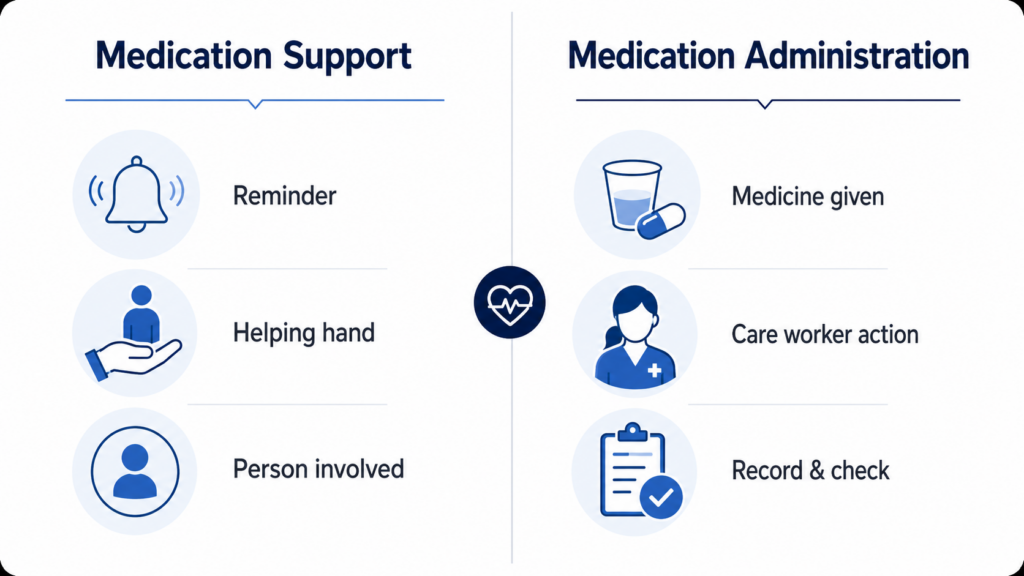
What Is Medication Support?
Depending on the care plan, a worker might:- Remind someone that their medicine is due
- Help them read medicine information
- Assist them with suitable packaging
- Support them to organise their medicines
- Record the help they receive
What Does Medication Administration Involve?
Medication administration gives the worker greater responsibility for the task.| Medication Support | Medication Administration |
|---|---|
| May involve reminders or assistance | Involves the worker giving the medicine |
| Can leave control with the individual | Gives the worker responsibility for the administration task |
| Follows assessed support needs | Requires suitable knowledge and competence |
| Supports independence where possible | Requires accurate checks and records |
Why Does the Difference Matter?
A person’s medication-support needs can change with illness, treatment, mobility, memory or communication. Care workers should follow the current care plan rather than rely on yesterday’s routine. When someone’s needs change, staff should report the change so the appropriate person can review the support plan. NICE places individual needs and preferences at the centre of medicines support.How to Become a Medication-Trained Care Worker: 8 Steps
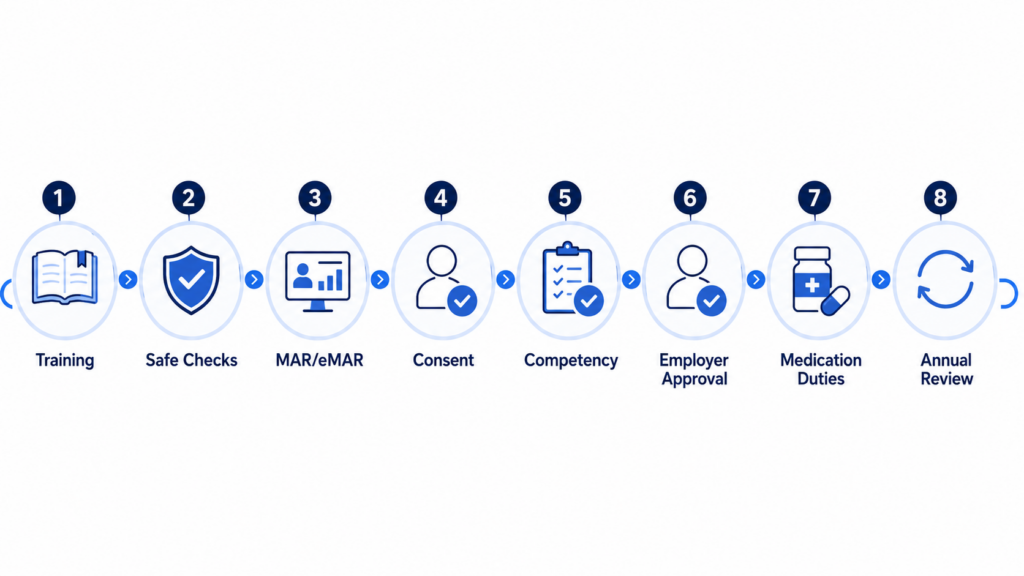
Becoming medication trained requires a clear progression from learning to competent workplace practice. CQC expects providers to match training with the worker’s role, tasks, care setting and medicines systems.
Step 1: Check Your Medication Responsibilities
Ask your employer whether your role involves prompting, assisting, administering medicines or undertaking specialist tasks.
Step 2: Complete Medication Administration Training
Learn the principles of safe administration, records, medicine risks, consent, errors and escalation.
Step 3: Understand the 6 Rights of Medication Administration
Learn to check the right person, medication, dose, route, time and documentation while following the person’s current medication instructions.
Step 4: Understand MAR and eMAR Records
Learn how your workplace records medication activity. CQC expects trained and competent staff to create or amend MAR information accurately, while providers should also train staff to use eMAR systems correctly.
Step 5: Learn About Consent, Refusal and Mental Capacity
Understand the person’s right to make decisions about their medicines. A person who has mental capacity retains the right to refuse medication.
Step 6: Complete a Workplace Competency Assessment
Your employer should assess how you apply your knowledge. NICE recommends direct observation when providers assess competence for medicines support.
Step 7: Follow Employer Approval and Procedures
Take on only the medication duties that your role, competence and workplace procedures cover.
Step 8: Maintain Your Competency
NICE recommends an annual review of medication-related knowledge, skills and competencies.
What Should Medication Administration Training Cover?

A good medication administration course should help care workers understand routine medicine support and recognise situations that require further advice.
Core Medication Knowledge
Training should develop understanding of:
- Common medicine forms and routes
- Dosage instructions and safe checks
- MAR and eMAR documentation
- PRN medicines
- Controlled drugs
- Storage and disposal
- Medication errors and near misses
- Adverse reactions and side effects
- Consent and refusal
- Infection prevention
- Escalation procedures
PRN and Controlled Medicines
PRN medicines require clear instructions about when the person may need them, how much staff can give and what workers must record. CQC advises providers to create clear processes for managing PRN medicines rather than relying only on scheduled medicine rounds.
Controlled drugs require additional controls. For example, care homes must record movements of Schedule 2 controlled drugs in their controlled-drug register.
Storage and Records
Workers need to follow storage requirements and keep medicine records accurate. CQC states that medicines must stay safe and effective during storage, while its updated MAR guidance places responsibility on trained and competent staff when they create or change records.
Medication Errors
Good training should also teach one crucial habit: report problems rather than hide them.
CQC expects providers to maintain processes for identifying, reporting, reviewing and learning from medicine-related incidents.
The aim goes beyond remembering a procedure. A capable care worker notices when the situation has changed and knows who to contact.
Medication Training Certificate vs Workplace Competency

| Training Certificate | Workplace Competency Assessment |
|---|---|
| Records course completion | Examines how you carry out workplace tasks |
| Develops knowledge | Tests how you apply that knowledge |
| Supports professional development | Relates directly to your responsibilities |
| Comes from the training provider | Forms part of the employer’s medicines-safety process |
What Might an Assessor Check?
An assessor may look at how you:- Follow medication instructions
- Use MAR or eMAR records
- Carry out safety checks
- Communicate with the person
- Respond to a refusal
- Recognise discrepancies
- Record medication activity
- Escalate concerns
- Stay within your responsibilities
What If You Change Employer?
Show your training history to your new employer. The new provider still needs to consider your competence against its own medicines systems, responsibilities and care arrangements. CQC highlights this issue particularly where services use temporary staff who may not know the provider’s eMAR system.When Do You Need Specialist Training?
Some medication tasks require additional skills. CQC states that care workers need specialist training and competency assessment before they administer insulin as a delegated task. It applies similar competency expectations to medicines administered through enteral feeding tubes. Know the task. Know your limits. Ask before you act when anything falls outside them.When Should a Medication-Trained Care Worker Stop and Seek Advice?

Medication competence includes knowing when not to continue.
A medicine round may look routine until one detail changes. The safest response does not involve guessing or trying to “fix” the problem yourself. It involves recognising the concern and following the correct escalation route.
Stop and Seek Advice When:
- The medicine label and MAR or eMAR information conflict
- The instructions appear unclear
- You cannot confirm whether someone already received a dose
- The person refuses their medicine
- The person’s swallowing ability or health changes
- You suspect a side effect or adverse reaction
- The task falls outside your training or competence
CQC expects providers to keep MAR information accurate and current, while NICE expects care workers to raise concerns about refusals, errors, adverse effects and changes in someone’s physical or mental health.
A Short Care Scenario
Imagine that Mrs Patel normally takes two tablets at breakfast. Today, her MAR lists both medicines, but one medicine box carries instructions that appear different.
Do not choose the instruction that “looks right”. Stop the administration process, keep the person safe and contact the appropriate senior colleague, pharmacy professional or prescriber through your organisation’s procedure.
The same principle applies when someone refuses medicine. If the person has capacity, they have the right to refuse it. Staff must not disguise the medicine in food or drink simply to overcome that refusal.
Safe medication practice does not mean having every answer. It means recognising when you need one.
How Medication Administration Training Can Support Your Care Career
How Medication Knowledge Supports Different Roles
| Care Role | How Medication Knowledge Adds Value |
|---|---|
| Care Assistant | Helps you follow medicine care plans, document support and recognise concerns |
| Support Worker | Helps you support individual routines while encouraging independence |
| Senior Care Assistant | Strengthens your ability to oversee routines and help colleagues follow procedures |
| Senior Support Worker | Supports clearer handovers, record checking and escalation |
| Team Leader | Helps you coordinate safe processes and respond appropriately to medication concerns |
Skills That Transfer Beyond the Medicine Round
Medication training can strengthen:
- Attention to detail
- Record keeping
- Risk awareness
- Communication
- Accountability
- Person-centred decision-making
- Confidence with escalation
- Understanding of professional boundaries
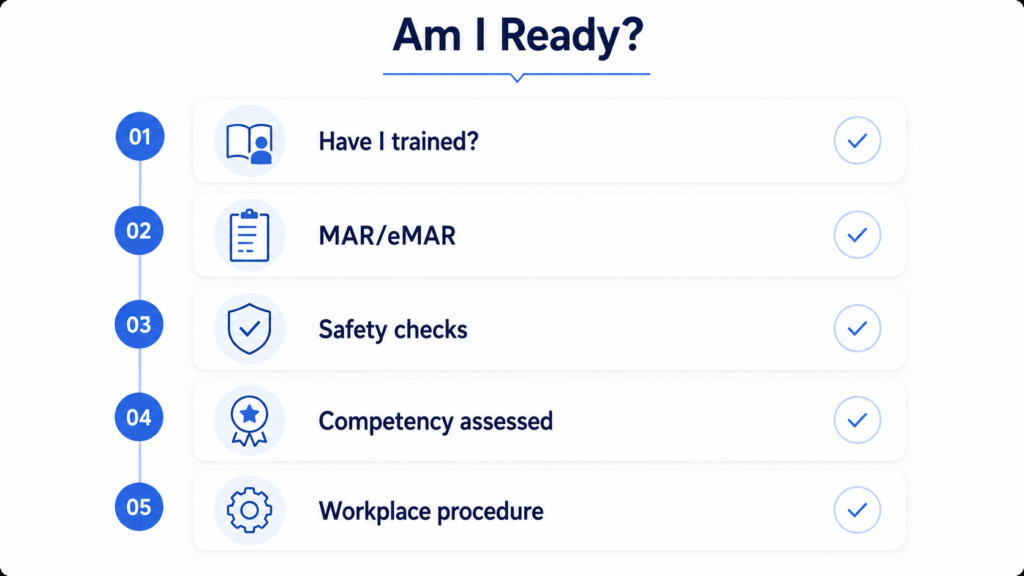
Medication Administration Training Checklist for Care Workers
Before Training
- Confirm whether your role includes medication duties.
- Ask which medicines tasks your employer expects you to undertake.
- Check whether your workplace uses MAR or eMAR records.
- Identify any specialist tasks that need additional learning.
After Training
You should understand:
- Safe medication checks
- Medicine instructions and routes
- Consent and refusal
- PRN medicines
- Medication records
- Errors and near misses
- When to escalate concerns
- Your own professional limits
Before Taking Medication Responsibility at Work
Confirm that you can:
- Follow the person’s current medicines care plan
- Use the workplace recording system correctly
- Recognise a discrepancy
- Respond appropriately to refusal
- Explain who you would contact when something goes wrong
CQC requires providers to assess staff competence before they allow new workers to manage or administer medicines.
Keep Your Knowledge Current
Do not treat competency as a one-time event. NICE recommends an annual review of the knowledge, skills and competencies of care workers who provide medicines support. Employers should also respond when incidents, changing responsibilities or new medication tasks reveal additional learning needs. Quick self-check: If the MAR did not match the label, a person refused a dose or a manager asked you to perform an unfamiliar medication task, would you know exactly what to do next? If not, seek guidance before taking responsibility.Final Takeaway: From Medication Training to Safe, Competent Care
Competence
Procedures
Frequently Asked Questions
Can a Care Worker Administer Medication Without Training?
Employers should not allocate medication administration duties to workers who lack suitable training and competence. CQC expects providers to assess competence before new staff manage medicines.
Can Care Workers Administer Controlled Drugs?
Yes, where the worker’s responsibilities, training, competence and provider procedures support the task. Care services must also follow specific controlled-drug recording requirements.
Can a Care Worker Administer Insulin?
A registered nurse can delegate insulin administration in appropriate circumstances. The care worker must complete specialist training and demonstrate competence for the named person or people.
Can Agency Care Workers Administer Medication?
Agency status does not remove competency requirements. The provider needs confidence that the worker understands the medication task and relevant workplace systems.
Can Care Workers Give PRN Medication?
They can follow an agreed PRN plan when clear instructions explain why, when and how staff should give the medicine and record the outcome.
Does Medication Training Transfer Between Employers?
Your training record can support your new role, but the new provider still needs to consider your competence for its medicines systems and responsibilities.
How Often Should Employers Review Medication Competency?
NICE recommends an annual review of relevant knowledge, skills and competencies for workers who provide medicines support.
Does a Medication Administration Certificate Expire?
Course providers set their own certificate terms. Workplace competence depends on current knowledge, skills, duties and employer assessment rather than the certificate alone.
Does CQC Require Annual Refresher Training?
CQC highlights NICE’s recommendation for an annual competency review. Employers should identify further training when roles, systems, incidents or learning needs make it necessary.
What Should a Care Worker Do After a Medication Error?
Protect the person, report the error promptly, follow clinical advice, record the incident accurately and cooperate with the provider’s review process. CQC expects services to identify, report, review and learn from medicines errors.