


What Does a Healthcare Assistant Course Include?
A Healthcare Assistant Course commonly covers healthcare settings, legal and ethical responsibilities, medical records, patient confidentiality, workplace safety, infection prevention, mobility, mental capacity, medical terminology and digital healthcare systems. The course provides structured knowledge-based learning rather than supervised clinical practice, so employers may still require induction, checks, mandatory training and workplace competency assessments.
What Is a Healthcare Assistant Course with a CPD Certificate?
A Healthcare Assistant Course with a CPD Certificate is an online training programme that introduces the principles, responsibilities and professional knowledge connected with healthcare support work.
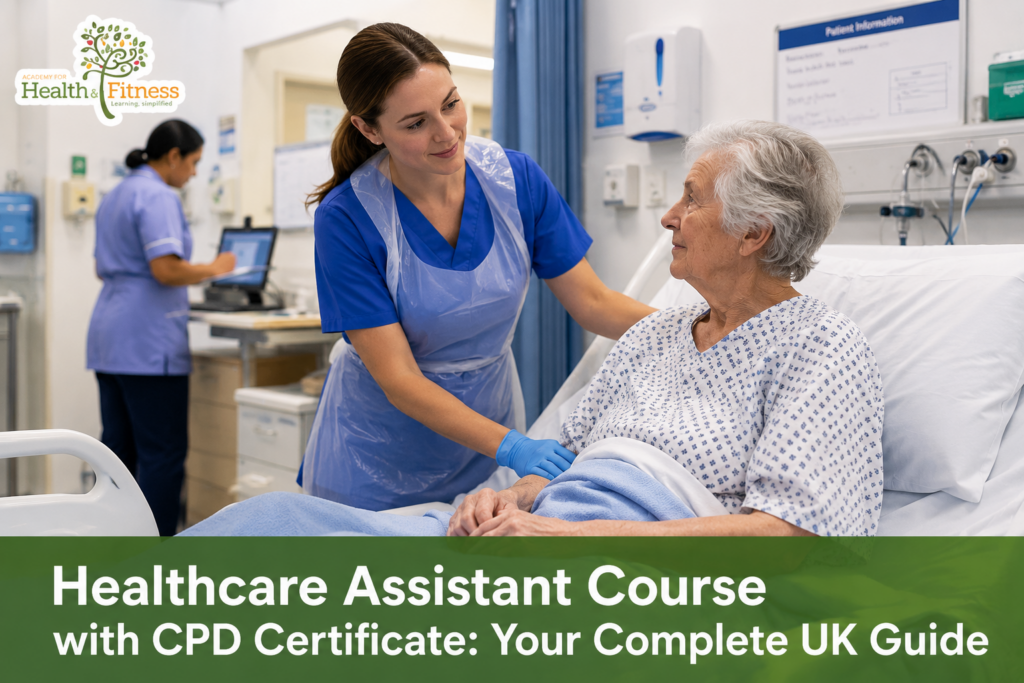
Healthcare assistants support patients and clinical teams across hospitals, care homes, hospices, community services and people’s homes. Their exact responsibilities vary between employers and settings. Common duties may include reassuring patients, supporting personal care, maintaining clean environments, recording basic information and working alongside nurses and other healthcare professionals.
The course helps learners understand the knowledge behind these responsibilities before or alongside employer-led training. It explores how healthcare services operate, why confidentiality matters, how infections spread and how legal or ethical responsibilities can affect patient support.
Because the course is delivered online, learners can study its lessons without attending a physical classroom. This flexibility may suit people balancing employment, caring duties or other commitments.
The CPD element confirms that a learner has completed structured continuing professional development. It can provide evidence of relevant learning, but it should not be confused with a regulated qualification, professional registration or proof that someone can perform clinical tasks independently.
Workplace procedures still require appropriate instruction, supervision and employer authorisation. Part 2 of this guide explains the differences between CPD training, the Care Certificate, regulated qualifications and workplace competency in greater detail.
Who Is the Healthcare Assistant Course For?

The Healthcare Assistant Course is designed for people who want to understand healthcare support before deciding how it may fit their career or professional development plans.
People Exploring Their First Healthcare Role
You may be interested in healthcare but unsure what support work involves. The course introduces common healthcare environments, responsibilities and terminology, helping you decide whether the field matches your interests and strengths.
It may be particularly useful if you are considering Healthcare Assistant, Healthcare Support Worker, Care Assistant or related entry-level opportunities.
Career Changers
Experience from retail, hospitality, childcare, administration or customer service can build transferable skills such as communication, patience, organisation and teamwork.
A Healthcare Assistant online course can help career changers connect these existing abilities with healthcare-specific knowledge, including confidentiality, patient rights and infection prevention.
Existing Care and Support Workers
People already working in care may use the course to refresh their knowledge or explore how healthcare settings differ from their current workplace.
For example, a community support worker may want to understand medical records, healthcare terminology or hospital service delivery more clearly.
Volunteers and Unpaid Carers
Volunteering or supporting a family member can create valuable awareness of people’s needs. However, informal experience does not always explain the legal, ethical and organisational principles behind formal healthcare services.
Structured learning can help volunteers and unpaid carers understand professional boundaries, record keeping, privacy and the importance of working within an assigned role.
Learners Preparing for Further Study
The course may also suit people considering a broader health and social care programme, apprenticeship or employer-led training route.
The National Careers Service identifies college courses, apprenticeships and working towards the role as possible ways to enter healthcare assistant work. It also notes that volunteering can help applicants gain relevant healthcare experience.
Healthcare Assistant Course Modules Explained
The Healthcare Assistant Training Course brings together 20 learning units covering professional responsibilities, healthcare records, patient safety, mobility, service delivery and technology. The modules are arranged to help learners see how healthcare systems, patient needs and workplace responsibilities connect.
The following module groups show what learners explore and why each area matters.
Module area | What learners explore | Why it matters in healthcare |
Healthcare settings | Hospitals, clinics, care environments and community services | Helps learners understand how duties and patient needs may vary between workplaces |
Legal and ethical responsibilities | Rights, responsibilities, professional conduct and ethical decision-making | Builds awareness of accountable, lawful and respectful support |
Medical records | Record maintenance, accuracy and appropriate information handling | Shows why clear documentation supports communication and continuity of care |
Patient confidentiality | Privacy, secure information and professional boundaries | Reinforces trust and the responsible use of sensitive patient information |
Health and safety | Workplace responsibilities, common risks and safer working principles | Helps learners recognise why hazards must be reported and managed appropriately |
Hygiene and infection control | Cleanliness, infection risks and prevention principles | Develops awareness of how safer routines can reduce avoidable transmission |
Mobility and immobility | The effects of restricted movement and different mobility needs | Helps learners understand how reduced mobility can affect comfort, independence and wellbeing |
Capacity and consent | Decision-making ability, patient choice and individual rights | Supports a more person-centred understanding of dignity and lawful care |
Healthcare service delivery | How services are organised, coordinated and improved | Shows how different teams and systems contribute to patient support |
Medical terminology | Common healthcare language and professional vocabulary | Makes clinical communication and healthcare records easier to understand |
Information technology | Digital records, healthcare systems and emerging technology | Builds awareness of how technology supports communication, administration and service delivery |
Healthcare Settings and Professional Responsibilities
Healthcare support is not limited to hospital wards. Assistants may work in NHS or private hospitals, adult care homes, hospices and clients’ homes.
Each setting creates different routines, risks and expectations. Learning about these environments helps learners understand why responsibilities can change according to the service, patient group and level of supervision.
The legal and ethical modules also introduce the boundaries that guide professional behaviour. Knowing when to follow instructions, report concerns or seek help is as important as understanding the task itself.
Medical Records and Confidentiality

Healthcare teams depend on information that is clear, relevant and handled securely. Poor documentation can create confusion, while inappropriate disclosure can damage trust and expose private information.
These modules help learners understand why records matter, how confidentiality supports patient rights and why information should only be accessed or shared through appropriate procedures.
Health, Safety and Infection Prevention

Healthcare environments bring people into contact with equipment, bodily fluids, medication, waste and infectious illnesses. Staff therefore need to recognise risks and follow the procedures established by their employer.
The course introduces the principles behind health and safety, hygiene and infection control. It develops awareness rather than replacing practical instruction on workplace equipment, personal protective equipment or specialist procedures.
Mobility, Capacity and Individual Choice
A patient’s ability to move, communicate or make decisions can change because of illness, injury, disability or treatment. Support must therefore respect both safety and personal independence.
Learning about mobility and mental capacity helps learners consider the individual rather than focusing only on a task. It also introduces the importance of choice, consent, dignity and seeking appropriate guidance when someone may have difficulty making a particular decision.
Medical Terminology and Healthcare Technology
Unfamiliar terminology can make healthcare records and workplace discussions difficult to follow. Building knowledge of common terms can help learners interpret information more confidently and communicate more clearly.
Technology also plays a growing role in patient records, appointments, service coordination and professional communication. The course introduces these systems while reinforcing the need for accuracy, confidentiality and responsible information use.
How Is the Healthcare Assistant Course Delivered and Assessed?
The Healthcare Assistant Course is delivered online, allowing learners to work through the modules from home or another suitable location. Course access is available for 12 months, so learners can organise study around their existing schedule rather than attending fixed classroom sessions.
The course is self-paced. This means one learner may complete the material quickly, while another may spread the lessons across several weeks. Tutor support is available on weekdays when learners need guidance about the course content.
Learning online offers convenience, but it also requires consistency. Creating a weekly study routine, taking notes and reviewing unfamiliar terminology can make the content easier to retain.
The current course information states that learners complete an assessment and must achieve at least 60% to pass. Successful completion provides access to CPD certificate options as evidence of continued professional development. Certificate formats and current charges should always be checked on the live course page before enrolment because provider terms may change.
Assessment confirms that the learner has engaged with and understood the course material. It does not demonstrate that the learner can complete physical care, clinical observations, medication support, moving and handling or other workplace duties without supervision.
Employers remain responsible for deciding which tasks a Healthcare Assistant may perform and what induction, practical instruction, background checks or competency assessment will be required.
Understanding the modules is only the beginning. The next part examines the professional, communication and employability skills learners can develop, before clarifying how a CPD certificate differs from the Care Certificate and employer-led training.
What Skills Can You Develop Through Healthcare Assistant Training?
Healthcare assistant training can build the professional knowledge, communication awareness and transferable skills needed to understand patient support more confidently. It can also help learners recognise appropriate boundaries, respond professionally and prepare for employer-led induction. However, online study alone does not confirm competence in physical care or clinical procedures.
The most useful healthcare assistant skills combine technical awareness with human qualities. Knowing the meaning of confidentiality matters, but so does recognising when a patient feels frightened. Understanding infection control is important, but workers must also follow the exact procedures used in their workplace.
The National Careers Service identifies sensitivity, patience, communication, teamwork, attention to detail, calmness under pressure and basic computer skills among the qualities associated with healthcare assistant work.
Communication and Patient Support
Clear communication helps patients understand what is happening and allows healthcare teams to share important information. It involves listening carefully, using suitable language and checking that the other person has understood.
Patients may communicate differently because of pain, anxiety, illness, disability, hearing loss, limited speech or unfamiliarity with healthcare terminology. A Healthcare Assistant must therefore avoid rushing conversations or making assumptions about what someone needs.
Good communication may involve:
Introducing yourself and explaining your role
Listening without interrupting
Using plain, respectful language
Allowing someone enough time to respond
Observing facial expressions and body language
Passing relevant information to an appropriate colleague
Recording information accurately
Reassurance is also part of communication. A calm explanation may help someone feel more comfortable before an appointment, examination or change in routine. However, reassurance should never become false certainty. Healthcare Assistants must stay within their responsibilities and refer clinical questions to suitably qualified professionals.
Confidentiality and Record-Keeping Awareness
Healthcare workers may encounter sensitive information about a person’s condition, treatment, family circumstances or personal life. This information must be handled carefully.
Healthcare assistant training introduces the reasons confidentiality matters and how poor information handling can affect privacy, dignity and trust. It can also help learners understand why records should be accurate, timely and based on facts rather than assumptions.
For example, writing that a patient “seemed difficult” gives little useful information. Recording what the person said, what was observed and what action was taken provides a clearer factual account.
Confidentiality does not mean keeping every concern secret. Information may need to be passed to an authorised colleague when it relates to patient care, safeguarding or immediate safety. The important point is to follow workplace procedures and share information through the correct channels.
Infection Prevention and Hygiene Awareness
Healthcare environments can bring patients, staff, visitors, equipment and bodily fluids into close contact. Infection prevention therefore depends on consistent routines rather than occasional caution.
A CPD Healthcare Assistant Course can introduce how infections spread and why hygiene measures protect both patients and workers. Learners may explore hand hygiene, environmental cleanliness, waste disposal, personal protective equipment and the importance of following local infection-control procedures.
Online learning develops awareness of these principles. It does not replace workplace instruction on equipment, isolation procedures, exposure incidents or the correct use of personal protective equipment.
Every healthcare setting has its own risk assessments and protocols. A hospital ward, residential service and community visit may each require different precautions.
Health and Safety Awareness
Healthcare support workers need to notice risks before they cause harm. These risks may include spillages, damaged equipment, obstructed walkways, unsafe disposal, incorrect storage or sudden changes in a patient’s condition.
Healthcare assistant training can help learners understand the shared responsibility for maintaining a safer environment. This includes recognising a potential hazard, responding within their role and reporting the concern promptly.
Health and safety awareness does not mean attempting to solve every problem independently. In many situations, the safest response is to stop, protect the person from immediate danger and contact an appropriate colleague.
Patient Mobility and Independence
Illness, surgery, injury, disability and age-related changes can affect how someone sits, stands or moves. Restricted mobility may also influence comfort, confidence, skin health and independence.
Course learning can introduce the effects of mobility and immobility. It may help learners understand why support should be person-centred rather than based on a standard routine.
A person may need encouragement, equipment, supervision or physical assistance. The correct response depends on their care plan, current condition and workplace assessment.
An online Healthcare Assistant Course cannot teach or assess safe physical moving and handling by itself. Learners should never attempt an unfamiliar technique simply because they have read about it. Practical instruction, suitable equipment and employer-approved competency assessment remain essential.
Capacity, Consent and Person-Centred Support
Person-centred support starts with recognising that the patient is an individual with their own preferences, experiences and priorities.
Healthcare assistant training can introduce the importance of asking permission, offering choices and explaining support before beginning. It also helps learners consider how illness, injury or cognitive impairment may affect a person’s ability to make a particular decision.
Capacity should not be judged solely because someone has dementia, a learning disability, a mental health condition or communication difficulties. Nor should workers assume that a person lacks capacity because they make a choice others consider unwise.
A Healthcare Assistant must work within organisational procedures, respect the individual’s rights and seek guidance when consent or decision-making ability is unclear.
Medical Terminology and Digital Confidence
Healthcare language can initially feel unfamiliar. Abbreviations, anatomical terms and clinical phrases may appear in records, handovers and conversations between professionals.
Learning common terminology can help future Healthcare Assistants follow information more confidently. It can also reduce the risk of misunderstanding instructions or using vague language when recording observations.
Digital confidence is becoming equally important. Healthcare organisations use electronic systems for records, appointments, communication and service coordination. Workers may need to enter information accurately, protect login details and recognise suspicious or inappropriate access.
The course introduces the role of healthcare technology. Employers will still provide training on the specific systems used within their organisation.
Employability Skills Healthcare Assistants Need
Healthcare knowledge matters, but employers also look for values and behaviours that influence how a person works.
Strong Healthcare Assistant candidates can usually show that they are:
Compassionate without becoming overfamiliar
Patient when people need additional time
Reliable during busy or demanding shifts
Observant enough to notice meaningful changes
Respectful of dignity, culture and personal choice
Able to cooperate with different professionals
Willing to receive feedback and continue learning
Calm enough to report concerns clearly
Careful with private information
Aware of their own professional limits
These qualities should be demonstrated through examples rather than simply listed on a CV. Experience from customer service, childcare, volunteering, hospitality or unpaid caring may offer relevant evidence when it shows communication, responsibility and respect.
What Does a CPD Certificate Mean for Healthcare Assistants?

A CPD certificate records that a learner has completed structured continuing professional development. Within a Healthcare Assistant Course, it may provide evidence that the learner has studied subjects such as patient confidentiality, infection control, medical records and professional responsibilities.
Learners may include the course in the training or professional development section of their CV. They should state its title accurately and avoid presenting it as a regulated qualification when it is not one.
In England and Northern Ireland, regulated qualifications can be checked through the official Register of Regulated Qualifications. The register identifies qualifications that are formally regulated and provides information about the awarding organisation, level and qualification details.
A CPD certificate can therefore support a job application by showing relevant learning, but its value depends on the employer, the course content and the role. It does not guarantee an interview, employment, a particular salary or permission to complete clinical duties.

The following comparison makes the distinction clearer:
Training route | Main purpose | What completion shows | Does it confirm workplace competence? |
CPD Healthcare Assistant Course | Develops or refreshes role-related knowledge | The learner has completed the stated course and assessment | Not by itself |
Care Certificate | Supports induction for health and care support workers in England | The worker has completed all required standards and assessments | It includes workplace application and assessment |
Regulated qualification | Provides formally assessed learning under an approved qualification specification | The learner has met the requirements of a regulated programme | It depends on the qualification and its assessment methods |
Employer-led training | Teaches procedures, equipment and responsibilities used in a specific workplace | The worker has completed the employer’s required training | It may include observation and competency sign-off |
The Healthcare Assistant Training Course is best presented as a route for building relevant knowledge and demonstrating continued learning. Learners should still check individual job descriptions before assuming that one course meets every employer requirement.
Is a Healthcare Assistant Course the Same as the Care Certificate?
No. A Healthcare Assistant Course with CPD Certificate and the Care Certificate may cover related topics, but they have different purposes and assessment requirements.
A CPD Healthcare Assistant Course provides structured learning that can be completed before employment, alongside work or as part of wider professional development. Assessment normally checks understanding of the course material.
The Care Certificate is an induction framework used for health and social care support workers in England. It was updated in 2025 and now contains 16 standards, including a standard covering awareness of learning disability and autism.
The standards cover areas such as:
Understanding the worker’s role
Duty of care
Equality and human rights
Person-centred support
Communication
Privacy and dignity
Nutrition and hydration
Mental health and dementia
Safeguarding
Basic life support
Health and safety
Information handling
Infection prevention
Learning disability and autism awareness
Crucially, the Care Certificate requires more than reading lessons and passing an online test. It involves theoretical learning, practical application and assessment within the workplace. All required elements must be completed before the Care Certificate can be awarded.
An online course may help someone understand topics that also appear in the Care Certificate. It may even make future induction easier to follow. However, it should not be described as a replacement for employer-led Care Certificate completion unless the full standards, practical requirements and workplace assessments have genuinely been met.
This distinction protects learners from believing that an online certificate automatically authorises them to work without supervision.
Can a CPD Healthcare Assistant Course Help You Get a Job?
A CPD Healthcare Assistant Course may strengthen employment preparation, but it cannot guarantee a Healthcare Assistant job.
The course may help learners:
Understand common healthcare language
Recognise professional responsibilities
Prepare examples for interview questions
Discuss confidentiality and dignity more confidently
Show commitment to continued learning
Identify gaps requiring further development
Approach induction with greater subject awareness
For someone with no previous healthcare experience, this knowledge can make job descriptions and interview questions feel less unfamiliar. A learner may be better prepared to explain why privacy matters, how they would report a concern or why they should work within professional boundaries.
Employers will still assess the complete candidate. Depending on the role, they may consider values, communication, previous experience, references, availability and English or numeracy skills. Entry routes also vary: the National Careers Service identifies college study, apprenticeships, volunteering and direct progression through related work as possible routes into healthcare assistant employment.
Patient-facing roles may also require an appropriate Disclosure and Barring Service check. The type of DBS check depends on the duties involved and legal eligibility, so the recruiting organisation normally decides which check is needed.
Other employment requirements may include:
Identity and right-to-work checks
Employment references
Occupational health screening
Employer induction
Mandatory training
Care Certificate assessment
Role-specific practical instruction
Observed workplace competency
Ongoing supervision and appraisal
These requirements should not discourage new applicants. They exist because caring for patients carries real responsibility. The best preparation combines relevant knowledge, honest applications and willingness to learn through supervision.
Healthcare Assistant Duties: How Course Learning Relates to the Role
Healthcare Assistant duties vary according to the employer, patient group and work environment. The course does not teach every workplace task, but its modules can help learners understand the principles behind common responsibilities.
Healthcare responsibility | Related course knowledge | How the learning may help |
Reassuring and communicating with patients | Professional responsibilities and medical terminology | Helps learners use clearer, more respectful communication |
Protecting private information | Confidentiality and medical records | Builds awareness of secure and appropriate information handling |
Maintaining a clean care environment | Hygiene and infection control | Explains why consistent prevention routines matter |
Reporting hazards or concerns | Health and safety | Helps learners recognise when an issue should be escalated |
Supporting individual choice | Capacity, consent and patient rights | Reinforces dignity and person-centred decision-making |
Responding to mobility needs | Mobility and immobility | Builds awareness of how movement limitations affect independence |
Updating records | Record maintenance and healthcare technology | Encourages accurate, factual and responsible documentation |
Working with healthcare teams | Service delivery and professional conduct | Shows how support roles contribute to coordinated care |
The National Careers Service describes possible duties such as supporting washing and dressing, helping at mealtimes, reassuring patients, assisting with mobility, maintaining supplies and carrying out basic health checks. Actual duties depend on employer training, delegation and assessed competence.
Course knowledge gives these responsibilities context. For example, learning about confidentiality explains why patient information cannot be discussed casually. Studying mobility explains why physical assistance should follow an assessed plan rather than instinct. Exploring professional boundaries helps learners recognise when to act, when to report and when to ask for help.
That connection between learning and employment preparation leads to the next stage of the guide: the practical career benefits of completing a Healthcare Assistant Course, the settings in which Healthcare Assistants work and the routes available for progression or further study.