

CPD Course vs Regulated Qualification: What Each Means, How Ofqual Status Differs, and Which Route Suits Your Goals
Have you found a course called “Level 3”, “Level 5”, “CPD accredited” or “recognised” and wondered whether it gives you a formal UK qualification? You are not alone. The wording can look similar, but the outcome can be very different. Choosing the wrong type of training could leave you with useful knowledge but without the qualification an employer, university or regulator actually requires.
This CPD Course vs Regulated Qualification guide gives you the simple answer: CPD courses mainly support continuing professional development, while a regulated qualification sits within a formal regulatory system and must meet defined requirements. A CPD course can strengthen knowledge, refresh skills and support a CPD record, but it does not automatically become an Ofqual regulated qualification simply because it has a certificate, diploma-style title or level number.
Workplace learning is a major part of the UK skills economy. In the 2024 Employer Skills Survey, 59% of employers provided training, 63% of employees received training, and 70% of employers that trained staff used online learning or e-learning. UK employers spent £53 billion on training and development.
In this guide, you will learn how CPD accreditation differs from Ofqual regulation, how the Regulated Qualifications Framework works, what Level 3 and Level 5 really mean, and whether CPD hours, points or credits count towards formal qualifications. You will also learn how employers may view CPD and how to check a course before you enrol.
Before you pay for any course, ask one question: “What exactly will I hold when I finish?” Keep reading, and you will know how to verify the answer.

What Is a CPD Course and What Is a Regulated Qualification in the UK?
A CPD course supports continuing professional development by helping you update knowledge, strengthen workplace skills and record ongoing learning. CPD can include online CPD courses, workshops, webinars, conferences, professional development courses and even relevant free CPD courses. A regulated qualification serves a different purpose. Ofqual defines it as a qualification offered by a recognised awarding organisation within its scope of recognition. Therefore, CPD learning does not automatically equal a formal regulated qualification.
To understand the difference clearly, look at what each option actually provides:
CPD Course:
First, a CPD course focuses on professional learning, knowledge updates, upskilling or reskilling. It may provide a certificate after finishing the course. However, that certificate does not automatically represent a vocational, professional or Ofqual-regulated qualification.
Regulated Qualification:
In contrast, a regulated qualification comes from a recognised awarding organisation within its approved scope. Ofqual applies official rules to these qualifications, while the official Register provides information that helps learners confirm their status and details.
So, is CPD a qualification? CPD can provide valuable evidence of learning, but it does not automatically become a formal qualification. For example, a learner might study a Health and Social Care Level 3 Diploma to develop knowledge while separately checking any formal requirements for their intended role.
You can verify formal status through the official Register of Regulated Qualifications, which shows whether a qualification is regulated and provides detailed information.
Ultimately, CPD develops professional knowledge, while a regulated qualification formally records achievement within a recognised and regulated qualification system.
What Does Ofqual Regulated Mean? RQF, Qualification Levels and Recognised UK Qualifications Explained
Ofqual regulated means that a qualification sits within the regulatory system overseen by the Office of Qualifications and Examinations Regulation in England. The regulator oversees recognised awarding organisations and the qualifications they offer within their approved scope. Meanwhile, the Regulated Qualifications Framework (RQF) helps learners compare the level and size of regulated qualifications. However, seeing “Level 3” or “Level 5” in a course title does not automatically prove Ofqual regulation.
To understand Ofqual regulation clearly, separate these three important concepts:
Regulated Qualifications Framework (RQF):
First, the RQF provides a framework for understanding the level and size of regulated qualifications. Ofqual introduced it in October 2015. Therefore, it helps learners compare qualifications without suggesting that every similarly titled course belongs to the framework.
Qualification Levels:
Next, RQF levels run from Entry Level through Level 8 and indicate difficulty level. For example, A levels sit at Level 3, while foundation degrees and HNDs sit at Level 5. Size remains a separate measure.
Recognised UK Qualifications:
Finally, learners should verify formal recognition rather than trust a course headline. Search the exact title, awarding organisation and qualification details. The Ofqual Register confirms whether a qualification holds regulated status and provides information for comparison.
For a clear breakdown of Entry Level through Level 8, check the GOV.UK guide to qualification levels.
Ultimately, check the qualification’s RQF level, awarding organisation and regulated status before treating any Level 3 or Level 5 course as recognised.
CPD Course vs Regulated Qualification: What Are the Essential Differences?
The main difference between a CPD course and a regulated qualification is their purpose and regulatory status. A CPD course usually supports continuing professional development, upskilling and workplace learning. In contrast, an Ofqual regulated qualification forms part of England’s regulated qualification system and must come from a recognised awarding organisation within its scope of recognition. Therefore, completing CPD can strengthen professional knowledge without automatically giving you a formal regulated qualification.
First, understand what each learning route actually represents:
CPD Course:
A CPD course develops or refreshes professional knowledge through structured learning. For example, employers may value CPD for upskilling, reskilling and continuing development. However, completing CPD does not automatically give the learner a regulated qualification.
Regulated Qualification:
By contrast, a regulated qualification comes from an Ofqual-recognised awarding organisation within its recognised scope. Ofqual applies regulatory rules covering areas such as qualification design, assessment, standards, certificates and information for learners. As a result, the qualification carries a formally regulated status that learners can verify.
CPD Course vs Regulated Qualification Comparison
Comparison | CPD Course | Regulated Qualification |
Purpose | Primarily, it supports professional development, knowledge updates, upskilling or reskilling. | In contrast, it confirms achievement against the requirements of a formally regulated qualification. |
Regulation | CPD status alone does not make the course Ofqual regulated. | Instead, Ofqual regulates the qualification when a recognised awarding organisation offers it within its approved scope. |
Assessment | Providers may use quizzes, assignments, reflections or other learning checks. | Meanwhile, awarding organisations must ensure assessments meet official rules and match the official course requirements. |
Qualification Level | A provider may use a level to describe learning depth. However, this does not prove RQF status. | By comparison, the RQF identifies the level and size of regulated qualifications. |
Certificate | Usually, the certificate records course or CPD finishing the course. | On the other hand, a regulated certificate records achievement of the specific qualification after the learner meets its requirements. |
Recognition | Employers may value relevant CPD for professional learning. | However, formal recognition comes through the regulated qualifications system. |
Career Use | CPD can strengthen professional knowledge, a CV or CPD portfolio. | Therefore, a regulated qualification may satisfy formal requirements where an employer, career route or education provider specifies it. |
Progression | CPD supports continued professional development but does not guarantee progression to further study. | Likewise, a regulated qualification may support further study or career progression where the receiving organisation accepts it. |
You can use the official Register of Regulated Qualifications to check whether an exact qualification is regulated, examine its details and compare similar qualifications. Therefore, do not ask only:
“Will I get a certificate?”
Instead, ask:
“What does this certificate formally represent?”
Ultimately, choose CPD for relevant professional development, but verify a regulated qualification whenever your career or study route formally requires one.
CPD Accreditation vs Ofqual Regulation: What Is the Essential Difference?
CPD accreditation and Ofqual regulation are not the same thing. Typically, accreditation shows that a CPD organisation has reviewed the learning against its learning standards. By contrast, Ofqual regulation applies to formal qualifications offered by recognised awarding organisations within their approved scope. Therefore, a CPD accredited course can provide useful evidence of continuing professional development without becoming an Ofqual regulated qualification. Importantly, words such as “accredited”, “certified” and “recognised” alone do not prove regulatory status.
First, understand what each term actually means before comparing courses:
CPD Accreditation:
CPD accreditation generally shows that an external CPD organisation has reviewed a course against its professional-learning criteria. For example, it can support CPD certification and professional-development records. However, accreditation alone does not create an RQF-regulated qualification.
Ofqual Regulation:
In contrast, Ofqual regulates recognised awarding organisations and qualifications within their approved scope in England. A regulated qualification must meet Ofqual’s regulatory conditions. Furthermore, learners can verify its official status through Ofqual’s qualification records.
CPD Accreditation vs Ofqual Regulation Comparison
Comparison | CPD Accreditation | Ofqual Regulation |
Main purpose | Primarily, it supports continuing professional development and demonstrates finishing the course of structured learning. | In contrast, it provides official oversight for recognised qualifications. |
Who oversees it? | A CPD accreditation or certification organisation applies its own review standards. | The Office of Qualifications and Examinations Regulation oversees recognised awarding organisations in England. |
Regulatory status | CPD accreditation does not automatically place a course on the RQF. | Instead, the qualification must fall within an awarding organisation’s recognised regulatory scope. |
Certificate meaning | Usually confirms finishing the course of CPD learning or training. | By comparison, it confirms achievement of a regulated qualification when learners meet its assessment requirements. . |
Qualification number | A CPD course does not automatically receive an Ofqual qualification number. | However, a regulated qualification receives an official qualification number within Ofqual’s system. |
Employer use | Employers may value it for upskilling, refresher learning or professional development. | In some cases, employers may require a regulated qualification for particular roles, progression routes or formal entry requirements. |
How to verify | Check who accredited the course and what their accreditation represents. | Finally, check the exact qualification, awarding organisation and regulatory status through official Ofqual information. |
When comparing the two, read the Ofqual Handbook on regulated and unregulated qualification claims. Ofqual requires awarding organisations to avoid statements that could make learners believe an unregulated qualification is regulated. In addition, their advertising must not mislead users.
Ultimately, CPD accreditation supports professional learning, while Ofqual regulation confirms formal regulatory status. Therefore, always check which option your career or study goal requires.
CPD Level 3 and Level 5 Explained: RQF Levels, Awards, Certificates and Diplomas
Does a CPD Level 3 or CPD Level 5 course equal an RQF Level 3 or Level 5 qualification? No, not automatically. A provider may use a level to describe a CPD course’s learning depth, but that wording alone does not establish RQF status. Within the regulated system, the qualification level describes difficulty, while qualification size reflects learning and assessment time. Therefore, always verify the exact qualification rather than relying on the course title.
To understand these terms clearly, separate the following six concepts:
CPD Level 3:
First, a CPD Level 3 title may describe the provider’s intended learning depth. However, the number alone does not confirm RQF Level 3 status. Check whether the exact qualification appears on Ofqual’s Register.
CPD Level 5:
Likewise, “CPD Level 5” does not automatically mean a regulated Level 5 qualification. Ask whether the course carries formal RQF status, has a unique qualification number and comes from a recognised awarding organisation.
RQF Levels:
By contrast, the Regulated Qualifications Framework uses Entry Levels and Levels 1–8 to describe regulated qualifications. The level indicates difficulty and complexity. Qualifications at the same level may still differ considerably in content, size and purpose.
Award:
Within Ofqual’s qualification-title rules, an Award identifies a relatively small regulated qualification. Qualification size remains separate from level. Therefore, an Award can sit at different RQF levels depending on its complexity and learning outcomes.
Certificate:
Next, a Certificate describes a larger qualification than an Award within official qualification naming rules. Its title alone does not tell you its level. Check the Register for its official level, awarding organisation and qualification details.
Diploma:
Finally, a Diploma generally represents a larger regulated qualification under Ofqual’s qualification-title conventions. However, seeing “Diploma” on a CPD course page does not itself establish regulation. Verify the exact qualification before drawing conclusions.
Instead, ask three separate questions before enrolling:
What level does the provider claim?
Read the wording carefully and determine whether the provider simply describes the course as Level 3 or Level 5, or identifies a formally regulated qualification.
Is that level an RQF qualification level?
A number in a course title does not prove RQF status. Confirm whether the level belongs to an actual regulated qualification rather than a provider’s description of learning difficulty.
Is the exact qualification regulated and listed?
Search the official Register of Regulated Qualifications using the qualification title or number. The Register shows regulated status and detailed qualification information.
Ultimately, check the level, qualification number and Register entry before assuming that “Level 3”, “Level 5”, “Certificate” or “Diploma” proves regulation.
CPD Hours, CPD Points and CPD Credits: Do They Count Towards Qualifications or University?
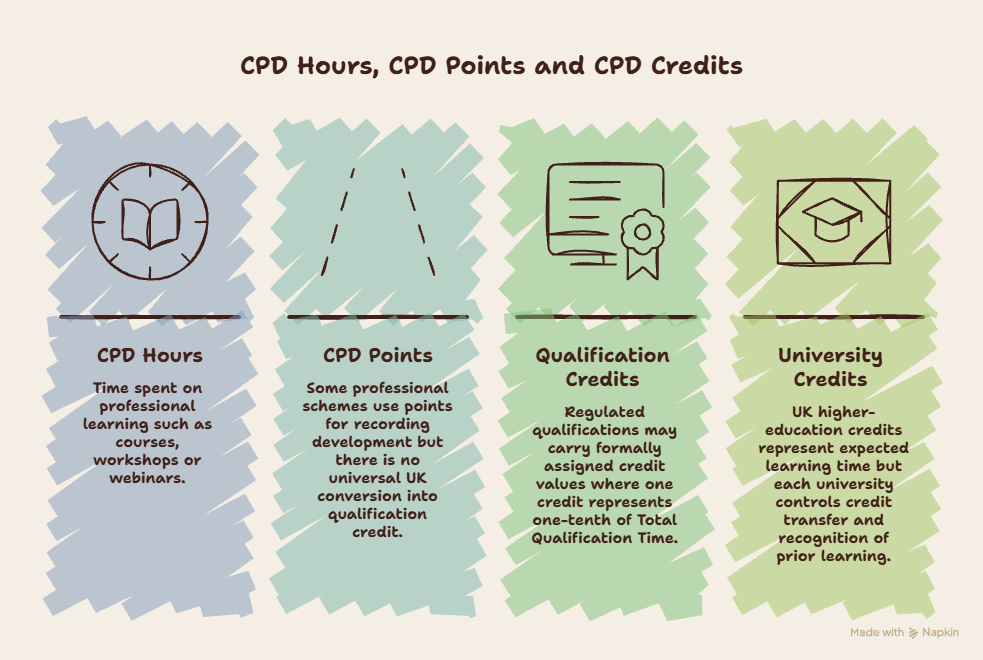
CPD hours, points and credits do not automatically count as RQF qualification credits or university academic credits. Instead, professional bodies and training schemes use different systems to record continuing professional development. Regulated qualifications and universities also use their own formal credit arrangements. Therefore, completing ten CPD hours does not automatically give you one qualification or university credit. A university may consider previous professional learning through recognition of prior learning, but it decides whether your learning meets its requirements.
To avoid confusion, keep these four measures separate:
CPD Hours:
First, CPD hours usually record how much time you spend on professional learning, such as courses, workshops or webinars. Your employer, regulator or professional body may set its own rules for recording acceptable activities.
CPD Points:
Next, some CPD schemes convert professional-development activities into points for recording purposes. However, no universal UK conversion system turns every CPD point into qualification credit. Always check the rules of your particular professional scheme.
Qualification Credits:
By contrast, regulated qualifications can carry official credit values. Under Ofqual’s qualification rules, where an awarding organisation assigns credit, one credit represents one-tenth of the qualification’s Total Qualification Time.
University Credits:
Finally, universities use academic credits to measure higher-education learning. One UK higher-education credit commonly represents ten hours of expected learning. However, each institution controls credit transfer and recognition of previous learning.
So, do CPD credits count towards university? Not automatically. A university may assess relevant previous learning, but you must ask the institution what evidence and credit it will accept.
Ultimately, CPD can strengthen professional development, but never assume its hours, points or credits automatically transfer into formal academic qualifications.
Is a CPD Certificate Recognised in the UK? Employers, Jobs and Career Progression
Yes, a CPD certificate can provide recognised evidence of professional learning in the UK, but employers do not automatically accept every CPD certificate for every job. Its value depends on your occupation, employer, regulator and reason for completing the training. CPD online courses can demonstrate recent learning, refresh existing knowledge and support professional development. However, some regulated professions legally require specific qualifications, experience or registration before someone can perform particular activities or use a protected professional title.
Therefore, consider CPD recognition across these three areas:
-
Employers:
First, employers decide whether CPD accredited courses meet their learning or recruitment needs. A relevant certificate can strengthen your CPD record and demonstrate initiative. However, always compare the training with the job advert’s essential requirements.
-
Jobs:
Next, check whether your target occupation requires registration, a regulated qualification, licence or specific experience. The GOV.UK Regulated Professions Register helps you identify regulated professions and their qualification requirements. CPD cannot override legal entry conditions.
-
Career Progression:
Finally, well-chosen CPD can help you update knowledge, explore new responsibilities and demonstrate continued learning. For example, NMC professionals must complete relevant CPD as part of revalidation. Still, career progression depends on the role’s full requirements.
Someone working with vulnerable adults could also take Safeguarding Vulnerable Adults Training to strengthen safeguarding knowledge alongside wider workplace development.
The best question is therefore not:
“Is CPD recognised?”
Ask:
“Recognised for what?”
That distinction helps you choose CPD that supports your career without confusing professional development with formal occupational or qualification requirements.
Training Provider, Awarding Organisation and Ofqual: Who Regulates and Awards Your Qualification?
A training provider, awarding organisation and Ofqual perform different roles in UK qualification delivery. The provider delivers the learning, while an awarding organisation develops or awards qualifications within its permitted scope. Ofqual regulates recognised awarding organisations and qualifications that fall within their scope of recognition in England. Crucially, Ofqual recognition does not mean every course an organisation offers has regulated status. Therefore, learners should check the exact qualification rather than relying on an organisation’s name or marketing claims.
To understand who does what, separate these three responsibilities:
Training Provider:
First, the training provider delivers your learning through lessons, resources and learner support. It may also prepare you for assessment. However, the provider’s own accreditation does not automatically give a course regulated qualification status.
Awarding Organisation:
Next, an awarding organisation develops or awards qualifications within its recognised remit. Ofqual defines a regulated qualification as one offered by Ofqual-recognised awarding organisation approved to offer the qualification. Always identify the organisation behind your qualification.
Ofqual:
Finally, the Office of Qualifications and Examinations Regulation regulates qualifications and recognised awarding organisations in England. Importantly, an organisation’s scope may cover specific qualification types, levels or subjects rather than everything it offers.
Therefore, before enrolling, identify:
- Name of the exact awarding organisation
- Full qualification title
- Official qualification number
- Published qualification specification
- Confirmed level and size
- Current regulated status
Use the official Register of Regulated Qualifications to check whether your exact qualification is regulated and review its detailed information.
Ultimately, check the qualification itself, not simply the provider or awarding organisation, before trusting any claim about Ofqual regulation.
CPD Requirements for Professionals: Healthcare, Care, Teaching, Management and Workplace Learning
There is no single CPD requirement for every UK professional. The amount and type of learning you need depend on your profession, regulator, professional body, employer and responsibilities. For example, the NMC requires nurses, midwives and nursing associates to complete 35 hours of relevant CPD during each three-year revalidation period, including 20 CPD hours completed with others. In contrast, the HCPC CPD requirements focus on maintaining a continuous learning record and demonstrating how development improves practice rather than completing a fixed number of points.
Therefore, consider how CPD requirements change across these four professional areas:
Healthcare:
CPD for healthcare workers depends heavily on professional registration. For example, NMC registrants must meet specific revalidation requirements. Meanwhile, HCPC professionals choose relevant learning activities and show how those activities benefit their practice and service users.
Care:
CPD for care workers helps staff strengthen knowledge, confidence and role-specific skills. Employers should identify learning needs around responsibilities such as safeguarding, medication, communication and person-centred care. Skills for Care also promotes continuous workforce development.
Teaching:
CPD for teachers should improve classroom practice and respond to professional needs. The Department for Education provides professional-development standards and programmes, while schools can shape development around their staff, pupils and organisational priorities.
Management and Workplace Learning:
CPD for managers can strengthen leadership, decision-making, communication and problem-solving. However, requirements vary between sectors and professional bodies. Managers should connect professional training courses with current responsibilities, performance goals and future career development.
Importantly, CPD extends beyond completing formal courses. Workplace learning can include:
- Formal courses and online learning
- Supervision, coaching or mentoring
- Reading and reflective learning
- Conferences and seminars
- Employer-led mandatory training
- Career development courses
- Professional learning linked to future responsibilities
For example, a care professional who wants to strengthen medicine-management knowledge could study Medication Administration Level 4 as part of broader professional learning. However, employers must still decide what training, supervision, approval and evidence of competence the person’s role requires.
Ultimately, identify your professional CPD requirements first, then choose learning that supports your role, responsibilities and future career development.
How to Check Whether a Course Is Regulated Before Enrolling
Before paying for a course, check its regulatory status rather than relying on the wording of an advert. The official Register of Regulated Qualifications lets you confirm whether a qualification is regulated, examine its details and compare it with similar qualifications. This matters because terms such as “Level 3”, “accredited” or “diploma” do not automatically prove Ofqual regulation. A few careful checks can protect your money and ensure the course matches your career goal.
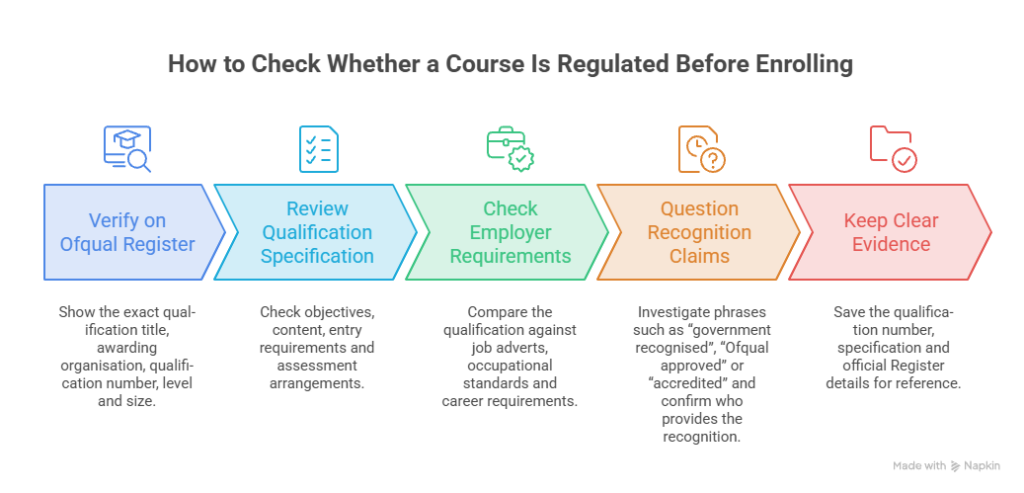
Therefore, use these five checks before you enrol:
Verify the qualification on the Ofqual Register:
First, search the exact qualification title on the GOV.UK Register of Regulated Qualifications. Then confirm its awarding organisation, qualification number, level and size. If the details differ, check before paying.
Review the official qualification specification:
Next, read the awarding organisation’s specification. It should explain the qualification’s objectives, content, entry requirements and how the qualification is assessed. Ofqual requires awarding organisations to publish specifications for regulated qualifications.
Check employer or professional body requirements:
Importantly, find out what your intended job actually requires. Compare job adverts and professional standards. A recognised course may still fail to meet a specific job requirement.
Question recognition and accreditation claim:
Likewise, check phrases such as “government recognised”, “Ofqual approved” or “accredited”. Ask who provides the recognition and whether the exact qualification falls within the awarding organisation’s Ofqual scope.
Keep clear evidence of your checks:
Finally, save the qualification number, specification and Register details. Remember, words such as “certificate”, “diploma”, “Level 3” or “Level 5” alone never confirm regulated status.
Ultimately, verify the qualification first, understand what employers require, and choose training based on evidence rather than persuasive marketing language.
Final Thought: Choose the Learning That Matches Your Goal
The CPD Course vs Regulated Qualification decision becomes much easier once you start with your destination.
If you want to update knowledge, record professional learning, strengthen workplace learning or stay current in your field, CPD courses may be suitable.
However, if a job, university, apprenticeship, professional registration or progression route requires a formal regulated qualification, verify that exact requirement before enrolling.
CPD and regulated qualifications are not rivals. They solve different problems. CPD supports continued learning and professional growth, while a regulated qualification provides formally regulated achievement against defined requirements.
So, before choosing between cpd courses, online cpd courses, cpd training courses or a formal qualification, ask what your next step actually demands.
Then check the evidence, understand the certificate you will receive and choose the learning route that can genuinely support where you want to go.
Table of Contents

Frequently Asked Questions
What is the difference between a CPD course and a regulated qualification?
A CPD course supports continuing professional development by helping learners update knowledge, build workplace skills or meet professional learning requirements. A regulated qualification follows a recognised qualification framework and regulatory requirements. CPD therefore supports development, while regulated qualifications formally certify assessed learning at defined levels.
Is a CPD course an Ofqual regulated qualification?
No. A CPD course can provide valuable professional development, but CPD accreditation does not automatically make it an Ofqual regulated qualification. Regulated qualifications must fall within an awarding organisation’s recognised scope and appear on the official Register of Regulated Qualifications with identifiable online qualification details.
What is the difference between CPD accreditation and Ofqual regulation?
CPD accreditation indicates that a learning activity has been reviewed against an accreditation provider’s standards for professional development. Ofqual regulation is different: Ofqual regulates qualifications, examinations and assessments in England. Therefore, a CPD accredited course should not automatically be described as an Ofqual regulated qualification.
Is a CPD certificate recognised by UK employers?
A CPD certificate can demonstrate completed professional learning, but employer acceptance depends on the role, organisation and purpose of the training. If a vacancy requires a specific regulated qualification, a CPD certificate may support your application but should not be treated as meeting that requirement.
What is the Regulated Qualifications Framework (RQF)?
The Regulated Qualifications Framework, or RQF, helps describe the level and size of regulated qualifications. Qualification levels indicate difficulty, while size reflects learning demand. This framework allows learners and employers to understand regulated qualifications clearly, but qualifications at the same level are not necessarily equivalent.
Is a CPD Level 3 course the same as an RQF Level 3 qualification?
Not automatically. A course marketed as CPD Level 3 does not become an RQF Level 3 regulated qualification simply because “Level 3” appears in its title. Learners should verify the qualification, awarding organisation and qualification number on the official Register of Regulated Qualifications before enrolling.
Do CPD hours, CPD points or CPD credits count towards qualifications?
CPD hours measure time spent actively learning, while CPD points or credits are often used by professional bodies to record development activity. These are not automatically the same as regulated qualification credits or university credits. Always check the awarding organisation, university or professional body’s requirements.
How can I check if a qualification is Ofqual regulated?
Use the Register of Regulated Qualifications to search the qualification title or awarding organisation. Check the qualification number, level, status and awarding organisation carefully. Do not rely on phrases such as “accredited”, “recognised”, “Level 3” or “government approved” when deciding whether a course is regulated.
Can CPD courses help you get a job or progress your career?
Yes, CPD can support career progression by helping professionals update knowledge, develop workplace skills and demonstrate ongoing learning. However, CPD does not replace a required formal qualification where an employer, regulator or professional body specifies one. Compare training against the requirements of your intended role.
Which is better: a CPD course or a regulated qualification?
Choose CPD when your goal is professional development, refresher learning, upskilling or meeting workplace learning requirements. Choose a regulated qualification when your career, employer, university or progression route requires a formally regulated credential. Before enrolling, check requirements rather than relying on course marketing terminology alone.