

Barriers in health and social care can prevent people from accessing services, understanding information or receiving the support they need. These difficulties may involve communication, physical accessibility, financial pressures, personal circumstances or the way services are organised.
For someone receiving care, even a seemingly small obstacle can make an appointment stressful or prevent them from participating in important decisions.
Understanding these barriers is particularly useful for health and social care students, care assistants and support workers. Recognising a problem is only the beginning; knowing how to respond matters just as much.
Here are 10 realistic scenarios showing how barriers affect care in the UK and what professionals can do to reduce them.
Health and Social Care Level 3 Diploma
What Are Barriers in Health and Social Care?
A barrier in health and social care is anything that makes it difficult for someone to access services, communicate their needs or receive appropriate support.
Barriers can arise before care begins or while someone is receiving it. For example, unreliable transport may prevent a patient from reaching hospital, while inaccessible information may stop them from understanding their treatment.
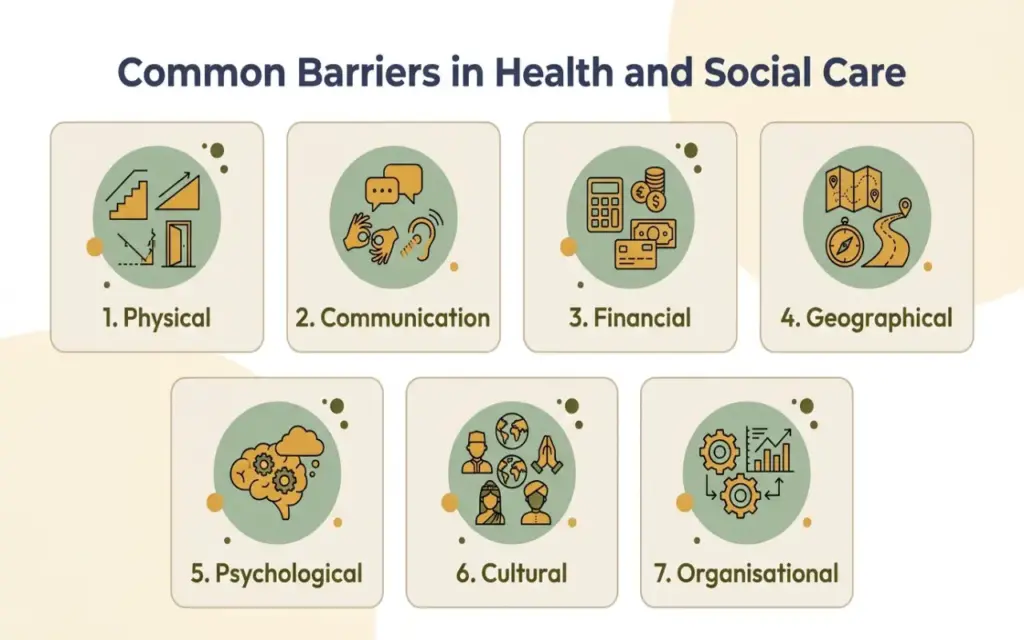
Common barriers include physical, communication, financial, geographical, psychological, cultural and organisational difficulties. Sometimes, several barriers affect the same person.
Understanding barriers in health and social care can help readers recognise why individual needs and circumstances matter.
Table of Contents


Health and Social Care Level 3 Diploma
10 Realistic Examples of Barriers in Health and Social Care
The following fictional scenarios reflect situations that can occur in UK hospitals, GP practices, care homes and community services. Each example explains the barrier, its possible impact and an appropriate response.
1. A Wheelchair User Cannot Access a Treatment Room
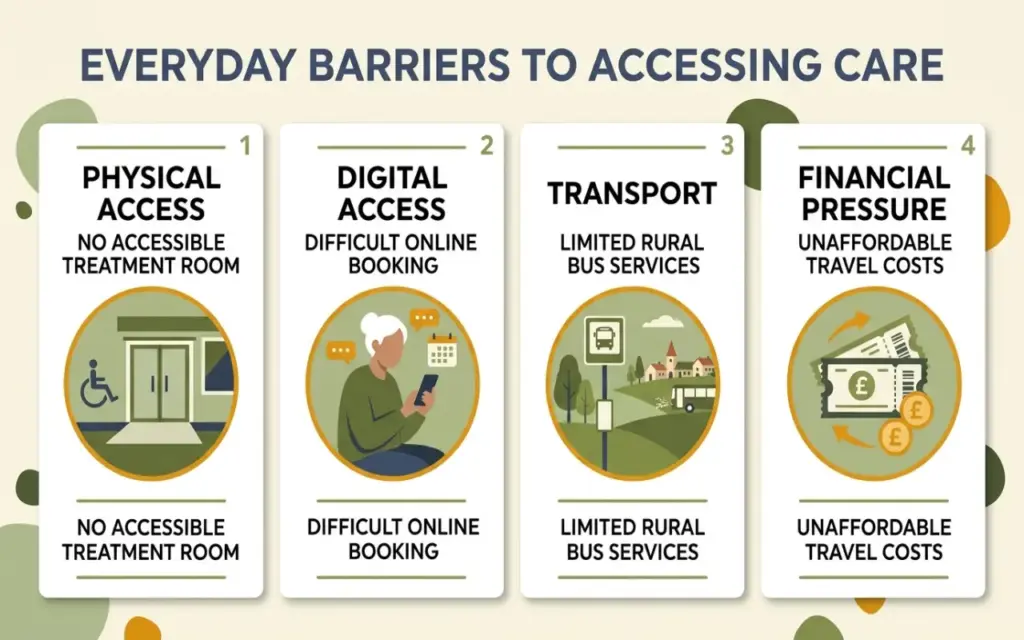
Scenario: Sarah uses a wheelchair and attends a community clinic for a routine appointment. When she arrives, she discovers that the treatment room is upstairs and the building has no accessible lift.
The barrier: Physical accessibility.
Sarah may have to rearrange her appointment, travel elsewhere, or wait for an alternative room. The problem is not her wheelchair use but the clinic’s inability to accommodate her access requirements.
How staff can respond:
Staff should acknowledge the difficulty and contact the appropriate person to arrange an accessible treatment space or another suitable appointment location.
They should explain the available options to Sarah rather than making decisions without her involvement.
Under the Equality Act 2010, service providers have duties concerning reasonable adjustments for disabled people.
An accessible environment helps people receive care without unnecessary delays or loss of independence.
2. A Patient Cannot Understand Treatment Instructions
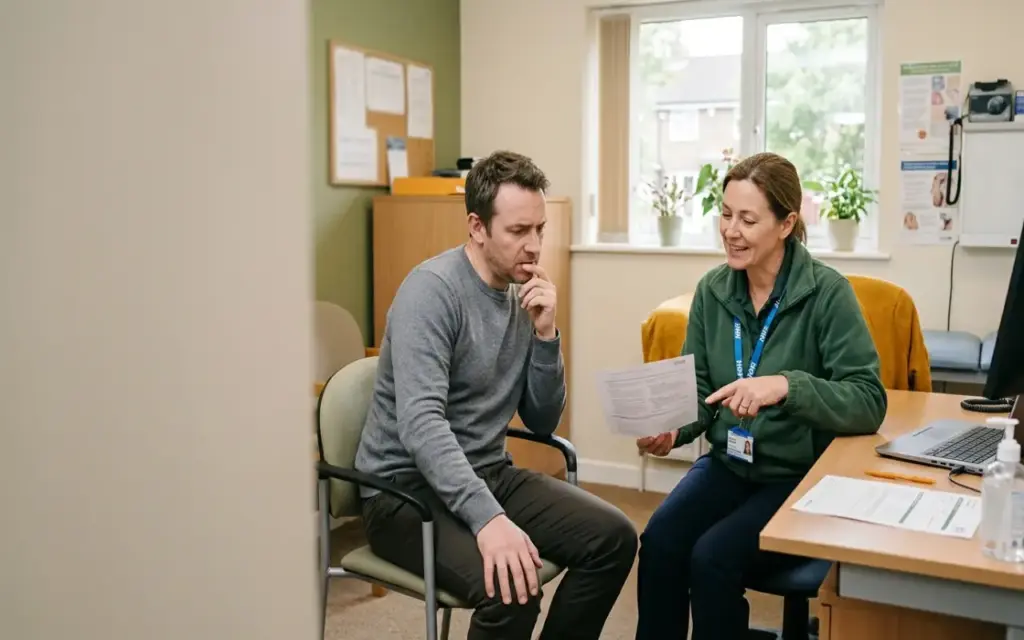
Scenario: Ahmed attends a GP appointment about a long-term health condition. He speaks some English but struggles to understand the explanation of his prescribed medication and possible side effects.
He nods politely, although he remains unsure what to do.
The barrier: Language and communication differences.
Misunderstanding treatment instructions could lead to incorrect medication use or missed follow-up care.
How staff can respond:
The healthcare professional should identify Ahmed’s preferred language and arrange suitable interpreting support when needed.
They can explain information clearly, avoid unnecessary medical jargon, and check understanding without making Ahmed feel embarrassed.
For important clinical conversations, staff should follow professional interpreting procedures rather than assuming that a family member or translation app is appropriate.
NHS England provides guidance on interpreting and translation services for primary care.
Effective communication involves checking what the person understands, not simply delivering information.
For learners entering the care sector, developing health and social care communication skills through relevant training can help build an understanding of effective communication and professional responsibilities.
3. A Person With Hearing Loss Misses Their Appointment
Scenario: Margaret has significant hearing loss and attends a hospital outpatient appointment. The receptionist tells her to wait until her name is called.
Unfortunately, names are announced only through a speaker system. Margaret does not hear hers and later discovers that her appointment has been missed.
The barrier: Inaccessible communication.
Margaret attended on time, but the service’s communication method did not meet her needs.
How staff can respond:
Reception staff could agree on a visual notification, display appointment information on a scree,n or approach Margaret directly when it is her turn.
Her communication preferences should be identified and recorded appropriately so she does not repeatedly face the same difficulty.
The NHS Accessible Information Standard sets requirements for identifying, recording, sharing, meeting and reviewing relevant information and communication needs within its scope.
The lesson: Making information accessible is just as important as making buildings accessible.
4. An Older Patient Struggles With Online Appointment Booking
Scenario: David needs to book an appointment with his GP practice. He is comfortable using a basic mobile phone but has difficulty navigating online forms.
He repeatedly attempts to book through the practice’s website and eventually gives up.
The barrier: Digital exclusion.
Digital services can make healthcare more convenient, but some people struggle because of limited digital skills, inaccessible systems, or lack of suitable devices.
The issue is not David’s age itself. People of any age may experience digital barriers.
How staff can respond:
Staff should explain the available booking methods and help David access an appropriate alternative, such as telephone assistance or in-person support where offered.
They can also raise recurring booking difficulties with the practice team.
A service should consider whether its systems are accessible to the people who need them.
The lesson: Technology should improve access to care without unnecessarily excluding people who cannot use a particular system.
5. A Rural Resident Cannot Reach a Healthcare Appointment
Scenario: Emma lives in a rural village and needs regular hospital appointments. Public transport is limited, and the earliest available bus arrives after her scheduled appointment.
She cannot drive and has nobody available to take her.
The barrier: Geographical location and transport availability.
Distance and unreliable transport may result in missed appointments, delayed assessments, or additional stress.
How staff can respond:
The booking team could discuss Emma’s travel difficulties and explore whether another appointment time is available.
Where clinically appropriate, a remote consultation might reduce unnecessary travel. However, telephone or video appointments are not suitable for every assessment or treatment.
Staff should also explain any relevant local transport support options that the service knows about.
Importantly, Emma should be involved in choosing a workable arrangement.
The lesson: Accessing care involves more than offering an appointment. Services should also consider whether people can reasonably attend it.
6. Travel Costs Prevent Someone Attending Specialist Care
Scenario: James has been referred for specialist NHS treatment. He needs several hospital visits over the coming weeks, but transport costs are placing considerable pressure on his limited income.
He starts considering whether to postpone some appointments.
The barrier: Financial difficulties.
Although NHS treatment is generally free at the point of use for eligible patients, associated expenses can still affect access.
Travel costs, parking charges and time away from work may create additional difficulties.
How staff can respond:
A member of the healthcare team could explain where James can obtain information about financial assistance.
The NHS Healthcare Travel Costs Scheme may provide reimbursement of reasonable travel costs for eligible patients attending qualifying specialist NHS appointments.
Eligibility depends on specific conditions, and routine GP visits are generally excluded.
Staff should avoid promising financial support before eligibility has been checked.
The lesson: Recognising financial barriers allows professionals to signpost people towards relevant assistance before difficulties disrupt their care.
7. A Patient Avoids Care After a Previous Negative Experience
Scenario: Lisa previously attended a consultation where she felt her concerns were dismissed.
Months later, she develops another health problem but hesitates to book an appointment because she worries that staff will not take her seriously.
The barrier: Psychological and emotional barriers.
Previous experiences, anxiety, embarrassment,t or mistrust can influence whether someone feels comfortable seeking care.
How staff can respond:
A healthcare professional should give Lisa time to explain her concerns and listen without judgement.
They can acknowledge her previous experience, explain the available options, and involve her in decisions about her care.
If Lisa wishes to raise a concern about an earlier appointment, staff can explain the appropriate feedback or complaints process.
The aim is not to pressure her into a particular decision but to help rebuild confidence through respectful communication.
The lesson: Feeling heard and respected can influence a person’s willingness to engage with care.
8. A Care Home Overlooks a Resident's Cultural Preferences
Scenario: Fatima lives in a residential care home. During her initial assessment, she explained that she follows specific religious dietary practices.
However, the meals regularly provided do not reflect her recorded preferences.
She becomes uncomfortable asking staff to make changes.
The barrier: Cultural needs being overlooked.
Ignoring personal preferences can affect dignity, comfort, nutrition, and a person’s sense of belonging.
How staff can respond:
Care workers should ask Fatima about her preferences rather than assume what she needs based on her background.
The relevant staff should review her care plan, communicate the agreed requirements to the catering team and check that suitable arrangements are in place.
In England, the Care Quality Commission’s guidance on dignity and respect reinforces the importance of treating people respectfully.
Respecting individual preferences is an important part of person-centred support. Those interested in strengthening their knowledge of adult social care practices can explore HF Online’s CPD learning covering care principles, communication and dignity.
The lesson: Culturally sensitive care begins with listening to individuals and respecting their expressed preferences.
9. A Service User With a Learning Disability Receives Confusing Information
Scenario: Daniel has a learning disability and attends an appointment to discuss a proposed medical procedure.
The healthcare professional uses complicated terminology and gives several instructions quickly.
Daniel becomes confused but is unsure how to ask for clarification.
The barrier: Inaccessible information and communication.
If Daniel cannot understand the explanation, he may struggle to participate meaningfully in decisions about his care.
How staff can respond:
The professional should use accessible language, explain information in manageable stages, and allow sufficient time for questions.
Easy Read materials, visual explanations or other communication support may help, depending on Daniel’s preferences.
A learning disability does not automatically mean someone lacks the capacity to make decisions.
The CQC’s requirements for consent to care and treatment emphasise lawful consent and the importance of understanding the proposed care.
The lesson: Accessible explanations help people understand their options and participate in decisions about their own care.
10. Poor Coordination Between Care Teams Delays Support
Scenario: Robert returns home after spending several days in hospital.
He receives domiciliary care, but his care workers have not received updated information about changes to his mobility and support needs.
As a result, the team is unsure whether his existing care plan remains suitable.
The barrier: Organisational communication and coordination.
Missing information can interrupt continuity of care and make it harder for professionals to provide appropriate support.
How staff can respond:
Care workers should report the missing information to their manager and avoid making unsupported assumptions about Robert’s needs.
The responsible professionals can clarify the changes, arrange a care-plan review and ensure information is shared securely with authorised staff.
Workers should follow workplace procedures and confirm that the relevant team members understand the updated arrangements.
The lesson: Good care depends on reliable coordination as well as the actions of individual professionals.
How Can Health and Social Care Workers Reduce Barriers?
Although each situation requires an individual response, several principles can help care workers recognise and address barriers more effectively.
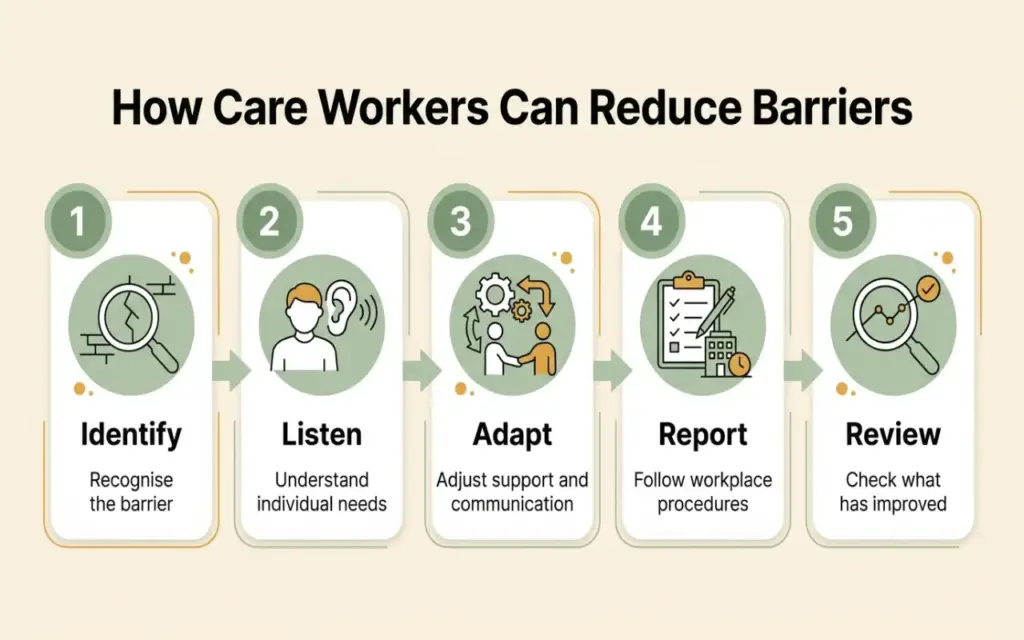
- Identify the problem early. Notice when someone struggles to access services, understand informatio,n or participate in their care.
- Listen before deciding what to do. Ask the person what would help and respect their preferences rather than making assumptions.
- Adapt communication and support. Use appropriate communication methods, accessible informatio,n or available assistance based on individual needs.
- Report and record concerns. Follow organisational procedures and involve managers or other professionals where decisions fall outside your responsibilities.
- Check whether the response worked. Review the situation and make further adjustments when necessary.
These steps reflect the importance of person-centred practice. In England, the CQC’s guidance on person-centred care sets out requirements concerning people’s needs, preferences and involvement in their care.
Understanding barriers also requires knowledge of professional responsibilities, safeguarding and effective communication.
For learners seeking a broader understanding of these subjects, HF Online’s Health and Social Care Level 3 Diploma provides flexible, CPD-accredited online learning covering communication, safeguarding, person-centred care and other relevant principles.
The course can support professional development, but completing it should not be confused with obtaining an Ofqual-regulated Level 3 qualification or a licence to practise.
Frequently Asked Questions
What Are Three Common Barriers in Health and Social Care?
Three common examples are physical barriers, communication barriers and organisational barriers. These might include an inaccessible building, information someone cannot understan,d or poor coordination between care teams. The barriers people experience vary according to their circumstances and the services they use.
How Do Barriers Affect the Quality of Care?
Barriers can cause missed appointments, misunderstandings, delayed treatment, and reduced involvement in decisions. They may also affect someone’s confidence, independence and dignity. Identifying difficulties early helps professionals provide more appropriate support.
What Should a Care Worker Do When Someone Faces a Barrier?
A care worker should listen to the person’s concerns, identify the difficulty and consider appropriate support within their role. If the problem requires specialist assistance or organisational changes, they should follow workplace procedures and involve the relevant professional or manager.
Can One Person Experience Several Barriers at Once?
Yes. For example, someone living in a rural area may struggle with transport costs while also needing accessible appointment information. Addressing only one difficulty may not resolve the overall problem. Care should consider the person’s individual circumstances.