


Without a voice, even the best care plan can fail. In health and social care settings, some individuals may find it difficult to communicate their wishes, understand complex information or feel confident expressing their preferences. This can happen because of dementia, disability, communication barriers, mental health challenges or unfamiliarity with care systems.
Advocacy in health and social care means supporting individuals to understand their rights, express their views and participate in decisions about their care and wellbeing. It is not about making choices for someone else; it is about helping people make informed decisions while ensuring their preferences, values and needs remain central to the support they receive.
From care assessments and safeguarding discussions to decisions covered by UK legislation such as the Care Act 2014 and Mental Capacity Act 2005, advocacy plays an important role in protecting individual rights. This guide explains what advocacy looks like in practice, the different types of advocacy, the role of an advocate and why advocacy knowledge is valuable for health and social care professionals.

What Is Advocacy in Health and Social Care?
In practical terms, advocacy means supporting individuals to understand their rights, communicate their views and participate in decisions about their care, treatment and wellbeing.
The purpose is to make sure people are not excluded from important conversations about their own lives — whether that’s a care plan, a treatment option, a living arrangement or a change to a daily routine. An advocate acts as a supporter, communicator and guide: they help someone access information, understand their choices and express an opinion, but they do not replace that person’s voice or decide what’s “best” for them.
For example, a resident in a care home who feels unsure about a proposed change to their support plan might work with an advocate to understand the paperwork, prepare questions and communicate their preferences directly to care staff.
What advocacy protects
- Individual choice — people retain control over decisions that affect their own lives.
- Rights — dignity, privacy, equality and respectful treatment are recognised and upheld.
- Communication — barriers caused by disability, language, cognition or confidence are actively addressed.
- Participation — care is done with a person, not simply to them.
Why Advocacy Matters in Practice
Modern health and social care is built around person-centred practice — support shaped around the individual, not just their condition. Without effective advocacy, people can struggle to raise concerns, understand their options or challenge decisions that don’t reflect their wishes, which affects their independence, confidence and overall experience of care.
It keeps decisions person-centred
Advocacy prompts professionals to ask the right questions before acting: What does this person actually want? Have they understood the information? Can they express a preference? Have they been included? A person receiving domiciliary care, for instance, may need support at particular times because of religious commitments or family responsibilities — advocacy helps make sure that preference is heard and factored into planning.
It protects people who are more likely to be overlooked
Older adults, people living with dementia, people with learning disabilities, people experiencing mental health difficulties, and anyone with communication impairments or low confidence around professionals are all more likely to be excluded from decisions unless advocacy support is actively offered.
It builds trust between people and professionals
When people feel heard, they engage more openly and honestly with care and treatment. Advocacy strengthens this by helping individuals understand professional advice, reducing misunderstandings, and making sure concerns are actually followed up — which is why recognising when someone needs advocacy support is a core professional skill, not a specialist add-on.
The Core Principles of Advocacy
Advocacy isn’t about speaking on someone’s behalf — it’s about helping them speak for themselves wherever possible. Five principles guide how that support should be delivered.
Respect for individual rights and dignity
A person’s health condition, disability, age or support needs should never reduce their involvement in decisions about their own life. This means listening carefully, avoiding judgement about personal choices, and providing information in a format the person can actually understand.
Empowerment and supporting choice
Empowerment means helping someone build the confidence, knowledge and control to participate in decisions about their care — rather than being a passive recipient of it. In practice this looks like clear information, encouraged questions, and space to make an informed choice.
Independence and impartial support
An advocate supports a person’s views — they don’t substitute their own. If someone chooses an option others might consider unusual, but they understand the consequences and have the mental capacity to decide, that choice should generally be respected.
This links directly to the Mental Capacity Act 2005, which states that making a decision others consider unwise does not, on its own, mean a person lacks capacity to make it.
Confidentiality and trust
People discuss sensitive information during advocacy support, so they need confidence that it will be handled responsibly — explained clearly, shared only when appropriate, and in line with organisational policy and legal requirements.
Equality, inclusion and accessibility
Advocacy removes barriers — whether these come from communication difficulties, language, sensory impairment, learning disability, mental health challenges, or cultural and social factors — by adapting how support is delivered rather than expecting everyone to communicate the same way.
What Does an Advocate Actually Do?
An advocate is a supportive presence in situations where someone may feel unable to communicate confidently or navigate a complex system alone. Their role is not to make decisions — it’s to make sure a person’s own decision-making is properly supported.
- Explaining information — breaking down complex terminology, procedures or assessment processes into something the person can understand and use.
- Supporting communication — helping someone prepare questions, take part in conversations with professionals, and get concerns recorded accurately.
- Representing views when needed — communicating what the person wants to professionals, always reflecting their wishes rather than the advocate’s own opinion.
- Supporting access to services — helping someone understand what’s available, how assessments work, and what their rights and options are.
- Helping people raise concerns — supporting someone through a complaints process, meetings, or a request for further support.
Advocate vs Care Worker: What's the Difference?
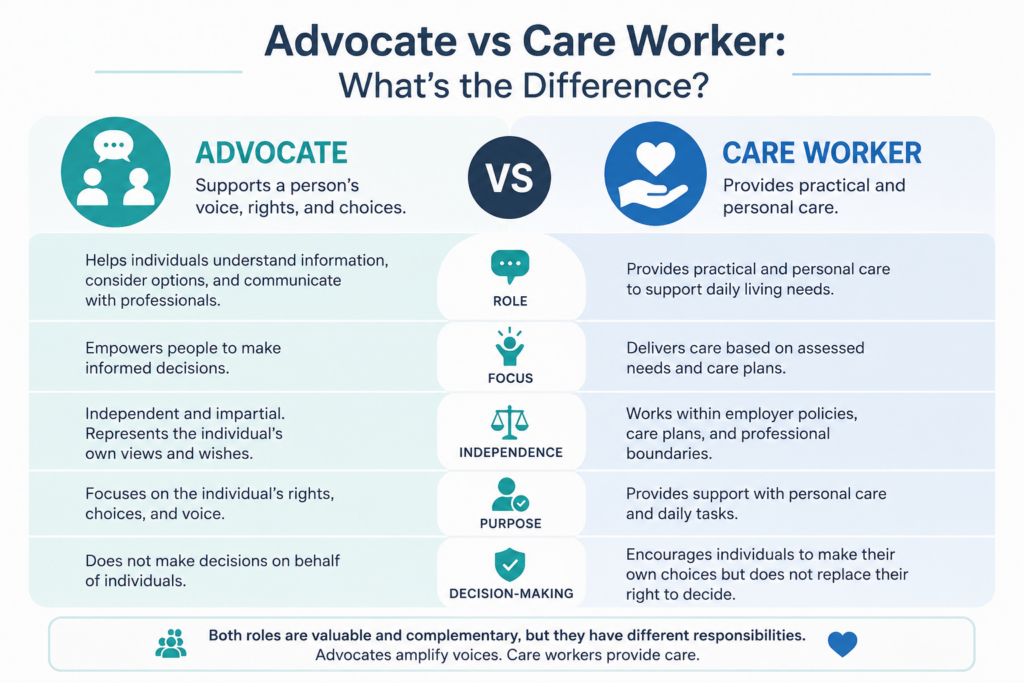
An advocate supports a person’s voice, rights, and choices by helping them understand information, consider their options, and communicate with professionals. Advocates remain independent and focus on representing the individual’s own views and wishes. Their role is to empower people to make informed decisions, not to make decisions on their behalf.
A care worker provides practical and personal care to support an individual’s daily living needs. They work within employer policies, care plans, and assessed needs while delivering ongoing support. Although care workers encourage individuals to make their own choices, their primary role is to provide care rather than advocacy, and they never replace the individual’s right to decide for themselves.
Types of Advocacy in Health and Social Care
Advocacy takes several forms depending on the person’s situation and needs. Recognising which type applies helps professionals know what kind of support to arrange.
| Type | What It Means | Example |
|---|---|---|
| Self advocacy | A person expresses their own views and preferences, with support if needed | Explaining preferred care arrangements during a review |
| Independent advocacy | An impartial advocate helps someone understand choices and communicate views | Support during a care needs assessment |
| Statutory advocacy | Advocacy an organisation is legally required to arrange in specific situations | An IMCA supporting someone who lacks capacity for a major decision |
| Citizen advocacy | A volunteer provides longer-term, relationship-based support | A volunteer helping someone stay involved in community decisions |
| Peer advocacy | Someone with similar lived experience supports another person | A person with mental health lived experience supporting another individual |
| Group advocacy | People with shared experiences raise concerns together | Residents raising shared concerns about service quality |
Self advocacy
Self advocacy — someone speaking up for their own rights and preferences, with or without support — is generally the ideal outcome, since it puts the individual directly at the centre of decision-making. Professionals support it by providing accessible information, allowing time for responses, and not making assumptions about what someone can or can’t communicate.
Independent advocacy
Independent advocacy comes from someone entirely separate from the services involved in a person’s care, which helps keep the focus on the individual’s own views rather than what’s convenient for the service. It’s typically used during assessments, reviews, complaints and major decisions.
Statutory advocacy: IMCA and IMHA
Two roles sit at the centre of statutory advocacy in the UK, both created by law rather than by choice of the care provider.
An Independent Mental Capacity Advocate (IMCA) supports people who lack the capacity to make a specific decision — such as serious medical treatment or a long-term accommodation move — and who have no one else appropriate to represent them. The IMCA doesn’t make the decision; they gather information, establish the person’s known wishes and values, and make sure these are considered by whoever does.
An Independent Mental Health Advocate (IMHA) supports people receiving certain forms of compulsory mental health treatment under the Mental Health Act 1983 to understand their rights and take part in decisions about their care.
Citizen, peer and group advocacy
- Citizen advocacy — a volunteer, usually independent of care organisations, builds an ongoing relationship to help someone stay involved in community life — for example, supporting attendance at community activities.
- Peer advocacy — someone with lived experience of a similar situation supports another person, drawing on shared understanding and trust.
- Group advocacy — people with shared experiences — residents, service users, disability groups — raise common concerns together to influence service improvements.
Real Examples of Advocacy in Care Settings
Advocacy happens across hospitals, care homes, supported living, community care and people’s own homes. A few practical examples:
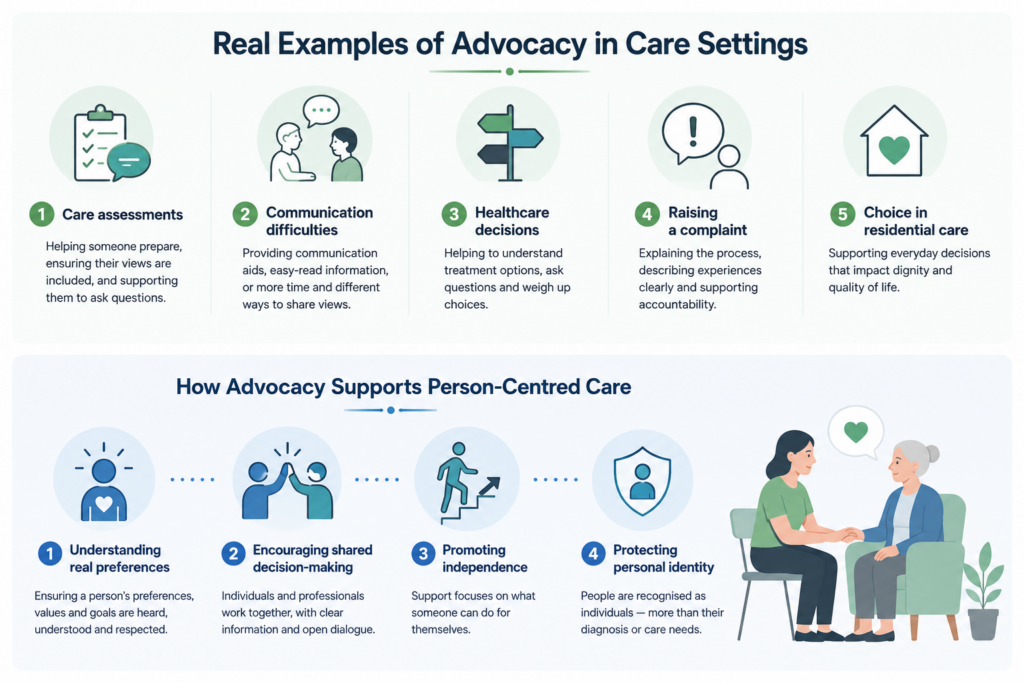
- Care assessments — an advocate helps someone prepare for the assessment, ensures their views are actually included, and supports them to ask questions rather than simply agree with what’s proposed.
- Communication difficulties — for people with learning disabilities, dementia, speech difficulties or neurological conditions, advocacy might mean communication aids, easy-read information, or simply more time and a different approach to sharing views.
- Healthcare decisions — support to understand treatment information, prepare questions before appointments, and weigh up available choices — while the individual keeps responsibility for the final decision wherever they’re able to make it.
- Raising a complaint — many people feel anxious about complaining or unsure how the process works; an advocate can explain the procedure and help someone describe their experience clearly, which supports accountability and service improvement.
- Choice in residential care — advocacy applies to everyday decisions too — routines, activities, food, personal care, contact with family — because small decisions have a real impact on dignity and quality of life.
How Advocacy Supports Person-Centred Care
Person-centred care means considering the whole person — their preferences, values, beliefs, lifestyle and goals — rather than focusing only on a medical condition or care requirement. Advocacy strengthens this approach in four practical ways:
- Understanding real preferences — instead of professionals assuming what someone wants, advocacy makes sure preferences are actually communicated and respected.
- Encouraging shared decision-making — individuals and professionals work together, with the individual able to understand information, ask questions and raise concerns.
- Promoting independence — support focuses on what someone can do for themselves, not on creating unnecessary dependence.
- Protecting personal identity — people are recognised as more than their care needs or diagnosis.
Advocacy and Safeguarding
Safeguarding is about preventing abuse, neglect and exploitation. Advocacy supports this by helping people communicate concerns and take part in the processes designed to protect them — which matters because many people struggle to report concerns in the first place, whether from fear of consequences, dependence on others, low confidence, or simply not understanding their rights.
- Helping people report concerns — supporting someone to explain what’s happened to the right professionals.
- Supporting involvement in safeguarding processes — safeguarding enquiries can involve multiple professionals and complex discussions; advocacy helps the individual stay informed and involved rather than sidelined.
- Protecting rights during investigations — even when protective action is necessary, the person should still be treated with dignity, and advocacy helps balance protection with personal choice.
UK Advocacy Legislation Explained
Several pieces of UK legislation underpin advocacy in health and social care. Understanding the legal basis helps professionals recognise when someone has a right to advocacy support — not just when it might be helpful.
- Mental Capacity Act 2005
- Care Act 2014
- Equality Act 2010
- Mental Health Act 1983 (as amended)
Mental Capacity Act 2005
The Mental Capacity Act 2005 applies to people aged 16 and over in England and Wales who may be unable to make a specific decision because of an impairment or disturbance affecting how their mind or brain works. Its central principle is that a person should be supported to make their own decision wherever possible — capacity is assumed, not assessed away by default.
| Principle | Meaning |
|---|---|
| Presumption of capacity | Every adult is assumed able to make their own decisions unless proven otherwise |
| Supporting decision-making | People must receive appropriate support before anyone concludes they can’t decide |
| Right to make unwise decisions | Disagreeing with someone’s choice doesn’t mean they lack capacity |
| Best interests | Decisions made for someone who lacks capacity must reflect their best interests |
| Least restrictive option | Any action taken should interfere as little as possible with rights and freedom |
Where a person lacks capacity for a serious decision and has no one appropriate to represent them, the Act provides for an Independent Mental Capacity Advocate (IMCA) to gather their known wishes and represent their interests — covering serious medical treatment, long-term accommodation moves, and significant changes to care.
Care Act 2014
Under section 67 of the Care Act 2014, a local authority must arrange an independent advocate for someone who would experience substantial difficulty being involved in a care and support process — such as a needs assessment, care planning, a review, or a safeguarding enquiry — and who has no one else appropriate to support them.
Full detail on how this duty should be applied is set out in Chapter 7 of the Care and Support Statutory Guidance. For example, an older adult living alone who struggles to follow a local authority assessment because of communication difficulties, and who has no appropriate family member or friend to help, would meet the threshold for this duty.
Equality Act 2010
The Equality Act 2010 protects people from discrimination across nine protected characteristics, including age, disability, race, religion or belief, sex and sexual orientation. In care settings, advocacy supports equality by helping people access information and communication in a format that actually works for them — for example, adjusted communication methods for someone with a sensory impairment.
Mental Health Act 1983
The Mental Health Act 1983 sets out the legal framework for the assessment, treatment and rights of people receiving certain forms of mental health care, and provides for Independent Mental Health Advocates (IMHAs) to support eligible patients to understand their rights and participate in treatment decisions — particularly important given how significantly these decisions can restrict someone’s freedom.
Skills Needed for Effective Advocacy
Advocacy is a distinct role, but the underlying skills are ones every health and social care professional draws on regularly.
- Communication — clear language, checked understanding, adapted methods, and enough time for someone to respond in their own way.
- Active listening — full attention, no interruptions, and the ability to notice when dissatisfaction is being expressed through behaviour rather than words.
- Empathy — understanding a situation from the individual’s perspective rather than defaulting to organisational process.
- Knowledge of rights — a working understanding of consent, confidentiality, safeguarding duties and capacity principles.
- Professional boundaries — supporting someone’s choices without imposing personal opinion, and knowing when to bring in specialist advocacy services.
Who Should Understand Advocacy?
Anyone working with people who receive care or support benefits from understanding advocacy — it’s particularly valuable for professionals who regularly support people with communication difficulties, disabilities, long-term conditions or complex needs.
- Care workers — spend the most time with individuals, so are well placed to notice when someone is struggling to express their views and needs additional support.
- Healthcare assistants — use advocacy awareness to communicate more effectively with patients across hospital, clinic and community settings.
- Support workers — apply advocacy skills to help people build confidence, make choices and get involved in community life.
- Senior staff and managers — need advocacy understanding to shape rights-based, person-centred practice across a service and respond appropriately when concerns are raised.
Why Advocacy Knowledge Matters for Your Career
Advocacy knowledge isn’t only for formal advocates — it’s a working part of good care practice, because most health and social care roles involve supporting people who need help communicating their needs, understanding information, or accessing services. Four things it directly improves:
- Quality of care — recognising a person’s actual preferences — their routine, communication needs, personal goals — rather than only completing tasks.
- Confidence in sensitive situations — knowing how to support someone through a difficult conversation or complex decision without taking control away from them.
- Independence and choice — offering real options and encouraging people to communicate preferences instead of making decisions on their behalf.
- Safeguarding practice — recognising when someone doesn’t feel heard, and supporting them to report concerns appropriately.
Structured training builds on this foundation — covering the meaning and purpose of advocacy, the different approaches, individual rights, communication strategies, and how advocacy connects to safeguarding and person-centred care. It’s useful for care assistants, support workers, healthcare assistants, social care professionals coordinating assessments and care planning, and anyone starting out in the sector.
The Academy for Health & Fitness offers CPD-accredited online courses covering advocacy, safeguarding and related areas of health and social care practice, for learners who want to build this knowledge formally as part of their professional development.

Common Misconceptions About Advocacy
“Advocacy means making decisions for someone”
It doesn’t. Advocacy supports someone to understand information, communicate their views and take part in decisions — it never replaces their voice, only helps make sure it’s heard.
“Only vulnerable people need advocacy”
Anyone can need advocacy support when they face a barrier — a complex decision, difficulty challenging professionals, or a need for communication support — regardless of how “vulnerable” they might otherwise seem.
“Care workers can’t support advocacy”
Care workers aren’t formal advocates, but they play a real role by listening, respecting choices, recognising communication needs, and knowing when to bring in independent advocacy support.
“Advocacy is the same as giving advice”
It isn’t. Advocacy is about helping someone understand information and communicate their own wishes — not about telling them what decision to make.
“Advocacy is only for major decisions”
Everyday choices — routines, activities, food, how support is delivered — matter just as much for someone’s dignity and independence as major healthcare or safeguarding decisions.
Final Thoughts
Advocacy in health and social care protects rights, promotes choice, and keeps individuals at the centre of decisions about their own care. From supporting communication to helping people understand their options, it creates a more inclusive and respectful care environment.
For health and social care professionals, understanding advocacy isn’t just about knowing the different types of support available — it’s about recognising the value of listening, respecting choice, and helping people keep control over their own lives.
If you want to build on this knowledge formally, the Academy for Health & Fitness offers CPD-accredited Health and Social Care courses covering person-centred care, communication, safeguarding, equality and inclusion, and professional values.
Frequently Asked Questions
What is advocacy in health and social care?
It means supporting individuals to understand their rights, communicate their views and participate in decisions about their care and wellbeing — making sure people are listened to and involved rather than having decisions made without their input.
What are the main types of advocacy?
Self advocacy, independent advocacy, statutory advocacy (including IMCA and IMHA), citizen advocacy, peer advocacy and group advocacy. Each fits different circumstances depending on the individual’s needs.
What does an advocate do?
An advocate helps someone understand information, express their views, access services and take part in decisions — without making decisions for them or replacing their choices.
Why is advocacy important in care?
It protects individual rights, supports independence, and helps make sure care decisions actually reflect a person’s needs, preferences and wishes.
What's the difference between advocacy and safeguarding?
Safeguarding protects people from abuse, neglect and harm. Advocacy makes sure people have a voice and stay involved in decisions. The two work together to protect both safety and rights.
Who may need advocacy support?
People with disabilities, communication difficulties, mental health conditions or cognitive impairments — and, in the right circumstances, anyone who needs extra support to express their views.
Is advocacy a legal requirement in the UK?
In specific circumstances, yes. The Mental Capacity Act 2005 and Care Act 2014 both include statutory duties to arrange advocacy support for eligible individuals.
Can a care worker act as an advocate?
Care workers can promote advocacy through communication, respect and encouragement, but formal independent advocacy is required where impartial support is needed.
Does advocacy training make someone a qualified advocate?
No — training builds knowledge and understanding, but it doesn’t make someone a legally appointed advocate or replace formal workplace requirements.