

A Learning Disability Awareness Course can help you understand learning disabilities more clearly and recognise why informed, person-centred support matters in health and social care. Around 1.3 million people in England have a learning disability, including more than 950,000 adults. However, every person’s abilities, communication preferences and support needs are different.
A Learning Disability Awareness Course builds knowledge of learning disabilities, mental health, care planning, health promotion and support approaches while contributing to your continuing professional development.
If you work in care, support others or want to develop your healthcare knowledge, understanding these topics can make everyday situations easier to interpret. This guide explains what a Learning Disability Awareness Course covers, what you can learn, the benefits of studying online, what a CPD certificate means and how the training may support wider health and social care development.
Table of Contents
What Is a Learning Disability Awareness Course?
A Learning Disability Awareness Course is training designed to develop your understanding of learning disabilities and the needs people may experience throughout their lives. Depending on the curriculum, learning may cover mental health, communication, care approaches, health promotion, behaviour and person-centred support.
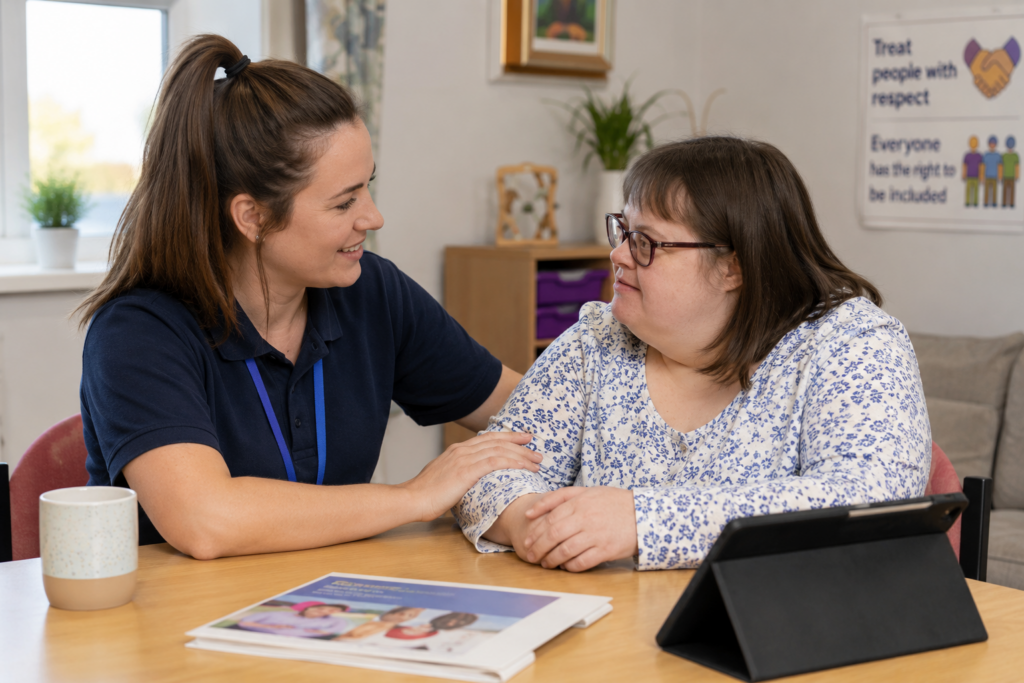
For example, someone working in health or social care may support a person who needs information explained differently, extra time to communicate or adjustments to the way care is provided. Therefore, awareness involves more than knowing a definition. It means understanding that each person has individual strengths, preferences and needs.
Online learning disability awareness training can also provide a structured way to build this knowledge. The Learning Disability Awareness Course from HF Online, for instance, covers ten learning modules and is designed for flexible online study.
What Is a Learning Disability?
A learning disability affects how a person understands new or complex information, learns new skills and manages some aspects of independent living. It begins before adulthood and continues throughout life. However, the level of support a person needs can vary considerably.
Some people have a mild learning disability and may live largely independently. Others may need more regular or extensive support. Therefore, good care should focus on the individual rather than making assumptions based only on a diagnosis.
In addition, people with learning disabilities have the same rights to dignity, respect, choice and opportunity as everyone else. Understanding this principle provides an important foundation for anyone developing learning disability awareness.
Learning Disability vs Learning Difficulty: What Is the Difference?
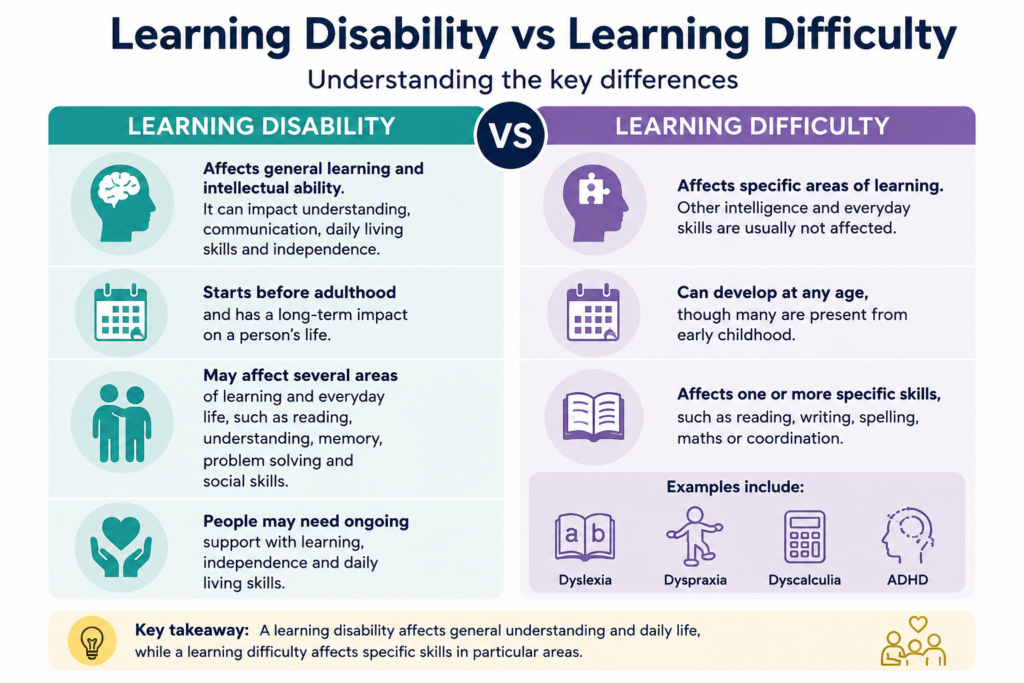
A learning disability and a learning difficulty are not the same thing.
A learning disability can affect broader intellectual and adaptive functioning. In contrast, a learning difficulty usually affects a particular area of learning. Dyslexia, for example, mainly affects reading and language-related skills, while dyspraxia can affect movement and co-ordination. ADHD can also create specific difficulties with attention and learning.
However, a person can have both a learning disability and one or more learning difficulties. As a result, professionals and carers should avoid using the terms interchangeably.
Knowing the difference helps create a clearer starting point for understanding individual needs.
Why Is Learning Disability Awareness Training Important?
Learning disability awareness training is important because it helps people understand individual needs, challenge assumptions and approach support with greater knowledge and respect. This matters particularly in health and social care, where communication and person-centred decisions can affect a person’s everyday experience.
Government guidance encourages health and care professionals to understand the needs of people with learning disabilities and support healthier, more independent lives. It also highlights the importance of dignity, equality and reasonable adjustments.
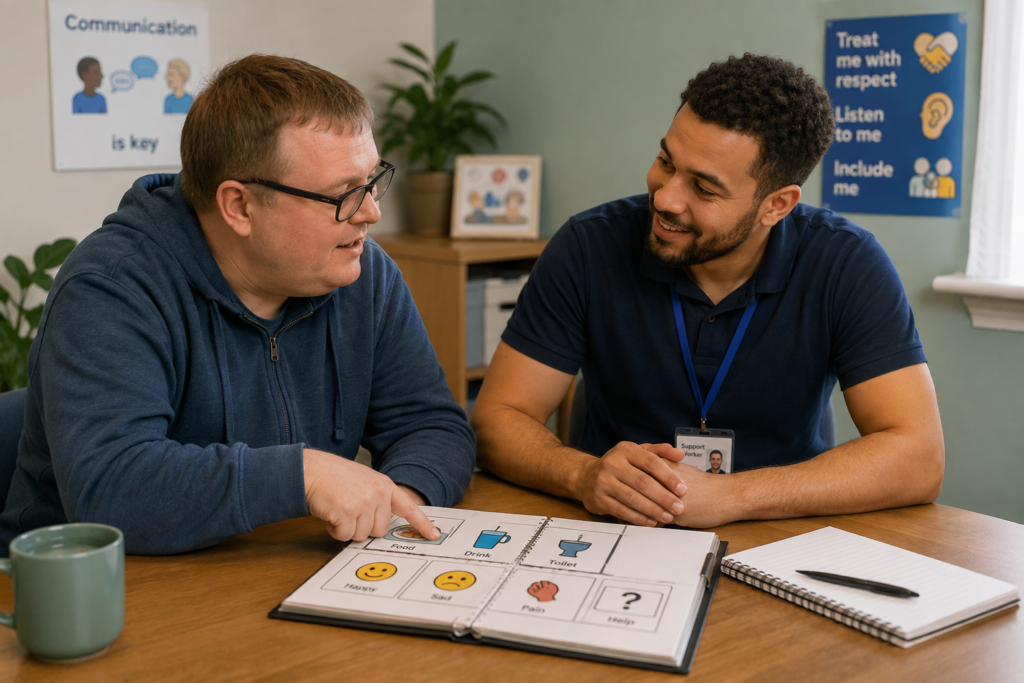
For example, a person with a learning disability may need more time to understand a question. Another person may communicate using pictures, gestures or other forms of communication. Therefore, using exactly the same approach with everyone may not meet each person’s needs.
Awareness can help you think more carefully about:
Individual needs and preferences. A diagnosis does not tell you everything about a person. Instead, support should consider their abilities, wishes, routines and circumstances.
Communication. Clear language, enough processing time and suitable communication methods can make information easier to understand.
Person-centred support. Rather than making decisions based only on what is convenient for services, person-centred care keeps the individual’s needs, choices and goals in focus.
Dignity and independence. Support should help people take part in decisions and maintain as much independence as possible.
Physical and mental health. People with learning disabilities may also experience physical or mental health needs. Therefore, awareness of the relationship between health, behaviour and wellbeing can be valuable.
Reducing stigma. Misconceptions can affect how people with learning disabilities are treated. Better awareness can challenge these assumptions and encourage more respectful interactions.
Learning disability awareness does not mean assuming that every person needs the same support. Instead, it helps you understand why individualised support matters and why listening to the person should remain central to care.
What Does the Learning Disability Awareness Course Cover?
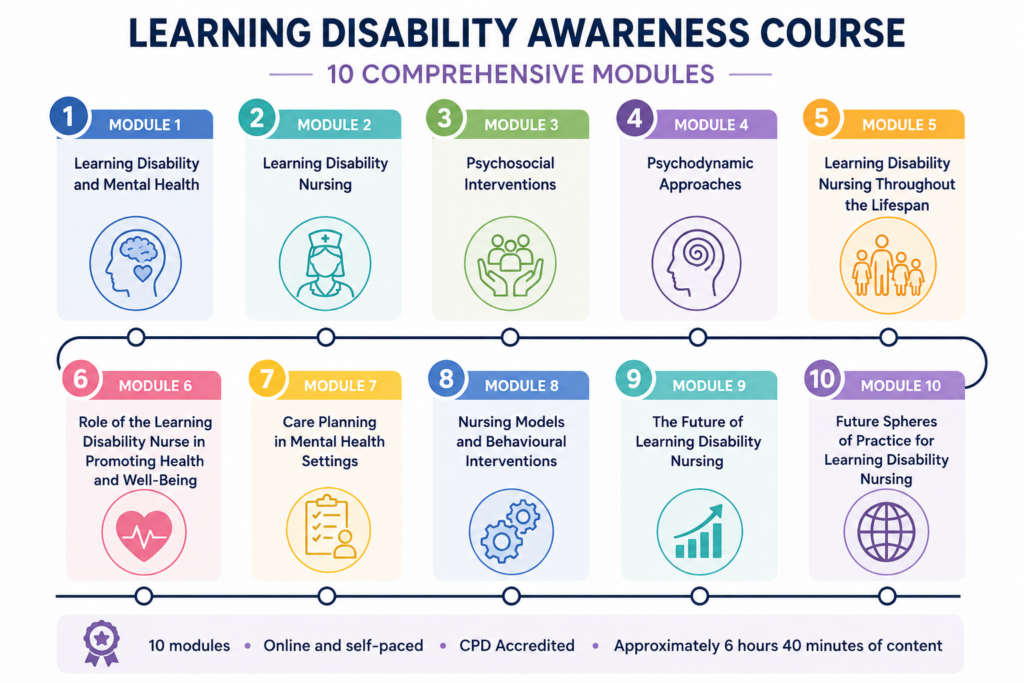
The HF Online Learning Disability Awareness Course contains 10 modules, with approximately 6 hours and 40 minutes of course content. Rather than focusing on one narrow area, the curriculum connects learning disability with mental health, nursing perspectives, psychosocial approaches, care planning, behaviour and health promotion.
Here is what the course modules cover.
Module 1: Learning Disability and Mental Health
The first module introduces the relationship between learning disability and mental health. It creates a foundation for understanding how mental health needs may affect people with learning disabilities and why professionals should consider the whole person rather than looking at one condition in isolation.
Module 2: Learning Disability Nursing
Next, the course introduces learning disability nursing. This module helps you explore the purpose and scope of this specialist field while building awareness of how learning disability nurses contribute to the health, wellbeing and support of people with learning disabilities.
Module 3: Psychosocial Interventions
This module explores psychosocial interventions and how psychological and social factors can influence a person’s wellbeing. As a result, learners can develop a broader understanding of support approaches that consider emotions, relationships, behaviour and the person’s wider environment.
Module 4: Psychodynamic Approaches
The course then introduces psychodynamic approaches. This topic explores ideas connected with emotions, experiences and behaviour. Therefore, it adds another perspective on how professionals may understand the factors that influence a person’s responses and psychological wellbeing.
Module 5: Learning Disability Nursing Throughout the Lifespan
Needs can change as people move through different stages of life. Therefore, this module looks at learning disability nursing throughout the lifespan, helping learners consider how age, development and changing circumstances may shape health and support needs over time.
Module 6: Role of the Learning Disability Nurse in Promoting Health and Well-Being
People with learning disabilities can experience significant health inequalities. Therefore, this module focuses on the role learning disability nurses can play in promoting health and wellbeing, while helping learners understand why health promotion forms an important part of wider support.
Module 7: Care Planning in Mental Health Settings
Effective care planning requires more than recording information. It should also reflect individual needs and appropriate support. This module introduces care planning in mental health settings and helps learners understand the role structured planning can play when supporting people with different needs.
Module 8: Nursing Models and Behavioural Interventions
This module introduces nursing models and behavioural interventions. In particular, it helps learners explore frameworks that may influence how professionals think about care and behaviour while developing a broader understanding of structured approaches used within learning disability services.
Module 9: The Future of Learning Disability Nursing
Health and social care continue to change as services, expectations and approaches develop. Therefore, this module considers the future of learning disability nursing and encourages learners to think about how professional roles and learning disability support may continue to evolve.
Module 10: Future Spheres of Practice for Learning Disability Nursing
Finally, the course looks beyond current practice by exploring future spheres of learning disability nursing. This module brings earlier themes together and introduces areas in which professional practice, service delivery and learning disability support may continue to develop.
Together, these ten modules move from the foundations of learning disability and mental health into wider questions about care, wellbeing, behaviour, professional roles and the future of learning disability services.
Want to Learn More About Learning Disability Awareness?
If these topics are relevant to your work or professional development, the Learning Disability Awareness Course offers a structured way to study them online at your own pace. The course currently includes ten modules, flexible online access and CPD-focused learning.
However, knowing what the course covers is only the first part of deciding whether it suits your goals. The next question is what knowledge you can gain from these modules, how that learning may benefit you and what a CPD certificate actually means.
What Will You Learn From a Learning Disability Awareness Course?
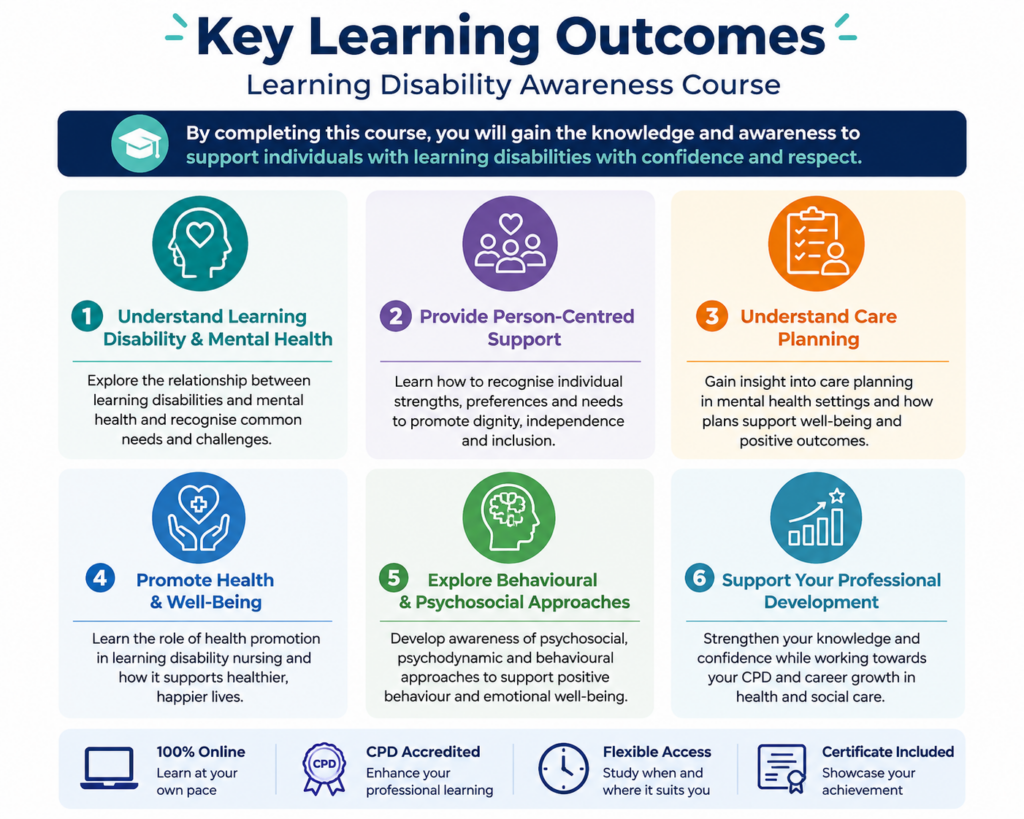
A Learning Disability Awareness Course can help you build a clearer understanding of learning disability, mental health, care planning, health promotion and different approaches to support. The aim is not simply to remember definitions. Instead, the learning helps you understand why people’s needs can differ and how professional approaches may respond to those differences.
Because the HF Online course moves across several areas of learning disability care, the knowledge you gain connects individual needs with wider health and social care practice.
Learning Disability and Mental Health Awareness
Learning disability and mental health are separate areas, but they can overlap. Someone with a learning disability can also experience anxiety, depression or other mental health difficulties.
The course introduces this relationship so that learners can understand why changes in mood, behaviour or wellbeing should not automatically be attributed to a person’s learning disability.
This wider awareness can encourage a more thoughtful approach to understanding the whole person.
Person-Centred Support and Individual Needs
One of the most important principles in learning disability support is recognising that no two people have exactly the same needs.
Throughout the course, topics such as care planning, health promotion and support approaches encourage learners to think about the individual rather than relying on assumptions.
Person-centred thinking considers factors such as a person’s preferences, communication needs, wellbeing, circumstances and level of independence. This helps build an understanding of why care should adapt to the person rather than expecting the person to adapt to a standard approach.
Psychosocial and Behavioural Approaches
Behaviour rarely exists without context. Emotional wellbeing, relationships, previous experiences and the surrounding environment can all influence how a person responds to situations.
The course introduces psychosocial, psychodynamic and behavioural perspectives so learners can explore different ways of understanding behaviour.
This does not qualify a learner to deliver specialist psychological or behavioural interventions. However, it can strengthen awareness of the factors professionals may consider when trying to understand someone’s needs or responses.
Care Planning and Health Promotion
Care planning helps organise support around identified needs, preferences and goals. Meanwhile, health promotion focuses on helping people maintain or improve their health and wellbeing.
The curriculum introduces both areas, allowing learners to understand how structured planning and health awareness can contribute to wider learning disability support.
This is particularly relevant because people with learning disabilities can experience significant health inequalities. UK government guidance therefore stresses the importance of accessible healthcare, reasonable adjustments and action to reduce avoidable differences in health outcomes.
Supporting People Across Different Stages of Life
Support needs can change throughout childhood, adulthood and later life.
For this reason, the course examines learning disability nursing across the lifespan. Learners can consider how ageing, changing health needs, family circumstances and different stages of life may influence the type of support a person requires.
Rather than viewing learning disability support as fixed, this topic encourages learners to recognise that people’s circumstances can evolve over time.
Understanding Changes in Learning Disability Services
The final modules look towards the future of learning disability nursing and professional practice.
Health and social care services continue to change as expectations around inclusion, personalised support, rights and health outcomes develop. Understanding this wider context can help learners see how learning disability services fit within an evolving care system.
Together, these learning outcomes turn the individual modules from Part 1 into a broader understanding of people, health, support and professional practice.
What Are the Benefits of Taking a Learning Disability Awareness Course?
The main benefit of a Learning Disability Awareness Course is the opportunity to develop focused knowledge that may support your continuing professional development. It can also help you understand topics that are relevant to health, social care and learning disability services.
The value of the course depends on your goals. Someone already working in care may want to refresh or expand their knowledge, while a beginner may use the course to understand an unfamiliar area before progressing to broader learning.
Benefits for Your Knowledge and Professional Development
Completing learning disability awareness training can help you:
- build a clearer understanding of learning disabilities and mental health
- recognise why support should reflect individual needs
- explore person-centred approaches to care
- understand the purpose of care planning
- develop awareness of health promotion
- explore psychosocial and behavioural perspectives
- broaden your knowledge of learning disability nursing
- record additional continuing professional development
These benefits are particularly useful when the learner understands the limits of awareness training. The course develops knowledge; it does not replace workplace competency assessment, professional registration or specialist clinical training where these are required.
Benefits of Online Learning Disability Training
Online training can also make professional development easier to fit around existing commitments.
The HF Online Learning Disability Awareness Course is currently listed as a beginner-level course with one year’s access and approximately 6 hours and 40 minutes of content. Learners can complete the course at their own pace and access the material online.
That flexibility can be useful if you are combining learning with work, family responsibilities or other study.
The course page also states that learners can access the course from a computer, tablet or smartphone and complete an online multiple-choice assessment after studying the learning materials.
Online learning therefore removes the need to attend a fixed classroom timetable while still providing a structured route through the subject.
What Does a CPD Certificate Mean?

A CPD certificate provides evidence that you have completed continuing professional development. CPD stands for Continuing Professional Development, which refers to learning undertaken to maintain, update or expand professional knowledge.
For a Learning Disability Awareness Course, a CPD certificate can show that you have completed structured learning around the subject.
HF Online currently identifies its Learning Disability Awareness programme as CPD-accredited and provides certification following successful completion of the required assessment.
However, the word certificate can cause confusion. A certificate of course completion and a regulated qualification are not automatically the same thing.
What Can You Use a CPD Certificate For?
Depending on your circumstances, you may use a CPD certificate as evidence of additional learning or professional development.
For example, it may help you:
- maintain a personal CPD record
- demonstrate that you completed additional subject-specific learning
- add relevant professional development to your CV
- discuss learning goals during supervision or appraisal
- identify areas for further development
Whether an employer, regulator or professional body accepts a particular course for a specific requirement will depend on its own rules. Therefore, you should always check the requirement before enrolling if you need training for a particular role or compliance purpose.
Is a CPD Certificate the Same as a Regulated Qualification?
No. A CPD certificate is not automatically the same as a regulated qualification.
CPD courses primarily support professional learning and knowledge development. A regulated qualification follows a formal regulatory framework and is awarded through an awarding organisation recognised for that qualification.
This distinction matters when applying for jobs or planning your career. If an employer requires a specific regulated qualification, completing an unrelated CPD course does not replace that requirement.
Instead, think of CPD as one part of ongoing professional development. It can complement existing experience or broader learning, but you should check exactly what a role requires before treating any certificate as a route into employment.
Is Learning Disability Awareness Training Mandatory for Care Workers?
CQC-registered health and social care providers in England must ensure their staff receive learning disability and autism training at a level appropriate to their role. However, this does not mean that every online Learning Disability Awareness CPD course automatically meets that legal requirement.
The requirement has applied to CQC-registered providers since 1 July 2022. Regulation 18 requires providers to ensure staff receive training in how to interact appropriately with people with a learning disability and autistic people at a level suited to their responsibilities.
This is an important distinction for care workers and employers. A course can provide useful learning disability awareness while still being different from the training an organisation uses to demonstrate regulatory compliance.
If you work for a registered provider, check your employer’s training requirements rather than assuming that any CPD certificate will meet them.
What Is the Oliver McGowan Mandatory Training?
The Oliver McGowan Mandatory Training on Learning Disability and Autism is a training package developed to improve how health and social care staff understand and support people with learning disabilities and autistic people.
The government published the Oliver McGowan Code of Practice to set standards for statutory learning disability and autism training. The code became final on 6 September 2025 and applies to CQC-registered health and social care providers in England.
The government describes Oliver McGowan Mandatory Training as its preferred and recommended training package for helping registered providers meet the legal requirement.
The wider legal requirement, however, focuses on whether providers ensure staff receive appropriate training. The CQC explains that Regulation 18 does not itself specify a particular named training package.
Is a CPD Learning Disability Awareness Course the Same as Oliver McGowan Training?
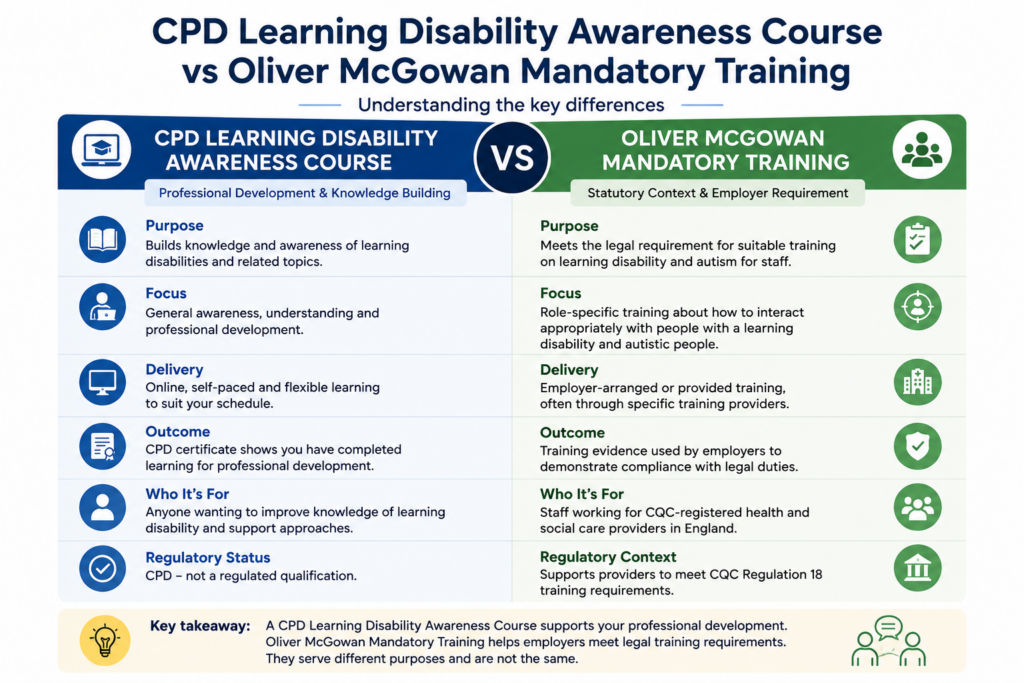
No. A general CPD Learning Disability Awareness Course should not automatically be described as Oliver McGowan Mandatory Training or as a substitute for it.
The HF Online course focuses on areas including learning disability and mental health, learning disability nursing, psychosocial approaches, care planning, health promotion and behavioural interventions.
It can therefore support broader learning disability awareness and continuing professional development.
However, staff working for CQC-registered providers should follow their employer’s required learning disability and autism training arrangements. Employers remain responsible for ensuring that staff receive appropriate training at the level required for their roles.
That difference is worth understanding before choosing any course: professional development and regulatory compliance can overlap, but they are not automatically identical.
Looking to Strengthen Your Learning Disability Awareness?
If your goal is to develop your knowledge of learning disability, mental health, care planning, health promotion and related approaches, the Learning Disability Awareness Course provides structured online learning with flexible access and CPD-focused certification.
Before choosing any professional development course, however, it is equally important to consider who the training is designed for, how it relates to your career goals and whether broader health and social care learning may be more suitable. Those are the questions we turn to next.
Who Should Take a Learning Disability Awareness Course?
A Learning Disability Awareness Course may suit anyone who wants to understand learning disabilities more clearly, particularly people working in or considering health and social care. It can also support existing workers who want focused CPD in learning disability, mental health and related approaches to care.
The course may be relevant to:
Care workers and support workers
Healthcare assistants
Health and social care learners
People interested in learning disability services
Existing care staff seeking additional CPD
Aspiring health and social care workers
Family carers who want to improve their awareness
Anyone interested in learning disability nursing and support
You do not necessarily need previous experience to begin learning about the subject. HF Online currently lists its Learning Disability Awareness Course at beginner level, with ten units and flexible online study.
However, course suitability and professional eligibility are different things. Completing awareness training can develop your knowledge, but it does not by itself qualify you for a regulated clinical profession such as learning disability nursing.
How Can Learning Disability Awareness Support a Career in Health and Social Care?
Learning disability awareness can support professional development in health and social care because many care roles involve working with people who have different communication, health, emotional and support needs.
For example, developing your awareness can help you understand why person-centred approaches matter, why communication may need to change from one person to another and why care planning should reflect individual circumstances.
The subject also connects naturally with wider areas of care, including:
Safeguarding
Mental health awareness
Communication
Health promotion
Care planning
Person-centred support
Professional responsibilities
Dignity and independence
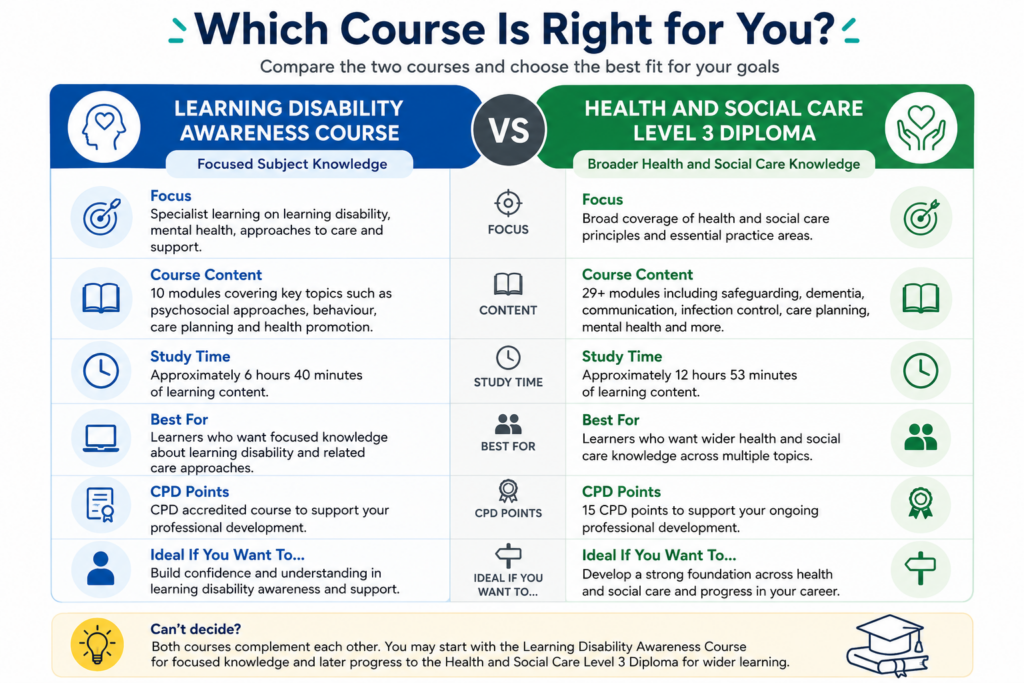
However, career development often requires broader learning as well. If you want to study health and social care beyond learning disability alone, the Health and Social Care Level 3 Diploma provides wider CPD-focused learning.
Its current curriculum covers 29 main learning modules plus assessment content, including health and social care principles, professional and ethical practice, care planning, medical records, dementia, infection control, mental health, communication, safeguarding and person-centred care.
Therefore, the right course depends largely on how focused or broad you want your learning to be.
Learning Disability Awareness Course or Health and Social Care Level 3: Which Should You Choose?
Choose a Learning Disability Awareness Course if your main goal is to develop focused knowledge of learning disability, mental health and related approaches to care.
In contrast, consider a broader Health and Social Care Level 3 course if you want to study multiple areas of care rather than concentrating mainly on learning disability.
Choose Learning Disability Awareness If…
The Learning Disability Awareness Course may be the better option if you want to explore topics such as learning disability and mental health, learning disability nursing, psychosocial approaches, behavioural interventions, care planning and health promotion.
The current HF Online course contains ten units and approximately 6 hours and 40 minutes of learning content.
It therefore offers a more focused learning pathway for someone specifically interested in learning disability awareness and related professional development.
Consider Health and Social Care Level 3 If…
The Health and Social Care Level 3 Diploma may suit you better if you want broader health and social care knowledge.
Its curriculum covers areas such as professional standards, ethics, care planning, medical records, public health, dementia, infection control, mental health, communication, safeguarding, health and safety and person-centred care.
HF Online currently lists the course as approximately 12 hours and 53 minutes, with one year’s access and 15 CPD points.
As a result, it covers a wider range of topics than the specialist Learning Disability Awareness Course.
Can You Study Both Courses?
Yes. The two courses focus on different learning goals, so studying both may provide complementary CPD.
You might begin with broader health and social care learning and then develop more focused awareness of learning disability. Alternatively, you could take the specialist course first and later expand into wider care topics.
The important point is to choose training according to what you need to learn, rather than simply collecting certificates.
If your employer requires particular training or a regulated qualification, check those requirements separately before enrolling.
How to Choose a Learning Disability Awareness Course
Before choosing online learning disability training, look beyond the course title. Two programmes with similar names can contain very different learning materials.
First, check the curriculum. A good course description should make it clear what you will actually study and whether the content matches your learning goals.
Next, consider the following factors:
Course content: Does it cover the areas you want to understand?
CPD status: Does the course support continuing professional development, and what certificate will you receive?
Delivery: Can you complete the learning online and at your own pace?
Duration: Is the amount of learning suitable for your needs?
Assessment: How does the provider check your understanding?
Access period: How long will you retain access to the learning materials?
Training purpose: Are you studying for general professional development, or does your employer require specific mandatory training?
Qualification status: Is the course CPD, or do you need a separately regulated qualification?
These checks make it easier to compare courses based on what they actually offer rather than relying on promotional wording.
Final Takeaway: Is a Learning Disability Awareness Course Worth It?
A Learning Disability Awareness Course can be worthwhile if you want structured learning about learning disability, mental health, care planning, health promotion and different approaches to support.
The value lies in developing understanding rather than simply gaining another certificate. Better awareness can help you recognise why individual needs differ, why person-centred thinking matters and how learning disability connects with wider health and social care practice.
A CPD certificate can also provide evidence of your professional development. However, it does not automatically replace regulated qualifications, mandatory employer training or professional registration where these are required.
Your next step therefore depends on your learning goal.
Ready to Build Your Learning Disability Awareness?
If you want focused learning in learning disability, mental health, care planning and related support approaches, explore the Learning Disability Awareness Course.
Study online at your own pace
Develop focused learning disability awareness
Explore ten structured learning modules
Support your continuing professional development
Receive certification after meeting the course requirements
Explore the Learning Disability Awareness Course
If you want to build broader knowledge across care planning, safeguarding, communication, mental health, health and safety, person-centred care and other areas of the sector, consider the Health and Social Care Level 3 Diploma as your wider learning pathway. Its current programme contains 29 main subject modules, assessment content, 15 CPD points and approximately 12 hours and 53 minutes of learning.
Frequently Asked Questions
What Is a Learning Disability Awareness Course?
A Learning Disability Awareness Course is structured training that helps learners understand learning disabilities and related support needs. Depending on the curriculum, it may cover mental health, person-centred approaches, care planning, behaviour, health promotion and professional roles. Online courses can also contribute to continuing professional development.
What Does a Learning Disability Awareness Course Cover?
Course content varies between providers. The HF Online programme currently covers learning disability and mental health, learning disability nursing, psychosocial and psychodynamic approaches, lifespan support, health promotion, care planning, behavioural interventions and the future of learning disability nursing across ten units.
How Long Does a Learning Disability Awareness Course Take?
Course duration depends on the provider and curriculum. HF Online currently lists its Learning Disability Awareness Course at approximately 6 hours and 40 minutes, with flexible study and one year’s course access. This allows learners to work through the material according to their own schedule.
Do You Get a Certificate After Learning Disability Awareness Training?
Many online courses offer a certificate after learners meet their completion and assessment requirements. HF Online currently identifies its Learning Disability Awareness programme as CPD-accredited. However, always check what type of certificate you will receive and whether it meets any specific employer or professional requirement.
Is Learning Disability Awareness Training Mandatory in the UK?
Requirements depend on your role and organisation. As explained earlier, CQC-registered providers in England must ensure relevant staff receive learning disability and autism training appropriate to their roles. However, a general CPD awareness course does not automatically satisfy every employer’s statutory or mandatory training requirement.Care workers should work within their training, competence and workplace procedures. They can play an important role in recognising and reporting concerning skin changes, but appropriately trained professionals should make clinical assessments and decisions that require clinical expertise.
Is a CPD Learning Disability Awareness Course a Qualification?
A CPD Learning Disability Awareness Course is not automatically a regulated qualification. CPD records continuing professional development and additional learning. Therefore, if a job requires a particular regulated qualification, professional registration or workplace competency assessment, you should check those requirements separately before relying on a CPD certificate.
Who Should Take Learning Disability Awareness Training?
Learning disability awareness training may benefit care workers, support workers, healthcare assistants, health and social care learners and others who want to develop their understanding of learning disabilities. It may also suit beginners interested in learning disability support or existing staff who want additional professional development.
Can Care Workers Complete Learning Disability Awareness Training Online?
Yes. Many providers offer online learning disability awareness training, allowing care workers to study around existing responsibilities. For example, HF Online provides its Learning Disability Awareness Course online with flexible scheduling and one year’s access to the course materials.
What Is the Difference Between a Learning Disability and a Learning Difficulty?
A learning disability can affect broader intellectual functioning and everyday adaptive skills. A learning difficulty usually affects a particular area of learning, such as reading or co-ordination. Dyslexia is one example of a learning difficulty. However, a person may experience both a learning disability and learning difficulties.
What Is Oliver McGowan Mandatory Training?
The Oliver McGowan Mandatory Training on Learning Disability and Autism is a specific training programme designed for health and social care staff. As discussed earlier, it should not be confused with every general Learning Disability Awareness CPD course. Staff should follow their employer’s training requirements where mandatory training applies.