

A NEWS2 score can reveal that a patient’s condition is changing before the warning signs become obvious. For example, faster breathing, falling oxygen levels or sudden confusion may signal deterioration even when a patient does not appear seriously unwell.
Healthcare support workers often spend considerable time with patients. As a result, they may notice subtle changes during routine care before the next formal review. Accurate observations and clear communication can therefore play an important part in recognising deterioration.
NEWS2 stands for National Early Warning Score 2. The system combines six routinely measured physiological observations into a score that helps healthcare teams assess acute illness and recognise deterioration. The Royal College of Physicians developed NEWS and introduced the updated NEWS2 system in 2017.
This guide explains what NEWS2 means, how the NEWS2 score chart works, what different scores indicate and how healthcare support workers can recognise and report concerns.
Table of Contents
What Is NEWS2 and What Does NEWS2 Stand For?
NEWS2 means National Early Warning Score 2, a standard scoring system that helps healthcare teams recognise acute illness and deterioration. The Royal College of Physicians NEWS2 guidance explains that the RCP introduced NEWS in 2012 and updated it to NEWS2 in December 2017.
NEWS2 gives points to physiological observations according to their measurement ranges. Therefore, measurements that move further away from the zero-score ranges generally receive more points. Staff then add the individual scores and account for supplemental oxygen to calculate the total NEWS2 score.
Why Is NEWS2 Used in Healthcare?
Healthcare teams use NEWS2 to recognise deterioration and identify when a patient may need further clinical assessment. In addition, the system gives staff a consistent way to record changes and communicate concerns.
According to the RCP, NEWS2 helps teams:
- Assess the severity of acute illness
- Detect clinical deterioration
- Support a timely clinical response
Repeated observations also help teams identify trends. For example, a rising score or a noticeable change in one parameter may show that a patient’s condition has worsened. As a result, the team can review the change and decide what action the patient needs.
NHS England also endorses NEWS2 as an early warning approach for acutely ill adult patients. Consequently, NEWS2 gives healthcare teams a shared framework when they discuss deterioration.
Who Is NEWS2 Designed For?
The RCP designed NEWS2 for people aged 16 and over. However, it does not recommend NEWS2 for children under 16 or during pregnancy. These groups can show different physiological responses and need appropriate age- or maternity-specific assessment systems.
Most importantly, NEWS2 supports clinical judgement rather than replacing it. Therefore, healthcare workers should raise concerns when a patient looks, feels or behaves differently, even when the NEWS2 score remains low.
What Are the Six NEWS2 Parameters?
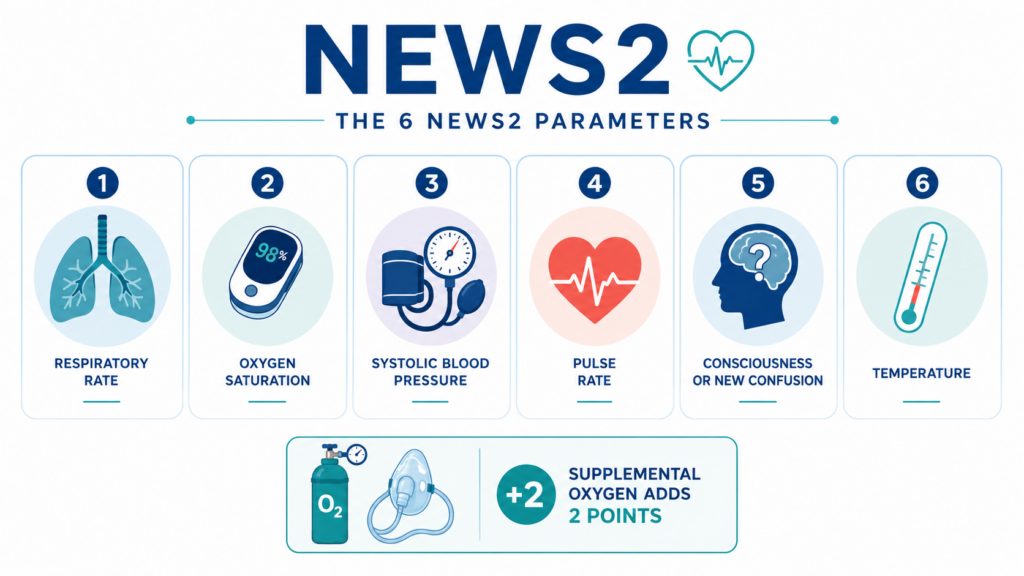
NEWS2 uses six physiological parameters to show how a patient’s body may respond to acute illness. Together, these observations provide a structured picture of the patient’s current condition.
| NEWS2 Parameter | What It Shows |
|---|---|
| Respiratory rate | How many breaths the patient takes each minute |
| Oxygen saturation (SpO₂) | The level of oxygen saturation in the blood |
| Systolic blood pressure | The arterial pressure when the heart contracts |
| Pulse rate | How quickly the heart beats |
| Consciousness or new confusion | Whether alertness or mental state has changed |
| Temperature | Whether body temperature sits within or outside the scoring ranges |
Accurate observations matter because one incorrect measurement can change the resulting score. In addition, staff should compare current observations with earlier results whenever possible. By doing so, they can identify trends that a single reading may not show.
New confusion deserves particular attention. NEWS2 uses ACVPU: Alert, new Confusion, Voice, Pain and Unresponsive. The RCP explains that new confusion, disorientation or agitation can appear subtly, even when the patient answers questions coherently. NEWS2 gives new confusion a score of 3.
Therefore, healthcare support workers should report unexplained new confusion rather than dismissing it as tiredness or usual behaviour.
How Does Supplemental Oxygen Affect the NEWS2 Score?
NEWS2 adds 2 points when a patient receives supplemental oxygen. Supplemental oxygen does not count as one of the six physiological parameters; however, it changes the total NEWS2 score.
Staff should therefore record oxygen use accurately. In addition, they should document the delivery device and flow rate according to local procedures.
How Does the NEWS2 Score Chart Work?
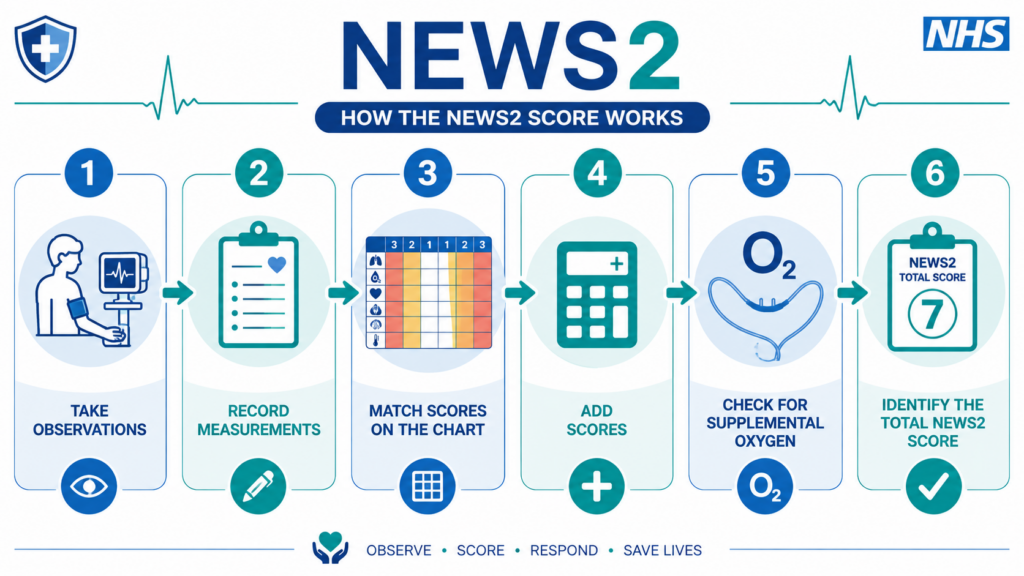
The NEWS2 score chart assigns points to each physiological observation according to its measurement range. Most parameters receive a score from 0 to 3. Staff then add these individual scores and the supplemental-oxygen weighting to calculate the total NEWS2 score.
You can view the official Royal College of Physicians NEWS2 resources for the complete scoring charts and trigger thresholds.
The scoring process follows a clear sequence:
- First, take the six physiological observations accurately.
- Next, record each measurement.
- Match each result with the appropriate NEWS2 score.
- Check whether the patient receives supplemental oxygen.
- Add the individual scores together.
- Finally, check both the total and whether any single parameter scores 3.
That last step matters because a single parameter scoring 3 can trigger an urgent response even when the total score remains below 5.
How Is a NEWS2 Score Calculated?
Staff calculate a NEWS2 score by adding the points from each observation and the supplemental-oxygen score where appropriate.
For example:
Respiratory rate score = 2
Oxygen saturation score = 1
All other parameters = 0
Supplemental oxygen = 0
Total NEWS2 score = 3
The arithmetic remains straightforward. However, accurate observations and correct scoring matter more than calculating the total quickly.
NEWS2 Scale 1 vs Scale 2
SpO₂ Scale 1 applies to most patients, whereas Scale 2 applies only to particular patients with confirmed hypercapnic respiratory failure and a clinically prescribed oxygen target of 88–92%. Hypercapnic respiratory failure occurs when carbon dioxide builds up in the blood.
A healthcare support worker should not choose Scale 2 independently. Instead, a competent clinical decision-maker must identify the need for Scale 2 and document that decision. Therefore, staff should follow Scale 1 unless an appropriate clinician has directed otherwise.
NEWS2 Score Interpretation: What Do the Numbers Mean?
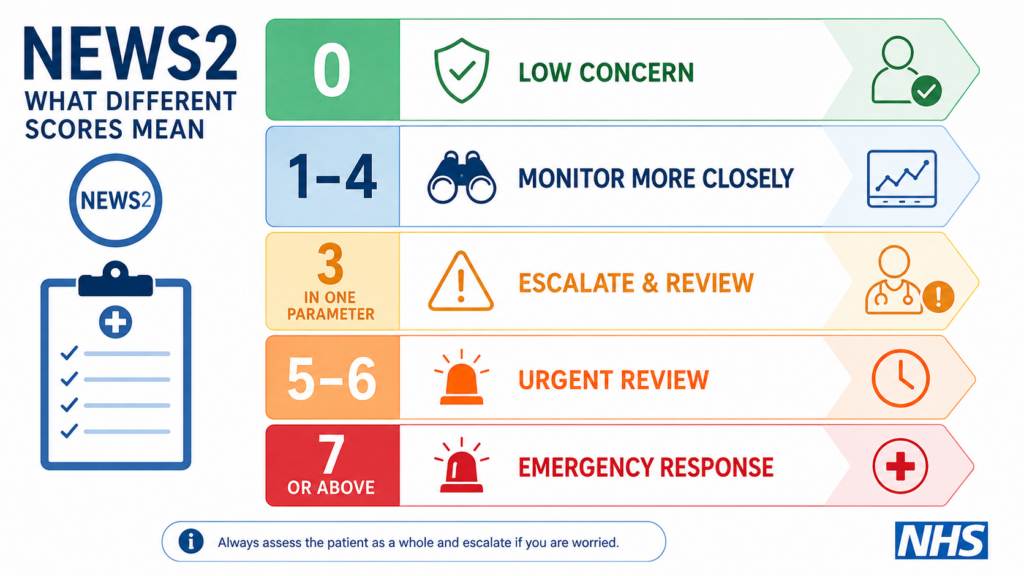
A higher NEWS2 score generally signals greater changes in a patient’s vital signs and a greater need for clinical review. However, staff should also consider individual parameter scores, previous observations and the patient’s overall condition.
The RCP uses the following main trigger levels:
| NEWS2 Result | Risk Level | What It Signals |
|---|---|---|
| Total 0 | Low | Routine NEWS2 monitoring |
| Total 1–4 | Low | Registered clinical review according to the response pathway |
| 3 in one parameter | Low–medium | Significant change requiring urgent review |
| Total 5–6 | Medium | Key threshold for urgent response |
| Total 7 or above | High | Emergency response threshold |
The RCP links these score ranges with increasingly urgent clinical responses.
What Does a Score of 3 in One Parameter Mean?
A score of 3 in one parameter means that one observation has moved far enough outside its zero-score range to trigger concern on its own.
The overall score may still remain below 5. However, staff should not ignore the individual parameter. The RCP advises clinical review and an appropriate monitoring plan. Therefore, healthcare support workers should report the result promptly and follow their local escalation pathway.
What Do NEWS2 Scores of 5–6 Mean?
A total NEWS2 score of 5 or 6 reaches the key threshold for an urgent clinical response.
At this level, the patient needs urgent assessment by someone with the skills to assess acute illness. As a result, healthcare support workers should communicate the score promptly and follow their organisation’s escalation procedure.
What Does a NEWS2 Score of 7 or Above Mean?
A NEWS2 score of 7 or above reaches the high-risk emergency-response threshold. The RCP advises immediate review and continuous monitoring at this level.
Even so, the thresholds only guide action. If a patient looks worse despite a lower score, staff should still raise the concern.
NEWS2 Scoring Example: From Observations to Escalation

A worked example shows how the individual observations combine into a total NEWS2 score.
Imagine an adult patient who appeared comfortable earlier in the shift. However, a healthcare support worker now notices unusual tiredness. The worker takes observations within their training and competence and records these Scale 1 results:
| Observation | Result | NEWS2 Score |
|---|---|---|
| Respiratory rate | 22 breaths/minute | 2 |
| Oxygen saturation | 94% | 1 |
| Supplemental oxygen | No — breathing room air | 0 |
| Systolic blood pressure | 104 mmHg | 1 |
| Pulse rate | 104 beats/minute | 1 |
| Consciousness | Alert | 0 |
| Temperature | 38.2°C | 1 |
| Total NEWS2 score | 6 | |
These values produce a total NEWS2 score of 6 under the official RCP scoring ranges. Therefore, the result reaches the urgent-response threshold.
The score matters, but so does the change in the patient. In addition, several observations now sit outside their zero-score ranges.
A simple sequence helps connect scoring with action:
- Observe — notice what has changed.
- Record — document the measurements accurately.
- Recognise — identify the score and any concerning trend.
- Report — communicate the concern through the local escalation pathway.
The registered clinical team then decides what assessment or treatment the patient needs.
Therefore, NEWS2 does more than produce a number. It connects observation with recognition, communication and timely clinical review.
What Should Healthcare Support Workers Do When a NEWS2 Score Is Concerning?
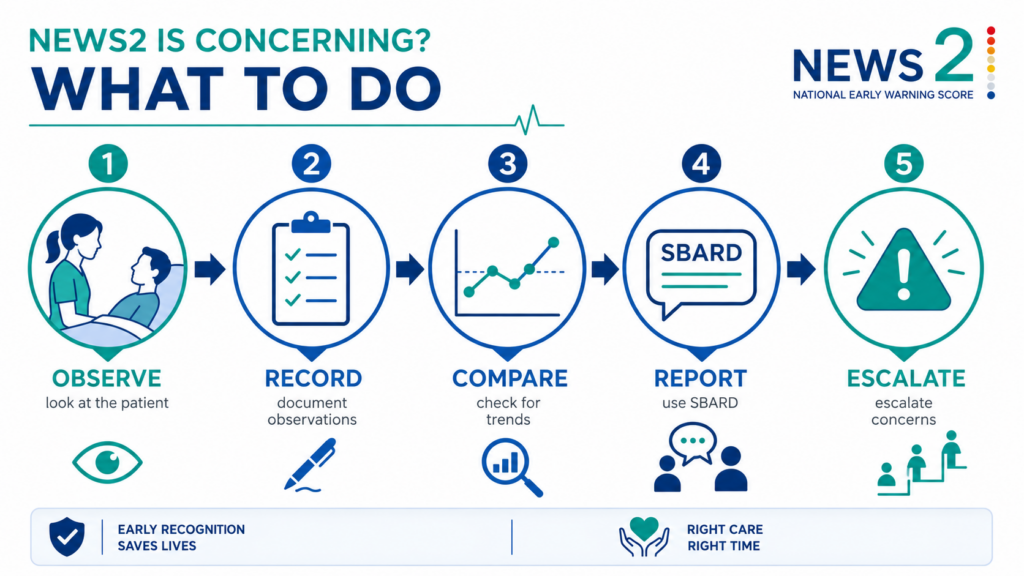
When a NEWS2 score causes concern, healthcare support workers should report the result promptly, explain what has changed and follow their local escalation pathway. However, they should never wait for a higher score when the patient already looks or feels worse.
Look for Trends, Changes and Soft Signs of Deterioration
One NEWS2 score shows one moment. In contrast, repeated observations can show whether a patient’s condition improves, remains stable or worsens.
NHS England’s PIER approach asks healthcare teams to consider vital-sign changes alongside softer signs. For example, deterioration may appear through reduced eating, changes in behaviour or mental state, or concerns from the patient or family.
Watch for:
- Faster or more difficult breathing
- New confusion, agitation or unusual sleepiness
- Reduced eating or drinking
- Changes in behaviour or mobility
- A patient saying that they feel worse
- A relative or carer raising a concern
Patient and family concerns matter because an early warning score cannot capture every change.
For example, NHS England’s Martha’s Rule information reports that between June 2025 and May 2026, 82% of Martha’s Rule calls involving acute deterioration would not have triggered escalation through the early warning score.
However, NHS England publishes these figures as management information. Therefore, readers should interpret them with appropriate caution rather than treat them as a direct statistical comparison between escalation systems.
Even with that limitation, the finding reinforces a practical point: use the NEWS2 score, but keep watching and listening to the person.
Escalate and Communicate Concerns Using SBARD
Structured communication helps staff explain a deterioration concern clearly. Therefore, some healthcare services use SBARD when staff escalate concerns.
| SBARD | What to Communicate |
|---|---|
| Situation | What concerns you now |
| Background | Relevant information about the patient |
| Assessment | Observations, NEWS2 score and recent changes |
| Recommendation | What review, advice or support you need |
| Decision | Confirm the agreed next step |
NHS England’s PIER approach specifically includes timely escalation through standardised communication tools.
Work Within Your Training, Competency and Local Policy
Healthcare support workers should only undertake NEWS2-related tasks within their training and competence.
For example, Royal Cornwall Hospitals NHS Trust requires its healthcare support workers to complete supervised practice and a competency framework before independently recording observations and NEWS2. In addition, the Trust expects workers to recognise and communicate deterioration. Other organisations may use different competency arrangements.
Therefore, always follow your employer’s policy and raise anything outside your competence with the appropriate registered professional.
NEWS2 and Sepsis: What Is the Connection?
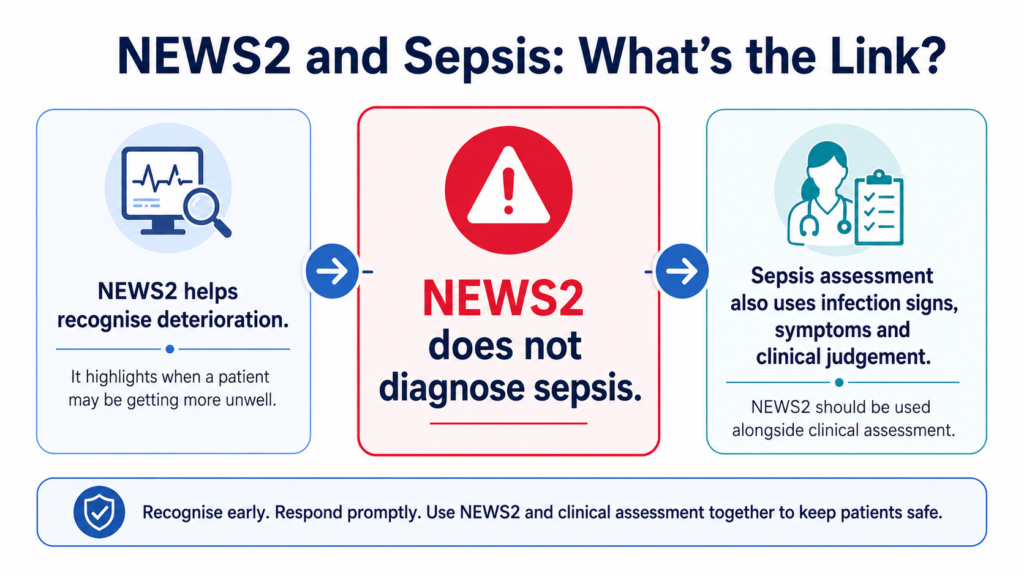
NEWS2 supports sepsis risk assessment by showing how suspected infection may affect a patient’s vital signs. However, NEWS2 cannot diagnose sepsis.
An infection can cause changes in breathing, blood pressure, consciousness and other observations. As a result, NEWS2 can help clinicians judge how seriously illness affects someone.
Current NICE guidance on suspected sepsis uses NEWS2 alongside suspected or confirmed infection, clinical findings and other reasons for concern in people aged 16 and over in relevant acute settings.
Can NEWS2 Diagnose Sepsis?
No. A NEWS2 score cannot confirm or rule out sepsis on its own.
For someone with suspected or confirmed infection, NICE uses these NEWS2 bands as part of its assessment of the risk of severe illness or death from sepsis:
| NEWS2 Score | NICE Risk Level |
|---|---|
| 0 | Very low risk when no other clinical concern exists |
| 1–4 | Low risk |
| 5–6 | Moderate risk |
| 7 or above | High risk |
However, NICE also asks clinicians to consider other causes for concern. Therefore, a person may move into a higher risk category even when their NEWS2 score falls below one of these thresholds.
How Does NEWS2 Fit Into Sepsis Risk Assessment?
NEWS2 helps clinicians assess illness severity; meanwhile, symptoms, infection status, examination findings and clinical judgement complete the picture.
A healthcare support worker does not need to diagnose sepsis to contribute to safer care. For example, if someone with possible infection develops faster breathing, falling blood pressure or new confusion, the worker can record the observations within their role and report the change promptly.
Therefore, think of NEWS2 as one part of the assessment rather than a standalone sepsis test.
Common NEWS2 Recording and Scoring Mistakes to Avoid
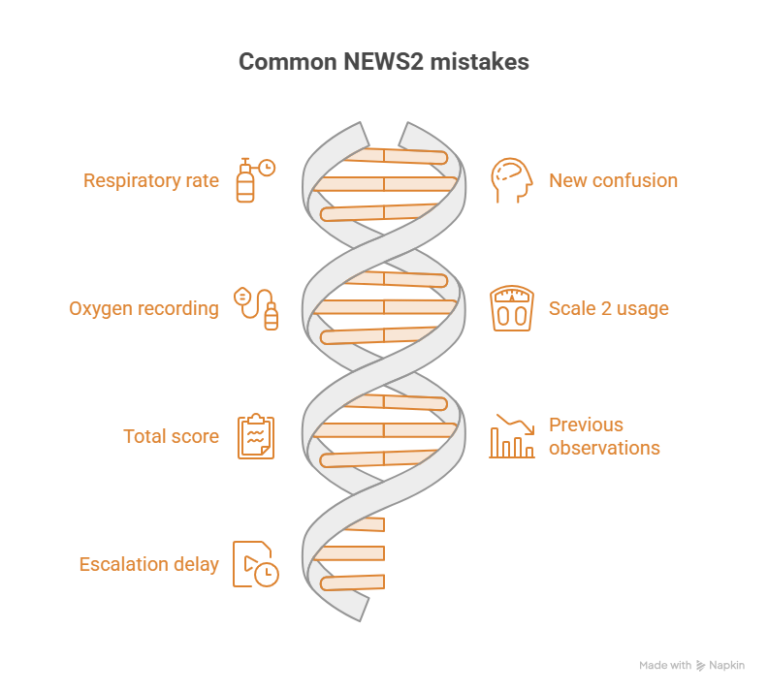
Common NEWS2 mistakes include inaccurate observations, incorrect oxygen recording, missed confusion and focusing only on the total score. Because each observation contributes to the final result, an error may alter the score or hide an important change.
| Common Mistake | Why It Matters |
|---|---|
| Estimating respiratory rate | An inaccurate count can change the NEWS2 score |
| Missing new confusion | NEWS2 gives new confusion 3 points |
| Recording oxygen incorrectly | Supplemental oxygen adds 2 points |
| Using Scale 2 without clinical direction | An appropriate clinician must determine when Scale 2 applies |
| Checking only the total score | A single parameter scoring 3 can trigger urgent review |
| Ignoring previous observations | A worsening trend may show deterioration |
| Delaying escalation | The patient may need prompt clinical review |
The RCP states that NEWS2 should supplement clinical judgement rather than replace it. Therefore, staff should combine accurate scoring with careful observation of the patient.
A simple routine can help:
Observe
→
Record
→
Compare
→
Report
Electronic systems may calculate the score automatically. However, they cannot decide whether someone measured an observation correctly or noticed a meaningful change in the patient’s condition.
Final Takeaway: NEWS2 Supports Earlier Recognition of Deterioration
NEWS2 helps healthcare teams turn routine observations into useful information about changes in a patient’s condition. However, for healthcare support workers, understanding NEWS2 involves more than adding numbers together.
Remember the essentials:
- First, take observations carefully and record them accurately.
- Use the NEWS2 score chart correctly.
- Check individual parameter scores as well as the total.
- In addition, compare current observations with earlier results.
- Watch for new confusion and softer signs of deterioration.
- Listen when patients, relatives or carers raise concerns.
- Escalate worrying changes promptly.
- Finally, work within your training, competence and local policy.
NHS England’s PIER approach links prevention, identification, escalation and response. Therefore, it encourages healthcare teams to look beyond a single score and consider physiological observations, subtle changes and concerns from patients or families together.
Martha’s Rule reinforces the same message. Between June 2025 and May 2026, 82% of acute-deterioration Martha’s Rule calls would not have triggered escalation through the early warning score alone. However, NHS England classifies these figures as management information and advises appropriate caution when interpreting them.
Ultimately, the principle remains simple:
understand the NEWS2 score, watch the patient and speak up when something changes.
Frequently Asked Questions
What Is a Normal NEWS2 Score?
A NEWS2 score of 0 means that the measured parameters fall within the NEWS2 zero-score ranges and the patient does not receive supplemental oxygen. However, a score of 0 does not guarantee that someone is well. Therefore, staff should still raise clinical concerns when the patient looks, feels or behaves differently.
What Is the Difference Between NEWS and NEWS2?
NEWS2 is the updated version of the original National Early Warning Score. The RCP introduced NEWS in 2012 and updated it in 2017. In particular, NEWS2 refined oxygen scoring for hypercapnic respiratory failure and added new confusion to the consciousness assessment.
What Does ACVPU Mean in NEWS2?
ACVPU means Alert, new Confusion, Voice, Pain and Unresponsive. NEWS2 uses ACVPU to assess consciousness. For example, new confusion, disorientation or agitation scores 3, even when the patient can still answer questions.
Can Healthcare Support Workers Calculate a NEWS2 Score?
Some healthcare support workers can record observations and NEWS2 scores when their role, training and competency allow it. However, employers define responsibilities locally. Therefore, HCSWs should follow their organisation’s policy rather than assume that every support worker can complete the same NEWS2 tasks. NHS Trust policies and job descriptions demonstrate this competency-based approach.
How Often Should Healthcare Staff Take NEWS2 Observations?
The NEWS2 result and the patient’s condition influence monitoring frequency. For example, current RCP material describes routine observations for a score of 0, registered nurse review for scores of 1–4, urgent responses at higher scores and continuous monitoring when the score reaches 7 or above. However, staff should always follow the patient’s monitoring plan and local escalation policy.
Do Care Homes and Community Teams Use NEWS2?
Some care-home and community services use NEWS2 as part of local deterioration pathways. However, escalation arrangements can differ from hospital pathways. Therefore, workers should follow the system, training and communication process that their organisation provides. NHS England’s PIER approach applies deterioration management across health and care settings rather than limiting it to hospital wards.