

A person who normally chats over breakfast suddenly seems confused, refuses food and struggles to walk. Would you recognise those changes as a possible sign that they need urgent medical attention?
Sepsis awareness for care workers starts with noticing what looks different from a person’s usual condition. Care workers often know a person’s routines, communication style, mobility and appetite, so they can spot changes that others may miss. These observations can provide valuable information when someone becomes unwell.
Sepsis develops when the body reacts severely to an infection and the reaction can become life-threatening. The condition can develop quickly, and some people may show less obvious symptoms. The NHS advises people to seek immediate medical help when they suspect sepsis.
This guide explains how sepsis develops, who faces greater risk, which early signs care workers should recognise and what changes require urgent escalation. It focuses on recognition and communication rather than diagnosis or treatment.
Sepsis Fast Facts for Care Workers
| Key point | What to remember |
|---|---|
| Sepsis | A serious reaction to an infection that can become life-threatening |
| Early recognition | Look for changes from the person’s normal condition |
| Care worker role | Observe, communicate concerns and follow workplace procedures |
| Diagnosis | Leave clinical diagnosis and treatment to appropriately qualified professionals |
| Emergency signs | Follow emergency procedures immediately when serious red flags appear |
Table of Contents
What Is Sepsis and Why Does It Matter in Care Settings?
Sepsis occurs when the body responds severely to an infection and that response can cause serious problems with normal body functions. The infection may start in different parts of the body, including the lungs, urinary tract, skin or wounds.
Not every infection causes sepsis. However, a person can deteriorate quickly when a serious infection triggers sepsis. The NHS describes sepsis as a life-threatening reaction to infection that needs urgent treatment.
For care workers, the key point is recognition. You do not need to diagnose sepsis to notice that someone has become suddenly confused, unusually weak or much more unwell than normal.
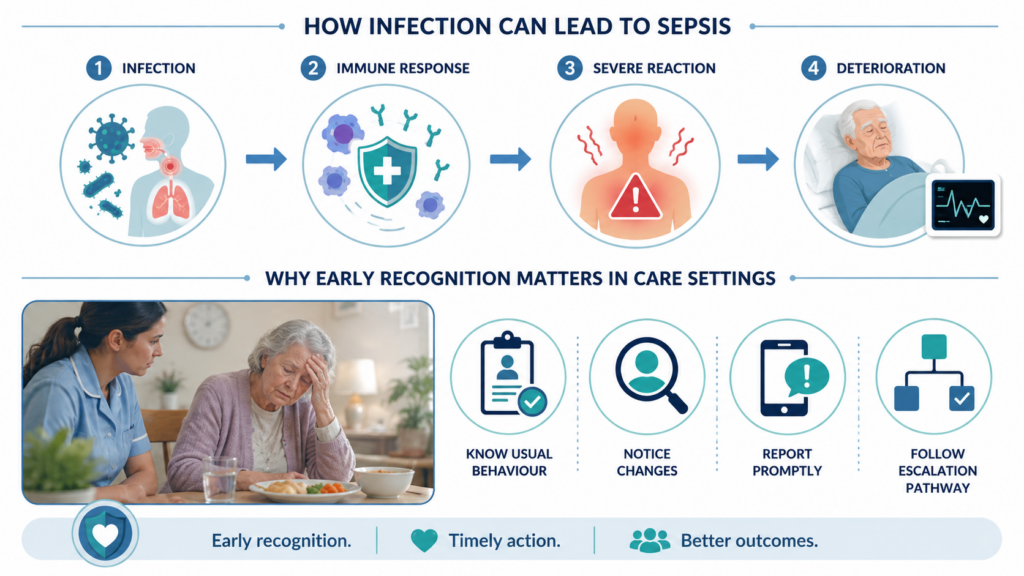
How Infection Leads to Sepsis
The process can develop in a simple sequence:
| Stage | What happens |
|---|---|
| Infection | Harmful microorganisms cause an infection somewhere in the body. |
| Immune response | The body reacts to the infection. |
| Severe reaction | The body’s response can affect normal functions and organ systems. |
| Deterioration | The person may develop serious symptoms and need urgent medical assessment. |
This explains why a seemingly familiar infection can become a serious health concern. Care workers should therefore pay attention when a person’s condition changes, particularly when infection symptoms accompany a sudden decline.
Why Early Recognition Matters in Care Environments
A person may not display every classic symptom. Older adults and people with dementia or communication difficulties can also present differently, which makes changes from their usual behaviour particularly important.
Care workers can strengthen recognition by:
- Knowing the person’s usual behaviour and routines
- Noticing sudden physical or behavioural changes
- Reporting concerns promptly
- Following the appropriate escalation pathway
Who Is Most at Risk of Developing Sepsis?
Older Adults and Vulnerable People at Higher Risk
Older adults may show less typical signs of infection or sepsis. For example, a sudden change in confusion, alertness or behaviour may provide an important clue even when a high temperature does not appear. The NHS specifically notes that sepsis symptoms can prove harder to notice in people with dementia, learning disabilities or communication difficulties. Care workers should pay particular attention to sudden changes in:- Alertness or communication
- Mobility
- Appetite and fluid intake
- Behaviour or mood
- General appearance and wellbeing
Health Conditions and Situations That Increase Sepsis Risk
Several health conditions and circumstances can increase a person’s vulnerability to serious infection. These can include:| Risk factor | Why it matters |
|---|---|
| Older age | Some older people may respond differently to infection. |
| Weakened immunity | The body may have greater difficulty fighting infection. |
| Long-term health conditions | Existing illness can increase vulnerability to complications. |
| Recent surgery | Surgical wounds can create opportunities for infection. |
| Invasive devices | Devices such as urinary catheters can create infection risks. |
Early Signs and Red Flags of Sepsis Care Workers Should Recognise
Sepsis can develop quickly, and symptoms can vary between people. The NHS lists adult symptoms including confusion or slurred speech, difficulty breathing, blue, pale, grey or blotchy skin, high or low temperature, shivering and passing very little or no urine for a prolonged period.
Care workers should not wait for every symptom to appear. Instead, they should consider the person’s overall condition and act when something feels seriously wrong.
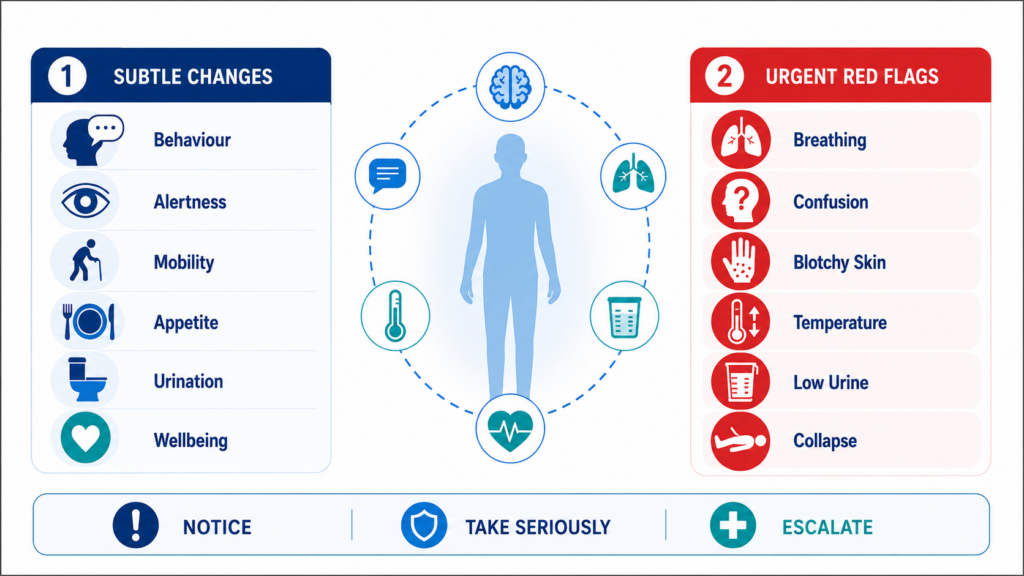
Subtle Changes That May Show Someone Is Becoming Unwell
Some changes may look minor when viewed alone. A sudden combination of changes can create a more concerning picture.
| Change from normal | What a care worker might notice |
|---|---|
| Behaviour | New confusion, unusual agitation or reduced communication |
| Alertness | Much more sleepy or difficult to engage |
| Mobility | Suddenly weaker or struggling with normal movement |
| Appetite | Eating or drinking considerably less |
| Urination | Passing much less urine than usual |
| General wellbeing | The person looks or feels significantly more unwell |
These changes do not prove that someone has sepsis. They can, however, signal deterioration that needs appropriate assessment.
Red Flag Symptoms Requiring Urgent Attention
Some symptoms demand immediate action. For adults, the NHS advises calling 999 or going to A&E when possible sepsis involves symptoms such as very fast breathing, confusion or slurred speech, blue, pale or blotchy skin, very high or very low temperature, or symptoms that cause serious concern.
If someone shows serious red flags such as difficulty breathing, blue or mottled skin, severe confusion or collapse, follow your organisation’s emergency procedure immediately. Do not simply wait for a routine handover or assume that another colleague will act.
The key message for care workers is straightforward:
Notice the change. Take serious deterioration seriously.
Escalate without delay.
Common Infections That Can Lead to Sepsis in Care Settings
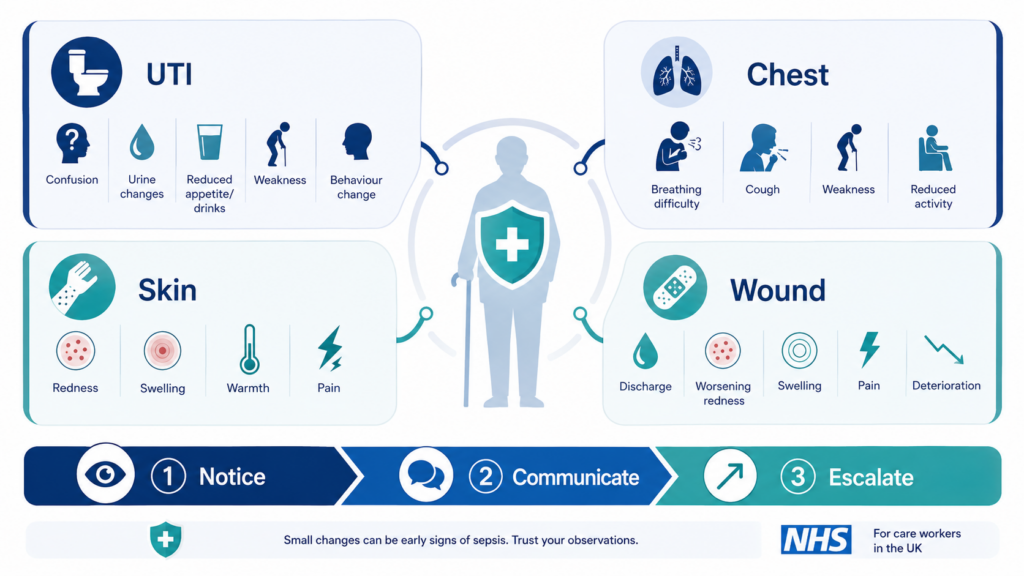
Many cases of sepsis start with an infection. In care settings, workers may encounter urinary, respiratory, skin and wound infections regularly. Recognising a change in an existing infection can therefore provide an important reason to raise concerns.
Care workers do not need to identify the exact cause of an infection. Instead, they should notice changes, communicate relevant information and follow their organisation’s procedures.
| Common infection | Changes that may need attention |
|---|---|
| Urinary tract infection (UTI) | New confusion, changes in urine, discomfort or a sudden decline in wellbeing |
| Chest infection | Increased breathing difficulty, coughing, weakness or reduced activity |
| Skin infection | Increasing redness, swelling, warmth, pain or changes around the affected area |
| Wound infection | New discharge, worsening redness, swelling, pain or deterioration in general health |
Urinary Tract Infections and Sepsis Risk
UTIs commonly affect older adults and can sometimes lead to serious complications. A person may show changes in behaviour or general wellbeing alongside urinary symptoms.
Care workers should pay attention to:
- New or worsening confusion
- Changes in urination
- Reduced appetite or fluid intake
- Increased weakness
- A sudden decline from normal behaviour
These changes do not confirm sepsis. They should prompt appropriate communication and assessment, particularly when the person appears increasingly unwell.
Respiratory, Skin and Wound Infections
Respiratory infections can affect breathing and energy levels, while skin and wound infections can worsen when infection spreads or the person becomes more unwell.
Care workers should report noticeable changes such as increasing breathlessness, worsening pain, spreading redness, new discharge or a marked decline in general wellbeing.
The key principle remains simple: notice the change, communicate it clearly and follow the correct escalation pathway.
How and When to Escalate Suspected Sepsis
Escalation depends on the person’s condition and the procedures that apply in the care setting. A care worker should not wait for every possible symptom before raising a concern.
For serious red flags, the response must become more urgent. The NHS advises adults to call 999 or go to A&E when possible sepsis includes symptoms such as very fast breathing, confusion or slurred speech, blue, pale or blotchy skin, very high or very low temperature, or other symptoms that cause serious concern.
Steps to Take When Possible Sepsis Signs Are Identified
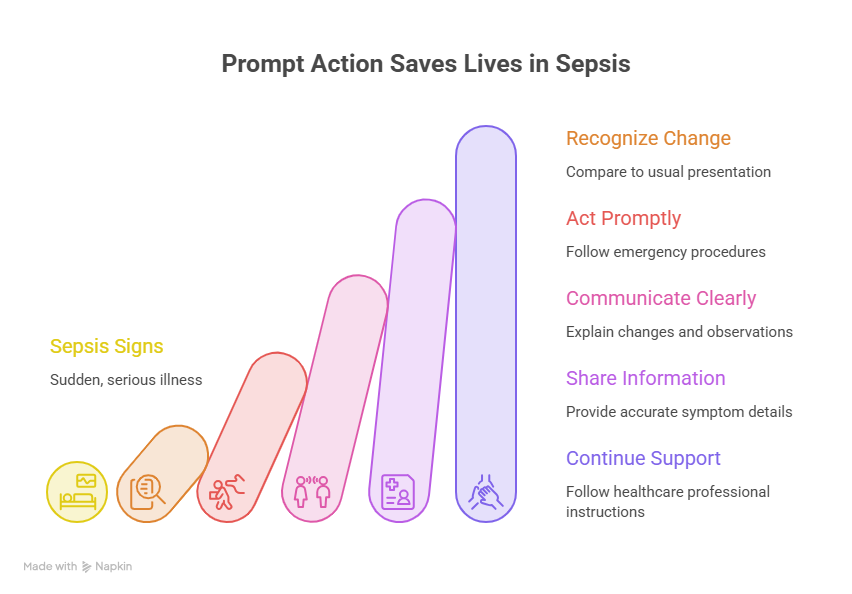
When a person becomes suddenly or seriously unwell:
- Recognise the change – compare the person’s current condition with their usual presentation.
- Act promptly – follow the emergency or escalation procedure that applies to the situation.
- Communicate clearly – explain what changed, when you noticed it and what you observed.
- Share relevant information – provide accurate details about symptoms, recent infection concerns and changes in behaviour.
- Continue appropriate support – follow instructions from the responsible healthcare professional or emergency service.
If serious red flags appear, do not delay emergency action while waiting for a routine handover or a senior colleague to become available.
Using SBAR to Communicate Concerns Clearly
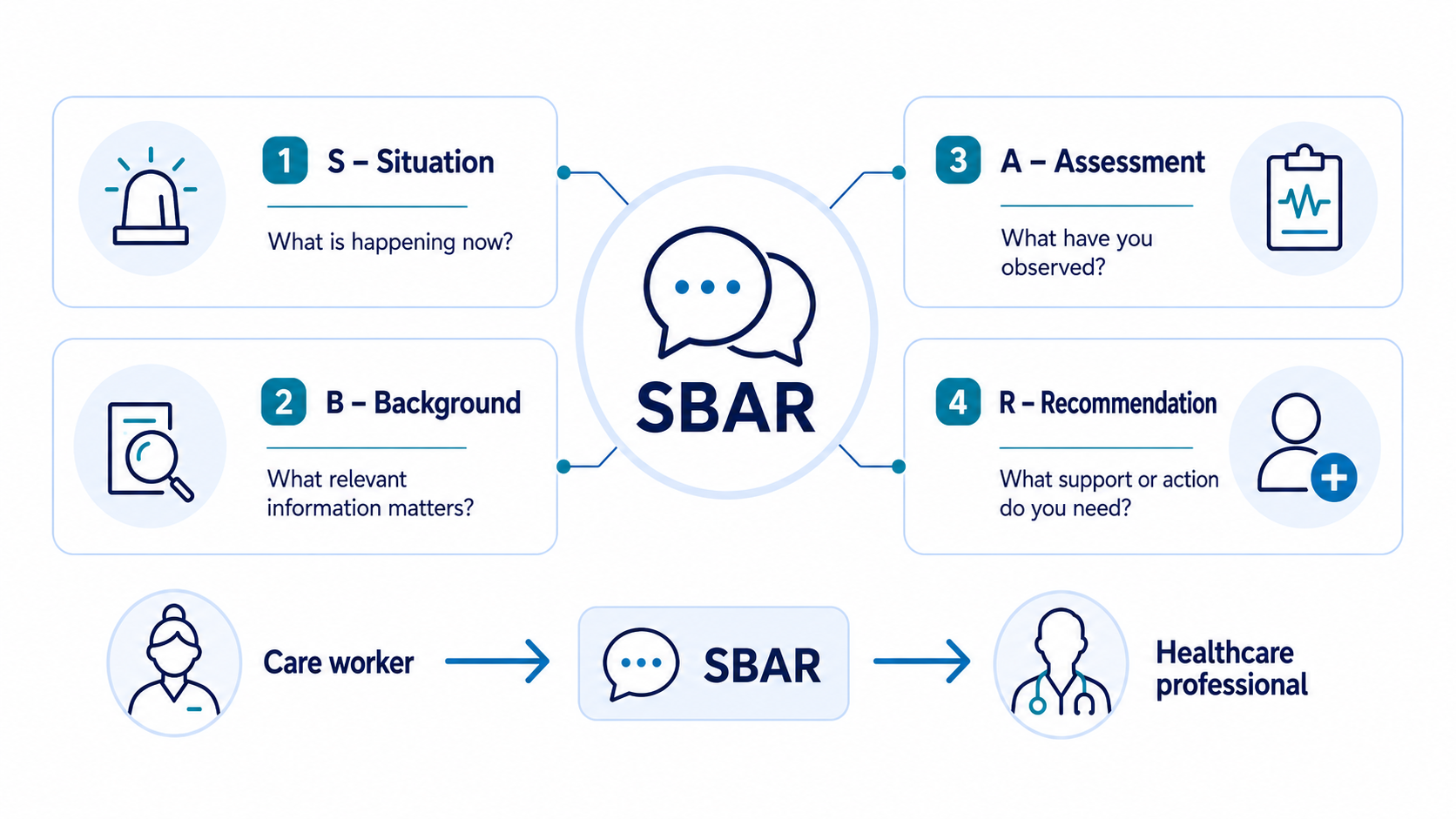
SBAR can help staff organise information during an urgent handover:
| SBAR | What to communicate |
|---|---|
| Situation | Explain what concerns you right now. |
| Background | Give relevant information about the person and recent changes. |
| Assessment | Describe what you have observed. |
| Recommendation | State what help or advice you need. |
Use SBAR when your workplace trains staff to use it. The framework supports clear communication, but it does not replace emergency procedures or clinical assessment.
Recording Observations and Following Workplace Procedures
Accurate records can help the care team understand how a person’s condition has changed. Follow your organisation’s recording requirements and document relevant observations clearly.
Healthcare professionals may use NEWS2 to assess acute deterioration in adults. NEWS2 supports clinical assessment and does not replace professional judgement.
Care workers should only complete NEWS2 observations or calculations when their role, training and workplace procedures require them to do so.
CQC Regulation 12 requires providers to deliver safe care, manage risks, prevent and control infection, and maintain arrangements for clinical or medical emergencies.
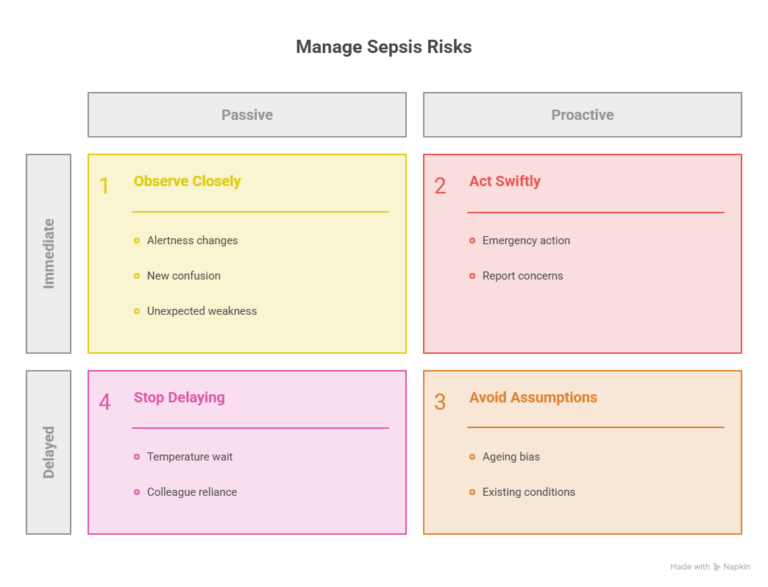
Critical Mistakes Care Workers Should Avoid When Recognising Sepsis
Small changes can become easy to dismiss, particularly when a person already has dementia, reduced mobility or a long-term condition. Care workers should avoid assuming that every new symptom comes from an existing diagnosis.
Assuming Changes Come From Ageing or Existing Conditions
A person with dementia may already experience confusion, but a sudden or significant change from their normal behaviour deserves attention.
Similarly, reduced mobility may form part of someone’s usual condition, while a sudden decline can signal that they have become unwell.
Look more closely when you notice:
- A sudden change in alertness
- New or worsening confusion
- Unexpected weakness
- A significant change in appetite or fluid intake
- A noticeable decline in general wellbeing
The change itself provides useful information. Record and communicate it rather than dismissing it.
Waiting Too Long Before Reporting Concerns
Avoid a “wait and see” approach when someone shows significant deterioration. You do not need to wait until every warning sign appears before raising a concern.
Do not:
- Assume another colleague has already reported the change
- Wait for a high temperature before taking concerns seriously
- Ignore sudden behavioural changes
- Delay emergency action when serious red flags appear
Prompt communication gives the appropriate healthcare professional an opportunity to assess the person and decide what happens next.
How Sepsis Awareness Training Supports Safer Care
Sepsis awareness training can help care workers build knowledge around infection risks, deterioration, warning signs and escalation. Structured learning can also help learners understand where their responsibilities begin and end.
Relevant learning can include:
- Recognising possible sepsis signs
- Understanding common infection risks
- Identifying changes from a person’s normal condition
- Communicating concerns clearly
- Understanding appropriate escalation pathways
- Knowing when emergency procedures may apply
Training does not replace clinical assessment, employer procedures or professional guidance. Instead, it gives care workers a stronger knowledge base for recognising concerns and communicating them appropriately.
For anyone working with older adults or other vulnerable people, sepsis awareness can form a useful part of wider professional development.
Final Takeaway: Why Sepsis Awareness Matters in Care
Sepsis can develop from common infections and can progress quickly. Care workers can support early recognition by noticing changes in behaviour, appearance, breathing, mobility, appetite and general wellbeing.
The most important principle is not to diagnose sepsis. Recognise significant changes, communicate concerns clearly and follow the correct escalation pathway. When serious red flags appear, act immediately according to the emergency procedure rather than waiting for symptoms to worsen.
CQC expects care providers to manage health and safety risks, prevent and control infection, and maintain appropriate arrangements for clinical or medical emergencies.

Good sepsis awareness therefore combines observation with appropriate action. By understanding the warning signs and knowing when to escalate, care workers can respond more confidently when a person’s condition changes.
Frequently Asked Questions
Can Care Workers Diagnose Sepsis?
No. Care workers recognise concerning changes and follow their workplace escalation procedures. A suitably qualified healthcare professional assesses the person and determines whether sepsis or another condition may explain the symptoms.
Can a Urinary Tract Infection Develop Into Sepsis?
A UTI can contribute to sepsis when an infection becomes serious. Care workers should report worsening symptoms or a sudden change in the person’s condition rather than assuming that a UTI will remain mild.
What Is the Difference Between Infection and Sepsis?
An infection occurs when microorganisms enter and multiply in the body. Sepsis describes a severe reaction to an infection that can cause serious illness and affect normal organ function.
Can Someone Have Sepsis Without a High Temperature?
Yes. A person does not need a high temperature to have sepsis. Other changes, such as confusion, breathing difficulties, altered skin colour or a marked decline in wellbeing, can also indicate serious illness.
What Should Care Workers Do If Their Concerns Are Not Taken Seriously?
State your observations clearly and follow the organisation’s escalation process. If the person shows serious or rapidly worsening symptoms, follow the emergency procedure immediately rather than waiting for a routine response.