

A missing signature. An unexpected stock difference. A Controlled Drugs Register that does not match the medicine cupboard. These small details can reveal bigger problems in a care home if staff do not notice them early.
Controlled drugs support many residents who need stronger medicines for pain relief, symptom control and specialist care. These medicines can make a significant difference to a person’s comfort and wellbeing, but they also require additional safeguards because staff must manage them responsibly.
Managing controlled drugs in care homes involves much more than keeping medicines locked away. Care teams need to understand how these medicines are stored, how staff record their movement, who can access them and what actions to take when something does not appear correct.
This guide explains controlled drug storage, record keeping, responsibilities, administration procedures, common errors and the UK guidance that supports safe practice.

Table of Contents
What Are Controlled Drugs in Care Homes?

Controlled drugs are medicines that require additional controls because they carry risks linked to misuse, dependence or incorrect handling. Healthcare professionals prescribe these medicines when residents need specific treatments, including stronger pain relief, symptom management or specialist support.
Care homes may support residents who use controlled drugs as part of their care plans. Staff must follow their organisation’s procedures to ensure these medicines remain secure and only authorised people manage them.
The UK classifies controlled drugs into different schedules based on their medical purpose and level of risk. Some medicines require stricter controls, with Schedule 2 controlled drugs usually requiring detailed records and secure storage arrangements.
Examples of controlled drugs used in care settings include:
| Controlled Drug | Why It May Be Prescribed |
|---|---|
| Morphine | Severe pain relief and symptom management |
| Oxycodone | Moderate to severe pain management |
| Fentanyl | Specialist pain control |
| Methadone | Specific treatment needs |
| Diazepam | Certain neurological and specialist conditions |
The controlled drugs used within a care home depend on each resident’s health needs and decisions made by qualified healthcare professionals.
Understanding Controlled Drugs and Why They Require Extra Controls
Controlled drugs require additional safeguards because care teams need to maintain accountability throughout their use. Staff need to know what medicine entered the service, who accessed it, when it was administered and whether the remaining stock matches the records.
| Question | Why It Matters |
|---|---|
| What medicine entered the service? | Confirms stock information |
| Who accessed or managed it? | Shows accountability |
| When was it administered? | Supports medication records |
| Does stock match records? | Identifies possible concerns |
For example, a routine check may reveal that the recorded balance does not match the available stock. Staff must investigate the concern rather than rely on assumptions.
These controls help care teams trace medicine movements, maintain accurate information and respond quickly when something does not appear correct.
Why Some Medicines Are Classified as Controlled Drugs
Controlled drugs receive additional safeguards because they require careful management around storage, access and documentation. These measures help reduce risks while ensuring residents receive appropriate treatment when required.
They may support people with severe pain, serious illness symptoms, end-of-life care needs or specialist medical conditions. Understanding why these medicines require extra controls helps care workers recognise the importance of safe handling and responsible practice.
Why Is Controlled Drug Management Important in Care Homes?

Controlled drug management protects residents, supports staff and allows care homes to maintain confidence in their medication systems.
The Care Quality Commission (CQC) expects providers to manage medicines safely under Regulation 12: Safe care and treatment. Providers must identify risks and take reasonable steps to protect people receiving care.
You can read more about CQC expectations through their official guidance on Safe care and treatment.
Poor controlled drug processes can create problems such as:
- Missing information
- Incorrect stock balances
- Delayed investigations
- Communication failures between staff
A reliable system allows care teams to identify concerns before they affect residents.
Protecting Residents and Reducing Medication Risks
Many residents rely on controlled drugs to manage significant symptoms. Safe handling allows staff to support residents while reducing avoidable risks.
Common risks include:
| Risk | Example |
|---|---|
| Documentation problems | A required entry is incomplete |
| Storage concerns | Someone accesses medicines without authorisation |
| Communication failures | Important information is not passed between shifts |
| Stock differences | Recorded quantities do not match available medicines |
These issues often develop through small mistakes rather than deliberate actions. A missing signature or unclear handover can create uncertainty about what happened.
Staff reduce these risks when they follow agreed processes, communicate clearly and raise concerns early.
Preventing Misuse, Errors and Poor Record Keeping
Controlled drug documentation provides a history of medicine activity. It shows what staff received, what they administered and what remains available.
Good practice includes:
- Completing records at the correct time
- Checking information before taking action
- Following workplace procedures
- Reporting concerns promptly
If staff notice a discrepancy, they should not alter records without following the correct process. Changing information without authorisation can remove important evidence about what happened.
Instead, staff should report the concern, allow the appropriate person to review the situation and record any required actions.
Good documentation does more than meet a requirement. It gives care teams the information they need to understand problems and prevent similar issues in the future.
How Are Controlled Drugs Stored in Care Homes?

Controlled drug storage protects medicines from unauthorised access while ensuring authorised staff can manage them when required.
A secure cupboard is only one part of safe storage. Care homes also need clear access arrangements, appropriate monitoring and staff who understand their responsibilities.
Controlled Drug Cupboard Requirements and Secure Storage
Care homes usually store controlled drugs in a dedicated controlled drug cupboard that provides greater security than general medicine storage.
The Misuse of Drugs (Safe Custody) Regulations 1973 outline requirements for the safe custody of certain controlled drugs. Care homes must also follow their own medication policies and risk assessments.
You can find further information about UK controlled drug legislation through the official legislation guidance on controlled drugs.
A secure storage system should include:
| Storage requirement | Purpose |
|---|---|
| Restricted access | Prevents unnecessary access |
| Secure locking arrangements | Protects medicines from misuse |
| Organised storage | Makes checks easier |
| Regular monitoring | Identifies concerns quickly |
The aim is not simply to lock medicines away. Staff need a system that allows them to know where medicines are, who manages them and what actions they complete.
Managing Access, Keys and Authorised Staff
Access to controlled drugs should remain limited to appropriate staff. Care homes decide access based on a person’s role, training, competency and workplace responsibilities.
Good access management includes:
- Keeping cupboard keys secure
- Allowing access only when required
- Reporting security concerns
- Following local procedures
A controlled drug cupboard can only protect medicines when staff manage access properly. Poor key control or unclear responsibility can create unnecessary risks.
Common Controlled Drug Storage Mistakes to Avoid
Storage problems can affect medication safety. Common mistakes include:
- Leaving controlled drug cupboards unsecured
- Poor management of keys
- Allowing unnecessary access
- Ignoring damaged storage equipment
- Failing to follow workplace procedures
Safe storage depends on both physical security and staff behaviour. A well-managed system gives care teams confidence that controlled medicines remain protected.
Controlled Drug Registers and Record Keeping in Care Homes
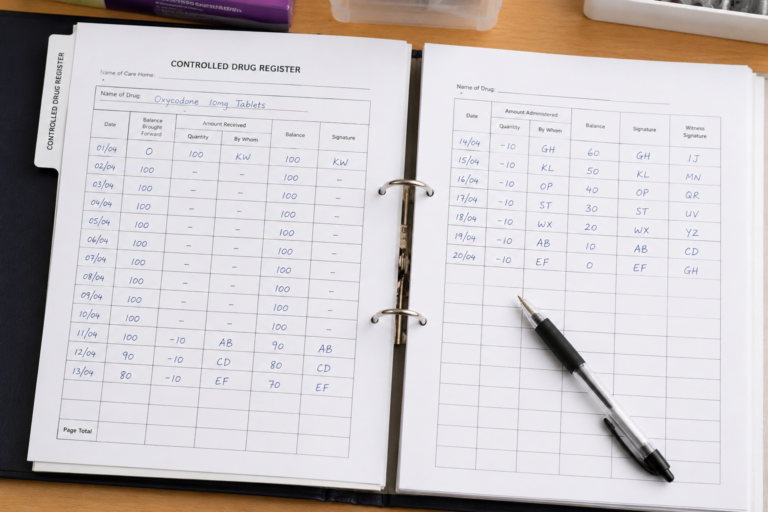
Secure storage protects controlled drugs physically, but records show what happens after medicines enter the service.
A Controlled Drugs Register creates a traceable record of medicine movements, helping staff understand what was received, administered, transferred or disposed of.
Accurate records allow care teams to confirm:
- Which medicines entered the service
- How much stock remains
- Who completed relevant actions
- Whether information matches the physical supply
The CQC highlights the importance of safe medicines management, and effective documentation forms an important part of this process.
What Is a Controlled Drugs Register?
A Controlled Drugs Register is a dedicated record used to track controlled drug activity within a care setting.
It provides an audit trail showing how medicines move through the service.
| Information recorded | Purpose |
|---|---|
| Medicine name and strength | Confirms the medicine being managed |
| Quantity received | Records incoming stock |
| Quantity administered | Tracks medicine use |
| Remaining balance | Confirms available stock |
| Disposal details | Records medicines removed from use |
| Staff signatures | Shows responsibility for actions |
Staff should complete entries clearly and follow their organisation’s procedures.
A well-maintained register allows staff to look back at medicine activity and understand exactly what happened.
What Information Must Be Recorded?
A Controlled Drugs Register should provide a clear history of every controlled drug movement within the care home. The record allows staff to understand what happened to a medicine from the moment it arrives until it leaves the service.
The information recorded usually includes:
| Record detail | Why it matters |
|---|---|
| Medicine name and strength | Confirms the exact controlled drug |
| Quantity received | Shows stock entering the service |
| Administration details | Records medicine use |
| Remaining balance | Allows stock checks |
| Transfers or returns | Tracks movement between services |
| Disposal details | Shows how unused medicines were managed |
Staff should complete entries clearly and at the appropriate time. They should never guess missing information or make unauthorised changes.
If a record does not match the available stock, staff should treat it as a concern that requires review. A clear record allows managers and healthcare professionals to investigate what happened and decide the appropriate action.
Controlled Drugs Register vs MAR Chart
A Controlled Drugs Register and a MAR (Medication Administration Record) chart both contain medication information, which can make them easy to confuse. However, they answer different questions.
| Controlled Drugs Register | MAR Chart |
|---|---|
| Tracks controlled drug stock movement | Records medication support for an individual resident |
| Shows quantities received, used and remaining | Shows whether a resident received prescribed medication |
| Focuses on medicine accountability | Focuses on resident medication history |
| Applies specifically to controlled drugs | Covers a wider range of prescribed medicines |
The easiest way to remember the difference:
The Controlled Drugs Register tracks the medicine. The MAR chart tracks the resident’s medication support.
Both records work together. The register shows what happened to the medicine supply, while the MAR chart shows the medication support provided to the individual.
For further guidance on medication records, you can also read our article on What Is a MAR Chart? Medication Records Explained for Care Workers.
Managing Stock Checks, Discrepancies and Disposal Records
Regular stock checks allow care homes to compare the physical amount of controlled drugs with the recorded balance. These checks help teams identify problems early and investigate differences before they become larger concerns.
Common reasons for discrepancies include:
- Missing signatures
- Incorrect quantities recorded
- Administration entries completed incorrectly
- Communication problems between staff
When staff identify a difference, they should follow a clear response process:
DO NOT ALTER THE REGISTER
↓
CHECK THE RECORDS AND RECOUNT THE STOCK WITH AN AUTHORISED PERSON
↓
INFORM THE REGISTERED MANAGER OR RESPONSIBLE PERSON
↓
RECORD THE CONCERN AND FOLLOW THE INCIDENT PROCESS
↓
REVIEW THE CAUSE AND COMPLETE ANY REQUIRED AUDIT ACTIONS
Staff should follow the care home’s policy for returning, wasting or destroying controlled drugs. Many organisations require a second trained person to witness and confirm disposal or destruction entries.
The Controlled Drugs Register should clearly show what happened, who completed the action and who witnessed it where required.
Who Is Responsible for Controlled Drugs in Care Homes?
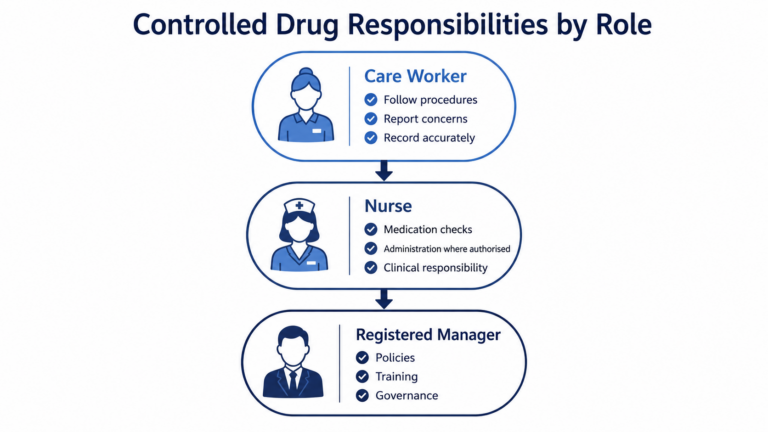
Controlled drug safety depends on everyone understanding their role. Different members of the care team contribute to safe practice, but their responsibilities depend on their position, training and competency assessment.
Clear role boundaries prevent confusion and help staff understand when they can act independently and when they need support.
Care Worker Responsibilities
Care workers may support medication-related tasks depending on their role, training and workplace requirements.
Their responsibilities often include following agreed procedures, supporting residents appropriately and reporting concerns when something appears incorrect.
Care workers should understand:
- Which medication tasks they can complete
- When they need support from another professional
- How to report concerns
- Why documentation matters
Completing controlled drug training does not automatically authorise a care worker to complete every medication task. Employers decide responsibilities based on workplace procedures and competency checks.
If a care worker notices a missing record, unusual stock balance or storage concern, they should report it through the correct process rather than attempting to correct it themselves.
Nurse and Healthcare Professional Responsibilities
Registered nurses and other healthcare professionals may have additional responsibilities when managing controlled drugs.
Depending on their role, they may complete medication checks, administer medicines where authorised, maintain clinical records and escalate concerns.
They must follow professional standards, organisational procedures and relevant medication guidance when managing controlled medicines.
Registered Manager Responsibilities
Registered managers help establish the systems that allow care homes to manage controlled drugs safely.
Their responsibilities may include maintaining medication policies, supporting staff training, monitoring procedures and reviewing incidents.
Good leadership creates an environment where staff feel confident raising concerns and improving medication practices.
How Are Controlled Drugs Managed During Administration?
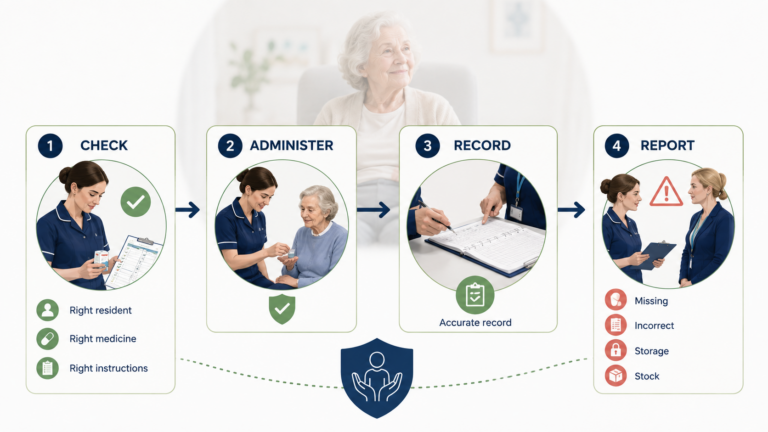
Controlled drug administration requires careful attention because staff must ensure medicines reach the correct resident and records reflect what happened.
Care homes should only allow appropriately trained and authorised staff to complete medication tasks within their role.
Checks Before Supporting or Administering Medication
Before supporting or administering medication, staff should complete the checks required by their role and workplace procedures.
These checks help confirm:
- The correct resident
- The correct medicine
- The correct instructions
- The correct documentation
Staff should ask for guidance if they are unsure about a medication task. Working within role boundaries protects both residents and staff.
Recording Administration Correctly
Recording administration accurately remains essential after a controlled drug has been given.
The record should show what medicine was administered, when the action occurred and who completed the task.
Many care settings use additional checks for controlled drugs. A second trained person may need to witness and verify administration or wastage entries depending on the organisation’s procedures.
The purpose of this additional check is to create stronger accountability and reduce the risk of recording mistakes.
Poor documentation can create uncertainty about whether a resident received medication, how much stock remains and who completed the action.
Reporting Concerns and Following Workplace Procedures
Staff should report controlled drug concerns as soon as possible. These may include:
- Missing medicines
- Incorrect records
- Storage problems
- Unexplained stock differences
Reporting concerns allows the appropriate people to investigate and decide the next steps.
A concern raised early is easier to review and resolve than a problem discovered later during an audit or medication review.
What Happens When Controlled Drug Errors Occur?
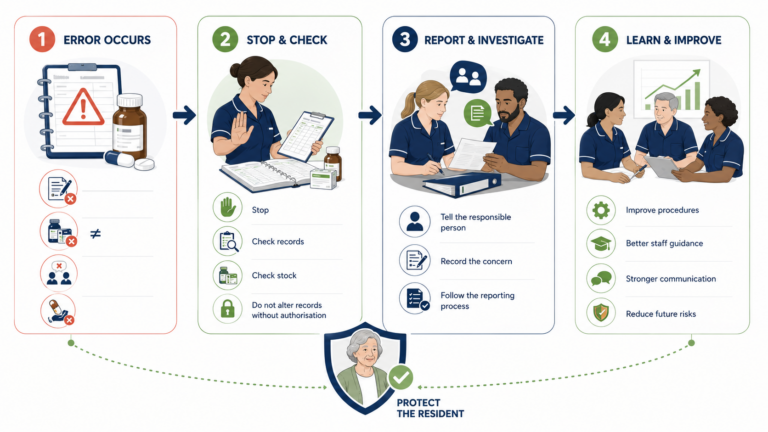
Controlled drug errors require a careful response because they can affect resident safety and medicine accountability.
The priority is to protect the resident, record what happened accurately and allow the appropriate people to investigate.
Common Controlled Drug Errors in Care Settings
Controlled drug errors can happen because of documentation problems, communication issues or unclear processes.
| Error type | Example |
|---|---|
| Record error | A required entry or signature is missing |
| Stock discrepancy | Physical stock does not match the register |
| Communication issue | Important information is not shared between staff |
| Administration mistake | Medicine is not managed according to instructions |
Understanding how errors occur allows care homes to improve their systems and reduce repeated problems.
What to Do When Records or Stock Balances Do Not Match
When staff discover a controlled drug discrepancy, they should follow the organisation’s reporting process.
They should:
- Stop and review the available information
- Avoid changing the register without authorisation
- Recheck stock and records with an appropriate person
- Inform the responsible manager
- Record the concern and complete required reports
Staff should never ignore differences or attempt to hide mistakes. Accurate reporting allows the team to understand what happened and take suitable action.
Learning From Medication Incidents
Medication incidents provide opportunities to improve care systems. Reviewing what happened can highlight weaknesses in communication, training or documentation processes.
Care homes may use incident reviews to:
- Improve procedures
- Provide additional staff guidance
- Strengthen communication
- Reduce future risks
The aim is not simply to identify mistakes. It is to understand why something happened and create safer ways of working.
UK Guidance for Controlled Drugs in Care Homes
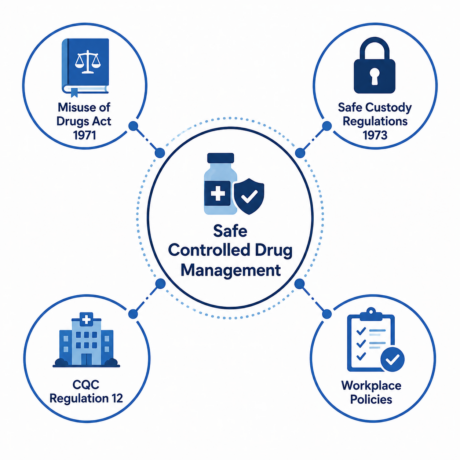
Care homes manage controlled drugs within a framework of UK legislation, professional guidance and workplace procedures. Understanding this guidance shows staff why controlled drugs require additional checks and responsibilities.
Controlled Drug Regulations and Safe Custody Requirements
| Guidance | Purpose |
|---|---|
| Misuse of Drugs Act 1971 | Provides legal controls around certain medicines |
| Misuse of Drugs (Safe Custody) Regulations 1973 | Supports secure storage requirements |
| NICE guidance on managing medicines in care homes | Supports safe medicines management guidance |
Care homes must also follow their own care home medication policy, which explains how staff should manage controlled drugs within their specific service.
CQC Expectations for Controlled Drug Management
The Care Quality Commission expects care providers to maintain safe systems for medicines management. Under Regulation 12: Safe care and treatment, providers must take appropriate steps to reduce risks and protect people from avoidable harm — including safe storage arrangements, accurate medication records, appropriate staff procedures, and effective systems for identifying concerns.
Workplace Policies, Training and Competency
Controlled drug responsibilities depend on a person’s role, training and competency assessment. Structured medication safety training builds the knowledge and confidence staff need to understand their responsibilities, recognise when they need additional support, and know how to report concerns — but training alone does not replace workplace assessments or authorisation processes.
Controlled Drug Safety Checklist for Care Workers
Controlled drug safety depends on consistent actions from everyone involved in medication support.
Care workers should remember:
- Follow workplace medication procedures
- Access controlled drugs only when authorised
- Keep storage areas secure
- Complete records accurately
- Check information before acting
- Report discrepancies promptly
- Ask for support when unsure
- Maintain resident confidentiality
This checklist provides a quick reminder of everyday responsibilities when supporting safe medication practices.
Why Controlled Drug Knowledge Matters for Care Careers

Understanding controlled drugs helps care workers develop stronger medication safety awareness and recognise how their role fits within wider care responsibilities.
Knowledge of controlled drug procedures can help staff understand:
- Why documentation matters
- How teams reduce medication risks
- When concerns require escalation
- How safe systems protect residents
For learners who want to develop their understanding of medication responsibilities, our Control and Administration of Medication course covers important areas of medication safety and administration knowledge.
Controlled drug training supports professional development, but responsibilities always depend on job role, workplace procedures and competency requirements.
Final Takeaway: Safe Controlled Drug Management Supports Safer Care
Controlled drugs play an important role in supporting residents with complex healthcare needs, but they require careful handling at every stage.
Secure storage, reliable records, trained staff and clear reporting processes all contribute to safer medication practices.
Understanding controlled drug responsibilities allows care workers to recognise risks, follow procedures confidently and support better outcomes for residents.
Want to strengthen your medication safety knowledge? Explore our Control and Administration of Medication course to develop your understanding of safe medication practices, responsibilities and care procedures.
Frequently Asked Questions
What Are Controlled Drugs in Care Homes?
Controlled drugs are medicines that require additional controls because they carry risks linked to misuse or incorrect handling. Care homes manage these medicines through secure storage, documentation and clear procedures.
How Should Controlled Drugs Be Stored in a Care Home?
Care homes should store controlled drugs securely with access limited to authorised staff. Storage arrangements should follow legislation, guidance and workplace procedures.