
Health and social care professionals resolving workplace conflict

Conflict Resolution in Health and Social Care: Techniques and Examples

Conflict resolution in health and social care helps professionals manage disagreements safely, communicate effectively and protect positive care relationships. Learn common causes of conflict, practical resolution techniques, realistic care-setting examples, de-escalation methods, escalation routes and ways to prevent future disputes.

User Icon Alexender Smith
Calendar Icon August 10, 2026

Conflict resolution in health and social care often begins before anyone raises their voice. A rushed handover, a frustrated relative or a disagreement over a person’s choices can quickly create tension. In care settings, where people work under pressure and decisions affect someone’s dignity, safety and independence, even a small misunderstanding can grow if nobody addresses it early.

Conflict resolution means recognising tension, listening carefully, understanding the cause and using calm, respectful communication to reach a safe and practical way forward.

This guide explains what causes conflict in care settings, how to spot the warning signs and which conflict resolution techniques can help. You’ll also see realistic examples involving care workers, service users and families, when a concern should be escalated, and how strong conflict management skills can support safer care, better teamwork and professional development.

Table of Contents

What Is Conflict Resolution in Health and Social Care?

Conflict resolution in health and social care means addressing disagreements calmly, fairly and constructively. The goal is not simply to stop an argument. Care workers need to understand what caused the disagreement, listen to everyone involved and work towards a safe solution that protects dignity, respect and positive relationships.

Disagreements can occur between colleagues, managers, service users, patients, families and carers. Two care workers may disagree about responsibilities during a busy shift, for example. A relative may question how staff support someone they care about, while a service user may become frustrated because they feel staff have overlooked their preferences.

Different views are not always a problem. In fact, healthy discussion can help teams identify concerns and improve decisions. Problems arise when people feel ignored, blamed or unable to communicate their concerns effectively. Addressing tension early can prevent a small disagreement from developing into hostility, damaged relationships or unsafe behaviour.

Effective resolution therefore relies on clear communication, active listening, empathy, problem-solving and professional boundaries. Care workers also need to recognise when a situation requires management support, formal reporting or safeguarding action.

Conflict Management vs Conflict Resolution

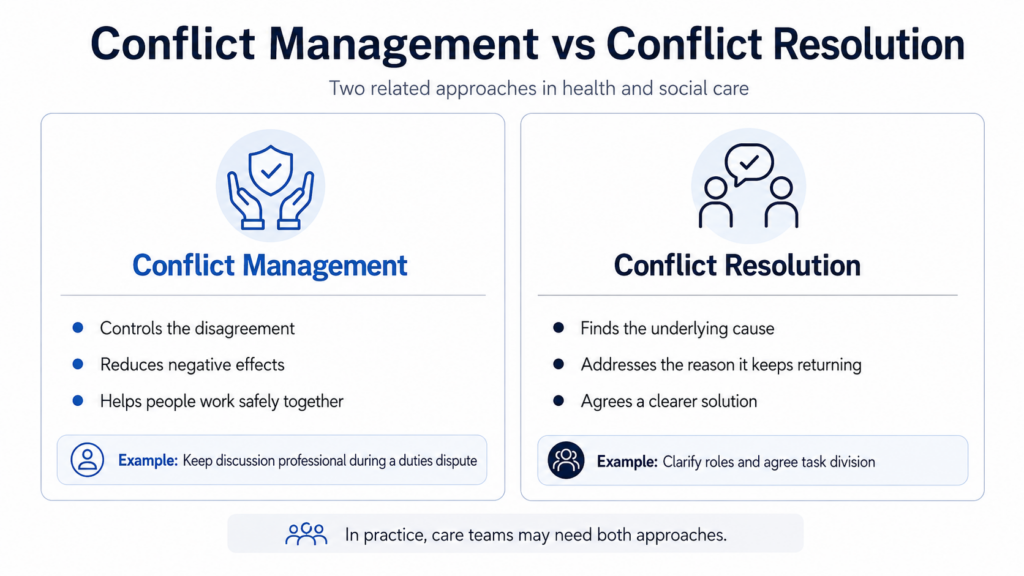
Although conflict management and conflict resolution are closely related, they serve slightly different purposes.

Conflict management focuses on controlling a disagreement and reducing its negative effects. Staff may not always remove the underlying difference completely, but clear boundaries and professional communication can help everyone continue working together.

Resolution goes a step further by identifying the underlying cause and trying to address it.

For example, imagine two care workers who repeatedly disagree about how they divide duties. Asking both workers to remain professional may control the immediate tension. However, reviewing their responsibilities, listening to their concerns and agreeing a clearer division of tasks can address the reason the disagreement keeps returning.

Health and social care professionals may need both approaches. Some issues can be settled through a direct conversation, while others require supervision, mediation, management involvement or formal escalation.

conflict-resolution-vs-conflict

Causes of Conflict in Health and Social Care

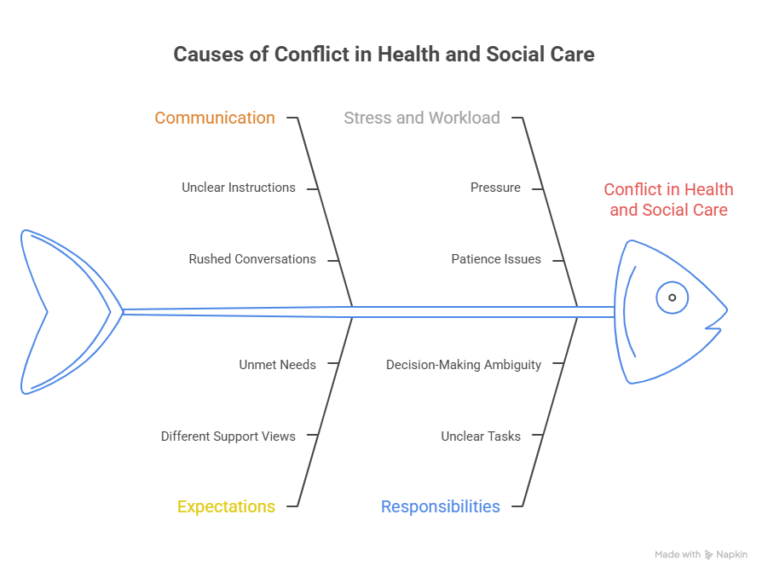
Conflict in health and social care rarely comes from one issue alone. Care environments bring together people with different responsibilities, experiences, needs, values and expectations. At the same time, staff may work under pressure while making decisions that directly affect another person’s daily life.

Some common causes include:

  • Poor communication: unclear instructions, rushed conversations or missing information can create misunderstandings.
  • Different expectations: workers, service users and relatives may have different views about what support should look like.
  • Stress and workload: pressure can affect patience, communication and how people respond to criticism.
  • Unclear responsibilities: conflict can develop when staff do not understand who should complete a task or make a decision.
  • Different values or preferences: disagreements can arise around independence, choice, risk, privacy, routines or personal beliefs.
  • Poor handovers: incomplete or inaccurate information can leave colleagues working from different assumptions.

A simple misunderstanding can therefore become a much larger disagreement if nobody clarifies what happened.

For example, suppose one care worker believes a colleague deliberately failed to complete an important task. The second worker may actually have been responding to an urgent situation elsewhere but failed to explain this during handover. If the first worker begins the conversation with blame, tension may increase. Asking what happened first could reveal the real cause.

This is why effective conflict resolution starts with understanding rather than assuming.
Causes-of-Conflict-in-Health-and-Social-Care

Early Warning Signs of Conflict

Conflict is often easier to manage before emotions become intense. Therefore, care workers should pay attention to changes in communication and behaviour rather than waiting for an argument to occur.

Early signs may include shorter or sharper replies, repeated disagreement, visible frustration, people avoiding one another, changes in tone of voice, complaints about the same issue, interruptions during conversations or a breakdown in teamwork.

Body language can provide clues too. A person may become tense, restless, withdrawn or visibly angry. However, workers should avoid assuming what someone feels based on body language alone. Instead, they can use what they notice as a reason to communicate and check whether something is wrong.

There is also an important boundary between ordinary conflict and a safety risk. Conflict does not automatically mean violence or aggression. However, when behaviour becomes threatening or aggressive, workers should prioritise safety rather than trying to “win” the disagreement. The Health and Safety Executive states that health and social care workers should not accept violent or aggressive behaviour as a normal part of their job. It also identifies such incidents as the third largest cause of RIDDOR-reported injuries in the sector. (HSE)

Recognising those warning signs early creates an opportunity to slow the situation down, understand what is driving it and choose an appropriate response before the conflict becomes harder to manage.

Conflict Resolution Techniques in Health and Social Care

Effective conflict resolution techniques in health and social care help staff reduce tension, understand concerns and reach a safe, respectful solution. The best response depends on the people involved, the level of risk and the organisation’s procedures. Staff should address conflict early where possible, but they must prioritise safety when behaviour becomes threatening or aggressive.
Technique What It Means Example in a Care Setting
Stay calm and de-escalate Control your tone, pace and body language to reduce tension. Speak calmly and give appropriate space when someone becomes frustrated.
Listen actively Let the person explain their concern before responding. Ask a family member what specifically worries them about a relative’s care.
Identify the root cause Look beyond the immediate disagreement to find the real issue. Check whether an unclear handover caused tension between colleagues.
Find a solution Agree practical actions that address the problem. Clarify duties and agree who will complete outstanding tasks.
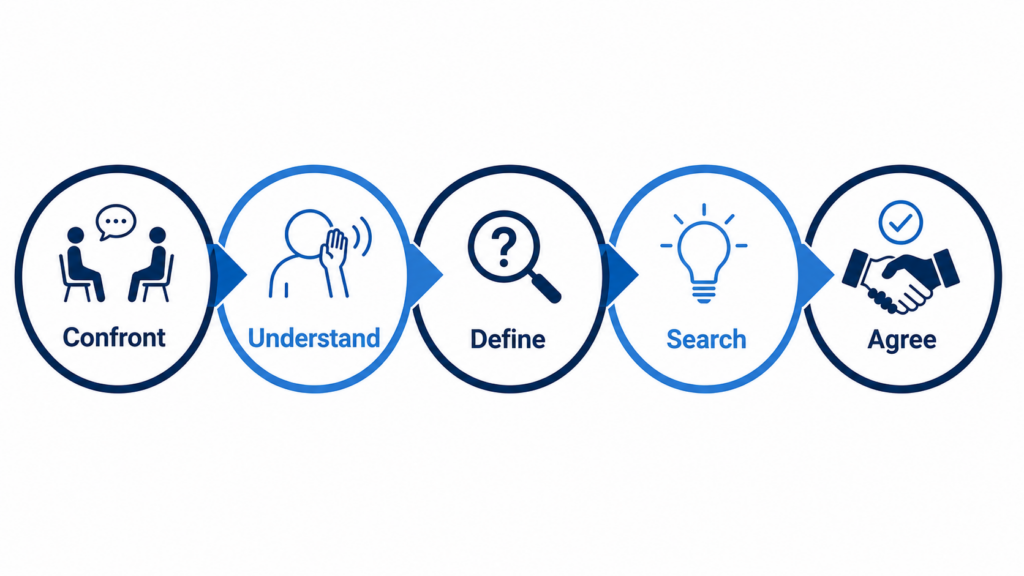
Use CUDSA Follow a structured process from identifying the issue to agreement. Define the problem, discuss options and agree a way forward.

Stay Calm and De-Escalate

Control your own response first. Use a steady voice, avoid confrontational language and give the person enough space. Do not match anger with anger. If the situation becomes unsafe, seek support and follow your organisation’s procedures.

Listen and Understand

Give each person time to explain their perspective. Ask open questions such as, “What is concerning you most?” Active listening helps separate facts from assumptions and often reveals why the disagreement started.

Identify the Root Cause

Look beneath the visible argument. Poor communication, unclear responsibilities, unmet expectations or different views about care may sit behind the conflict. Addressing the real cause reduces the chance of the same problem returning.

Find and Agree a Solution

Focus on what needs to happen next. Clarify responsibilities, agree realistic actions and confirm any required follow-up. A good resolution creates clarity rather than simply ending the conversation.

The CUDSA Conflict Resolution Model

CUDSA means Confront, Understand, Define, Search and Agree. It gives care workers a simple structure for moving from disagreement towards problem-solving while keeping communication focused and constructive

Conflict Resolution Examples in Health and Social Care

Realistic conflict resolution examples in health and social care show how disagreements can develop and how staff can respond without making the situation worse. The right response depends on the cause of the conflict, the people involved and whether any safety or safeguarding concerns exist.
Conflict Example Likely Cause Appropriate Response
Conflict between care workers Workload pressure, unclear duties or poor handover Clarify what happened, avoid personal blame and agree responsibilities or next steps.
Conflict with a service user Feeling unheard, loss of choice or misunderstanding Listen carefully, acknowledge the concern and explain available options clearly.
Conflict with a family member Different expectations about care or poor communication Identify the exact concern, provide accurate information and involve a senior worker when necessary.
Conflict over care choice and risk Different views about independence, safety or acceptable risk Explore the person’s wishes, explain concerns and follow appropriate care-planning and risk procedures.
Conflict during a shift handover Missing, unclear or inconsistent information Check the facts, correct misunderstandings and improve how information is shared between shifts.

Conflict Between Care Workers

Two care workers may disagree about unfinished tasks, responsibilities or how a situation was handled during a shift. Instead of making personal accusations, they should discuss the specific issue, check what happened and clarify what needs to happen next. For example, one worker may think a colleague deliberately left work incomplete. After discussing the shift, they may discover that the colleague had to respond to an urgent care need. Key lesson: focus on facts and responsibilities rather than assumptions about another person’s attitude.

Conflict With a Service User or Family

A service user or relative may become frustrated because they believe staff have ignored a preference, failed to communicate clearly or made a decision without enough explanation. The care worker should listen first, identify the exact concern and explain what they can address. If the matter falls outside their authority, they should involve an appropriate senior colleague rather than making promises they cannot keep. Key lesson: acknowledging a concern does not mean automatically agreeing with it. It shows that the person has been heard.

Conflict Over Care, Choice and Risk

Conflict may arise when a person wants greater independence while staff have concerns about safety. Staff should avoid turning the conversation into an argument about control. Instead, they should explore what the person wants to achieve, explain the identified risks and consider whether safer options can support the person’s choice. Key lesson: conflict resolution should respect the person’s voice while keeping appropriate safety responsibilities in view.

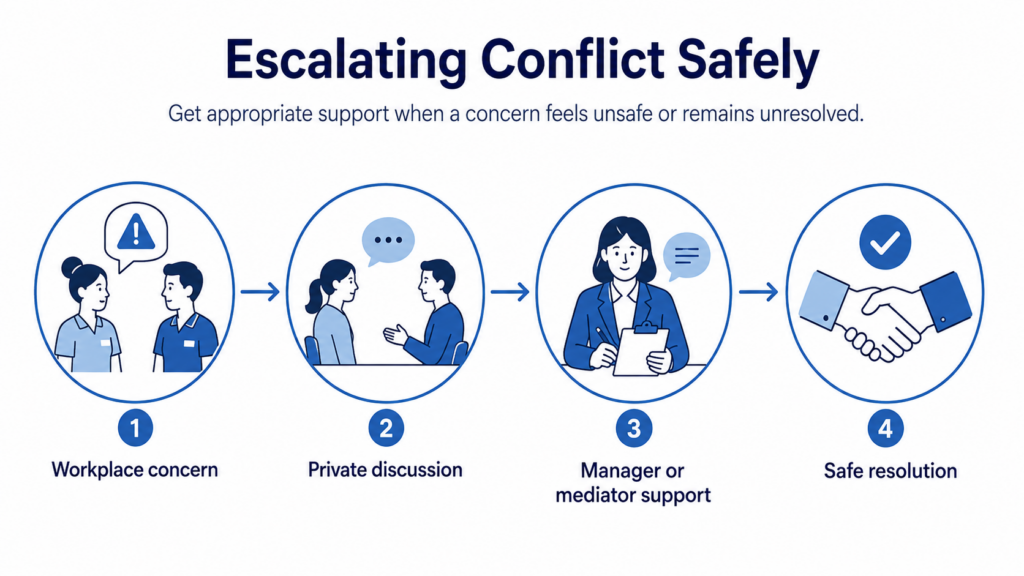
When to Escalate Conflict in Health and Social Care

Not every conflict should be resolved through an informal conversation. Sometimes the safest and most professional response is to involve someone with greater responsibility.

Escalation may be appropriate when the disagreement continues despite reasonable attempts to resolve it, when staff cannot remain impartial, when a decision is outside their authority or when the situation involves serious concerns about conduct or safety.

The key question is not, “Can I settle this myself?” It is:

“Is informal conflict resolution still appropriate and safe?”

When to Involve a Manager or Mediator

A manager may need to become involved when a conflict is repeated, affects care, disrupts teamwork or cannot be resolved by the people directly involved.

Mediation may also help when both sides need structured support to communicate and work towards an agreement. However, mediation is not suitable for every situation. Serious allegations, immediate safety concerns or suspected abuse require the appropriate formal procedure rather than an attempt to negotiate the issue away.

Workers should therefore follow their organisation’s conflict, grievance, complaints or incident-reporting procedures and stay within their role.

Safeguarding, Bullying and Safety Concerns

A disagreement becomes much more serious when there is suspected abuse, neglect, discriminatory treatment, coercion, intimidation or another safeguarding concern.

In England, CQC Regulation 13 requires regulated providers to protect people using services from abuse and improper treatment. CQC also expects safeguarding policies to explain how concerns about abuse can be raised. (Care Quality Commission)

That means staff should not treat a potential safeguarding concern as an ordinary personality clash.

The same principle applies when conflict becomes threatening or violent. HSE guidance says employers must assess and control risks from work-related violence and aggression, while certain incidents may also fall within formal reporting requirements. (HSE)

If someone is at immediate risk, safety takes priority over continuing the discussion.

Care-worker-escalating-a-conflict-to-a-senior-care-manager.

Conflict Resolution for Health and Social Care Careers

Conflict resolution is valuable beyond the moment a disagreement occurs. It demonstrates communication, judgement, emotional control and problem-solving — qualities that can matter in care work, professional development and recruitment.

However, workers should be precise about what their training or experience proves. Completing a course about conflict resolution can strengthen knowledge, but it does not automatically prove occupational competence in every care role.

Conflict Resolution in Qualifications and CPD

Learners completing health and social care qualifications may be asked to demonstrate communication, reflection, safe working or approaches to difficult situations, depending on the qualification and its assessment requirements.

Conflict experiences can sometimes provide useful material for reflective learning. For example, someone might consider:

  • What caused the disagreement?
  • How did I respond?
  • What effect did my communication have?
  • What would I change next time?
  • Did I follow the correct policy and remain within my role?

However, learners should always follow the actual assessment criteria for their qualification rather than assuming that one conflict example automatically satisfies a particular unit.

It is also important to distinguish CPD from regulated qualifications. GOV.UK provides a Register of Regulated Qualifications for checking whether a qualification is officially regulated in England or Northern Ireland. Therefore, a CPD certificate should not automatically be described as a regulated qualification unless its regulatory status has been confirmed. (GOV.UK)

For employers, professional development also forms part of a wider competence picture. In England, CQC Regulation 18 concerns the deployment of suitably qualified, competent and experienced staff. (Care Quality Commission)

Conflict Resolution Interview Questions

A care employer might ask a behavioural question such as:

“Tell me about a time you dealt with a disagreement at work.”

The STAR method can help organise the answer. The National Careers Service recommends STAR for interview responses and defines it around Situation, Task, Action and Result. (National Careers Service)

A concise answer might work like this:

Situation: Two colleagues disagreed about responsibilities during a busy shift.

Task: I needed to help clarify what still needed completing without allowing the disagreement to disrupt support.

Action: I listened to both perspectives, focused the conversation on the outstanding work rather than blame, and clarified priorities with the senior worker.

Result: The required tasks were allocated clearly, and we later discussed how the handover could be improved.

The strongest interview answers also explain what the person learned. Employers are usually more interested in professional judgement and behaviour than in hearing a dramatic story.

Health-and-social-care-professional-developing-conflict-resolution-skills

How to Prevent Conflict in Health and Social Care

Preventing conflict does not mean trying to eliminate every disagreement. Different opinions are inevitable when people work together and when care involves personal needs, preferences and risks.

The better goal is to prevent avoidable misunderstandings from becoming damaging conflicts.

Clear Roles, Boundaries and Communication

Many disagreements become harder because expectations were unclear from the beginning.

Teams can reduce this risk by making responsibilities clear, completing effective handovers, sharing relevant information appropriately and explaining decisions rather than expecting colleagues or service users to understand them automatically.

Professional boundaries also matter. A care worker should know which decisions they can make, when they need permission or advice and when a concern belongs with a senior colleague.

For service users and families, communication should remain clear and respectful. If plans change, explaining why can prevent uncertainty from becoming frustration.

Supervision and Reflective Practice

Some conflicts reveal wider problems rather than isolated personality differences.

Repeated disagreements about handovers may indicate an information-sharing problem. Regular disputes over responsibilities may show that roles are unclear. Similar complaints from several people may reveal a communication issue that requires wider attention.

Supervision and reflective practice create opportunities to examine these patterns rather than treating every incident separately.

HSE similarly emphasises learning from incidents as part of managing workplace violence and aggression risks, including appropriate reporting and review. (HSE)

The useful question after a conflict is therefore not only:

“Was the disagreement resolved?”

It is also:

“What could prevent the same problem from happening again?”

Final Thoughts

Conflict resolution in health and social care works best when staff respond early, listen carefully and keep the focus on the problem rather than the person. A calm conversation can often prevent a misunderstanding from becoming a damaged working relationship, formal complaint or more serious confrontation.

However, good conflict resolution also means recognising its limits. Staff should not try to informally “resolve” suspected abuse, serious bullying, threats, violence or safeguarding concerns. In those situations, following the correct reporting and escalation process becomes more important than reaching agreement.

For care professionals, the goal is not to avoid every difficult conversation. It is to handle disagreement with respect, judgement and awareness of safety. When teams combine these skills with clear roles, good communication and reflective practice, conflict can become an opportunity to identify problems and improve how people work together — rather than something that simply gets ignored until it escalates.

Frequently Asked Questions

Follow your organisation’s recording and reporting procedures. Record relevant facts, what happened, actions taken, people involved and any agreed follow-up. Avoid emotional descriptions, assumptions or blame. Serious incidents may require additional reporting under organisational or legal procedures.

Avoid insults, threats, blame and dismissive phrases such as “you’re overreacting” or “just calm down”. Also avoid making promises outside your authority. Use specific, neutral language and focus on the concern, what happened and what needs to happen next.

Yes, workers should not put themselves at unnecessary risk simply to continue a disagreement. Where violence or aggression presents a danger, they should use the organisation’s emergency and safety procedures and seek appropriate assistance. HSE guidance requires employers to manage risks from workplace violence and aggression. (HSE)

Conflict resolution training can contribute to continuing professional development when it is relevant to a person’s role or learning goals. However, CPD training and a regulated qualification are not automatically the same thing. Learners should check the course status and any requirements set by their employer, regulator or professional body. (GOV.UK)

Yes. Unresolved conflict can weaken communication, disrupt teamwork and increase the risk of misunderstandings. In care settings, this may affect handovers, decision-making and the consistency of support. Resolving issues early helps teams stay focused on safe, respectful and person-centred care.

Start by listening calmly and identifying the exact concern. Avoid becoming defensive or dismissive. Explain relevant information clearly, respect the person’s choices where appropriate and look for a practical solution. If the issue involves safety, safeguarding or decisions outside your role, escalate it appropriately.

Absolutely. The course is 100% online, self-paced, and accessible for 12 months, enabling learners to balance study with professional or personal commitments.

Learners receive a CPD-accredited certificate, available in digital (PDF) or printed formats, or as a combined bundle. This certification validates your expertise and enhances your CV.

Conflict resolution is valuable for CPD because care professionals regularly handle difficult conversations, disagreements and emotionally challenging situations. Developing these skills can support safer communication, better teamwork, reflective practice and more confident decision-making in health and social care settings.

August 10, 2026

Recent Blogs

top