Level 3 Diploma in Health and Social Care sounded like the answer for Aisha—an example of the choice many learners face. Then she opened three job adverts. One asked for care experience, another named a regulated qualification, while an NHS support role focused more on values, communication and teamwork. With around 1.5 million people working across adult social care in England, there are many possible routes into the sector, but they don’t all begin with the same course.
Level 3 learning can support applications for care, support and healthcare assistant roles, but the outcome depends on the course type, experience and employer criteria.
This guide looks at the jobs that may relate to Level 3 Health and Social Care, including NHS support opportunities and the checks, skills and qualifications employers may expect. It also explains the difference between CPD learning and regulated qualifications, before exploring career progression, further study and the professional roles that require separate approved training.
What Can You Do With a Level 3 Diploma in Health and Social Care?
A Level 3 Diploma in Health and Social Care can build knowledge relevant to roles such as care assistant, support worker, healthcare assistant and residential support worker. However, the jobs you can apply for will depend on the exact qualification, your previous experience and the criteria set by each employer.
Care Assistant
Supports people with personal care, meals, mobility and daily routines.
Support Worker
Helps people maintain independence, make choices and take part in everyday activities.
Healthcare Assistant
Assists patients with basic care while supporting nurses and other healthcare professionals.
Healthcare Support Worker
Provides practical patient support across hospitals, clinics and community health services.
Domiciliary Carer
Visits people in their homes to support personal care, meals and daily living.
Residential Support Worker
Supports people living in residential services with routines, appointments and activities.
Mental Health Support Worker
Helps people follow support plans, manage routines and access suitable services.
Learning Disabilities Support Worker
Supports communication, independence, choice and community participation for people with learning disabilities.
What Is a Level 3 Diploma in Health and Social Care?
A Level 3 Diploma in Health and Social Care usually refers to a course that develops more advanced knowledge than an introductory Level 1 or Level 2 programme. However, the title doesn’t identify one standard course. Different providers may use similar names for programmes with different purposes, assessments and forms of recognition.
Across England, Wales and Northern Ireland, Level 3 sits alongside qualifications such as A levels, advanced apprenticeships, Access to Higher Education diplomas and T Levels. The level describes the difficulty of the learning, not the subject coverage, course length or value to a particular employer. Two Level 3 programmes can therefore demand a similar standard of learning while covering different amounts of content. Scotland uses the separate Scottish Credit and Qualifications Framework, so learners should not compare the numbers without checking the framework.
Diploma, Certificate or Short Course: What’s the Difference?
The course title can offer a clue about its size, but it doesn’t give the full picture.
|
Course title |
What it commonly indicates |
|
Diploma |
A larger programme covering several learning areas |
|
Certificate |
A shorter programme with a narrower scope |
|
Short course |
Focused learning on a specific topic, which may or may not lead to a formal qualification |
Within Ofqual-regulated provision, awarding organisations commonly use “certificate” for medium-sized qualifications and “diploma” for larger ones. Yet learners should still check the total qualification time, credits, units and assessment method rather than judging a course by its title.
Knowledge-Based and Competence-Based Learning
A knowledge-based course focuses on what you understand. You may complete written assignments, case studies, quizzes or reflective tasks on topics such as safeguarding, duty of care, communication and person-centred support.
A competence-based qualification also checks how you apply learning within a real work setting. It may require workplace observation, professional discussions, witness statements or evidence from your role. This difference matters. A fully online knowledge course can support professional development, but it cannot prove workplace competence unless the assessment includes suitable practice-based evidence.
Why the Awarding Body Matters
The training provider delivers the learning, but a recognised awarding organisation sets and awards a regulated qualification. Before enrolling, check:
- The full qualification title
- The awarding organisation
- The qualification number
- The level and total qualification time
- The assessment method
- Any placement or workplace requirements
- The intended progression route
Ofqual regulates awarding organisations and qualifications in England. The UK government register also covers regulated vocational qualifications in Northern Ireland. Wales uses its o wn regulatory arrangements, while Scotland follows a separate qualifications framework.
CPD Training and Regulated Qualifications
CPD training and regulated qualifications serve different purposes. A CPD course supports continuing professional development by helping learners update or expand their knowledge. However, CPD accreditation alone doesn’t place a course on a national qualifications framework.
A regulated qualification must meet the relevant regulator’s conditions and appear on the appropriate qualifications register. It should also name its awarding organisation and qualification number. Learners can use the GOV.UK regulated qualification service to check the title, level, awarding body and current status of qualifications available in England and Northern Ireland.
This explains why two courses called “Level 3 Diploma in Health and Social Care” may lead to different outcomes. One may provide CPD learning through online assessments. Another may offer a regulated qualification with assignments and workplace observation. Always check the course details against your employment, study or progression goal before making a decision.
Which Jobs Relate to a Level 3 Diploma in Health and Social Care?
Completing Level 3 learning doesn’t automatically secure a job. It can develop knowledge relevant to several care and support roles, while employers decide their own entry requirements.
The exact opportunities will depend on the course you complete, your experience and the vacancy. Always read the job description and person specification before applying.
|
Role |
Main duties |
Common setting |
What employers may request |
|
Care Assistant |
Personal care and daily support |
Care homes or people’s homes |
Care values, DBS check and employer training |
|
Support Worker |
Independence and community support |
Supported living or community services |
Communication skills and relevant experience |
|
Healthcare Assistant |
Basic patient care and clinical team support |
Hospitals, clinics or care services |
Literacy, numeracy and employer training |
|
Residential Support Worker |
Support within residential services |
Adult or children’s residential homes |
Shift flexibility and safeguarding awareness |
Care Assistant
Care assistants help people manage everyday tasks while protecting their dignity, privacy and choices. The work can include washing, dressing, eating, moving safely and taking part in social activities.
They also watch for changes in a person’s health or behaviour. For example, a care assistant might notice that a resident has lost their appetite and report this concern to a senior colleague. Accurate notes help the wider team respond.
Care assistants work in residential homes, nursing homes and people’s own homes. Employers usually provide induction and role-specific training, even when an applicant already holds a relevant course or qualification.
When searching for care assistant jobs with Level 3 Health and Social Care, check whether the vacancy asks for a regulated qualification, previous experience or a willingness to complete training after appointment.
Support Worker
Support workers help people make choices and maintain as much independence as possible. They may assist with daily routines, appointments, shopping, budgeting, community activities and communication.
The work also involves emotional support. A support worker might help someone plan a bus journey, attend a community group or prepare a meal rather than completing every task for them.
Clear records and professional boundaries remain essential. Workers must record relevant information, protect confidentiality and avoid relationships or actions that fall outside their role.
Responsibilities differ across adult social care, learning disability services, mental health support, housing and community organisations. Some roles involve personal care, while others focus more on practical support, tenancy skills or community access.
Healthcare Assistant or Healthcare Support Worker
Healthcare assistants and healthcare support workers help nurses and other clinical professionals provide patient care. They may work in hospitals, clinics, community teams, hospices or care services.
Their duties can include helping patients wash, dress, eat and use the toilet. They may also prepare care areas, clean equipment and reassure people who feel anxious.
Some workers take and record agreed observations, such as pulse, temperature or breathing rate. They only complete these tasks after suitable training and within the limits of their role. They must report concerns to the appropriate clinical professional.
A Level 3 course doesn’t qualify someone to carry out clinical procedures without training, supervision and workplace approval.
Entry requirements vary between employers. NHS guidance states that healthcare support worker roles usually expect good literacy and numeracy. Some employers also request GCSEs, a healthcare qualification or relevant experience, while NHS applicants must show how their behaviour reflects NHS values.
Domiciliary Carer
Domiciliary carers visit people in their own homes. They help clients continue living in familiar surroundings while receiving agreed support with daily tasks.
A visit might include personal care, preparing a meal, supporting mobility or checking that the person has taken medication. Workers must follow the care plan and only provide medication support that matches their training and responsibilities.
Home-care workers often work alone and travel between several clients during a shift. Good timekeeping matters, but workers must also report delays, safety concerns and changes in a person’s condition.
Some employers ask for a driving licence because workers need to reach homes across a wide area or work when public transport runs less often. The National Careers Service notes that driving can help when a role involves travelling between home-care clients.
Residential Support Worker
Residential support workers help children or adults who live in a care setting. They support physical wellbeing, emotional needs and daily routines while building stable professional relationships.
The role can include helping residents attend appointments, plan activities, develop daily living skills and manage household tasks. Workers may also speak with relatives and other professionals.
They keep care plans and records current. They must also record incidents, behavioural changes and safeguarding concerns through the service’s agreed process.
Residential services often operate throughout the day and night. Workers may need to cover evenings, weekends and bank holidays as part of a rota.
Children’s residential care has different regulatory and training expectations from adult social care. In England, children’s home staff must have the experience, qualifications and skills appropriate to their work, while requirements also differ across Wales, Scotland and Northern Ireland.
Mental Health Support Worker
Mental health support workers provide practical and emotional support to people experiencing mental health difficulties. They listen without judgement and help people follow agreed routines or support plans.
For example, a worker might help someone attend an appointment, prepare food or return to a daily activity after a difficult period. The aim is to support choice and independence, not take control.
Workers need to recognise changes in mood, communication or behaviour. They must report risks or safeguarding concerns through the correct route and seek help when a situation moves beyond their responsibility.
Mental health support workers don’t diagnose conditions, provide therapy or change treatment plans unless they hold the separate professional qualifications and authority required for those tasks.
Learning Disabilities Support Worker
Learning disabilities support workers help people make choices, communicate and take part in everyday life. Support should reflect the person’s abilities, preferences, sensory needs and communication style.
For example, a worker might use pictures, simple language or extra processing time to help someone choose what to eat. They might also support travel, shopping, household tasks or participation in a local activity.
Workers should seek consent, offer meaningful choices and avoid completing tasks that the person can manage with suitable support. They also need to recognise signs of distress, abuse or neglect and follow safeguarding procedures.
Positive support means understanding why a situation has become difficult. It doesn’t mean punishing, controlling or making assumptions about the person’s behaviour.
Rehabilitation Support Worker
Rehabilitation support workers help people follow plans agreed by rehabilitation or therapy professionals. They may work with people recovering from an illness, injury, operation or period of poor mental health.
Their work can include encouraging safe movement, helping with routines and supporting activities that build independence. They also record progress and report any changes to the relevant professional.
For example, a rehabilitation worker might support someone to practise an everyday task recommended by an occupational therapist. The worker follows the agreed plan rather than creating or changing the treatment themselves.
Occupational therapy support workers often work alongside occupational therapists to help people regain independence. Similar assistant roles can support physiotherapy or speech and language therapy services.
Physiotherapist, occupational therapist and speech and language therapist are regulated professional titles. People using these titles must meet the relevant education and registration requirements, while support workers operate within delegated plans and defined responsibilities.
Senior Care Worker
Senior care worker usually represents a progression route rather than an immediate first job after completing a Level 3 course. Employers often expect relevant care experience, sound judgement and evidence that the worker can take greater responsibility.
Senior workers may support new employees, coordinate parts of a shift and check that care records remain accurate. They may also speak with relatives, healthcare professionals and service managers.
Their duties can include reviewing care plans, monitoring care standards, maintaining medication records and responding when staff need guidance. They must still work within their authority and refer decisions that need a manager or regulated professional.
Skills for Care identifies Level 3 study as one route that may support progression towards senior work. However, experience, performance, employer requirements and role-specific development also shape whether someone can move into greater responsibility.
Can You Work for the NHS With Level 3 Health and Social Care?
Yes, Level 3 Health and Social Care learning may support applications for some NHS care and support roles. It doesn’t guarantee employment, as every vacancy has its own essential and desirable criteria.
Some NHS support posts don’t require a specific Level 3 qualification. Others may request relevant care learning, previous experience or evidence that you can work at the expected level.
Role titles also vary between NHS organisations. Similar duties may appear under titles such as healthcare support worker, healthcare assistant, clinical support worker or nursing assistant.
Healthcare Support Worker
Healthcare support workers help nurses, doctors, midwives and therapy professionals provide person-centred care. They can work in hospitals, GP practices, community teams and people’s homes.
Their duties may include helping patients with washing, dressing, meals, mobility and appointments. Some workers also record basic observations after completing suitable training and workplace competency checks.
Healthcare Assistant
Healthcare assistant is another common title for a support role. The work may involve personal care, preparing patient areas, serving meals, listening to patients and reporting changes to a registered professional.
The duties depend on the ward, service and patient group. A healthcare assistant in an outpatient clinic may have a different routine from someone working on an older people’s ward.
Clinical Support Worker
Clinical support workers usually assist registered professionals with agreed patient-care tasks. They may help people move safely, prepare equipment, maintain clean care areas and record observations within their training.
Some roles involve direct ward care. Others sit within specialist services, such as outpatient departments, breast units, paediatrics or mental health teams.
Current NHS vacancies use the title across Band 2 and Band 3 posts, although the duties and entry criteria differ between employers.
Therapy Support Worker
Therapy support workers assist occupational therapists, physiotherapists, speech and language therapists or other rehabilitation professionals. They help patients follow activities or treatment plans set by the qualified practitioner.
For example, a worker may support someone to practise movement, communication or daily living tasks. They may also prepare equipment, record progress and report concerns to the therapy team.
These workers operate under agreed supervision and delegated plans. They don’t assess patients independently or replace the regulated therapist.
Maternity Support Worker
Maternity support workers assist midwives and wider maternity teams before, during and after birth. Their work may include preparing equipment, helping with personal care, supporting infant feeding and completing agreed observations.
The role can exist in hospitals, birth centres and community services. Entry and development requirements depend on the level of the post and the employer’s maternity support worker framework.
Mental Health Support Worker
Mental health support workers help patients manage daily routines, communicate their needs and take part in agreed activities. They may work on inpatient wards, in community teams or within specialist mental health services.
Workers must notice and report changes in behaviour, mood or risk. They provide support within the care plan but don’t diagnose conditions or make independent treatment decisions.
Ward-Based Support Roles
Ward-based support workers help patients and clinical teams throughout the day. Common tasks can include personal care, meal support, bed-area preparation, patient communication and basic observations.
The work requires close teamwork. Support workers must know when to act, when to report a concern and when a task falls outside their training.
What Do NHS Employers Look For?
NHS employers assess the whole application rather than relying on the course title alone. A Level 3 course may strengthen your knowledge, but you must still show that you meet the vacancy’s essential criteria.
Care Values
Employers look for people who treat patients with dignity, kindness and respect. You should be able to support choice, protect privacy and respond without judgement.
Your application needs evidence. For example, you might explain how you helped a customer, colleague or person in your care feel heard during a difficult situation.
Communication
Support workers communicate with patients, relatives and multidisciplinary teams. They need to listen, explain information clearly and adapt their approach when someone feels anxious, confused or unwell.
Written communication also matters. Workers must record information accurately and avoid assumptions or unclear language.
Literacy and Numeracy
Good literacy and numeracy help workers read care information, complete records and understand measurements. Some NHS posts request English and maths qualifications, while others assess these skills during recruitment.
NHS England notes that good literacy and numeracy are useful for healthcare support work. Some employers may require GCSEs or equivalent qualifications.
Teamwork
Healthcare support workers rarely work in isolation from the wider service. They share information with nurses, therapists, midwives, doctors and other support staff.
Employers want evidence that you can follow instructions, ask for help and contribute to safe care. Good teamwork also means raising concerns rather than assuming someone else will act.
Confidentiality
NHS workers handle sensitive information about people’s health, care and personal circumstances. Applicants need to understand that they should only access or share information for a valid work reason.
This applies to spoken conversations, paper records, digital systems and social media. Curiosity isn’t a reason to view someone’s record.
Experience With Patients or Service Users
Some vacancies ask for care experience. Others accept transferable experience from customer service, volunteering, unpaid caring or community work.
NHS England explains that health or care experience may be useful for some healthcare support worker roles, but it isn’t always essential.
Ability to Follow Procedures
Support workers must follow care plans, infection-prevention measures, safeguarding procedures and local reporting routes. They also need to recognise the limits of their role.
An employer may test this through a scenario question. For example, you could be asked what you would do after noticing an unexplained injury or sudden change in a patient’s condition.
Relevant Qualifications
Some vacancies list a care qualification as essential. Others describe it as desirable or ask the successful applicant to complete training after starting work.
Check the full person specification. A job title alone won’t tell you whether the employer wants Level 2, Level 3, the Care Certificate, relevant experience or a particular occupational qualification.
Where Can Level 3 Health and Social Care Learners Work?
Level 3 health and social care learning may support applications across public, private and voluntary services. The right setting will depend on your course, experience, interests and each employer’s requirements.
NHS and Community Health Services
Hospitals employ support workers across medical, surgical, maternity, mental health and rehabilitation services. Some roles focus on ward care, while others support outpatient clinics or specialist teams.
Community workers may visit patients at home, support clinics or work with district nursing and rehabilitation teams. NHS healthcare support workers can work across hospitals, GP practices, homes and community settings.
Residential Care Homes
Residential care homes support people who can’t manage all aspects of daily life without help. Services may focus on older people, dementia care, learning disabilities or long-term support needs.
Workers can help with personal care, meals, mobility, activities and emotional wellbeing. They also record changes and report concerns to senior staff.
Domiciliary Care Services
Domiciliary care takes place in the person’s own home. Workers travel between visits and provide support based on an agreed care plan.
The role may involve personal care, meal preparation and medication assistance within the worker’s training. Lone working is common, so staff need to follow safety procedures and report concerns without delay.
Some employers request a driving licence. This often depends on the service area, shift times and access to public transport.
Supported-Living Services
Supported-living workers help people manage daily life while living in their own tenancy or shared accommodation. The focus usually rests on independence rather than completing every task for the person.
Support may include budgeting, cooking, appointments, travel and community activities. Workers must respect the person’s home, choices and tenancy rights.
Mental Health Services
Mental health support roles exist in community services, residential settings, inpatient units and supported accommodation. Workers may help people establish routines, attend appointments and work towards agreed recovery goals.
The work requires calm communication and clear boundaries. Staff must recognise changes, record concerns and seek clinical or senior support when risks increase.
Learning Disability and Autism Services
These services may include supported living, residential care, day opportunities and community outreach. Workers help people communicate, make decisions and take part in everyday life.
For example, a support worker might use visual information to help someone plan a journey. They may also adjust the environment when noise, lighting or unexpected changes cause distress.
Charities and Voluntary Organisations
Charities employ support workers across disability, homelessness, carers’ services, mental health and community outreach. Some roles involve direct support, while others focus on information, advocacy or practical help.
Entry requirements vary. A charity may value relevant knowledge and lived experience, but it can still request safeguarding checks, previous support work or role-specific training.
What Skills Can You Develop Through Level 3 Health and Social Care?
Level 3 health and social care learning can strengthen the skills used in care, support and healthcare environments. These skills don’t replace workplace training, but they can help you understand how safe and respectful support should work in practice.
Care and Communication Skills
Active listening
A support worker may sit with someone who feels worried about an upcoming appointment. Listening without interrupting can help the worker understand the concern and report it accurately.
Clear communication
A care assistant may need to explain a change to someone’s daily routine. Simple language and a calm tone can reduce confusion and help the person make an informed choice.
Accessible communication
Someone with a learning disability may understand pictures more easily than long written instructions. A worker could use visual prompts to explain meal choices or planned activities.
Person-centred support
Two people living in the same care home may want different morning routines. Person-centred support means respecting those preferences rather than expecting everyone to follow one fixed schedule.
Respect for dignity and choice
A person receiving personal care should have privacy and control wherever possible. The worker can close doors, explain each step and ask permission before offering support.
Confidentiality
A healthcare assistant may hear sensitive information during a shift. They should share it only with colleagues who need it to provide safe care, not discuss it in public areas.
Safety and Professional Practice
Safeguarding awareness
A worker may notice unexplained bruising or a sudden change in behaviour. They should record what they observed and report the concern through the service’s safeguarding procedure.
Duty of care
If someone wants to take part in an activity that carries risk, the worker shouldn’t dismiss the choice. They should consider safer ways to support the person while respecting their independence.
Risk awareness
A domiciliary carer may notice loose flooring in a client’s home. Reporting the hazard can help reduce the chance of a fall without restricting the person’s movement.
Accurate reporting
Care notes should describe what happened, not what the worker assumes. Writing that someone “ate half their lunch” gives the team clearer information than saying they “seemed unwell”.
Professional boundaries
A service user may ask a support worker to lend them money. The worker should explain the boundary and follow the organisation’s procedure rather than entering a personal financial arrangement.
Health and safety
A care worker may need to follow infection-prevention procedures before supporting someone with personal care. This could include handwashing, suitable protective equipment and safe waste disposal.
Employability Skills
Teamwork
A healthcare support worker may notice that a patient has become less responsive. Sharing this information with the nurse without delay helps the wider team take suitable action.
Time management
A domiciliary carer may have several planned visits. Good time management means preparing properly, allowing for travel and reporting delays rather than rushing care.
Reliability
People may depend on workers for meals, medication support or personal care. Arriving as agreed and completing records properly helps maintain trust and continuity.
Problem-solving
A person may refuse an activity because the environment feels too noisy. A support worker could explore a quieter option rather than assuming the person doesn’t want to participate.
Digital record keeping
Many services use electronic care systems. Workers need to enter clear, factual notes, protect login details and avoid accessing records unrelated to their responsibilities.
Emotional resilience
Care work can involve illness, distress or loss. A worker may need to seek supervision, reflect on difficult events and use workplace support while continuing to provide calm care.
Observation
Small changes can matter. A care assistant who notices reduced mobility, confusion or a change in appetite should record the details and report them to the appropriate colleague.
Level 3 Health and Social Care Course
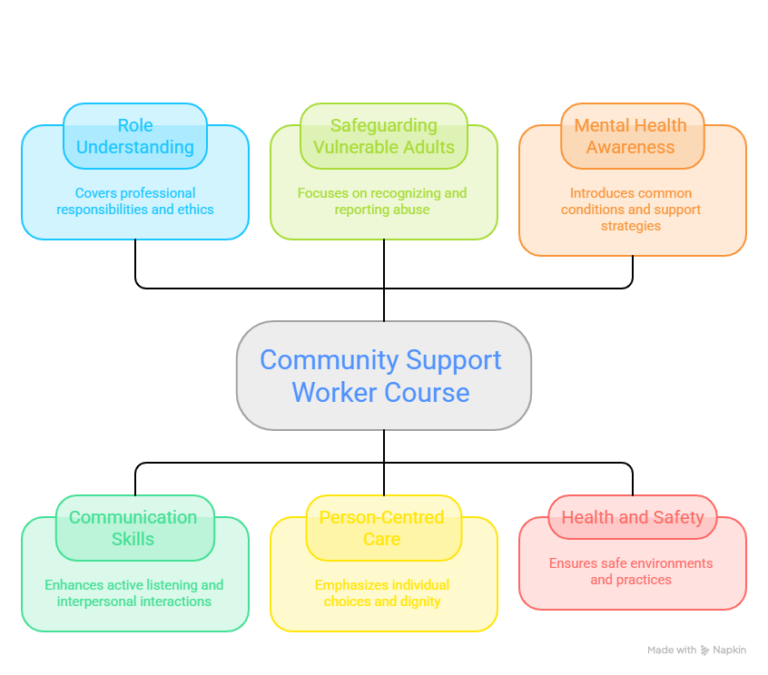
The Level 3 Health and Social Care course introduces core topics such as person-centred care, safeguarding, communication, equality and professional responsibilities. It may suit beginners exploring the sector, existing care staff updating their knowledge or career changers seeking structured professional development. Before enrolling, compare the curriculum, assessment method and course recognition with the requirements of your intended role.
What Comes After a Level 3 Diploma in Health and Social Care?
After a Level 3 Diploma in Health and Social Care, you may progress into greater workplace responsibility, higher-level study, an apprenticeship or university preparation. The right route depends on your course type, experience and long-term goal.
Progression Within Adult Social Care
Adult social care offers several possible progression routes. You might begin in a care or support role, build workplace competence and later apply for positions with coordination, supervision or management duties.
Possible roles include:
Senior Care Worker
Supports day-to-day care delivery and may guide less experienced colleagues.
Lead Adult Care Worker
Takes greater responsibility for person-centred support, records and communication within an adult care service.
Care Coordinator
Organises care visits, staff rotas and communication between workers, clients and families.
Team Leader
Supervises part of a service and helps staff follow care plans, procedures and quality standards.
Deputy Manager
Supports the manager with staffing, care quality, safeguarding and the daily operation of the service.
Registered Manager
Holds formal responsibility for managing a regulated care service and meeting the relevant regulatory requirements.
These roles don’t follow automatically from completing Level 3 study. Employers also consider experience, workplace competence, leadership ability, vacancies and further professional development. Skills for Care’s Care Workforce Pathway covers development from care and support work through to deputy and registered manager roles.
Progression to Level 4 or Level 5 Study
Level 4 or Level 5 learning may suit people who want to develop knowledge of leadership, service management, quality improvement or specialist care. It can help an experienced worker understand how individual care responsibilities connect with wider team and organisational decisions.
For example, someone preparing for supervisory or management responsibilities could explore a Level 5 Health and Social Care course. Before enrolling, check whether the programme offers CPD learning or a regulated qualification and whether it meets your employer’s requirements.
Higher-level study doesn’t guarantee promotion. Employers will still consider your experience, performance, competence and ability to lead others safely.
Adult Care Apprenticeships
An adult care apprenticeship combines paid employment with structured learning. Apprentices develop knowledge and workplace skills through a mixture of on-the-job experience and off-the-job training.
This route may suit someone who wants to learn while working rather than complete a separate online course before applying for care jobs. The employer and training provider support the programme, while the apprentice completes the required learning and assessment.
Skills for Care describes an apprenticeship as a work-based training programme that combines on-the-job and off-the-job learning. Available routes can support entry, development and progression across adult social care.
Access to Higher Education
An Access to Higher Education Diploma can prepare adults for university when they don’t hold the qualifications needed for direct entry. Learners often choose a pathway related to health professions, nursing, social science or social work.
An Access course isn’t the same as every Level 3 Health and Social Care programme. It follows a specific academic route designed to prepare learners for higher education.
Before applying, ask the university whether it accepts the chosen Access Diploma for your intended degree. Course subject, grades, credits and English or maths requirements may all matter. UK government guidance states that adults aged over 19 can use an Access to Higher Education Diploma to prepare for university when they lack the required qualification level.
University Routes
Level 3 study may form part of a route towards university, but the course title alone doesn’t confirm eligibility. Each university sets its own academic and non-academic entry requirements.
Possible areas of study include:
- Nursing
- Social work
- Occupational therapy
- Public health
- Health studies
- Psychology
Some universities accept relevant Access to Higher Education Diplomas or specified Level 3 qualifications. Others ask for particular subjects, grades, credits, GCSEs or evidence of relevant experience.
Professional courses may also require interviews, occupational health checks, DBS checks or evidence that applicants understand the role. Check the current university course page before choosing your Level 3 route. Official higher-education guidance advises applicants to review each provider’s published entry requirements because they differ by institution and degree.
How to Choose the Right Level 3 Health and Social Care Route
Choose a Level 3 route by starting with the outcome you need. A course that suits professional development may not meet the requirements for workplace competence, university entry or a named job vacancy.
Your goal | Route to investigate |
Build introductory care knowledge | CPD or knowledge-based course |
Prove workplace competence | Regulated, assessed occupational qualification |
Progress in an existing care role | Employer-approved Level 3 pathway |
Prepare for university | Academic Level 3 or Access route accepted by the university |
Apply for NHS support jobs | Relevant learning plus vacancy-specific requirements |
Before enrolling, check the following points.
Who awards the course?
Look for the full name of the training provider and, where applicable, the recognised awarding organisation.
Is it regulated?
Check the appropriate qualification register rather than relying on terms such as “accredited”, “endorsed” or “Level 3”.
Does it require workplace observation?
An occupational qualification may require assessors to observe your competence in a suitable care setting.
Does it carry recognised credits?
Check the number and type of credits and confirm how employers or universities use them.
Does it meet an employer’s requirements?
Compare the exact qualification title with the vacancy’s person specification. Similar course names may not carry the same recognition.
Does a university accept it?
Ask the admissions team about the exact course, awarding body, grades and credits before enrolling.
Is it CPD rather than a formal qualification?
CPD can support knowledge and professional development, but it doesn’t automatically provide a regulated qualification or evidence of workplace competence.
Is a Level 3 Diploma in Health and Social Care Worth It?
A Level 3 Diploma in Health and Social Care may be worthwhile when its content and recognition match your goal. Its value depends on what you need the course to help you understand, demonstrate or progress towards.
It may suit you when:
- You want structured knowledge of health and social care
- You’re considering care or support work
- You already work in care and want further development
- You plan to progress to higher-level study
- An employer has requested suitable Level 3 learning
Further checking becomes essential when:
- You need a regulated qualification
- You need assessment within a care workplace
- You want entry to a specific university course
- You’re preparing for a regulated profession
- A vacancy names a particular awarding body or qualification
Don’t judge a programme by its title alone. Check the awarding body, regulatory status, assessment method and progression route against the result you need.
Final Thoughts
A Level 3 Diploma in Health and Social Care can support several routes into care, support and healthcare assistant work. However, the outcome depends on the exact course, your experience and the requirements set by employers.
Before choosing your next step, check whether the course is regulated, whether workplace assessment is required and whether it matches your career or study goal. The right route should support realistic progression, not rely on the course title alone.
Frequently Asked Questions
In health and social care, a barrier refers to anything that prevents a person from accessing, understanding, or receiving the care and support they need. Barriers can be physical (like inaccessible buildings), financial (such as the cost of transport or treatment), or social and cultural (like stigma or language differences). These obstacles make it harder for people to receive equal, effective, and compassionate care.
One of the most common barriers is poor communication between professionals and patients. This can happen when medical jargon is used, interpreters are unavailable, or information is provided in inaccessible formats. As a result, people may misunderstand instructions, miss appointments, or feel anxious about treatment. Improving communication—through plain language, visual aids, and active listening—can greatly reduce this issue.
While different sources may group them differently, the most recognised eight barriers in health and social care include:
• Communication barriers
• Physical barriers
• Financial barriers
• Cultural and attitudinal barriers
• Digital barriers
• Organisational or systemic barriers
• Emotional barriers (such as fear or stigma)
• Language and literacy barriers
Together, these barriers can make care less effective, especially for people who already face disadvantage or discrimination.
The four main physical barriers in health and social care usually include:
• Inaccessible buildings (no ramps, lifts, or wide doors)
• Poor signage or lighting in facilities
• Limited or unavailable transport options
• Lack of suitable equipment, such as mobility aids or hearing loops
When physical environments are not accessible, people with disabilities, sensory impairments, or mobility challenges struggle to reach and use essential services.
Health and social care workers play a key role in identifying, understanding, and removing barriers to care. They can do this by listening carefully to individuals’ needs, adapting communication styles, and making reasonable adjustments. Carers also advocate for their clients—helping them access services, arrange interpreters, or connect with financial and community support. Their empathy and awareness directly shape how inclusive and accessible care becomes.
Reducing barriers starts with small, practical steps. Services can use clear communication, provide accessible facilities, and offer financial or transport support for those in need. Training staff in cultural awareness and inclusive communication also helps build trust. On a larger scale, better system coordination and digital inclusion programs can make care smoother and fairer for all.
Recognising barriers early helps professionals prevent inequality and improve outcomes. When barriers go unnoticed, people are more likely to delay care, misunderstand advice, or stop seeking help altogether. Identifying these obstacles allows carers and organisations to make timely adjustments—ensuring every individual gets the support they deserve.
Barriers affect everyone differently, but they most often impact vulnerable groups—including older adults, people with disabilities, those living in poverty, and individuals from minority ethnic backgrounds. People who face more than one form of disadvantage often experience the greatest challenges. That’s why equality and inclusion must remain at the heart of every care policy and practice.
When communication fails, care quality suffers. Patients may take the wrong medication, miss important instructions, or feel too uncomfortable to ask questions. This can lead to poorer health outcomes, longer recovery times, and even hospital readmissions. On the other hand, good communication builds trust, encourages understanding, and improves overall satisfaction with care.
Some of the best strategies include training staff in inclusive communication, making buildings accessible, and offering flexible appointment options. Providing digital support, using interpreters, and promoting cultural awareness also help reduce misunderstandings and build trust. Most importantly, listening to patients’ voices ensures that care is not just available—but truly accessible to everyone.
Table of Contents