


Safeguarding training is mandatory for many UK workers, particularly in regulated care, healthcare, education and childcare settings. However, there is no single safeguarding certificate or renewal schedule required for every job. The rules depend on your sector, responsibilities, employer and the UK nation where you work.
For example, a care assistant may need adult safeguarding training during induction, while a school’s designated safeguarding lead requires more specialised preparation.
Knowing the difference helps you choose appropriate training and meet workplace expectations.
Build Your Safeguarding Knowledge with HF Online
HF Online’s Vulnerability, Abuse & Safeguarding course offers an online option for developing safeguarding knowledge. Before enrolling to meet a workplace requirement, check that the course content and completion evidence are accepted by your employer.
For broader guidance on protecting adults at risk, see safeguarding vulnerable adults.
Vulnerability, Abuse & Safeguarding
Is Safeguarding Training a Legal Requirement in the UK?
Safeguarding training can be a legal or regulatory requirement, but the rules are not identical across workplaces.
In England, for example, CQC Regulation 13 on safeguarding requires regulated care providers to protect service users from abuse and improper treatment. Its guidance includes safeguarding training appropriate to staff responsibilities.
Other sectors have different statutory duties and official guidance. Scotland, Wales and Northern Ireland also operate under their own safeguarding frameworks.
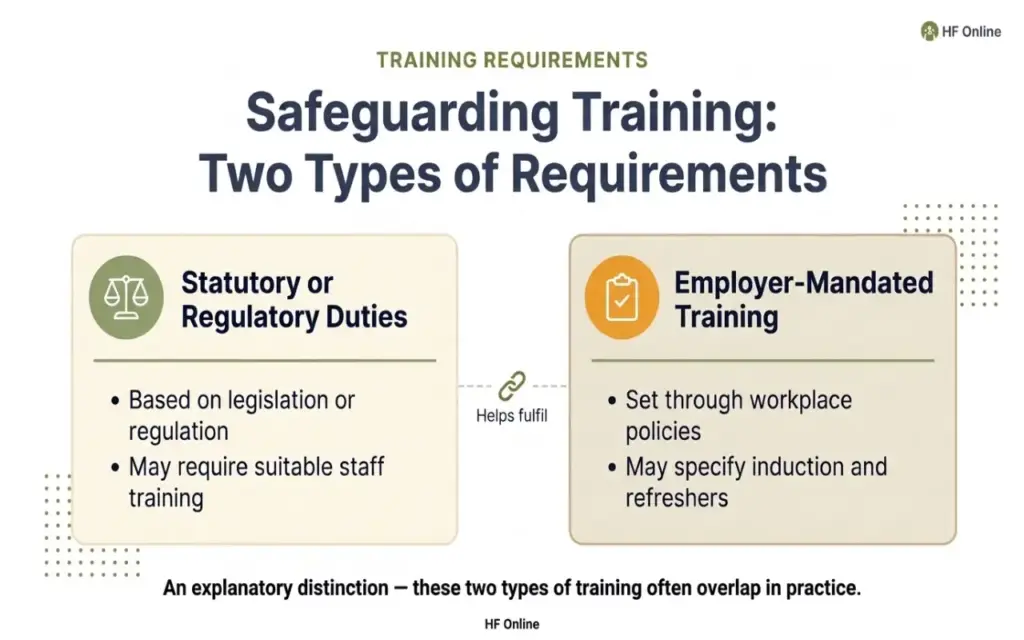
Statutory Training vs Employer-Mandated Training
These terms are related but not interchangeable.
Employer-mandated training is training an organisation requires employees to complete under its policies, contracts or workplace procedures.
A legal or regulatory duty may require an organisation to ensure staff are appropriately trained without prescribing a specific commercial course. Employers may then establish their own induction, refresher and assessment arrangements to meet those obligations.
For example, a care home might require safeguarding training during induction and additional refresher sessions. The provider must meet applicable regulatory duties, while its own training policy may specify how those duties are implemented.
Who Needs Mandatory Safeguarding Training? Rules by Sector
Safeguarding training requirements depend on who workers support, the risks they encounter and their professional responsibilities.
The following comparison focuses mainly on England. Workers in Scotland, Wales and Northern Ireland should check the rules and guidance applicable to their nation.
| Sector | Who Needs Training? | Main Requirement or Expectation |
|---|---|---|
| Adult social care | Care assistants, support workers, managers and relevant staff | Role-appropriate safeguarding training and updates |
| NHS and healthcare | Clinical and relevant non-clinical staff | Training matched to safeguarding responsibilities and competencies |
| Schools and colleges | Staff and designated safeguarding leads | Induction, safeguarding training and appropriate updates |
| Early years and childcare | Relevant childcare staff and safeguarding leads | Training under applicable EYFS safeguarding requirements |
| Charities and voluntary organisations | Trustees, employees and volunteers as appropriate | Training proportionate to safeguarding risks and responsibilities |
Adult Social Care and Care Homes
Mandatory safeguarding training is particularly relevant to care homes, domiciliary care services and other regulated adult care settings.
Care assistants and support workers must be prepared to recognise possible abuse, respond appropriately and report concerns through established procedures.

This includes recognising different types of adult abuse.
Alongside safeguarding duties, CQC Regulation 18 on staffing requires providers to ensure staff receive appropriate support, training and professional development.
Training should reflect the employee’s actual duties rather than simply provide a certificate.
NHS and Healthcare Workers
Healthcare safeguarding requirements vary according to professional responsibilities and patient contact.
Clinical staff may need more advanced safeguarding competencies than employees whose duties involve limited contact with patients. Adult and child safeguarding training also address different responsibilities.
NHS employers assess safeguarding training needs against relevant professional competency frameworks, organisational policies and staff responsibilities. For example, the 2025 intercollegiate safeguarding competency framework sets out role-based expectations for healthcare staff working with children and young people. Adult safeguarding competencies should be considered separately, according to the employee’s duties and the people they support.
A general online course may contribute to safeguarding awareness, but it should not automatically be treated as equivalent to an NHS-required competency level.
Schools, Colleges and Childcare Settings
In England, Keeping Children Safe in Education 2026 sets out safeguarding expectations for schools and colleges.
Staff must receive safeguarding and child protection training at induction, with appropriate updates. Designated safeguarding leads have additional training responsibilities.
Early years providers must also follow the applicable EYFS statutory framework, including requirements concerning safeguarding policies, staff training and designated safeguarding responsibilities.
The training needed by a classroom assistant may therefore differ from that required by a safeguarding lead.
Charities, Volunteers and Community Organisations
Safeguarding responsibilities are not limited to paid employees.
Charities working with children or adults at risk should ensure that trustees, staff and volunteers have appropriate safeguarding knowledge for their roles.
The Charity Commission safeguarding guidance explains trustees’ responsibilities for protecting people who come into contact with their charity.
However, not every volunteer must complete the same course. Training should reflect their duties, the people they support and the risks involved.
What Safeguarding Training Level Do You Need?
Safeguarding training is often described using Levels 1, 2 and 3, particularly in healthcare. These generally indicate increasing responsibilities and competency expectations.
Safeguarding Levels 1, 2 and 3 Explained
- Level 1: Introductory awareness, recognising concerns and knowing how to report them.
- Level 2: Additional knowledge for staff whose duties involve greater safeguarding responsibilities.
- Level 3: More advanced competencies for relevant professionals, including some healthcare practitioners.
Safeguarding training levels are commonly used within healthcare competency frameworks, but their meaning and application can vary by sector and training provider. Employers should confirm which competencies staff need for their roles. A course labelled Level 2 or Level 3 is not automatically an Ofqual-regulated qualification or proof that a particular workplace requirement has been met.
Introductory adult safeguarding training may also address who may be at risk of abuse or neglect.
How Often Should Mandatory Safeguarding Training Be Refreshed?
There is no universal UK-wide safeguarding training renewal period.
Some workplaces require annual updates, while others follow different schedules based on professional guidance, risk assessments and staff responsibilities.
Employers should consider refresher training when:
- Safeguarding policies or official guidance change.
- Employees take on additional responsibilities.
- Training records or competency assessments identify knowledge gaps.
Refresher sessions may also revisit reporting procedures and raising safeguarding concerns at work.
A certificate’s completion date does not necessarily determine when further training is required.
How to Choose Suitable Safeguarding Training
Before enrolling on a mandatory safeguarding training course, check whether it meets your workplace’s actual requirements.
Consider these five questions:
- Role relevance: Does the training address your safeguarding responsibilities?
- Sector requirements: Does it reflect applicable guidance and workplace policies?
- Course content: Does it cover recognising concerns, appropriate responses and reporting?
- Assessment: What evidence of completion or competency does the provider offer?
- Employer acceptance: Has your employer confirmed that the training is suitable?

For a more detailed explanation, see what adult safeguarding courses cover.
Can Online Safeguarding Training Meet Workplace Requirements?
Yes, online safeguarding training can meet some workplace learning requirements, provided the course is appropriate and accepted by the employer.
If you are taking training for employment, ask your manager or training coordinator whether the course covers the required competencies and whether its completion evidence will be accepted.
However, certain roles may require additional practical instruction, supervision or specialist learning. For example, some adult care staff need knowledge of Deprivation of Liberty Safeguards.
Online study can be a useful starting point, but completing a course does not automatically demonstrate compliance with every regulatory or professional requirement.
Knowing Your Safeguarding Training Responsibilities
Mandatory safeguarding training is not identical across UK workplaces. The right training depends on your responsibilities, sector and applicable requirements.
Check your employer’s expectations and relevant official guidance before choosing a course. Suitable online learning can help develop safeguarding knowledge, but it must match the requirements of your role.
Frequently Asked Questions About Mandatory Safeguarding Training
No. There is no universal requirement for every UK employee to complete the same safeguarding course. Obligations depend on their role, sector, workplace policies and applicable legislation.
Volunteers may need safeguarding training when their responsibilities involve children, adults at risk or safeguarding-related activities. Organisations should determine appropriate training based on duties and risks.
Not necessarily. A course certificate may not have a fixed expiry date, but employers can still require refresher training to maintain safeguarding knowledge and competency.
Potentially, if the course meets the relevant training requirements and the employer accepts it. CPD recognition alone does not establish regulatory compliance or make a course a regulated qualification.
In England, Keeping Children Safe in Education 2026 came into force on 1 September 2026. One important change is that all school and college staff covered by the guidance must read Part One in full, rather than relying on the previously available shorter Annex A version.
Table of Contents