What would you do if a service user or family member suddenly raised a complaint about the care they had received? Knowing how to handle complaints in health and social care is an important part of professional practice, particularly when a concern involves communication, dignity, safety or the quality of support.
Effective complaint handling in health and social care is not simply about responding to someone who is unhappy. It involves listening carefully, treating the person with respect, recording relevant information and following the appropriate procedure. It can also help providers identify weaknesses and improve the quality of care. CQC Regulation 16 requires regulated providers to have an effective and accessible system for receiving, handling and responding to complaints. (Care Quality Commission)
For care workers, understanding how to handle complaints also means recognising when an ordinary concern may point to a more serious problem. A complaint about poor communication may need routine follow-up, while a concern about abuse, neglect or unsafe care may require prompt escalation.
This guide explains complaints in health and social care, including how professionals should respond to concerns, record information, follow a health and social care complaints procedure, recognise safeguarding issues and learn from feedback. It also explores responding to complaints in healthcare, professional development and the value of complaint handling training.
Understanding Complaints in Care Settings
A complaint is an expression of dissatisfaction about a service, action, decision or experience. In health and social care, it may come from a service user, patient, resident, relative, carer or someone acting on another person’s behalf.
Complaints can concern something that happened, something that did not happen or the way a service was delivered. For example, someone might complain about poor communication, delayed care, lack of privacy or the behaviour of a member of staff.
However, not every concern follows the same route. A person may simply want an explanation or provide feedback, while another concern may require a formal investigation. Staff therefore need to understand what the person is reporting and follow their organisation’s policy.
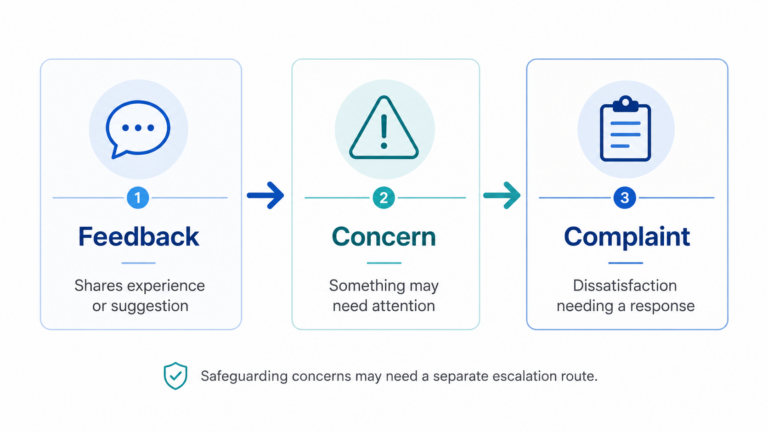
What Counts as a Complaint, Concern or Feedback?
Feedback is information about someone’s experience of a service. It may be positive, negative or neutral. A resident might praise staff communication, for example, or suggest that information for families could be clearer.
A concern usually identifies something that may need attention. It does not always become a formal complaint. A relative might tell a care worker that they are worried because they have not received an expected update about their family member.
A complaint expresses dissatisfaction and normally requires a response through the provider’s complaints arrangements. It can be made verbally or in writing, depending on the organisation’s procedure.
These categories can overlap. Someone may begin by raising a concern informally and later decide to make a formal complaint if the issue remains unresolved.
The important point is that staff should not dismiss an issue simply because the person has not used the word “complaint”. CQC states that providers should have an effective and accessible system for receiving and responding to complaints. (Care Quality Commission)
Common Types and Examples of Complaints
Complaints can arise in almost every area of health and social care. Some may involve a relatively straightforward service issue, while others may indicate a more serious failure in care.
| Complaint type |
Typical examples |
| Quality of care |
Missed care, delayed support or unmet needs |
| Communication |
Information not explained clearly or updates not provided |
| Staff behaviour |
Rudeness, dismissive communication or unprofessional conduct |
| Dignity and respect |
Lack of privacy or failure to respect personal preferences |
| Safety |
Concerns about unsafe practice, medication or possible neglect |
| Service arrangements |
Appointment problems, delays or difficulties accessing support |
For example, a family member may complain that they have repeatedly asked questions about a relative’s care but have not received clear answers. The immediate issue may be communication, but the provider should still consider whether the problem reflects a wider weakness in its systems.
Similarly, a person receiving domiciliary care may report that a scheduled visit was missed. This should not automatically be treated as a minor inconvenience. The provider may need to establish what happened, whether the person’s needs were affected and whether further action is required.
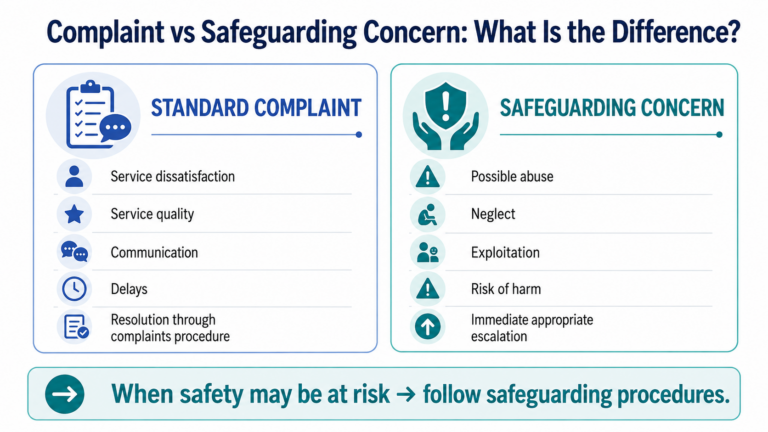
Complaint vs Safeguarding Concern: What Is the Difference?
A complaint and a safeguarding concern are not automatically the same thing. A complaint may relate to dissatisfaction with a service, while a safeguarding concern involves a possible risk of abuse or neglect and may require a different response.
| |
Standard complaint |
Safeguarding concern |
| Main issue |
Dissatisfaction with a service, experience or decision |
Possible abuse, neglect, exploitation or risk of harm |
| Main purpose |
Resolve the concern and improve the service |
Protect the person from harm or further risk |
| Examples |
Poor communication, delays or service quality |
Abuse, neglect, financial exploitation or serious unsafe care |
| Action |
Follow the organisation’s complaints procedure |
Follow safeguarding procedures and escalate appropriately |
| Potential agencies involved |
Provider, manager or complaints lead |
Safeguarding services, NHS, police or other relevant agencies, depending on the circumstances |
The distinction matters because a complaint should not be used as a substitute for safeguarding action.
For example, a person complaining that their appointment was delayed may have a normal service complaint. However, if someone reports that an adult with care and support needs is repeatedly being left without essential care, the concern may require safeguarding action.
The Care and Support Statutory Guidance makes an important distinction between a complaint, a concern about the quality of care or practice and an allegation involving a person in a position of trust. It also states that concerns about abuse or neglect must be passed to a responsible person or agency. (GOV.UK)
Care worker action: If a complaint suggests immediate danger, abuse, neglect or another serious safeguarding concern, do not wait for the ordinary complaints process to resolve the issue. Follow your organisation’s safeguarding procedure and escalate the concern to the appropriate person.
Why Effective Complaint Handling Matters
Good complaint handling gives people a safe way to speak up when something goes wrong or when they believe care could improve. Complaints can also help staff and managers identify problems that they might otherwise miss.
When staff listen to concerns, investigate them fairly and take appropriate action, they can improve safety, responsiveness and person-centred care. CQC Regulation 16 requires providers to operate effective systems for receiving, handling and responding to complaints. (Care Quality Commission)
Improving Care Quality and Person-Centred Care
Person-centred care means respecting each person’s needs, preferences and circumstances. Complaints can show where someone’s experience does not meet these principles.
For example, a resident may complain that staff enter their room without giving them enough privacy. Another person may say that staff ignore their preferences about how they want their support. These concerns may show that the provider needs to improve communication, care planning or staff practice.
The Care Act statutory guidance recognises dignity, respect, control over day-to-day life and protection from abuse and neglect as important aspects of wellbeing. (GOV.UK)
Protecting Service Users and Their Rights
People should feel able to raise concerns without worrying that their care will suffer as a result.
This matters especially when someone relies on care or support every day. Staff should respond fairly, listen carefully and never discourage someone from making a complaint.
Providers should also consider each person’s communication needs and accessibility requirements. Clear information can help people understand how to raise concerns and take part in the complaints process.
Building Trust With Service Users and Families
Trust grows when professionals listen to concerns and respond respectfully.
Care workers do not need to agree with every complaint. However, they should remain professional, avoid assumptions and focus on understanding the person’s experience.
A simple response can acknowledge the concern without promising a particular outcome:
“Thank you for raising this. I will make sure your concern reaches the appropriate person.”
Clear explanations about the next steps can also reassure service users and families. Even when the final outcome differs from what they expected, good communication helps them understand how the organisation handled their concern.
Explore Safeguarding Training
Develop essential knowledge of safeguarding vulnerable adults, recognising concerns and responding appropriately. CPD Accredited and 100% online, ideal for continuing professional development in health and social care.
Step-by-Step Complaint Handling Process
Effective complaint handling should follow a clear process, while the response should reflect the seriousness of the concern, the person’s needs and the organisation’s procedure. The basic approach is to listen, respond, record, escalate, investigate, resolve and learn.
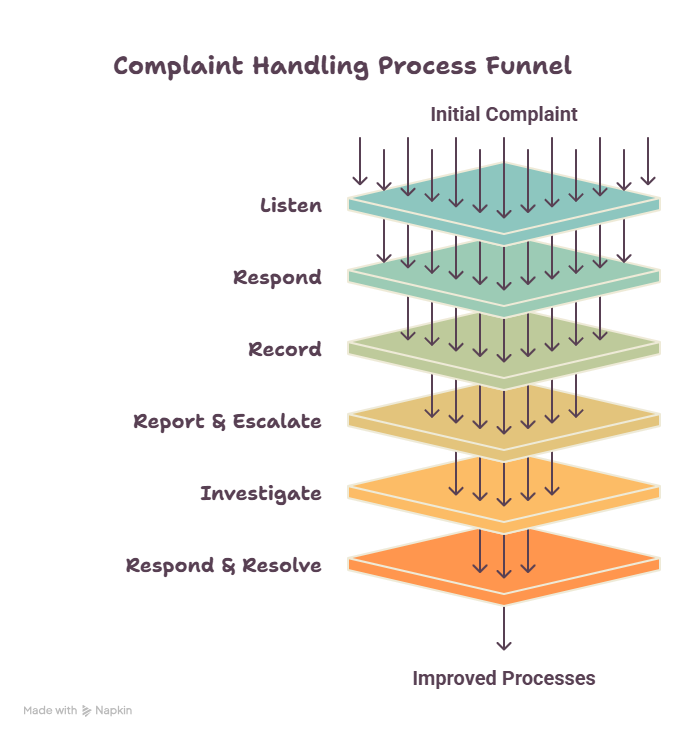
Step 1: Listen Carefully and Understand the Concern
Stay calm and let the person explain what happened. Avoid interrupting, arguing or defending yourself. Ask clear questions where needed, such as:
“Can you tell me what happened and when you first noticed the problem?”
Listening does not mean accepting every allegation as fact. It means understanding the person’s experience and giving the concern proper attention.
Step 2: Respond With Empathy and Stay Professional
Acknowledge the concern without promising a particular outcome.
“I understand why you are concerned. I will make sure this is reported through the correct process.”
Avoid defensive comments such as “That isn’t my fault”. Explain what you can do within your role and who will handle the matter if further investigation is needed.
Step 3: Record the Complaint Accurately and Confidentially
Record what the person reported, when and where the issue occurred, who was involved and what action you took. Use factual language, avoid speculation and protect the information appropriately. CQC Regulation 16 requires providers to operate effective systems for receiving, recording, handling and responding to complaints. (Care Quality Commission)
Step 4: Report and Escalate Appropriately
Follow your organisation’s procedure and report the concern to the appropriate manager or complaints lead. If the concern suggests abuse, neglect or serious harm, follow safeguarding procedures. Frontline staff should not decide for themselves whether a concern warrants escalation. (GOV.UK)
Step 5: Investigate Fairly
Establish what happened without assuming who was responsible. Review relevant records and staff accounts, and separate facts from opinions.
Step 6: Provide a Clear Response
Explain what you investigated, what you found and what action will follow. This may include an explanation, apology or corrective action. Where a notifiable safety incident occurs, the Duty of Candour requires appropriate openness and transparency. (Care Quality Commission)
Step 7: Learn and Improve
Look for recurring problems and consider whether communication, procedures, staffing or training need to change. The aim is not simply to close a complaint, but to understand what happened, put things right where possible and improve care.
Health and Social Care Complaints Procedure in the UK
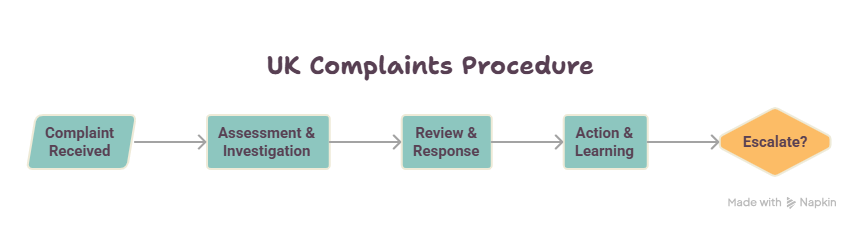
The exact health and social care complaints procedure varies between care homes, domiciliary care providers, NHS services and local authorities. However, most formal processes involve receiving the complaint, assessing the concern, investigating it, providing a response and taking appropriate action.
For regulated providers, CQC Regulation 16 requires an effective system for receiving, recording, handling and responding to complaints. (Care Quality Commission)
How Formal Complaints Are Usually Processed
Complaints may be made verbally, in writing, by email or through an organisation’s online system. Once received, the provider should establish what happened, who needs to investigate, whether there are immediate safety concerns and what information is required.
The investigation should be proportionate to the complaint. A straightforward concern may be resolved quickly, while a complex case may require more detailed investigation.
There is no single response deadline for every health and social care complaint. Timescales depend on the service and its procedure. NHS England states that complaints should normally be made within 12 months and that complaints are acknowledged within three working days. The investigation timeframe depends on the circumstances. (NHS England)
Care professionals should therefore avoid promising a specific response date unless this is confirmed by the organisation’s policy.
The Role of Care Workers, Managers and Registered Providers
Complaint handling involves different responsibilities.
A care worker may receive the initial complaint, listen to the concern, record relevant information and report it according to the organisation’s procedure.
A manager or complaints lead may investigate the issue, review records, speak with staff and communicate the outcome.
A registered provider or registered manager has wider responsibility for ensuring appropriate complaint systems are in place and used effectively.
Importantly, receiving a complaint does not mean a care worker must investigate it. Frontline staff should follow their role and pass the concern to the appropriate person.
NHS and Adult Social Care Complaint Routes
For NHS services, people can normally complain directly to the service that provided their care. NHS England allows complaints to be made verbally or in writing and generally applies a 12-month timeframe. (NHS England)
Adult social care complaints are governed by relevant statutory arrangements. Local authorities must have procedures for handling complaints and, where reasonably practicable, provide assistance to help people understand the process or obtain advice. (GOV.UK)
The correct route depends on whether the complaint concerns a local authority, NHS service or care provider.
Practical point: If someone asks how to make a complaint, follow your organisation’s policy and direct them to the appropriate complaints route rather than giving advice based on assumption.
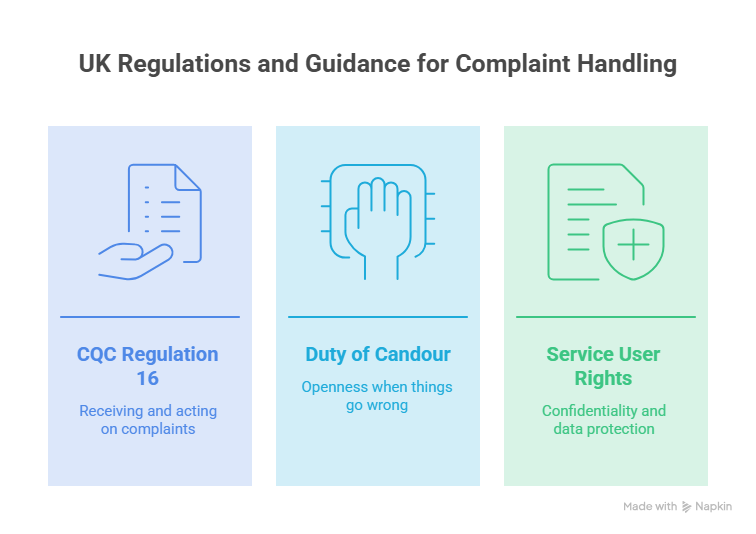
UK Regulations and Guidance for Complaint Handling
Complaint handling sits within a wider framework covering quality, safety, dignity, confidentiality and accountability.
Understanding the main requirements helps care professionals see why complaints must be taken seriously.
CQC Regulation 16: Receiving and Acting on Complaints
CQC Regulation 16 is particularly important for services regulated by the Care Quality Commission.
It requires providers to have an effective and accessible system for receiving and acting on complaints. Providers must also investigate complaints and take appropriate action where failures are identified. (Care Quality Commission)
This means a complaints procedure should be more than a document stored in an office.
People should know how to raise concerns. Staff should know what to do when a complaint is received. Managers should be able to demonstrate that complaints have been considered and appropriate action has been taken.
CQC inspection evidence also shows why this matters. In a recent example, CQC identified failures where complaints were not acknowledged promptly, concerns were not handled through the correct process and the provider did not have a system for analysing complaints or sharing learning with staff. (Care Quality Commission)
Duty of Candour and Openness When Things Go Wrong
The statutory Duty of Candour is set out in Regulation 20 of the Health and Social Care Act 2008 (Regulated Activities) Regulations 2014.
CQC describes it as a general duty for regulated providers to be open and transparent with people receiving care. Where a notifiable safety incident occurs, additional requirements apply. These include informing the relevant person, providing reasonable support, giving an account of the known facts and providing an apology. (Care Quality Commission)
The Duty of Candour is therefore relevant when a complaint involves an incident where something has gone wrong with care or treatment.
It is important not to confuse ordinary complaint handling with the statutory Duty of Candour. Not every complaint triggers the specific requirements for a notifiable safety incident.
However, honesty and openness remain important professional principles when responding to concerns.
Confidentiality, Data Protection and Service User Rights
Complaint records may contain sensitive personal information. Staff therefore need to handle them carefully.
Only relevant information should be shared with people who have a legitimate reason to receive it. Records should be stored securely and handled according to the organisation’s confidentiality and data protection procedures.
This becomes particularly important when a relative, friend or other representative complains on behalf of someone receiving care.
The organisation may need to establish whether the person is authorised to act on the individual’s behalf or whether another lawful basis applies.
Confidentiality does not mean refusing to deal with a complaint. It means managing information responsibly while allowing the concern to be investigated appropriately.
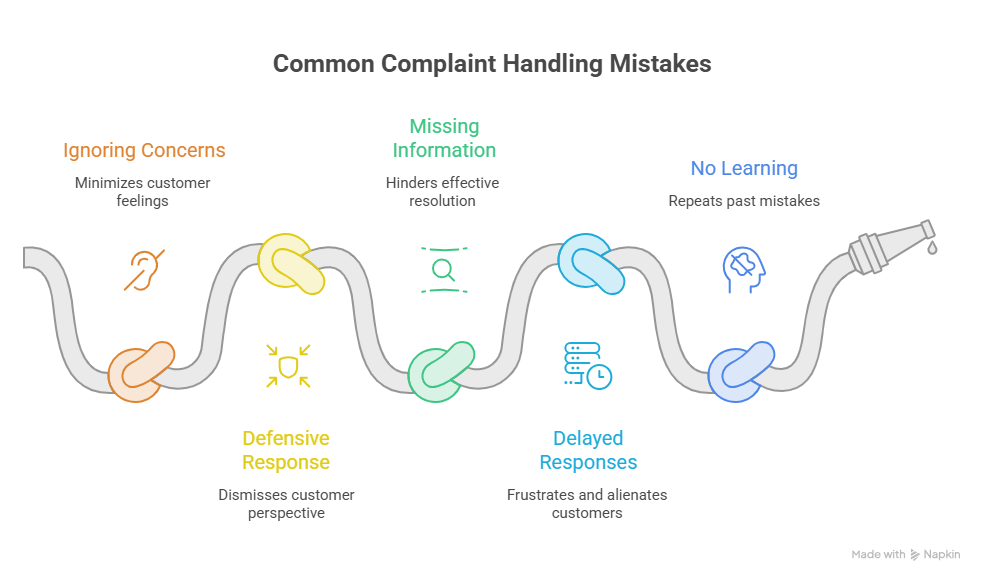
Common Mistakes When Handling Complaints
Even when an organisation has a clear complaints procedure, poor responses can make a difficult situation worse.
Ignoring or Minimising Concerns
A complaint should not be dismissed simply because it appears minor to staff.
What seems small to a professional may be significant to the person receiving care.
For example, repeated concerns about communication could indicate a wider problem with how information is shared.
Listen first, establish what the person is concerned about and then follow the appropriate process.
Becoming Defensive or Dismissive
Defensive behaviour can quickly turn a difficult conversation into a conflict.
Statements such as “That isn’t my responsibility” or “Nobody else has complained” do not address the person’s concern.
Instead, acknowledge what has been raised and explain what you can do within your role.
Failing to Record Important Information
Poor documentation can make it difficult to establish what happened.
Records should focus on relevant facts, actions and outcomes. They should not contain speculation or unnecessary personal comments.
If a complaint is passed verbally from one member of staff to another without being recorded properly, important information can easily be lost.
Delaying or Poorly Communicating Responses
People may become more frustrated when they receive no information after making a complaint.
If an investigation is taking longer than expected, the appropriate person should communicate with the complainant according to the organisation’s procedure.
Silence can create the impression that the complaint has been ignored, even when an investigation is taking place.
Failing to Learn From Complaints
A complaint that is closed without reflection may solve one immediate problem while leaving the underlying issue unchanged.
Managers should look for patterns, consider whether procedures need to change and identify whether staff need additional support or training.
Learning from complaints is therefore an important part of improving care quality.
Why Complaint Handling Training Matters
Complaint handling training can help professionals understand how to communicate with people who are dissatisfied, recognise concerns, follow reporting procedures and contribute to better care.
However, training should form part of wider professional development. Completing an online course does not automatically make someone competent to investigate formal complaints or replace employer policies, statutory requirements or role-specific training.
Developing Communication and Professional Skills
Complaint handling relies heavily on communication.
Professionals need to listen carefully, ask appropriate questions, remain respectful and explain information clearly.
These skills are also useful when working with service users, relatives, colleagues and other professionals in everyday care.
Training can help learners understand why certain communication approaches are more effective than defensive or dismissive responses.
Building Confidence When Responding to Concerns
A complaint can be uncomfortable, particularly when someone is angry or distressed.
Understanding the correct process can make it easier for staff to remain calm and avoid making promises they cannot keep.
Confidence should come from understanding professional responsibilities, not from trying to win an argument.
Supporting Safer and Higher-Quality Care
Complaint handling connects with wider areas of health and social care practice, including safeguarding, dignity, communication, person-centred care and quality improvement.
For example, a complaint about missed care may prompt a review of staffing or scheduling. A complaint about privacy may highlight the need to reinforce dignity standards.
The complaint itself can therefore become a source of learning.
How These Skills Support Professional Development
For people working or planning to work in health and social care, complaint handling knowledge can complement broader learning in communication, safeguarding, person-centred care and professional responsibilities.
Relevant health and social care training can help learners build subject knowledge and understand the principles that shape professional practice.
However, learners should always check the requirements of a particular employer, role or regulated profession before assuming that a CPD course replaces a formal qualification.
Conclusion: Improving Care Through Effective Complaint Handling
A complaint can be uncomfortable for everyone involved, but it can also reveal something that needs attention. Effective complaint handling in health and social care starts with listening and continues through accurate recording, appropriate escalation, fair investigation and clear communication.
For care workers, the key is to understand the limits of their role. They should not dismiss concerns, promise outcomes they cannot control or investigate matters beyond their authority. Instead, they should listen respectfully, record relevant information, follow the correct procedure and escalate serious concerns when required.
For providers and managers, complaints offer valuable information about people’s experiences. When organisations examine patterns, respond openly and act on what they learn, complaints can support better communication, safer practice and more person-centred care. CQC’s regulatory approach also makes clear that effective complaint systems should lead to meaningful learning and improvement. (Care Quality Commission)
Ultimately, good complaint handling is not about preventing people from complaining. It is about creating a culture where people can raise concerns safely, professionals know how to respond and organisations use feedback to improve care.
Strengthen Your Safeguarding Knowledge
Learn to recognise safeguarding concerns, understand your responsibilities and respond appropriately. CPD Accredited and 100% online, ideal for continuing professional development in health and social care.