

Family Support Worker Course with CPD Certificate – What’s Included and Who Should Enrol
A Family Support Worker Course provides foundational knowledge on child safeguarding, family risk assessments, multi-agency referrals, and support planning. While a CPD certificate demonstrates professional development and theoretical understanding, it is an un-regulated training credential that complements—but does not replace—statutory social work qualifications, background checks (DBS), or practical workplace experience.
Moreover, the need for family services is clear today. For example, national figures show the scale of need for family services today. Specifically, England recorded 402,400 children as children in need on 31 March 2025—around one in every 30 children. In addition, almost 633,000 referrals reached children’s social care during the year. These figures do not measure vacancies, but they show the scale and complexity of support needs across families and communities.
Furthermore, during the course, you learn how family difficulties develop and how workers approach safeguarding, assessment, communication and relationship-building. You also explore policy, professional ethics, support planning and referrals. This knowledge can strengthen your CV and CPD record, although employment still depends on experience, checks, qualifications and each employer’s family support worker requirements, so you can plan realistic next steps carefully.
Ready to understand the work before applying for it? This guide explains what the training covers, who should enrol and how a CPD certificate differs from a regulated qualification. The Family Support Worker – CPD Accredited course builds structured knowledge before you pursue volunteering, related work or further training.

What Is a Family Support Worker Course Online and What Does It Include?
An online Family Support Worker course is a self-paced training module that teaches the core principles of early intervention, UK safeguarding legislation, multi-agency practice, and family assessment frameworks. As a result, it prepares learners to support vulnerable children and parents before family issues escalate to statutory social care interventions.
More importantly, The course connects learning with the responsibilities family support workers face every day, including:
- Family support principles, family dynamics and common sources of conflict
- UK legislation, policies and professional responsibilities
- Safeguarding, child protection and recognising vulnerability
- Assessing needs and identifying family strengths
- Building professional relationships and communicating without judgement
- Early intervention, referrals and multi-agency practice
- Ethics, confidentiality and professional boundaries
Our Family Support Worker – CPD Accredited course brings these areas together in a structured and accessible format. You explore how to recognise concerns, communicate with families, understand support needs and follow ethical practice.
Moreover, knowledge alone does not prove workplace competence. However, a course cannot replace supervised experience, background checks, references or employer-led training.
use family support worker training UK as a foundation, then build practical experience and role-specific evidence before applying for family support positions with confidence.
How Is the Course Delivered, Assessed and Who Should Enrol?
Specifically, Online Family Support Worker – CPD Accredited is delivered asynchronously via digital learning platforms over a 12-month access window. In addition, assessment is conducted through automated multiple-choice examinations (requiring a 60% pass mark) alongside optional reflective written assignments to evaluate professional judgement.
In particular, this CPD-accredited family support worker training may suit:
- Career Starters: Aspiring family support workers seeking foundational knowledge prior to applying for entry-level roles or volunteering.
- Education Practitioners: Teaching assistants, early years staff, and pastoral care workers expanding their safeguarding expertise.
- Community Workers: Youth workers, charity volunteers, and housing officers supporting vulnerable households.
- Active Support Staff: Experienced care and support workers seeking verifiable CPD hours to update their professional profile.
After successfully completing the Family Support Worker Course Online, you can order a CPD Certificate as evidence of your continuing professional development and achievement. The certificate can strengthen your professional profile and demonstrate your commitment to developing relevant family-support knowledge and skills.
Product & Pricing Overview
- Access Period: 12 Months (Self-Paced Digital Access)
- Assessment: Automated Multiple-Choice Exam (60% Passing Grade Required)
- Digital CPD Certificate: £10
- Printed CPD Certificate: £29
- Digital + Printed Bundle: £39
However, this course does not replace social work registration, regulated qualifications or workplace assessment. Therefore, check the access period, tutor support, retake policy, device compatibility, certificate costs and refund terms before enrolling. These details help you choose training that matches your learning needs and career goals.
Family Support Worker Job Description: Duties, Purpose and Difference From a Social Worker
A Family Support Worker delivers practical, day-to-day assistance and early intervention guidance to families facing acute stress. Unlike Social Workers, Family Support Workers do not hold statutory authority, cannot perform legal risk assessments, and do not require formal registration with Social Work England. According to the National Careers Service, workers also create plans, support parenting skills and follow safeguarding procedures within professional limits and local policies.
Family support worker job descriptions usually cover five responsibilities:
Assessment:
First, workers assess family needs through conversations, home visits and regular reviews. They identify risks. They also recognise strengths that can support lasting change together.
Support Plans:
Next, they develop and review support plans with families. They strengthen parenting skills, improve communication and create positive routines that make everyday life manageable again.
Child Growth:
Then, workers promote children’s development through learning, language and emotional support. They notice changes, share concerns and help parents respond to developmental needs appropriately.
Collaboration:
Meanwhile, they collaborate with partner agencies through meetings, referrals and signposting. As a result, clear communication helps families reach specialist services without repeating their story unnecessarily during assessments.
Documentation:
Finally, workers maintain accurate records of visits, actions, risks and decisions. They follow safeguarding procedures, seek supervision and escalate concerns through the correct channels promptly.
How Does a Family Support Worker Differ From a Social Worker?
Both family support workers and social workers help people manage difficult circumstances, but their authority, qualifications and responsibilities differ. In practice, family support workers provide practical, early and targeted assistance within organisational procedures. By comparison, social workers complete statutory assessments, manage higher-risk cases and practise as regulated professionals after completing recognised training and registration in England. The clearest way to understand the difference is to compare what each professional contributes:
Family Support Worker:
A family support worker offers practical help, parenting guidance and service referrals. They follow support plans, record concerns and escalate safeguarding risks through supervision promptly.
Social Worker:
A social worker assesses complex needs, protects vulnerable people and makes statutory decisions. In England, they need a recognised qualification and Social Work England registration.
Family Support Worker vs. Social Worker: Direct Comparison
| Comparison point | Family Support Worker | Social Worker |
|---|---|---|
| Purpose | Gives practical and preventive help to children, parents and carers. | Protects vulnerable people, completes formal assessments and coordinates statutory support. |
| Duties | Reviews needs, supports routines, makes referrals, records visits and contributes to shared plans. | Assesses risk, manages complex cases, writes reports and develops statutory plans. |
| Authority | Works within employer procedures, supervision and agreed plans, while escalating serious safeguarding concerns. | Uses statutory responsibilities within legislation, professional standards and organisational powers. |
| Qualifications | Employers may accept relevant Level 3 learning, experience, volunteering or transferable skills. | Requires a recognised social work qualification before registration and professional practice. |
| Registration | No single statutory register covers every family support worker role. | Social Work England regulates practitioners and maintains England’s public register. |
| Salary | National Careers Service estimate: £24,000–£36,000. | National Careers Service estimate: £32,000–£48,000. |
| Career direction | May progress into senior family support, early help, safeguarding or service coordination. | May specialise in children’s, adult, mental health or management services. |
Therefore, family support workers provide structured practical help, while social workers hold regulated responsibilities for formal assessment, protection and statutory intervention.
Who Do Family Support Workers Help and Why Does Family Support Matter?
Family support workers help households manage pressures that affect safety, stability and everyday life. For example, families may face parenting difficulties, separation, domestic abuse, poverty, housing insecurity, mental ill health, substance misuse, SEND, bereavement, isolation, communication barriers, school absence or imprisonment. Moreover, these challenges often overlap. For example, insecure housing can increase stress, interrupt school attendance and damage relationships. Effective support therefore considers the whole household rather than treating one visible problem alone.
Department for Education data shows that parental mental health concerns affected 35% of assessed children in 2025, while parental domestic abuse affected 33%.
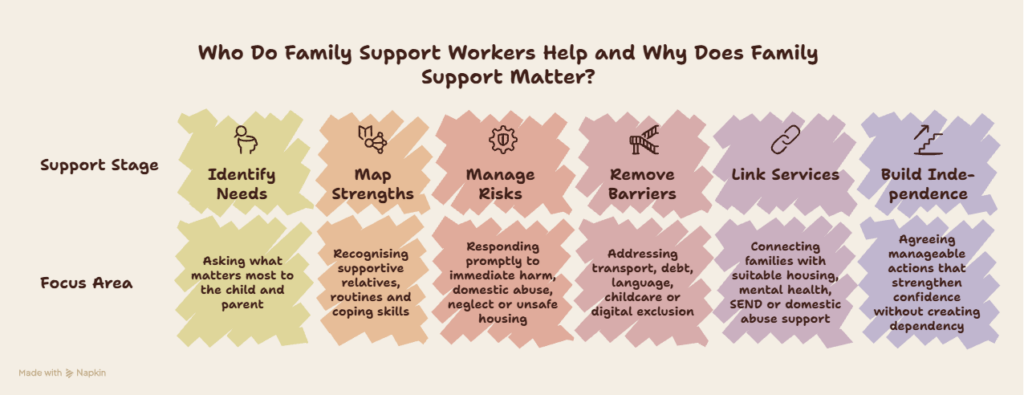
Good support therefore looks at the whole family. It asks:
Identify Needs: What matters most to the child and parent?
First, identify what matters most to the child and parent. For example, ask what they want to change. Then place their views at the centre of assessment, planning and every review meeting with the professionals supporting them.
Map Strengths: What is working well already?
Next, explore what already works well within the household. Recognise supportive relatives, routines and coping skills. These strengths provide practical foundations for progress and help families feel respected during difficult periods and possible future setbacks.
Manage Risks: Which risks need urgent action?
However, identify risks that require urgent action. In particular, consider immediate harm, domestic abuse, neglect or unsafe housing. Follow safeguarding procedures promptly rather than delaying action while gathering unnecessary information or relying on assumptions when pressure rises.
Remove Barriers: Which practical barriers block progress?
Then, uncover practical barriers that block progress. Consequently, transport, debt, language, childcare or digital exclusion can prevent engagement. Addressing these obstacles often makes wider emotional and behavioural support more effective because families can participate more consistently.
Link Services: Which service can provide specialist help?
Afterwards, connect the family with suitable specialist help. For instance, specialist help may include housing, mental health, SEND or domestic abuse services. Clear referrals reduce delays and prevent families repeating painful information during stressful assessments and service changes.
Build Independence: How can the family gain confidence rather than become dependent?
Finally, build confidence without creating dependency. Therefore, agree on small actions that the family can manage themselves. Review progress, celebrate improvement and gradually reduce support when the household can maintain positive change as professional support gradually reduces safely.
Ultimately, family support works best when professionals reduce risk, strengthen existing abilities and keep each child’s needs firmly central throughout.
Family Support Worker Skills: Communication, Home Visits and Professional Boundaries
Professional family support relies on three core competencies: non-judgemental communication, strict home-visit safety protocols, and robust boundary setting. Workers must maintain clear ethical separation between personal relationships and professional duty. For instance, the National Careers Service highlights listening, patience, flexibility, teamwork and clear communication as core abilities. These skills help workers build trust while keeping children, parents and colleagues safe during sensitive conversations, home visits and difficult decisions.
Three areas matter most:
Communication:
First, use active listening, empathy and plain language to understand concerns. Additionally, adapt your approach for children, SEND, disability or language needs. Ask open questions, check understanding and avoid judgement. Clear communication reduces conflict, strengthens trust and helps families take part in decisions that affect their lives during assessment and planning.
Home Visits:
Next, review known risks, follow lone-working procedures and confirm the visit’s purpose. However, observe carefully without making assumptions. Leave immediately if the environment becomes unsafe. Afterwards, record what you saw, heard and did, then escalate safeguarding concerns through the correct organisational route. Moreover, seek supervision whenever risk, uncertainty or professional concern increases.
Professional Boundaries:
Finally, explain confidentiality and its limits from the start. Avoid personal loans, unsuitable gifts, private social-media contact and promises you cannot keep. Write objective notes based on evidence, not opinion. Strong boundaries protect the family, the worker and the integrity of the support plan across every professional interaction and decision.
Together, these skills help family support workers build trust, manage risk and deliver consistent, professional support in complex situations every day.
Family Support Worker Scope: Child Protection, Child Development and Family Assessment
Safeguarding encompasses all policies designed to promote child welfare, whereas Child Protection specifically focuses on interventions for children suffering—or likely to suffer—significant harm. Therefore, family support workers need enough knowledge to recognise concerns, respond calmly and follow reporting procedures.
Additionally, they must understand child development and assess the wider family situation without making assumptions. In particular, England’s Working Together to Safeguard Children 2026 guidance explains how agencies should coordinate help, protection and statutory action across services.
Three connected responsibilities shape safe practice:
Child Protection:
First, recognise possible signs of abuse, neglect or exploitation, including unexplained injuries, persistent hunger, fearfulness or sudden behavioural changes. If a child speaks, listen carefully. Meanwhile, stay calm and never promise secrecy. Afterwards, record their words accurately, then report the concern through your organisation’s safeguarding route promptly, without attempting a formal personal investigation.
Child Development:
Next, consider how children grow physically, emotionally, socially and through communication, play and learning. For example, behaviour can reveal fear, unmet needs, developmental differences or SEND-related challenges. Therefore, compare observations with the child’s age, circumstances and usual presentation. However, avoid labels. Instead, share concerns with appropriate professionals and keep the child’s experience central throughout assessment.
Family Assessment:
Finally, assess the wider family picture by exploring parenting capacity, housing, finances, relationships, culture, support networks and protective factors. Importantly, separate evidence from assumption. At the same time, identify strengths alongside risk. When significant harm may exist, escalate concerns because local authorities lead section 47 enquiries, while family support workers contribute information within their role.
Together, these skills help workers recognise harm, understand children’s needs and support safe, coordinated decisions without exceeding their professional authority.
Family Support Planning, Intervention Strategies and Case Management
Family support planning converts complex assessment data into structured, measurable intervention goals. Meanwhile, effective case management requires maintaining objective records, protecting confidential data, and applying evidence-based methodologies like trauma-informed support and strengths-based coaching. England’s Working Together to Safeguard Children 2026 guidance supports coordinated Family Help assessments and plans, consistent practitioner relationships and multidisciplinary working. Good planning therefore connects family views, professional evidence, safeguarding decisions and measurable progress instead of producing paperwork that nobody uses during reviews and changing family circumstances.
Three connected areas turn assessment evidence into safe, accountable family support:
Family Support Planning:
Family support planning turns assessment findings into clear, shared actions. Specifically, it records priorities, responsibilities, deadlines and review measures. As a result, families and professionals can understand the next steps and how professionals will check progress.
Sample Actionable Family Support Plan –
| Element | Specification |
|---|---|
| Identified Need | Unexcused school absence (child misses school twice weekly) |
| Desired Outcome | Achieve 95%+ school attendance and establish calm morning routines |
| Agreed Action | Implement bedtime device limits and structured morning preparation schedules |
| Responsible Parties | Parent, Family Support Worker, and School Attendance Officer |
| Review Window | 4-week progress evaluation |
Intervention Strategies:
Next, family intervention strategies translate goals into purposeful action. For example, workers may use strengths-based conversations, parenting routines, motivational approaches, trauma-aware engagement and practical signposting. However, when families resist support, workers should explore previous experiences, barriers and fears instead of blaming them. Afterwards, they can adapt communication and rebuild trust carefully through clear, respectful choices.
Case Management:
Finally, case management keeps support organised, accountable and secure. Workers manage appointments, coordinate referrals, update plans and prepare for reviews. In addition, they separate fact from opinion, protect confidential records and explain decisions clearly. If risk rises, immediate escalation is required. Similarly, safe closure or transfer needs a recorded reason and careful handover process.
Together, planning, intervention and case management help families make measurable progress while professionals monitor risk and remain accountable.
Early Help Services, Family Hubs and Multi-Agency Working of Family Support Worker
Multi-agency working connects distinct public services—schools, health visitors, police, housing authorities, and social care—under a single unified support plan. Guided by Working Together to Safeguard Children, early help arrangements ensure families receive coordinated care without repeating their history to multiple agencies. In practice, families rarely need one service because school absence may connect with housing, parental health, SEND, domestic abuse or debt. As a result, coordinated support becomes especially important when several needs overlap. England recorded 402,400 children in need and 632,800 referrals to children’s social care in 2025, showing why coordinated support matters.Moreover, Working Together to Safeguard Children 2026 now joins targeted early help and section 17 support through Family Help, promoting consistent practitioners, shared assessments and multidisciplinary plans.
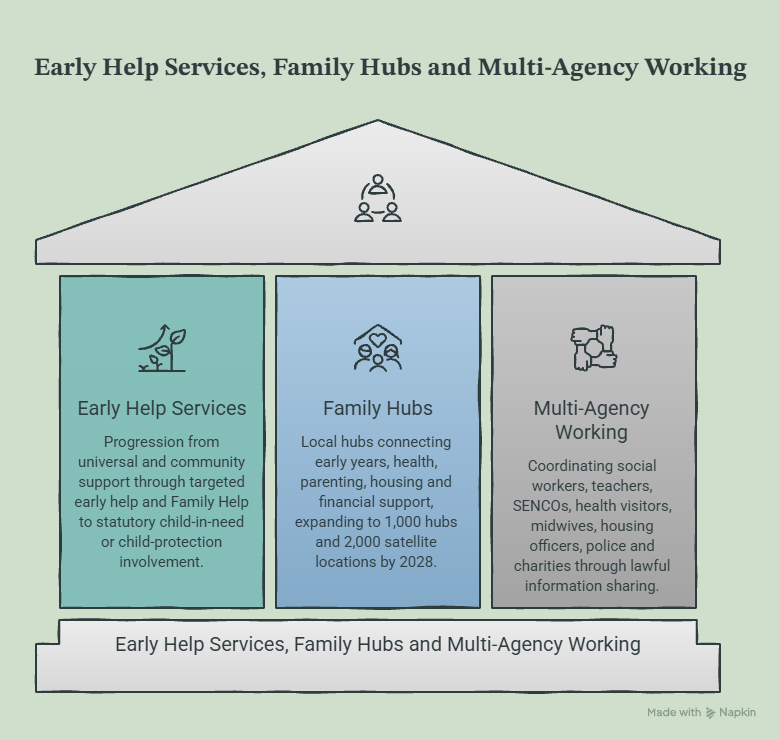
Three connected systems help families receive suitable support before difficulties escalate or risks increase further:
Early Help Services:
First, support may move across universal and community services, including schools, health and youth provision; targeted early help for multiple or complex needs; coordinated Family Help plans; and statutory child-in-need or child-protection involvement when thresholds apply. Therefore, practitioners should match intervention intensity to changing need and risk carefully.
Family Hubs:
Next, Best Start Family Hubs connect early years, health, parenting, housing and financial support locally. In March 2026, the government reported over 200 new hubs and expected 800 by April’s end, with up to 1,000 hubs and 2,000 satellite locations planned across England by 2028. As a result, families should have easier access to connected services.
Multi-Agency Working:
Finally, family support workers coordinate with social workers, teachers, SENCOs, health visitors, midwives, housing officers, police and charities. They clarify roles, share relevant information lawfully, make accurate referrals and escalate risk promptly. As a result, a lead practitioner keeps the family plan coherent and reduces the need for families to repeat their stories across services.
Together, early help, Family Hubs and multi-agency working connect families with timely support while professionals monitor changing needs and risks.
How to Become a Family Support Worker: Entry Requirements, Salary and Career Path
Entering family support work requires demonstrable experience with children or vulnerable adults, a clear Enhanced DBS check, and strong safeguarding knowledge. Meanwhile, salaries range from £24,000 to £36,000 for direct support roles, with clear progression routes into social work, management, or specialist advocacy.
Possible UK Career Routes and Salary Estimates
| Job role | Short description | Estimated UK salary |
|---|---|---|
| Family Support Worker | Assesses family needs, develops support plans and connects parents and children with suitable services. | £24,000–£36,000 |
| Social Work Assistant | Supports people with practical, emotional and social needs under qualified social workers’ guidance. | £20,000–£28,000 |
| Residential Support Worker | Supports children or vulnerable adults within residential homes and promotes their safety, wellbeing and independence. | £22,000–£30,000 |
| Youth Worker | Helps young people develop confidence, life skills, relationships and educational or personal goals. | £24,000–£37,000 |
| Education Welfare Officer | Works with schools and families to address attendance problems and remove barriers to education. | £24,000–£32,000 |
| Community Development Worker | Builds local projects, increases participation and helps communities respond to shared social problems. | £19,000–£36,000 |
| Advocacy Worker | Helps children, families or vulnerable adults express their views and understand decisions affecting their care. | £19,000–£30,000 |
| Counsellor | Provides structured emotional support and helps individuals or families understand feelings and manage difficulties. | £25,000–£48,000 |
| Social Worker | Protects vulnerable people, completes statutory assessments and coordinates formal care or safeguarding interventions. | £32,000–£48,000 |
| Social Services Manager | Leads social care services, manages staff, budgets and service quality across councils or charities. | £35,000–£65,000 |
These figures provide general estimates rather than guaranteed starting pay. Location, employer, experience and responsibilities can change earnings. Counselling, social work and management roles also require additional qualifications, experience or professional registration.
Build relevant knowledge first, gain credible experience next, then pursue roles that match your qualifications, strengths and long-term ambitions.
CPD Certificate vs Family Support Worker Level 3 Qualification and Apprenticeship
A CPD certificate verifies that you have completed continuing professional development reading. Meanwhile, a Regulated Level 3 Qualification appears on official national registers (like Ofqual), while an Apprenticeship blends full-time paid employment with supervised workplace assessments. Therefore, understanding these differences helps you choose suitable learning, avoid misleading claims and explain your achievement accurately to employers.
Before enrolling, consider what each learning route proves and whether it matches the family support worker requirements listed by employers:
CPD Certificate:
A CPD Certificate confirms that you completed professional-development learning. It can strengthen your CV, support reflection and demonstrate commitment. However, it does not automatically prove occupational competence, provide statutory authority or equal a regulated qualification.
Family Support Worker Level 3 Course:
A commercial Family Support Worker Level 3 course may describe learning difficulty or course positioning. Therefore, check the awarding organisation, qualification number and regulatory status before assuming that the programme carries official Level 3 recognition.
Regulated Level 3 Qualification:
A regulated Level 3 qualification appears on the relevant official register and follows defined assessment rules. It names an approved awarding organisation and may require assignments, practical evidence or workplace observation, depending on its specification.
Apprenticeship:
An apprenticeship combines paid employment, structured learning and workplace development. Level 4 routes, including Children, Young People and Families Practitioner or Early Intervention Practitioner, also require occupational training and an independent end-point assessment before completion.
The following table compares each learning route :
| Comparison point | CPD Certificate | Family Support Worker Level 3 Course | Regulated Level 3 Qualification | Apprenticeship |
|---|---|---|---|---|
| Main purpose | Records continued professional development and subject knowledge. | Introduces family-support learning described at Level 3 depth. | Provides formally recognised vocational learning through an approved awarding organisation. | Combines paid employment, structured study and supervised workplace development. |
| Regulatory status | Usually non-regulated unless the provider confirms otherwise. | The title alone does not confirm regulated status. | Appears on the relevant official qualifications register. | Follows an approved occupational standard and apprenticeship requirements. |
| Assessment | May include quizzes, assignments or an online examination. | Assessment varies and may remain fully online. | Uses defined assessments, including assignments or workplace evidence. | Includes training, workplace evidence and end-point assessment. |
| Employment value | Supports a CV and CPD portfolio but does not prove competence. | Builds knowledge, although employers may not recognise it as a formal qualification. | May meet employer qualification requirements. | Demonstrates occupational competence after successful completion. |
| Entry requirements | Often accepts beginners. | Provider conditions vary. | Requirements depend on the awarding organisation. | Requires an apprenticeship job. |
| Best suited to | Flexible CPD learners. | Beginners exploring family support. | Learners who need recognised achievement. | People seeking paid workplace training. |
Therefore, choose CPD for knowledge development, a regulated qualification for formal recognition, or an apprenticeship for structured workplace competence.
Final Thought: Build Family Support Knowledge with the Family Support Worker Course with CPD Certificate
The Family Support Worker Course with CPD Certificate is not about giving you authority to solve every family problem. In particular, it helps you understand how professionals support children, parents and carers through safeguarding, communication, assessment and planned intervention.
Start by learning what the family support worker role involves and how workers respond to changing needs, risks and family circumstances. The Family Support Worker Course with CPD Certificate will help you build your knowledge of child protection, family relationships, professional boundaries, early help, support planning and multi-agency working.
Use the CPD certificate as evidence of continuing professional development rather than guaranteed employment or workplace competence. Employers may still expect relevant experience, background checks, professional references, regulated qualifications or further workplace training.
Ultimately, are you ready to understand family support work and prepare for your next step? Enrol in the Family Support Worker – CPD Accredited and begin building relevant knowledge today.
Table of Contents

Frequently Asked Questions
What does a family support worker course include?
A family support worker course typically covers family support principles, legislation, safeguarding, family challenges, relationship-building, communication, needs assessment and support planning. Online programmes may also include quizzes, assignments and assessments to check learners’ understanding overall.
Is a CPD family support worker course recognised in the UK?
A CPD family support worker course can be recognised as continuing professional development, but employer acceptance varies. It demonstrates learning and commitment, not automatic occupational competence, professional registration or equivalence to a regulated UK qualification.
Is a CPD certificate the same as a regulated qualification?
No. A CPD certificate records continuing professional development, while a regulated qualification must appear on the appropriate official qualifications register and meet regulatory requirements. Always check the exact qualification title, awarding organisation and regulatory status.
Do I need a Level 3 qualification to become a family support worker?
Not always, but many employers prefer or require Level 3 learning. National Careers Service guidance says direct applicants usually need experience with children or families plus a minimum Level 3 qualification in a related subject.
Can I become a family support worker with no experience?
Yes, but gaining experience usually improves your chances. Volunteering or paid work in nurseries, youth projects, family refuges, community centres or mental health services can help you build experience before applying for family support roles.
How long does family support worker training take?
Training length varies by provider, course depth and study pace. Some online CPD programmes can be completed within weeks, while learners may receive months of access. Always check learning hours, assessments, deadlines and access periods.
What safeguarding training does a family support worker need?
Family support workers need safeguarding knowledge appropriate to their role, including recognising abuse or neglect, responding to disclosures, recording concerns, information sharing and following referral procedures. Employers may also require organisation-specific safeguarding and child-protection training.
Do family support workers need an Enhanced DBS check?
Many family support roles require enhanced background checks because workers may support children or vulnerable people. The exact DBS level depends on duties and activity. Employers determine eligibility and request the appropriate check where permitted.
Do I need a driving licence for family support work?
Not for every role, but National Careers Service guidance says many family support worker positions require a driving licence. Community and home-visiting roles involve travel, so applicants should always check each employer’s job specification carefully.
Where do family support workers work?
Family support workers may work in clients’ homes, schools, offices, courts, family centres, charities, community services and local-authority settings. Their work often involves home visits, partner-agency meetings and supporting families across several community-based environments daily.
What is the average family support worker salary in the UK?
The National Careers Service currently lists family support worker pay at about £24,000 for starters and up to £36,000 for experienced workers. Actual salaries vary by employer, location, responsibilities, experience, working pattern and specialist duties.
Can a family support worker become a social worker?
Yes. Family support work can provide experience for progressing towards social work, but further study is required. In England, practising as a social worker requires a social work degree or postgraduate qualification and professional registration