CPR and Basic Life Support Course with CPD Certificate – Modules and Benefits
Build the Knowledge and Confidence to Respond to a Life-Threatening Emergency
A cardiac arrest, choking incident or breathing emergency can happen without warning. In those first critical moments, knowing how to recognise an emergency and understanding the principles of CPR and Basic Life Support (BLS) can make an important difference while professional medical assistance is being summoned.
The CPR and Basic Life Support Course with CPD Certificate provides structured online training for learners who want to understand cardiopulmonary resuscitation, cardiac arrest response, Automated External Defibrillator (AED) use, choking emergencies and essential Basic Life Support procedures.
Basic Life Support is a fundamental area of emergency care. Current UK BLS training commonly covers recognition of cardiac arrest, the Chain of Survival, CPR and AED use, while broader courses may also address choking and responses for adults, children and infants. These subjects are particularly relevant for people working in healthcare, health and social care, childcare and other environments where an emergency response may be required.
This online Basic Life Support Course is designed to make essential concepts easier to understand. You will explore how to assess an emergency, recognise when someone may require immediate assistance, understand the principles behind chest compressions and rescue breaths, learn how an AED supports resuscitation and consider how responses differ according to the casualty and circumstances.
For healthcare assistants, care workers, support workers, childcare professionals and other learners, completing CPR and Basic Life Support training can also strengthen professional development by increasing awareness of emergency procedures and helping you understand your responsibilities when faced with a potentially life-threatening situation.
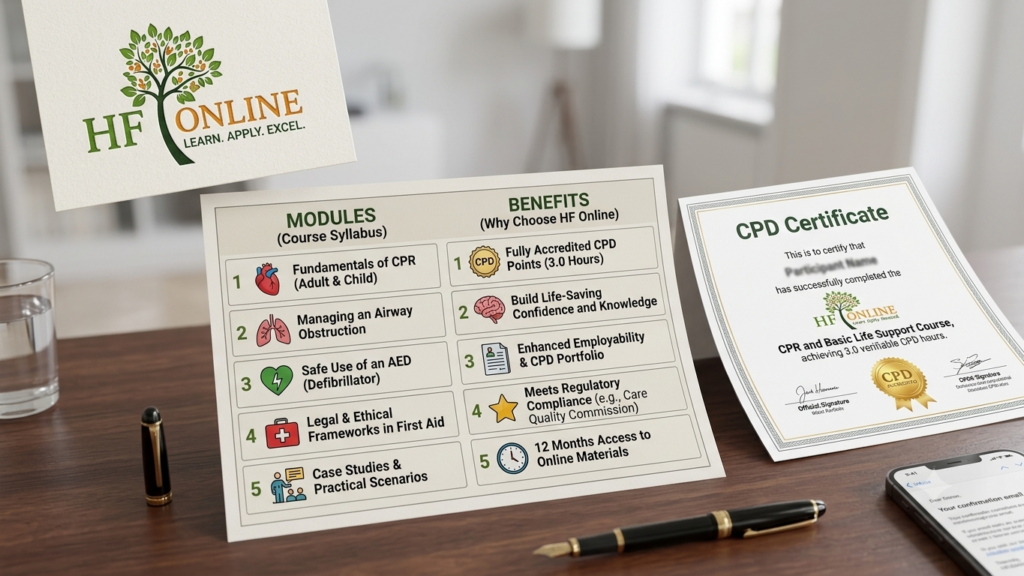
After successfully completing the course and its assessment requirements, eligible learners can receive a CPD certificate, providing evidence of continued professional learning.
What Is CPR and Basic Life Support?
Basic Life Support (BLS) refers to the immediate care given to someone experiencing a life-threatening emergency, particularly when normal breathing or circulation has been compromised. It commonly includes recognising cardiac arrest, calling for emergency assistance, cardiopulmonary resuscitation and using an Automated External Defibrillator where appropriate.
Cardiopulmonary Resuscitation (CPR) is a central part of Basic Life Support. CPR uses chest compressions, with rescue breaths where appropriate, to help maintain circulation and oxygen delivery when a person is in cardiac arrest.
Basic Life Support also involves recognising that an emergency is occurring and taking appropriate action without unnecessary delay. Effective emergency response is therefore not simply about remembering individual techniques. It depends on understanding the sequence of actions that connects early recognition, emergency activation, CPR, defibrillation and advanced medical care.
An online CPR and Basic Life Support Course provides learners with structured knowledge of these principles. However, online learning should not be misrepresented as a substitute for hands-on competency assessment where an employer, professional body or workplace policy requires face-to-face demonstration of CPR or other resuscitation skills.
Why Is Basic Life Support Training Important?
Cardiac arrest can occur suddenly and requires an immediate response. When the heart stops pumping blood effectively, the brain and other vital organs are deprived of oxygen. Recognising the emergency, contacting emergency medical services and beginning appropriate Basic Life Support measures quickly are therefore central to the Chain of Survival.
BLS training helps learners understand what to do during these high-pressure situations. Without prior knowledge, an emergency can feel confusing and overwhelming. Structured CPR training creates a clearer framework for recognising danger, seeking assistance and responding in an organised way.
Basic Life Support knowledge is particularly relevant within healthcare and social care. Healthcare assistants, support workers, carers and other professionals may work with older adults, people living with long-term conditions or individuals who could become acutely unwell.
The value of BLS knowledge extends beyond professional healthcare environments. Parents, teachers, childcare workers, fitness professionals, community workers and members of the public can also benefit from understanding how emergency response works.
What Will You Learn in a CPR and Basic Life Support Course?
A comprehensive CPR and Basic Life Support Course introduces the essential principles of emergency response and resuscitation.
Learners can develop their understanding of emergency scene assessment, cardiac arrest recognition, the Chain of Survival, cardiopulmonary resuscitation, chest compressions, rescue breaths, Automated External Defibrillator use and choking response. Depending on the exact curriculum, training may also cover differences in Basic Life Support for adults, children and infants.
Rather than learning CPR as an isolated subject, the course helps you understand how different emergency actions connect. Recognising cardiac arrest, contacting emergency services, beginning CPR and accessing an AED are all parts of a wider emergency response.
The training also encourages learners to understand personal safety, communication and the importance of acting within the limits of their training and professional responsibilities.
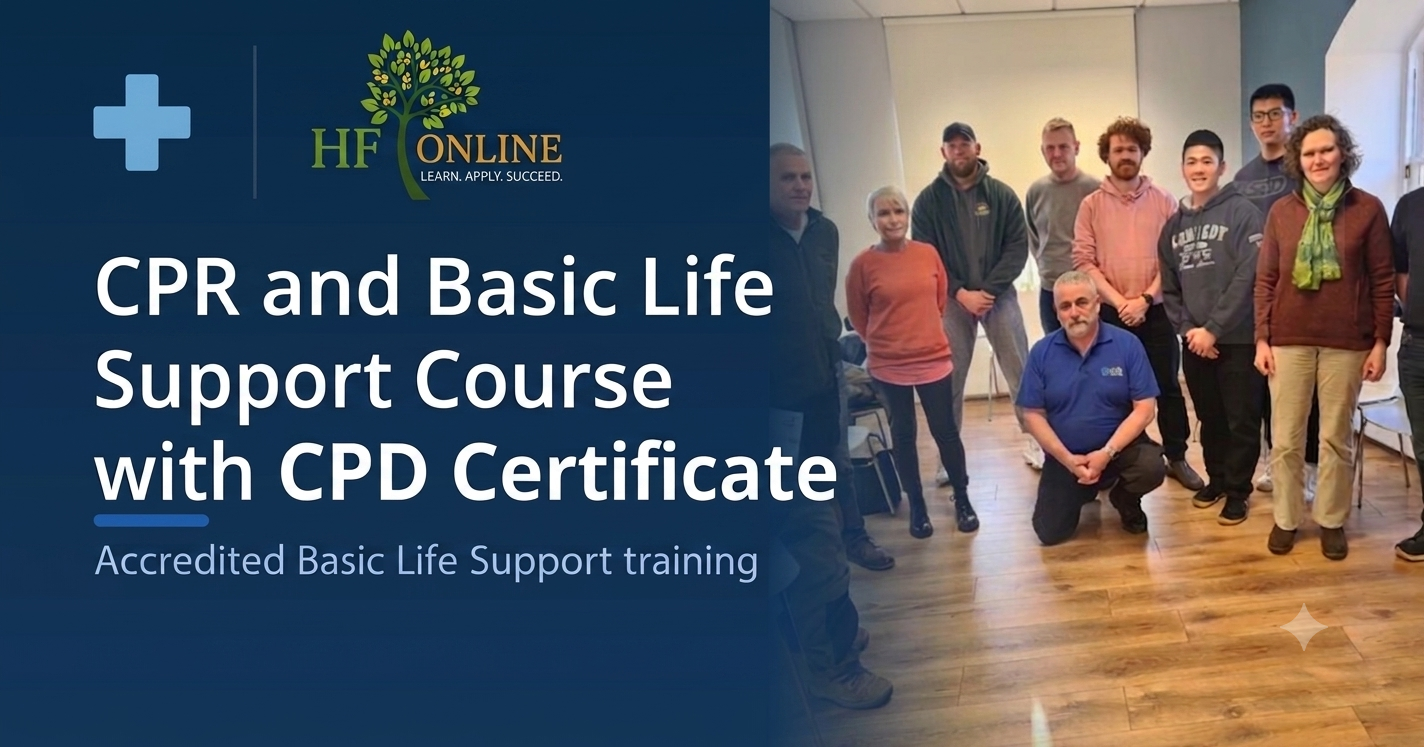
CPR and Basic Life Support Course Modules
Module 1: Introduction to Basic Life Support
The first module introduces Basic Life Support, its purpose and its role during medical emergencies.
You will explore what BLS means, when it may be required and why early intervention matters when someone is unresponsive or not breathing normally. The module establishes a clear foundation for the rest of the course by introducing the sequence of actions used during an emergency response.
Learners also consider the importance of remaining aware of their surroundings before approaching a casualty. An effective emergency response should not create additional danger for the casualty, responder or other people nearby.
The module introduces professional and ethical considerations surrounding emergency assistance, helping learners understand the importance of seeking appropriate help and acting within their level of training.
Module 2: The Chain of Survival
The Chain of Survival is one of the most important concepts in Basic Life Support training. It describes a sequence of actions intended to improve the response to cardiac arrest.
Learners explore the importance of recognising cardiac arrest, activating emergency medical assistance, starting CPR, providing early defibrillation where appropriate and ensuring access to advanced medical care.
Understanding the Chain of Survival helps learners see why emergency response is time-sensitive. No single action operates independently. Each stage supports the next, creating a coordinated approach from the first recognition of an emergency through to advanced treatment and recovery.
This module also helps learners understand their own place within the emergency response process. Even when advanced medical professionals are on their way, early actions by people already at the scene can be an important part of the overall response.
Module 3: Recognising Cardiac Arrest
Before CPR can begin, a responder needs to recognise that a potentially life-threatening emergency is occurring.
This module explores the signs associated with cardiac arrest and explains the importance of checking responsiveness and breathing according to current training guidance.
Learners consider the difference between normal and abnormal breathing and why unusual gasping should not automatically be interpreted as normal respiration. The course also reinforces the importance of contacting emergency services promptly when cardiac arrest is suspected.
Recognising cardiac arrest can be difficult in a stressful situation. Structured Basic Life Support training helps learners develop a clearer mental framework for assessing what is happening and determining when an emergency response should be initiated.
Module 4: Cardiopulmonary Resuscitation (CPR)
Cardiopulmonary resuscitation is at the heart of Basic Life Support. This module develops your understanding of CPR and explains why high-quality chest compressions are essential during cardiac arrest.
Learners study the principles behind chest compressions and rescue breaths, including how CPR supports circulation while emergency medical assistance is being arranged.
The module explains the sequence involved in CPR and introduces the considerations that influence effective resuscitation. Learners also explore why interruptions should be minimised and why responders need to follow recognised resuscitation guidance rather than relying on assumptions.
CPR is a physical skill. An online course can provide valuable knowledge and reinforce the correct sequence, but learners who require demonstrated CPR competence for employment should confirm whether their role also requires instructor-led training and hands-on assessment.
Module 5: Automated External Defibrillator (AED) Awareness
An Automated External Defibrillator (AED) is designed to analyse the heart’s rhythm and, when indicated, deliver an electrical shock during certain cardiac arrests.
This module introduces learners to the purpose of an AED and explains how defibrillation fits within the Chain of Survival. You will learn about preparing for AED use, following device instructions and continuing CPR as directed during the emergency response.
Modern AEDs are designed to provide clear prompts to guide the responder. Nevertheless, prior CPR and AED training can improve understanding of what the device is doing and why following its instructions matters.
The course also addresses important safety considerations so learners understand how AED use integrates with CPR rather than viewing defibrillation as a separate emergency procedure.
Module 6: Responding to Choking Emergencies
Choking occurs when an obstruction interferes with normal breathing. A severe airway obstruction can rapidly become life-threatening, making early recognition and an appropriate response essential.
This module helps learners understand the signs of choking and distinguish between situations where a person can still cough or breathe and those where the airway may be severely obstructed.
Learners explore the recognised sequence of actions used to respond to choking and understand when emergency medical assistance should be requested. The module also considers how choking response differs for adults, children and infants.
For people working in care, healthcare, childcare, hospitality and community environments, choking awareness can be especially valuable because an obstruction can occur unexpectedly during eating or other everyday activities.
Module 7: Adult, Child and Infant Basic Life Support
Basic Life Support principles apply across age groups, but there are important differences when responding to adults, children and infants.
This module introduces those differences and helps learners understand why the casualty’s age and circumstances influence the emergency response. Learners explore age-appropriate considerations surrounding CPR, airway emergencies and emergency assistance.
The aim is not simply to memorise different procedures. Understanding why approaches vary helps learners build a more coherent picture of BLS across different casualty groups.
For healthcare workers, teachers, nursery staff, parents and carers, this broader understanding can be particularly valuable because emergencies may involve people of different ages.
Key Benefits of a CPR and Basic Life Support Course
Completing a CPR and Basic Life Support Course with CPD Certificate can strengthen your understanding of emergency response while supporting continued professional development.
One of the most significant benefits is increased awareness. Medical emergencies can develop quickly, and knowing the principles of BLS can help you recognise when a situation may require urgent action.
The course also provides a structured understanding of CPR, AED use, choking response and the Chain of Survival. Instead of viewing each subject separately, learners understand how these elements work together during an emergency.
For people working in healthcare and social care, BLS knowledge can complement wider training in patient safety, safeguarding, infection control and emergency care. For learners preparing to enter these sectors, it can also provide useful background knowledge before undertaking role-specific workplace training.
A CPD certificate can provide evidence that you have completed structured professional learning. However, learners should always check the requirements of their employer or professional body because some roles require hands-on CPR training and competency assessment in addition to online learning.
Who Should Take a CPR and Basic Life Support Course?
A CPR and Basic Life Support Course can benefit a wide range of learners because cardiac arrest, choking and breathing emergencies are not limited to hospitals.
The course is particularly relevant for healthcare assistants, care workers, support workers, nurses seeking refresher learning, residential care staff, domiciliary carers, therapy assistants and other people working across health and social care.
Teachers, teaching assistants, nursery staff, childcare professionals, fitness professionals, community workers, volunteers and people responsible for workplace safety may also benefit from developing their understanding of CPR and BLS.
Parents, carers and members of the public who want to become more informed about emergency response can also study Basic Life Support.
The appropriate level and delivery method will depend on why you need the training. If CPR certification is required for employment, always check whether your organisation accepts online CPD learning or requires face-to-face instruction and assessed demonstration of resuscitation skills.
CPD Certificate and Professional Development
After completing the CPR and Basic Life Support Course and meeting the relevant assessment requirements, learners may receive a CPD certificate as evidence of their continued professional development.
CPD training can demonstrate a commitment to maintaining and expanding professional knowledge. It may be useful for CVs, professional portfolios, workplace learning records and career development discussions where relevant.
However, a CPD certificate should be described accurately. It is not automatically equivalent to a regulated first aid qualification, professional licence or hands-on competency assessment.
This distinction is especially important for CPR because effective resuscitation involves physical techniques. Where a workplace requires demonstrated competence, learners should complete any additional instructor-led or face-to-face assessment specified by their employer or professional body.
Why Choose an Online CPR and Basic Life Support Course?
Online CPR and Basic Life Support training offers a flexible way to develop emergency-response knowledge around work, study and family responsibilities.
Learners can work through structured course materials, revisit important concepts and strengthen their understanding of CPR, AED use, choking and cardiac arrest without travelling to a classroom.
This makes online learning particularly suitable for CPD, introductory training and knowledge refreshers.
The strongest reason to complete BLS training, however, goes beyond earning a certificate. Understanding how emergency response works can help you become more informed, more prepared and more aware of the actions required when somebody experiences a life-threatening medical emergency.
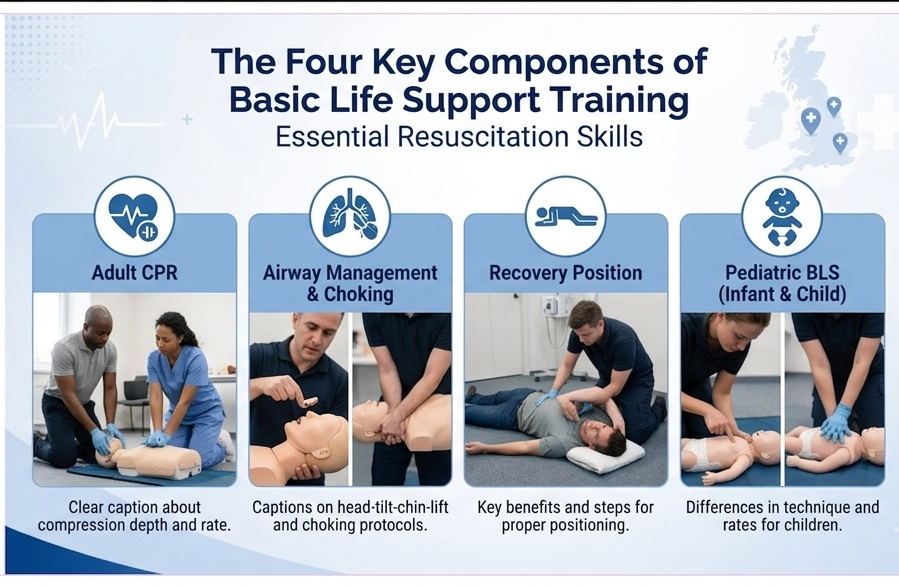
The Four Key Components of Basic Life Support Training
Frequently Asked Questions
What is CPR and Basic Life Support training?
CPR and Basic Life Support training teaches learners how to recognise life-threatening emergencies and understand the immediate response to cardiac arrest, breathing emergencies and choking. Typical BLS training covers CPR, the Chain of Survival and AED awareness.
What does a Basic Life Support Course cover?
A Basic Life Support Course commonly covers emergency assessment, cardiac arrest recognition, CPR, chest compressions, rescue breaths, Automated External Defibrillator use, choking response and the Chain of Survival. Course content can vary between providers.
What is the difference between CPR and BLS?
CPR is a resuscitation technique involving chest compressions and, where appropriate, rescue breaths. Basic Life Support is broader and can include recognition of cardiac arrest, calling emergency services, CPR, AED use and other immediate emergency actions.
Can I learn CPR online?
Online CPR training can teach the principles, sequence and knowledge behind cardiopulmonary resuscitation. However, learners who need demonstrated CPR competence for employment may also need face-to-face instruction and hands-on assessment.
What is an AED?
An Automated External Defibrillator is a device designed to analyse the heart’s rhythm during cardiac arrest and advise or deliver a shock when appropriate. AEDs provide prompts that guide responders through their use.
Does Basic Life Support include choking?
Many Basic Life Support courses include choking recognition and response alongside CPR and AED training. Learners should check the exact syllabus of their chosen course before enrolling.
Does BLS cover children and infants?
Many BLS programmes address differences between adult, child and infant resuscitation. The exact content depends on the course and intended learner group.
Who should complete Basic Life Support training?
BLS training is relevant to healthcare assistants, care workers, support workers, nurses, childcare professionals, teachers, workplace staff, parents, carers and members of the public interested in emergency-response knowledge.
Is a CPD BLS certificate a regulated first aid qualification?
Not necessarily. A CPD certificate demonstrates continued professional learning but should not automatically be treated as equivalent to a regulated first aid qualification or assessed hands-on CPR certification.