

Working in a nursery means more than supporting children’s learning and development. It also means recognising when something may be wrong and knowing how to respond appropriately. That is why safeguarding training is an essential part of working in early years settings.
Nursery staff in England must undertake safeguarding training that meets the Early Years Foundation Stage (EYFS) requirements at least every two years. Designated safeguarding leads (DSLs) need additional training appropriate to their responsibilities.
However, choosing the right training is not always straightforward. Should you take Level 1 or Level 2? Can you complete the course online? Will a certificate meet your nursery’s requirements?
This guide explains the current safeguarding training requirements, what different staff members need to learn and how to choose suitable training.
Child Protection and Safeguarding
Is Safeguarding Training Mandatory for Nursery Staff?
Yes. Safeguarding training is mandatory for nursery practitioners working under England’s EYFS framework.
The EYFS statutory framework sets the safeguarding and welfare requirements for registered early years providers in England, including nurseries and preschools.
Under these requirements, nursery providers must ensure that staff receive appropriate safeguarding training and understand how to identify and respond to potential abuse, harm or neglect.
Training must cover the criteria in Annex C of the EYFS framework. These include recognising safeguarding concerns, understanding reporting procedures and knowing the responsibilities of different professionals.
Does Every Nursery Worker Need the Same Training?
All nursery practitioners need appropriate safeguarding knowledge, but additional training depends on their responsibilities.
For example, a nursery assistant needs to recognise potential safeguarding concerns and understand how to report them. A designated safeguarding lead needs further knowledge to support staff, coordinate safeguarding arrangements and manage concerns appropriately.
Nurseries must also ensure employees understand their own safeguarding policies and procedures.
This means completing a general online course may be useful, but it does not remove the need for workplace-specific induction and guidance.
The requirements discussed here primarily apply to England. Wales, Scotland and Northern Ireland have separate early years safeguarding frameworks, so staff working elsewhere in the UK should check the rules relevant to their setting.
What Level of Safeguarding Training Do Nursery Staff Need?
One of the most common questions is whether nursery staff need Level 1, Level 2 or Level 3 safeguarding training.
These labels are widely used by training providers, but they do not represent a single universal statutory grading system for nursery safeguarding training.
In England, the important requirement is that safeguarding training meets the EYFS criteria and is appropriate to the person’s role.
Level 1, Level 2 and Level 3 Safeguarding Explained
Training providers commonly use these descriptions:
- Level 1 safeguarding: Usually introduces safeguarding awareness, recognising concerns and basic reporting responsibilities.
- Level 2 safeguarding: Often develops understanding of abuse, neglect, child protection procedures and professional responsibilities.
- Level 3 safeguarding: Commonly provides more advanced learning relevant to staff with additional safeguarding responsibilities.
However, course titles and content vary between providers. A Level 2 certificate does not automatically demonstrate that every EYFS training requirement has been met.
Safeguarding Training by Nursery Role
| Nursery role | Main training considerations |
|---|---|
| Nursery assistant | Recognising safeguarding concerns, reporting procedures and workplace policies |
| Nursery practitioner | EYFS safeguarding criteria, identifying risks and appropriate responses |
| Room leader | Core safeguarding knowledge alongside supervisory responsibilities |
| Nursery manager | Staff safeguarding competence, policies, procedures and management responsibilities |
| Designated safeguarding lead | Core training plus additional DSL responsibilities and relevant local arrangements |
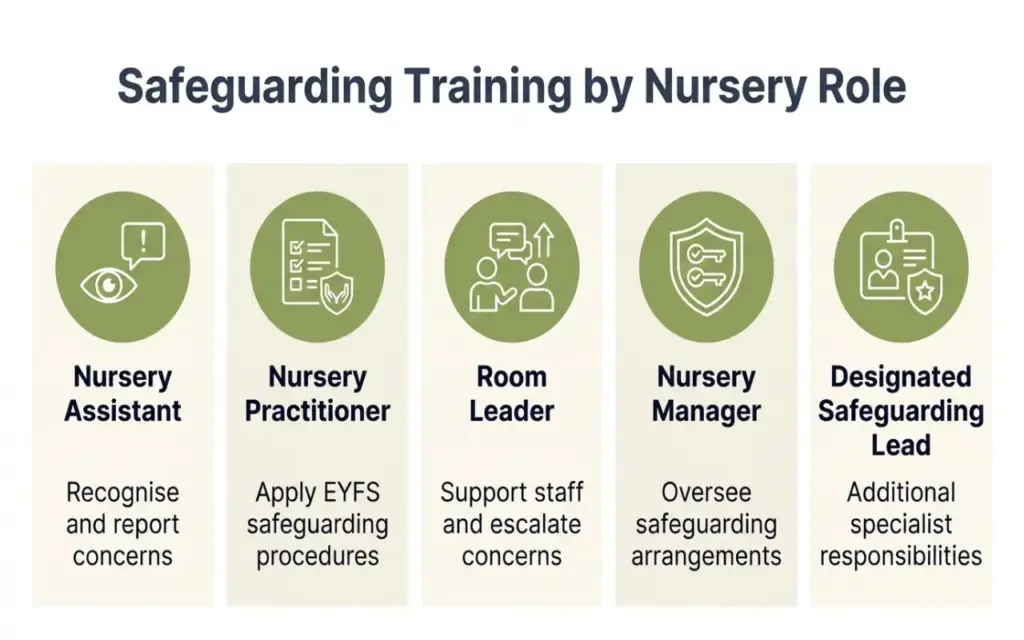
The appropriate training should reflect what each employee actually does.
For example, nursery managers may need broader knowledge of the responsibilities of a safeguarding officer when reviewing how safeguarding duties are allocated across their setting.
Managers may also benefit from understanding how safeguarding coordinators support staff when concerns arise or procedures need reviewing.
What Does Nursery Safeguarding Training Cover?
Good safeguarding training should help nursery staff recognise concerns, understand their responsibilities and respond appropriately.
It should address situations that can arise when caring for babies, toddlers and young children, including those who cannot clearly communicate what has happened.
Recognising Abuse, Neglect and Safeguarding Concerns
Training should explain the four commonly recognised categories of child abuse:
- Physical abuse
- Emotional abuse
- Sexual abuse
- Neglect
Nursery workers should also understand possible warning signs, such as unexplained injuries, significant behavioural changes, changes in wellbeing or concerning interactions involving adults.
These signs do not automatically establish that abuse has occurred. They indicate that a concern may need further attention.
Recognising difficulties in children with special educational needs and disabilities (SEND), including communication differences, is particularly important.
Responding to and Reporting Concerns
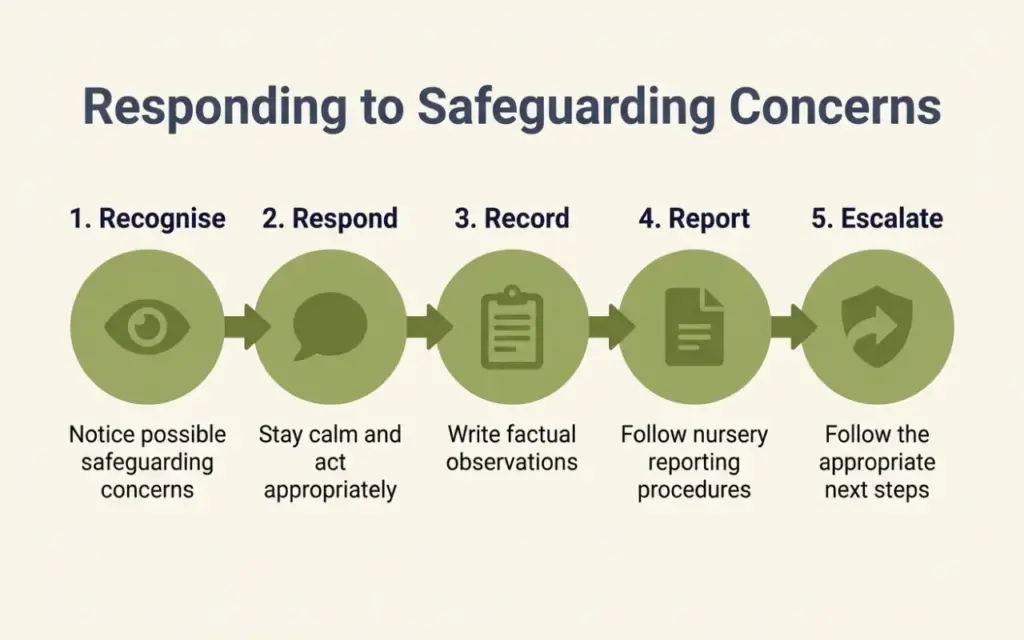
Safeguarding training should explain how to:
- Recognise possible signs of harm or neglect.
- Respond calmly and appropriately when a concern arises.
- Make an accurate, factual record.
- Report concerns promptly using the nursery’s safeguarding procedures.
- Follow the appropriate escalation process when necessary.
For example, imagine a nursery assistant notices an unexplained injury and a significant change in a toddler’s behaviour.
The assistant should not attempt to investigate the situation independently. Instead, they should record the relevant observations and report the concern promptly through the setting’s safeguarding procedures.
The Department for Education’s safeguarding guidance for early years providers emphasises the importance of recognising concerns early and following clear reporting procedures.
How Often Should Nursery Staff Update Safeguarding Training?
Nursery staff in England must complete safeguarding training meeting the EYFS criteria at least every two years.
However, this does not mean safeguarding knowledge only needs attention once every two years.
Staff should also receive relevant updates when policies, guidance or safeguarding procedures change.
Understanding the Two-Year Training Requirement
A nursery practitioner who completes appropriate safeguarding training in November 2026 would normally need to renew that training by November 2028 at the latest.
However, their employer may arrange earlier refresher activities or additional training based on local requirements, updated guidance or identified learning needs.
New employees also need to understand the safeguarding procedures used in their particular nursery, even if they already hold a certificate from another setting.
Nursery managers should maintain accurate training records and check that staff remain familiar with current safeguarding responsibilities.
What Changed in the EYFS in September 2026?
The latest EYFS framework came into force on 1 September 2026.
According to the Department for Education’s September 2026 EYFS updates, important changes include:
- Clearer safer sleep requirements within the framework.
- A requirement for providers to have regard to guidance on children’s screen use.
- Updated requirements for reporting allegations of harm.
- Changes relating to criminal-record checks, recruitment and staff suitability.
- Additional safeguarding and welfare clarifications.
These changes reinforce the need for nurseries to review their policies and ensure staff understand relevant updates.
They do not necessarily require every nursery worker to purchase a new safeguarding course immediately. Providers should establish whether existing training and any additional updates adequately cover the current requirements.
Designated Safeguarding Lead Training in Nurseries
Every nursery in England must have a designated practitioner who takes lead responsibility for safeguarding children.
This person is commonly called the designated safeguarding lead, or DSL.
The DSL plays an important role in helping staff understand safeguarding procedures and ensuring concerns are handled appropriately.
What Additional Training Does a Nursery DSL Need?
Alongside the safeguarding training expected of other practitioners, DSLs need additional training covering their enhanced responsibilities.
This includes understanding how to support staff, respond to concerns, coordinate safeguarding arrangements and promote a positive safeguarding culture.
The EYFS also requires DSL training to take account of relevant advice from local safeguarding partners or the local authority.
Nursery managers should therefore check that any proposed DSL training meets the additional requirements in Annex C.
A general safeguarding certificate should not automatically be treated as sufficient preparation for the designated role.
Can Nursery Staff Progress Into Safeguarding Leadership?
Nursery workers who develop their safeguarding knowledge may become interested in taking on additional responsibilities.
Experience in recognising concerns, following reporting procedures and supporting safe practice can provide a useful foundation.
However, safeguarding leadership requires appropriate training, experience and employer support.
For readers considering a broader career pathway, our guide to becoming a child protection officer explores the responsibilities and preparation involved.
How to Choose Safeguarding Training for Nursery Staff
The most suitable safeguarding course is not necessarily the one with the highest advertised level.
Instead, consider whether its content matches current requirements, your responsibilities and your nursery’s safeguarding arrangements.
Online, In-Person and Free Safeguarding Training
Nursery workers can access safeguarding learning through different formats.
| Training option | Potential benefits | What to consider |
|---|---|---|
| Online training | Flexible study around work commitments | Check content, assessment and EYFS coverage |
| Face-to-face training | Discussion, practical examples and interaction | May require scheduled attendance |
| Employer-provided training | Directly relevant to workplace procedures | Check whether all required training criteria are covered |
| Free government training | Accessible foundation for early years safeguarding | Additional DSL training may still be necessary |
| Specialist DSL training | Focuses on enhanced safeguarding duties | Check Annex C and local training expectations |
The Department for Education has developed free safeguarding training for early years educators in collaboration with the NSPCC.
It covers the general practitioner criteria in the EYFS safeguarding training annex, but not all additional DSL requirements.
This provides an accessible option for early years workers who need to develop or update their safeguarding knowledge.
What Should You Check Before Enrolling?
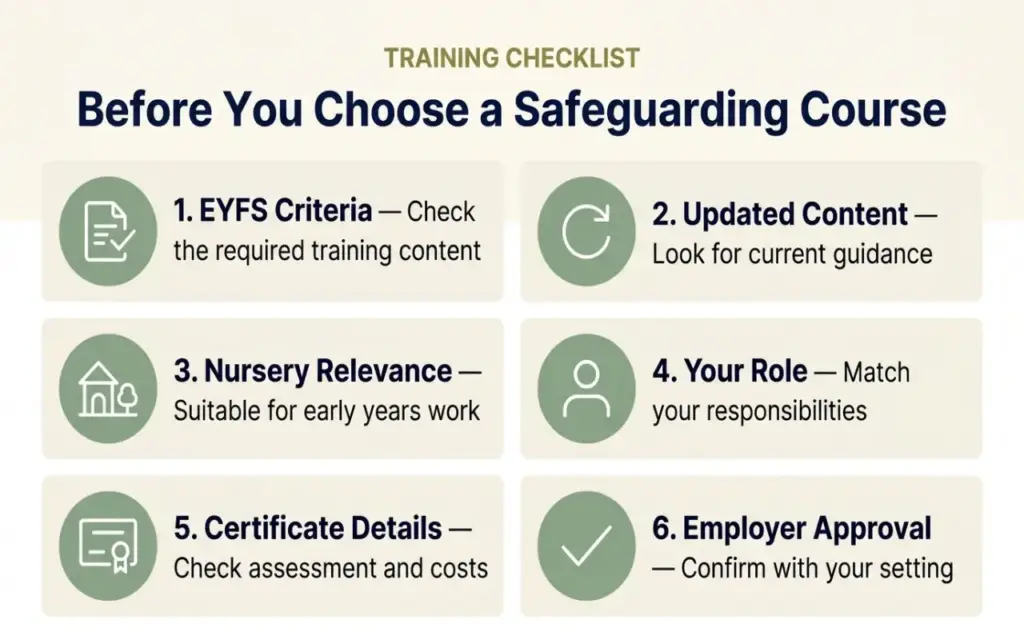
Before choosing a course, ask these six questions:
- Does it cover EYFS Annex C? Compare the syllabus against the current training criteria.
- Is the content up to date? Check whether relevant 2026 guidance and safeguarding procedures are reflected.
- Is it appropriate for nursery work? Training should address safeguarding children aged from birth to five.
- Does it match your responsibilities? DSLs require additional training beyond general practitioner knowledge.
- What certificate is provided? Understand the assessment, certification arrangements and any additional costs.
- Will your employer accept it? Confirm the course’s suitability with your nursery manager before enrolling.
These checks help prevent confusion between completing a course and meeting workplace safeguarding expectations.
For a broader comparison, see our guide to what to look for in a child protection and safeguarding course.
A Relevant Online Safeguarding Course from HF Online
If you want to strengthen your knowledge of child protection through flexible study, HF Online offers a Safeguarding and Protection for Children Level 2 course.
The online course covers safeguarding principles, recognising child protection concerns, relevant legal responsibilities, reporting procedures and referrals.
It is designed for learners including childcare assistants, school support staff, youth workers and volunteers.
The course includes an online multiple-choice assessment, with a minimum passing score of 60%. Learners who pass can apply for a CPD certificate, subject to the provider’s stated certificate charges.
It provides a professional-development learning option rather than a regulated early years qualification. Before enrolling, compare its syllabus with the current EYFS Annex C criteria and your nursery’s requirements.
Does Safeguarding Training Help With Nursery Career Development?
Safeguarding knowledge is relevant throughout an early years career.
For nursery assistants and new practitioners, training helps build confidence in recognising concerns and understanding professional responsibilities.
For more experienced employees, continuing professional development can support supervisory responsibilities and an interest in safeguarding leadership.
However, a safeguarding training certificate is not the same as an approved early years qualification.
The Department for Education sets separate early years qualification requirements for staff who count towards specified qualification-based staff-to-child ratios in England.
Completing a standalone safeguarding course does not automatically make someone eligible to count as a qualified Level 2 or Level 3 practitioner.
Some nursery workers may eventually explore related child welfare careers, including pastoral support careers in schools, although those roles involve different responsibilities and employment expectations.
Frequently Asked Questions
Find answers to common questions about nursery safeguarding training, certificates and requirements for early years staff.
01 Do Nursery Assistants Need Safeguarding Training?
Yes. Nursery assistants working under England's EYFS requirements need appropriate safeguarding training. They must understand how to recognise potential abuse or neglect, report concerns and follow their setting's safeguarding procedures.
02 Is Level 2 Safeguarding Compulsory for Nursery Staff?
Not as a universal course title. The EYFS specifies safeguarding training criteria rather than requiring every practitioner to hold a commercially labelled Level 2 certificate. Course content must meet the relevant requirements.
03 Can Nursery Safeguarding Training Be Completed Online?
Yes. Online safeguarding training can be suitable if it covers the relevant requirements. Employers should check the course content and ensure staff also understand their nursery's own safeguarding procedures.
04 Is Free Safeguarding Training Available for Nursery Workers?
Yes. The Department for Education offers free online safeguarding training developed with the NSPCC for early years educators. Additional learning is required for designated safeguarding leads.
05 Does a Safeguarding Certificate Expire After Two Years?
A provider's certificate may have its own stated validity period. Separately, England's EYFS requires appropriate safeguarding training at least every two years. Staff should follow both the statutory requirement and their employer's training arrangements.
06 What Should Nursery Staff Do if They Suspect Abuse?
Staff should follow their setting's safeguarding procedures, record relevant information accurately and report concerns promptly to the appropriate safeguarding lead. Where a child is in immediate danger, emergency action may be necessary.
Table of Contents