

Every year, foodborne illness costs the global economy an estimated $110 billion, and major recalls regularly make headlines for all the wrong reasons. One contamination incident can shut down operations overnight, trigger legal action, and permanently damage public trust. In food businesses, safety failures are rarely small. The consequences ripple through supply chains, customers, and brands.
The stakes go far beyond regulatory compliance. A single lapse can undo years of brand-building, erode consumer confidence, and hit your bottom line hard through recalls, waste, and lost contracts. Strong food safety systems are now a competitive advantage, not just a legal requirement.
A Food Safety Management System (FSMS) is a systematic, risk-based approach to ensuring food safety at every stage of your operation. This guide goes beyond theory, offering a practical, step-by-step roadmap to build, implement, and sustain an FSMS that stands up to audits and outperforms competitors.
What is a Food Safety Management System?
Simply put, a Food Safety Management System (FSMS) is how you control food safety in a planned, consistent way. Rather than relying on experience or last-minute checks, it helps you identify risks early and manage them every day.
In practice, an FSMS brings together hygiene rules, hazard controls, staff training, and record keeping into one clear system. For example, instead of just “knowing” food must stay cold, you set limits, check temperatures, record results, and act if something goes wrong.
As a result, food safety becomes part of normal operations, not a box-ticking exercise. And while compliance matters, an effective FSMS mainly exists to protect customers, your reputation, and your business.
While an FSMS sets out what needs to be done, staff still need the right knowledge to apply it correctly. For this reason, Level 3 food hygiene training is often used to support supervisors and managers responsible for maintaining the system.
What is the Purpose of a Food Safety Management System?

The main purpose of a Food Safety Management System (FSMS) is to prevent unsafe food from reaching customers. However, it also helps you stay in control of risks every day, even when things get busy. Instead of reacting to problems, you can stop them before they happen.
The Food Standards Agency (FSA) estimates 2.4 million cases of foodborne illness annually in the UK, showing why prevention systems matter.
Protecting customers and building trust
First, an FSMS protects people’s health. It helps you identify risks such as bacteria or allergens and put controls in place early. For example, clear allergen procedures in a café reduce the risk of cross-contact and give customers confidence.
Creating consistency in daily operations
At the same time, an FSMS brings consistency. Clear procedures mean staff follow the same safe steps on every shift. As a result, food safety does not rely on one experienced person being present.
An FSMS helps you:
- standardise cleaning and hygiene routines
- control temperatures during storage and cooking
- manage allergens and labelling
- train staff to follow the same safe methods
Supporting compliance and your reputation
Finally, an FSMS helps you meet legal requirements and prove what you do. Because you keep clear records, inspections run more smoothly. More importantly, you protect your reputation, reduce costly mistakes, and run your business with confidence.
10 Steps to creating a food safety management system
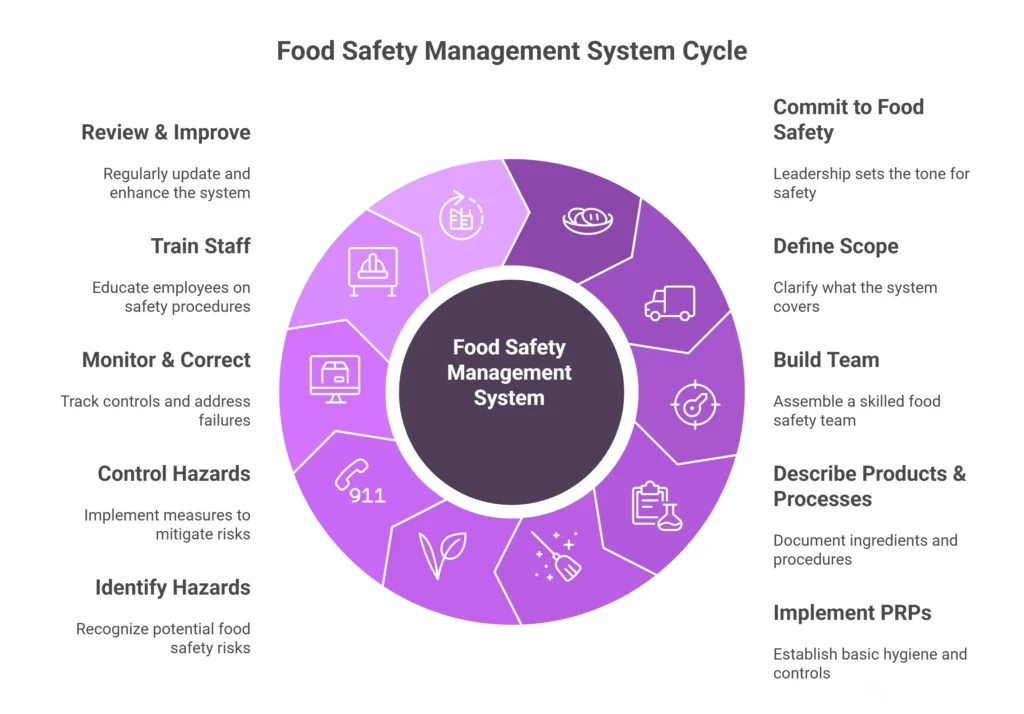
Building a Food Safety Management System may sound complex at first. However, when you break it down into clear steps, it becomes much more manageable. Below, we walk through ten practical steps you can follow, whether you run a small café or a larger food operation.
Step 1: Commit to food safety from the top
First, food safety must matter to leadership. If owners and managers take it seriously, the rest of the team usually follows. So, set a clear food safety policy and show staff that safety always comes before speed or cost.
Step 2: Define the scope of your FSMS
Next, decide what your FSMS covers. For example, does it include one site or multiple locations? Does it cover storage, preparation, transport, or all three? By being clear early on, you avoid gaps later.
Step 3: Build your food safety team
Then, bring the right people together. Your team should include staff who understand daily operations, cleaning, and maintenance. Although one person may lead, food safety works best as a shared responsibility.
Step 4: Describe your products and processes
After that, document what you make and how you make it. This includes ingredients, allergens, storage conditions, and shelf life. At the same time, create a simple process flow diagram and walk through it on-site to check it reflects reality.
Step 5: Put prerequisite programmes (PRPs) in place
Before looking at hazards, you need strong basics. Therefore, make sure you have controls for:
- cleaning and sanitation
- personal hygiene
- pest control
- maintenance
- supplier approval
Without these in place, hazard controls will struggle to work.
Step 6: Identify food safety hazards
Now, look at where things could go wrong. Consider biological, chemical, and physical hazards at each step. For example, cooked food cooling too slowly can allow bacteria to grow. Because of this, cooling often becomes a key focus.
Step 7: Decide how you control those hazards
Next, decide which controls matter most. Some risks need strict controls, such as cooking temperatures or allergen checks. Others may sit within your routine hygiene practices. As a result, you focus effort where it matters most.
Step 8: Set monitoring and corrective actions
Then, decide how you will check controls and what you will do if they fail. For example, if a fridge temperature rises too high, staff should know exactly who to tell and what action to take. This clarity prevents delays and confusion.
Step 9: Train your staff
Even the best system fails if people don’t understand it. So, train staff based on their role and check they apply what they learn. Short, regular refreshers often work better than one long session.
Step 10: Review and improve the system
Finally, keep the system alive. Review records, investigate problems, and update controls when processes change. Over time, this step helps your FSMS stay effective rather than becoming paperwork no one uses.
When you follow these steps in order, food safety becomes part of how you work every day, not just something you think about during inspections.
Maintaining your FSMS: how to keep it effective year-round

Creating an FSMS is a strong start. However, the real challenge is keeping it working day after day. Food safety risks change, staff move on, and processes evolve. Because of this, your FSMS needs regular care, not a once-a-year review.
When you treat food safety as part of daily operations, the system stays useful instead of becoming paperwork.
Make food safety part of daily routines
First, build food safety into everyday tasks. Instead of adding extra work, link checks to what staff already do.
For example:
- check fridge temperatures during opening checks
- confirm cleaning during shift handovers
- review allergen controls before service starts
As a result, safety becomes habit, not a reminder.
Review records little and often
Next, don’t let records pile up. Although it may feel quicker to review them monthly, small and frequent reviews work better.
By checking records weekly, you can:
- spot trends early
- fix repeated issues quickly
- support staff before mistakes grow
For instance, if cooling records show frequent delays, you can adjust batch sizes before a problem occurs.
Keep staff training fresh
Over time, people forget or take shortcuts. Therefore, regular training matters.
Short refreshers work best, especially when:
- processes change
- new staff join
- incidents or near misses occur
Because training links directly to real tasks, staff stay engaged and confident.
Carry out internal checks and audits
Even strong systems drift. So, schedule regular internal checks.
These don’t need to feel formal. You can:
- observe how staff follow procedures
- review key controls
- ask simple “why” questions
As a result, you catch gaps early and fix them without stress.
Update the system when things change
Finally, keep your FSMS up to date. New equipment, new suppliers, or new menu items all bring new risks.
Whenever something changes:
- review hazards
- adjust controls
- brief staff
This way, your FSMS grows with your business rather than holding it back.
Audit and certification readiness (ISO 22000 / FSSC 22000 / customer audits)
Audits can feel stressful. However, with the right preparation, they become routine checks rather than major disruptions. When you keep your FSMS in good shape year-round, audit readiness follows naturally.
Whether you’re preparing for ISO 22000, FSSC 22000, or a customer audit, the basics stay the same. You need clear processes, solid records, and confident staff.
Understand what auditors actually look for
First, it helps to know what auditors expect. Although standards vary, auditors usually focus on how well your system works in practice.
They will typically check:
- whether your hazard analysis makes sense
- how you control key food safety risks
- if records match what happens on the floor
- how you handle problems and improve
So, instead of memorising clauses, focus on doing the basics well.
Keep documents clear and easy to find
Next, make sure your documents work for you, not against you. Auditors don’t expect perfection. However, they do expect clarity and control.
Before an audit:
- check procedures match current practices
- remove old or unused documents
- confirm records are complete and signed
As a result, you avoid delays and awkward searches during the audit.
Prepare your team, not just your paperwork
Audits don’t just test documents. They test people too. Therefore, staff should understand their role in food safety.
Help your team by:
- explaining what an audit looks like
- encouraging honest answers
- reminding them it’s fine to say “I’ll check”
For example, a kitchen supervisor who calmly explains cleaning checks builds far more confidence than someone guessing under pressure.
Do internal audits before external ones
Internal audits act as practice runs. So, use them wisely.
By auditing yourself first, you can:
- spot gaps early
- fix issues calmly
- build staff confidence
Because problems get addressed beforehand, external audits feel far less intense.
Be ready for customer audits
Customer audits often focus on specific risks, such as allergens or traceability. Therefore, review customer requirements carefully.
Make sure you can:
- trace ingredients quickly
- explain key controls clearly
- show recent records without delay
When you stay prepared, audits become conversations, not confrontations.
How to Implement a Food Safety Management System
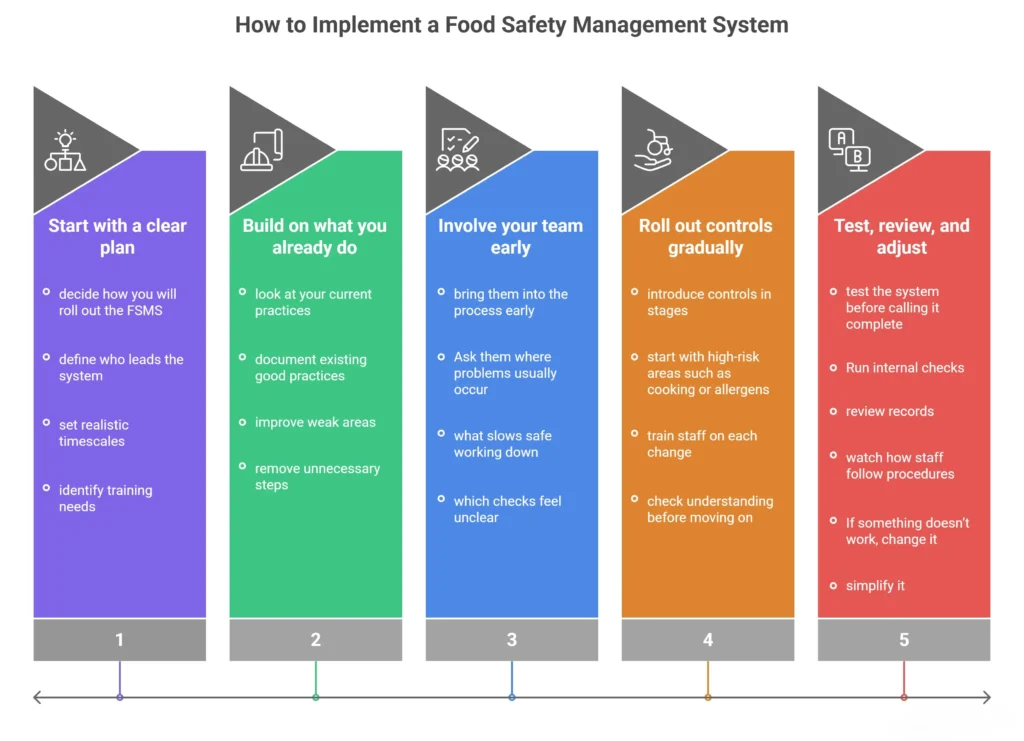
Implementing a Food Safety Management System (FSMS) can feel overwhelming at first. However, when you take it step by step, the process becomes far more practical. The key is to focus on how food safety works in your business, not how it looks on paper.
Rather than rushing to write procedures, start by understanding your risks and building habits that last.
Start with a clear plan
First, decide how you will roll out the FSMS. Although every business differs, a simple plan keeps everyone aligned.
Your plan should:
- define who leads the system
- set realistic timescales
- identify training needs
As a result, you avoid confusion and last-minute pressure.
Build on what you already do
Next, look at your current practices. In many cases, you already follow safe methods. You may clean regularly, check temperatures, or manage allergens well.
So, instead of starting from zero:
- document existing good practices
- improve weak areas
- remove unnecessary steps
For example, a takeaway that already logs fridge temperatures can simply tighten limits and review records more often.
Involve your team early
An FSMS works best when staff feel involved. Therefore, bring them into the process early.
Ask them:
- where problems usually occur
- what slows safe working down
- which checks feel unclear
Because they know the day-to-day reality, their input makes the system practical.
Roll out controls gradually
Then, introduce controls in stages. If you change everything at once, people get overwhelmed.
Instead:
- start with high-risk areas such as cooking or allergens
- train staff on each change
- check understanding before moving on
As a result, controls stick rather than fade.
Test, review, and adjust
Finally, test the system before calling it complete. Run internal checks, review records, and watch how staff follow procedures.
If something doesn’t work, change it. For instance, if a form feels too complex, simplify it. Over time, small adjustments make the system stronger.
Challenges in Implementing an FSMS (and How to Overcome Them)

Implementing a Food Safety Management System can feel challenging, especially when daily operations already demand your attention. However, most problems follow the same pattern across food businesses. The key is to recognise them early and apply practical solutions that actually work on the ground.
Below are the most common challenges and, more importantly, how you can deal with them.
Challenge 1: Lack of time and resources
The problem:
Many businesses operate with tight schedules and small teams. As a result, FSMS tasks often feel like extra work rather than part of normal operations.
The solution:
Instead of doing everything at once, prioritise high-risk areas such as cooking, cooling, and allergens. Then, spread responsibilities across the team rather than relying on one person. Small, regular actions always work better than rushed fixes.
Challenge 2: Staff resistance and low engagement
The problem:
Staff may see the FSMS as paperwork that slows them down. Therefore, they may skip checks or fill in records later.
The solution:
Explain why controls matter using real examples. For instance, show how one missed allergen check could seriously harm a customer. Also, involve staff in shaping procedures. When people help design the system, they are far more likely to follow it.
Challenge 3: Overcomplicated systems
The problem:
Many businesses copy large systems that don’t suit their size. As a result, forms become long, confusing, and ignored.
The solution:
Keep procedures simple and practical. If a form takes too long to complete during service, shorten it. In most cases, fewer checks done properly work better than many checks done poorly.
Challenge 4: Keeping the FSMS up to date
The problem:
Menus change, suppliers change, and staff change. However, FSMS documents often stay the same.
The solution:
Link FSMS reviews to change. Whenever you add a new dish, supplier, or piece of equipment, review risks at the same time. Even short updates help prevent gaps.
Challenge 5: Balancing food safety with busy periods
The problem:
During peak times, speed can take priority over safety. Because of this, shortcuts become tempting.
The solution:
Set clear expectations. Managers should always model safe behaviour, even when under pressure. When staff see safety comes first, they follow suit.
Conclusion
A strong Food Safety Management System isn’t just about passing inspections. Instead, it helps you protect customers, support your team, and run your business with confidence every day. When food safety becomes part of how you work, risks stay under control.
However, an FSMS only works when you use it consistently. By reviewing, improving, and involving your team, you create a system that stays effective, practical, and ready for whatever comes next.