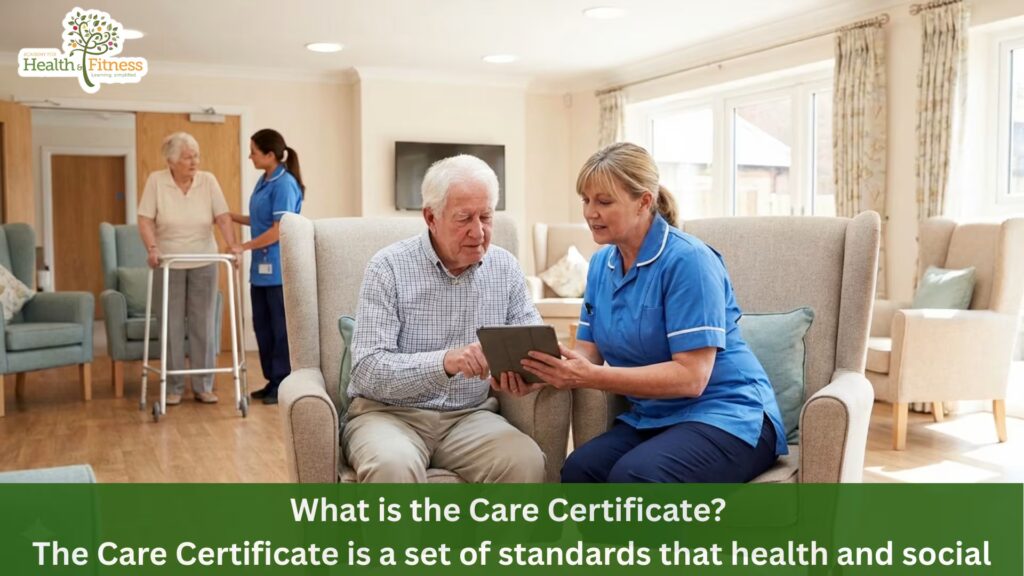


The Care Certificate isn’t just another qualification but the foundation of safe, compassionate practice in health and social care. Developed by Skills for Care, Health Education England and Skills for Health, the Care Certificate sets a consistent baseline for support workers and healthcare assistants across services. By ensuring everyone meets the same standards, the certificate helps protect people receiving care and those providing it.
In simple terms, the Care Certificate is a set of standards that health and social care workers must meet during their induction to demonstrate that they know how to deliver safe, person‑centred support. It applies to non‑regulated roles such as healthcare assistants, support workers and social care workers, giving them the knowledge and behaviours needed to provide high‑quality care.
In this article you’ll discover:
- What the Care Certificate is and who needs it
- A simple explanation of the 16 standards (including the new Standard 16)
- Why the Care Certificate matters for care quality, safety and career growth
- How to complete it and make the most of the experience
- Common myths and how to avoid them
- Practical tips for learners and employers
- Frequently asked questions
Let’s explore how this certificate supports professionals and why it remains a crucial requirement in health and social care.
What Exactly Is the Care Certificate?
The Care Certificate is a nationally recognised set of learning outcomes that ensure everyone working in support roles across health and social care has the same fundamental skills, knowledge and behaviours. Introduced in 2015 in response to the Cavendish Review, it was created by Skills for Care, Health Education England and Skills for Health with input from the Care Quality Commission and Department of Health. The certificate aims to raise standards by providing a consistent training framework for the non‑regulated workforce.
Who Is It For?
The certificate is designed for:
- New healthcare assistants and support workers in hospitals, care homes or community services
- Adult social care workers supporting people at home or in residential settings
- Non‑clinical volunteers or agency staff working regularly with vulnerable people
Regulated professionals (e.g. nurses, doctors, social workers) already cover these competencies through their professional registration, so they do not need to complete the Care Certificate.
History and Updates
Originally, the Care Certificate consisted of 15 standards. In March 2025, it was refreshed to reflect current practice and legislation. The updated programme now includes 16 standards, adding a new requirement on learning disability and autism awareness. This change recognises the need for a workforce that understands the specific needs of people with learning disabilities and autism and can provide person‑centred support.
Health Education England notes that the certificate is part of an ongoing programme to help develop the workforce and supports both new and experienced staff. Completing it usually takes around 12 weeks during induction and can be combined with e‑learning or face‑to‑face training.
Supporting Your Induction
The certificate isn’t just an online course; it is integrated into an employer’s induction process. Workers learn on the job while supervised by experienced colleagues, build a portfolio of evidence and demonstrate competence through observation and assessment. This structured approach ensures that learning is applied in real‑world situations — not just theory — and encourages reflective practice.
The Care Certificate Standards (16 Core Areas)
The updated certificate covers 16 standards that form the basis of safe and compassionate care. Each standard is assessed through practical observation, discussion and evidence. Here is a simplified breakdown:
- Understand your role — know your responsibilities, organisational policies and professional boundaries.
- Your personal development — engage in learning, feedback and supervision to improve your practice.
- Duty of care — understand your legal and moral obligations to prevent harm and safeguard those you support.
- Equality, diversity, inclusion and human rights — respect differences and promote fairness for all.
- Work in a person‑centred way — ensure the person’s wishes, choices and dignity are at the centre of care.
- Communication — use clear and appropriate communication for people with varied needs.
- Privacy and dignity — protect confidential information and respect personal space.
- Fluids and nutrition — support hydration and balanced diets safely.
- Awareness of mental health and dementia — recognise mental health conditions, dementia and learning disabilities, and provide support accordingly.
- Adult safeguarding — protect adults from abuse and neglect, understand signs and reporting procedures.
- Safeguarding children — recognise and report concerns about children’s welfare.
- Basic life support — know how to perform CPR and other lifesaving procedures.
- Health and safety — work safely by managing risks, infection control and emergency procedures.
- Handling information — maintain accurate records and follow data protection rules.
- Infection prevention and control — follow standard precautions to prevent infections.
- Awareness of learning disability and autism — understand the needs of people with learning disabilities and autism, adapt communication and support to promote inclusion.
These standards reflect the areas inspectors look at when assessing quality under the Care Quality Commission (CQC) framework and align with the principles of person‑centred care.
How the Standards Link to Regulations
The Care Certificate is not a statutory requirement, but employers use it to demonstrate compliance with the Health and Social Care Act 2008 (Regulated Activities) Regulations 2014 and the CQC fundamental standards. For example, the duty of care and safeguarding standards relate to Regulation 13 on safeguarding service users from abuse, and the infection control standard helps meet Regulation 12 on safe care and treatment. Having staff who have completed the certificate provides assurance that the organisation meets the CQC’s expectations for induction and training.
Why the Care Certificate Is Crucial for Health and Social Care Workers

Promotes Safe and Consistent Care
By setting minimum standards across a range of core competencies, the certificate ensures that staff have a consistent level of knowledge, behaviour and skills. This consistency helps reduce variations in care quality and improves safety. The CQC uses the certificate as evidence that employers provide adequate training and support.
Builds Confidence and Competence
Completing the certificate empowers new staff. It provides a clear structure for learning and helps them understand their role, recognise ethical dilemmas and communicate effectively. This knowledge improves confidence and decision‑making, leading to better outcomes for the people they support.
Supports Career Development
The certificate is a stepping stone to further qualifications such as the Level 2 Diploma in Care or apprenticeships. It demonstrates commitment to professional development and can enhance employability. Employers often require the certificate as part of induction; having it shows you meet essential standards of care.
Aligns with Person‑Centred Care and Values
Person‑centred care is at the heart of the certificate. Standards 5 (Work in a person‑centred way), 6 (Communication) and 7 (Privacy and dignity) emphasise that care should respect people’s rights, choices and independence. When workers understand and apply these values, they build trusting relationships and deliver care that is responsive and compassionate.
Helps Meet Regulatory Expectations
The CQC inspects whether providers have trained and competent staff. The Care Certificate helps organisations show regulators that they follow best practice and provide safe care. It also helps meet the Cavendish Review recommendation for a standardised approach to training health and social care support staff.
How the Care Certificate Works in Practice
Induction and Assessment
Most organisations integrate the certificate into a 12‑week induction. Workers receive classroom or e‑learning sessions, shadow experienced colleagues and then apply their learning under supervision. Evidence of competence is gathered through:
- Observations — supervisors watch workers performing tasks (e.g., supporting meals, communicating with service users) and provide feedback.
- Workbooks or portfolios — learners record reflections, case studies and evidence of meeting each standard.
- Witness testimonies — colleagues provide statements about how the worker has applied the standards.
- Professional discussions — supervisors and learners discuss scenarios to explore understanding and decision‑making.
The learner must meet all standards before being signed off. Although there is no statutory time limit, most complete the certificate within 12 weeks to support early competence and confidence.
The Role of Mentors and Supervisors

Mentors play a vital role in guiding learners through the certificate. They model good practice, answer questions and provide constructive feedback. Supervisors assess competence objectively and encourage learners to reflect on their experiences. Regular supervision sessions allow learners to discuss challenges, celebrate achievements and identify further learning needs.
Evidence Requirements
Learners need to demonstrate knowledge, understanding and practical application. Evidence might include:
- Completed care plans and communication logs
- Risk assessments and safeguarding reports
- Records of training attended
- Reflective accounts explaining why certain actions were taken
All evidence should be dated, signed and stored securely. The certificate has no formal qualification level, but the portfolio can be used as evidence towards a Level 2 or Level 3 vocational qualification.
Implementation Guidance
For organisations, implementing the certificate effectively involves:
- Designing an induction programme that covers all standards
- Allocating mentors or supervisors to support learners
- Providing time for reflection and assessment
- Keeping accurate training records and evaluation reports
Guidance and resources from NHS Employers and Health Education England provide employers with checklists, learning materials and templates.
Key Benefits for Employers and Learners

Benefits for Employers
- Improved recruitment and retention — offering structured training attracts candidates and encourages them to stay.
- Standardised quality — ensures all staff meet a baseline competence level.
- Better reputation and inspection outcomes — demonstrates commitment to safe, high‑quality care and satisfies CQC expectations.
- Reduced incidents — competent staff are less likely to make mistakes, reducing complaints and safeguarding concerns.
- Foundation for further training — staff can progress to apprenticeships or diplomas.
Benefits for Learners
- Confidence and competence — clear guidance and regular feedback help workers feel more confident and capable.
- Recognition and credibility — the certificate provides evidence of fundamental skills valued by employers.
- Career progression — acts as a bridge to more advanced qualifications and roles.
- Reflective practice — encourages workers to learn from their experiences and continue improving.
Common Myths and Misunderstandings
- “It’s just a tick‑box exercise.” While there are workbooks and checklists, the certificate requires demonstration of competence in real situations. Supervisors observe performance and gather evidence — it’s not just paperwork.
- “The certificate replaces formal qualifications.” It doesn’t. The certificate provides a baseline; it complements qualifications like NVQs or Diplomas rather than replacing them. It ensures all staff meet essential standards before progressing to advanced studies.
- “It’s optional.” Though not a legal requirement, most employers expect new staff to complete it as part of induction. CQC inspectors view the certificate as evidence of good practice and use it to evaluate workforce competence.
- “It’s only for the first few weeks.” The certificate forms part of the induction but also encourages lifelong learning. Workers should revisit the standards throughout their career and use reflective practice to improve.
Making the Most of the Care Certificate
Tips for Learners
- Engage with training opportunities. Attend workshops, webinars and shadowing sessions to deepen your understanding.
- Ask questions. If something isn’t clear, speak to your mentor. Understanding why you are doing something is as important as how.
- Keep your portfolio organised. Record evidence as you go along and reflect on what you learned. This makes assessment easier and demonstrates your progression.
- Seek feedback. Constructive feedback helps you improve. Don’t be afraid to ask colleagues or service users for their opinions on your support.
- Reflect on practice. Take time after shifts to think about what went well and what could be improved. Reflection turns experience into learning.
Tips for Employers
- Provide structured induction. Ensure that new staff have time to learn, observe and reflect before taking on full responsibilities.
- Assign mentors. Experienced staff can support learners and model good practice.
- Monitor progress regularly. Use supervision sessions to discuss evidence and provide feedback.
- Create learning resources. Provide easy access to policies, e‑learning modules and case studies.
- Recognise achievement. Celebrate when staff complete the certificate. Recognition encourages commitment and morale.
Conclusion
The Care Certificate lays the foundation for safe, compassionate care. By understanding what the certificate covers and why it matters, both learners and employers can ensure that care is consistent, person‑centred and aligned with national standards. Completing the certificate isn’t just a training requirement — it’s a commitment to professionalism, accountability and ongoing improvement.
Looking to strengthen your practice or support your team? For structured learning and practical guidance, explore our Care Certificate Online Training Course. It offers comprehensive modules, assessments and mentoring to help you gain confidence and provide high‑quality care.