

What Is the Care Certificate?

The Care Certificate is a foundation qualification designed for new health and social care staff in the UK. You can think of the Care Certificate as your starter pack for a career in caring.. Created in 2015 by Health Education England, Skills for Care, and Skills for Health, it was born from the Cavendish Review’s call for consistent training and values across the sector.
The certificate isn’t just about ticking boxes; it covers 15 standards of knowledge and behaviour, from understanding your role and safeguarding to communication and infection control. Imagine your first shift, trying to remember everything you’ve learned: how to help someone out of bed safely, how to speak to them respectfully when they’re anxious. These standards ensure you’re prepared, so you can provide safe, compassionate and person‑centred care from day one.
Is it legally required? No. But it’s widely expected. Most care homes, domiciliary care agencies and NHS trusts ask new staff to complete it during the first 12 weeks of employment. That’s because it shows you understand the basics, safeguarding, communication, infection control, and reassures service users, families and regulators that you’re working to a nationally agreed standard. If you were trusting someone with your wellbeing, wouldn’t you want them to have that baseline training?
Why the Care Certificate Matters in Healthcare
Consistency and Confidence
Consistency matters. Ever visited two care homes and felt like you’d stepped into completely different worlds? Without a common standard, support can vary wildly. The Care Certificate levels the field; it gives every new carer — whether in a rural home or a busy city hospital — the same grounding in duty of care, privacy, dignity, and person‑centred practice. That shared foundation builds trust — between professionals, families, and the people they care for. And that trust matters.
Safety and Accountability
Safety isn’t optional. The Care Certificate teaches core skills: safeguarding adults and children, basic life support, infection control, even how to keep information secure. It’s built around protecting people from harm. Wouldn’t you want the person looking after your mum to know what to do if something goes wrong? It also ticks the boxes inspectors look for. A well‑trained workforce means fewer accidents, smoother inspections and, yes, less staff turnover.
The Power of Learning and Development

Think back to the last time you learned a new skill — didn’t it make you feel more confident and invested? A Skills for Care blog from 2025 stressed that investing in learning is one of the best ways to keep people on the job. They even crunched the numbers: care workers who take more than 30 training sessions see their turnover rates drop from 31.5% to 22.2%.
The 16 Care Certificate Standards – Overview
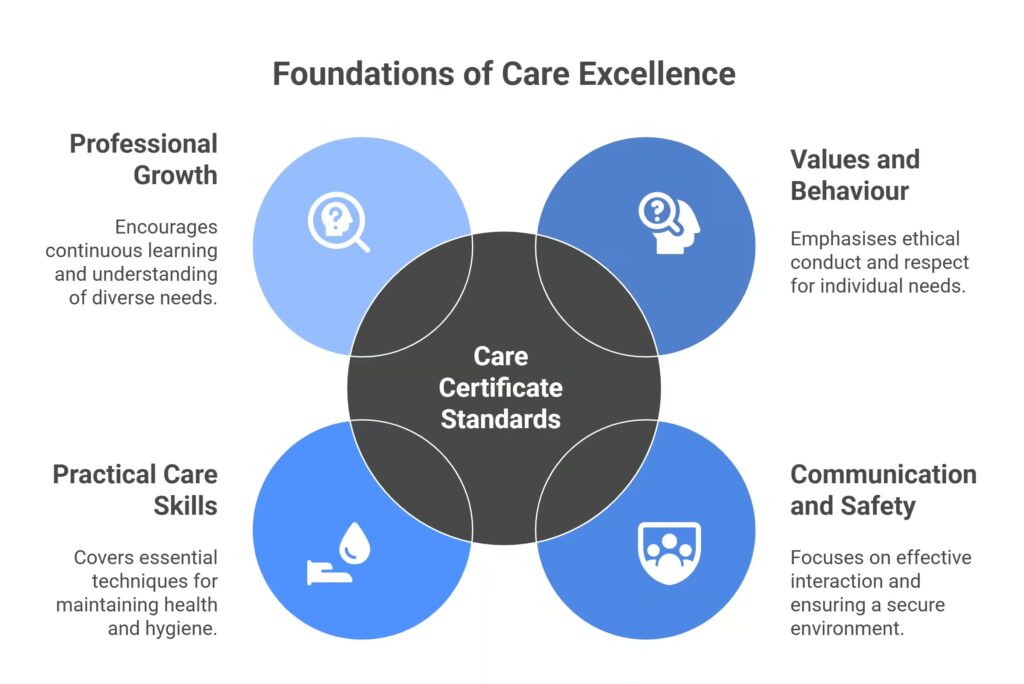
The Care Certificate’s 16 standards can be grouped into four themes. Each standard represents a critical area of knowledge or behaviour that care workers must demonstrate.
Values and Behaviour
- Understanding Your Role & Professional Boundaries – clarifies responsibilities, accountability and how to work within your scope.
- Personal Development – encourages reflective practice and continuous learning.
- Duty of Care – explains moral and legal obligations to keep people safe.
- Equality and Diversity – promotes fairness and respect for different backgrounds.
- Working in a Person‑Centred Way – emphasises tailoring care to individual needs, values and preferences.
- Privacy and Dignity – ensures people’s personal space, choices and identities are respected.
Communication and Safety

- Communication – teaches active listening, clear language and recognising non‑verbal cues.
- Fluids and Nutrition – covers hydration, balanced diets, and spotting signs of malnutrition.
- Fluids and Nutrition – covers hydration, diet and recognising signs of malnutrition.
- Safeguarding Adults and Safeguarding Children – helps workers recognise abuse and follow reporting procedures.
Health and Safety – introduces risk assessment, emergency response and safe working practices. - Basic Life Support – teaches immediate care for cardiac arrest and other emergencies.
Practical Care Skills
- Handling Information – instructs on confidentiality, data protection and record keeping.
- Infection Prevention and Control – covers hygiene, PPE and reducing the spread of infections.
Professional Growth
- Awareness of Mental Health, Dementia and Learning Disability – increases understanding of cognitive and emotional needs.
- Personal and Professional Development (sometimes included within personal development) – supports reflective practice and goal setting.
These standards ensure that new staff are competent across a broad range of practical, ethical and interpersonal areas. They also encourage workers to adopt a person‑centred approach, viewing each service user as an individual with unique needs and preferences
Benefits of the Care Certificate
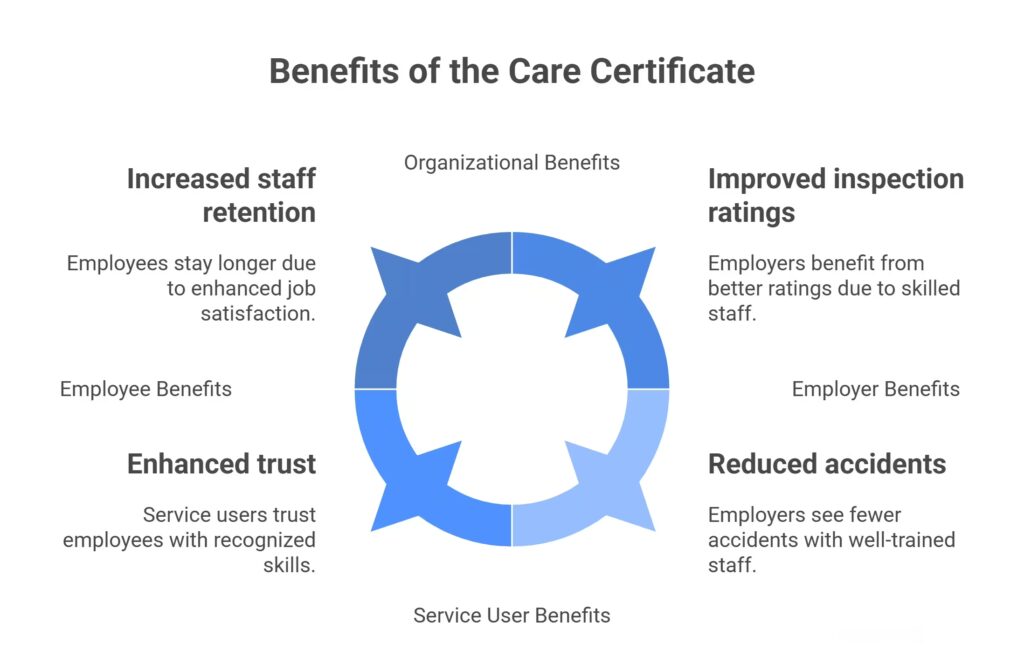
The Care Certificate brings tangible benefits for employees, employers and service users.
For Employees
Completing the certificate builds confidence and competence. New carers often feel nervous about handling medication, dealing with emergencies or supporting someone with dementia. The Care Certificate’s structured training demystifies these tasks and gives workers the tools they need to deliver care safely. It also provides a sense of purpose; staff know their work is built on nationally recognised standards. In practice, many care workers report feeling more secure and valued after achieving the certificate, which can make them more likely to stay in the sector.
For Employers
Employers gain a more consistent and skilled workforce. With everyone trained to the same baseline, managers spend less time correcting basic mistakes and more time developing staff. A well‑trained team is also less likely to be involved in accidents or safeguarding incidents. This can improve inspection ratings and reduce costly staff turnover. According to Skills for Care’s data, providers that invest in training enjoy lower turnover rates.

For Service Users
For people receiving care, the certificate means better quality and safer support. Service users can trust that staff know how to respect their dignity, listen to their needs and respond appropriately in emergencies. A simple example: imagine a new care worker assisting an older person who has become distressed. Thanks to their training in communication and dementia awareness, the worker knows to speak calmly, use simple language and involve the person in decisions. This helps to de‑escalate anxiety and maintain independence. Over time, these small acts of respect and competence build a culture of trust and compassion.
Who Needs the Care Certificate?
The Care Certificate is expected for all new support staff in regulated health and social care settings. This includes:
- Healthcare assistants working in hospitals and clinics.
- Care assistants and support workers in residential homes, nursing homes and domiciliary care.
- Community carers and those providing outreach support.
Registered nurses, doctors and allied health professionals are exempt because their professional qualifications already cover equivalent competencies. However, many organisations encourage all staff – including cleaners, cooks and volunteers – to understand the standards so that everyone contributes to a safe, person‑centred environment.
How the Care Certificate Supports Career Progression
Completing the Care Certificate is often the first step in a progressive career pathway. Once staff have gained confidence in the basics, they can pursue higher qualifications such as the Level 3 Diploma in Health and Social Care or the Level 5 Leadership and Management Diploma. Many employers recognise the certificate as evidence of commitment and potential. It can therefore enhance employability and help workers move into more senior roles, such as team leader or deputy manager.
The certificate also encourages lifelong learning. By including personal development and reflection, it prompts workers to think about their strengths, identify gaps and plan further training. This habit of self‑improvement is valued by employers and regulators alike.
Challenges and Misconceptions

“It’s just basic training”
Some people dismiss the Care Certificate as “basic” or “common sense.” In reality, the certificate addresses critical areas that can be easily overlooked. Many safeguarding incidents or care failures occur because fundamental principles – like respecting dignity or keeping clear records – are not consistently applied. The certificate ensures these basics are understood and practised.
Implementation Barriers
Another challenge is inconsistent delivery. Because employers are responsible for assessing staff, the quality of training can vary. Time pressures, limited supervision and a lack of qualified assessors sometimes mean the certificate is rushed or treated as a tick‑box exercise. To address this, Skills for Care has launched initiatives to support employers with quality assurance and standardised assessment. For example, their Learning and development matters campaign highlights the importance of ongoing training and shares resources to help organisations deliver the certificate effectively. They also encourage the use of reflective discussions and observations rather than paper‑based tests alone.
Balancing Work and Study
Care work is demanding, and finding time to study can be difficult. Many workers juggle shifts, family commitments and, in some cases, multiple jobs. Employers can ease this burden by providing protected study time, mentorship and constructive feedback. A supportive environment helps staff not only complete the certificate but also embrace its principles.
How to Get the Care Certificate
Most workers complete the Care Certificate during their first 12 weeks of employment. The process usually involves:
- Classroom or online learning – covering the knowledge elements of each standard. Employers may use e‑learning platforms, in‑house training or accredited external providers.
- Practical observation – a supervisor or mentor watches the worker demonstrate skills like safe moving and handling, communication or safeguarding procedures.
- Evidence gathering – workers collect examples of their practice, such as care plans, reflective notes or feedback from colleagues. They may complete written assessments, but emphasis is increasingly placed on real‑world competence.
- Manager sign‑off – once the worker has demonstrated all 15 standards, a registered manager or assessor signs off the certificate.
Conclusion
After exploring what the Care Certificate covers, this qualification stands out as the bedrock of quality care. Without it, consistency suffers and safety slips – isn’t that worrying? Sector experts like Craig Wade call it “an important step forward” that benefits both workers and those they support.
Real change means investing in people. Ongoing learning keeps carers skilled, engaged and valued. Looking ahead, let’s keep training at the heart of care – from the Care Certificate through to advanced qualifications.

Recent Blogs
How The UK’s Social Care System Supports People with Disabilities? A Comprehensive Insight!
Social support plays a very crucial role in supporting disabled people. It helps them to reduce psychological stress, boosts self-esteem, combats isolation, and improves mental health.


What Is PIES In Health And Social Care And Why It Matters?
Want to know how health and social care professionals support every aspect of a person’s well-being? The PIES model—Physical, Intellectual, Emotional, and Social—addresses all areas of care, ensuring a more...
Equality and Diversity in Health and Social Care
In a diverse society like the UK, no two patients are the same — and no two care journeys should be either. Equality and diversity are the cornerstones of compassionate,...

How to Get a Free Student ID Card in the UK?
Are you a student in the UK looking to unlock a world of discounts, campus perks, and essential student services? Your Student ID Card is the key! From saving on...

Health and Social Care Level 5 with CPD Certificate: What to Know?
Thinking about progressing in health and social care—or ready to build stronger leadership and care management skills? The Health and Social Care Level 5 with CPD Certificate could be your...

Promoting Effective Communication in Health and Social Care
Want to communicate more confidently in care—or understand why every conversation matters? This guide to Promoting Effective Communication in Health and Social Care explores trust, safety, active listening and person-centred...

Why Is Communication Important in Health and Social Care?
Wondering why communication matters so much in care—or ready to strengthen the way you support others? Communication Skills in Health and Social Care could be your next smart move.

Level 3 Health and Social Care: Best Online Course Guide for 2026
Thinking about a career in care—or ready to take your next step? Finding the right Level 3 Health and Social Care online course starts with knowing what you need. Explore...

Reflective Practice in Health and Social Care Explained
Ever finished a shift wondering what you could have done differently? Reflective Practice in Health and Social Care helps you turn those questions into learning. Discover simple models and relatable...

What Is Safeguarding in Health and Social Care? Why It Matters
Safeguarding in health and social care protects adults and children from abuse, neglect and exploitation. Learn the principles, warning signs, laws and reporting responsibilities.

NHS Healthcare Support Worker Salary: Bands, Enhancements and Take-Home Pay
Discover how much NHS Healthcare Support Workers earn, including Band 2 and Band 3 salaries, NHS pay enhancements, overtime opportunities and take-home pay information.

Health and Social Care Courses: UK Beginner Guide for Careers
Thinking about a career in care or unsure which training route is right for you? Health and Social Care Courses can help you understand course levels, qualifications, skills and career...

Band 2 vs Band 3 Healthcare Assistant: Duties, Pay and Progression
Understand the difference between Band 2 and Band 3 Healthcare Assistant roles, including daily duties, NHS pay, responsibilities, skills and progression routes for healthcare careers.

Care Planning Course with CPD Certificate: Modules, Skills and Professional Benefits
Care planning plays an important role in delivering person-centred support by helping professionals understand individual needs, preferences and wellbeing goals. Learn what a care planning course covers, including key modules,...

Level 3 vs Level 5 Health and Social Care: What Is the Difference?
Thinking about progressing in care but unsure which level to choose? Compare Level 3 vs Level 5 Health and Social Care and find the route that fits your career.

How to Use the NHS Jobs Website: A Step-by-Step Guide for Applicants
Learn how to use the NHS Jobs website with this step-by-step guide. Discover how to search vacancies, create an account, apply online and improve your NHS application.