

What Is the Care Certificate?

The Care Certificate is a national training programme designed for people who are new to health and social care roles. It was created in 2015 by Skills for Care, Health Education England and Skills for Health following the Cavendish Review. The aim was to ensure that health care assistants and social care support workers receive consistent training and supervision before working unsupervised. The Care Certificate sets out minimum induction standards and includes a mix of learning, reflection and workplace assessment.
Originally, the framework listed 15 standards, but the most recent updates have added a 16th standard to recognise the importance of ongoing personal and professional development. The standards cover everything from understanding your role and duty of care to safeguarding, communication, equality, infection prevention and control, and your own development. Employers use the certificate as a structured induction to make sure new staff have the values, knowledge and skills to provide compassionate, high‑quality care.
Is the Care Certificate Mandatory to Work in a Care Home?
Let’s get this straight — there’s no law that says you have to hold a Care Certificate before stepping into a care home job. You can start without it. But here’s the catch: care providers still need to prove their staff are safe, skilled, and competent. Derbyshire County Council explains that the Care Certificate “is not a legal requirement,” but the Care Quality Commission (CQC) treats it as a kind of gold standard for quality. So, even if it’s not written into law, it’s written into practice.
Think of it this way — unless you’ve already done an equivalent induction somewhere else, you’ll almost certainly be asked to complete the Care Certificate within your first few months. It’s part of showing you can do the job confidently and safely. OneFile, a training provider, puts it simply: the certificate isn’t mandatory by legislation, but the CQC checks that employers meet its standards. In real life? Most care homes will hire you as a trainee or junior care assistant and give you around twelve weeks to get it done. During that time, you’ll usually work under supervision — learning, practising, and gradually proving you’ve got what it takes.
Who Needs to Complete the Care Certificate?

The Care Certificate is aimed at people new to care roles who provide direct support. According to the joint FAQ from Health Education England, Skills for Care and Skills for Health, it applies to:
- Healthcare: healthcare support workers, health care assistants, assistant practitioners and anyone supporting clinical roles where there is direct contact with patients.
- Adult social care: care assistants, care workers, homecare workers and care support workers working in residential homes, domiciliary services, supported living, hospices or extra care housing.
Workers who do not provide direct care – such as kitchen staff or domestic workers – are usually exempt. Registered professionals like nurses, physiotherapists and occupational therapists already meet equivalent standards through their professional training and therefore do not need the Care Certificate.
How to Complete the Care Certificate in a Care Home Setting
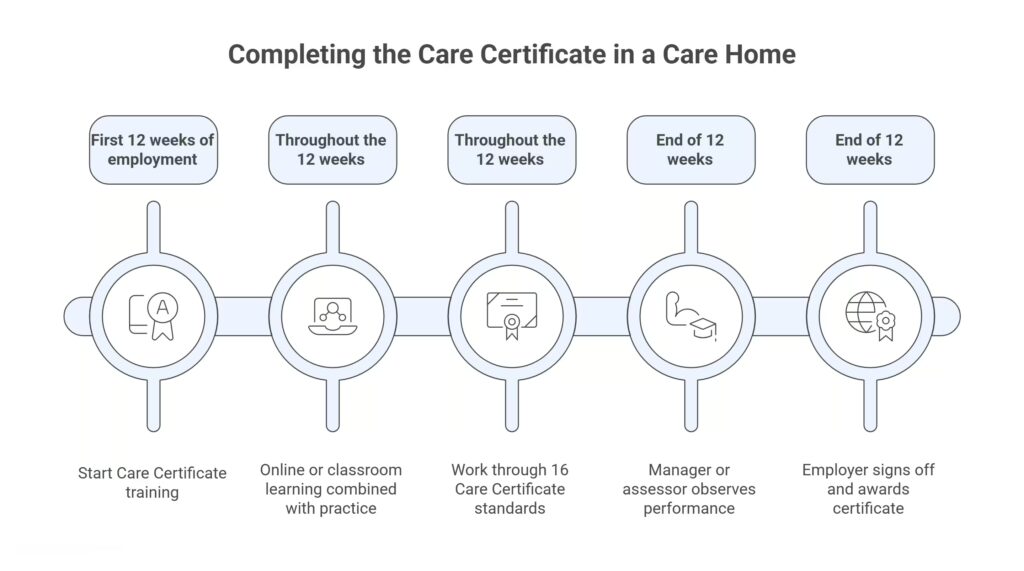
The Care Certificate is designed to be completed during your initial phase of employment, usually within the first 12 weeks. It’s a key component of your induction process that ensures you’re equipped with the essential knowledge and skills to provide high-quality care. Here’s an in-depth look at how the process typically works in a care home setting:
Start with Induction Training
When you begin your role at a care home, your induction training will usually include the Care Certificate. This training is structured to ensure that you’re not only learning the theory behind best practices but also gaining hands-on experience to put your learning into action. During this induction, you’ll be introduced to various topics that align with the Care Certificate’s 16 standards, covering everything from duty of care to safeguarding, equality, infection control, and more.
Combination of Online and Classroom Learning
To accommodate different learning preferences, the Care Certificate often combines online modules with in-person classroom training. The online modules allow you to learn at your own pace, while classroom training offers the opportunity for group discussions, practical demonstrations, and direct interaction with experienced professionals. This blended learning approach ensures that you are not just memorizing information but also understanding how to apply it in real-world care settings.
On-the-Job Training and Practice
In addition to formal learning, a significant portion of the Care Certificate is spent applying your new knowledge in the care home environment. During your first 12 weeks, you’ll be mentored and supported by experienced staff who will guide you in real-world tasks, such as administering medication, communicating with patients, and following infection control protocols. These practical experiences help solidify what you’ve learned and ensure you are competent in key aspects of care.
Observations and Assessments by Supervisors
A manager or designated assessor will closely observe your performance in various care activities. They’ll assess your ability to apply the Care Certificate standards in real care situations. For example, they may observe you performing tasks like moving and handling patients safely, ensuring hygiene standards are met, or engaging in effective communication with patients and colleagues. These assessments are designed to evaluate not only your knowledge but your competence in applying that knowledge in practice.
Building Confidence and Competence
As you progress through your Care Certificate training, you’ll have the chance to build both your confidence and competence. You’ll receive constructive feedback and additional support where needed, enabling you to refine your skills. Over time, you’ll become more confident in your role, which will help you provide more compassionate and effective care to residents.
Completion and Sign-Off
Once you’ve successfully demonstrated your ability to apply the Care Certificate standards safely and competently, your manager or assessor will “sign you off.” This means you’ve completed the training and have met all of the requirements to be awarded the Care Certificate. It’s an important milestone in your care career, confirming that you have the essential skills to work independently in the care home setting.
By the end of the Care Certificate process, you will have gained the knowledge, skills, and confidence necessary to deliver high-quality care in a safe, compassionate, and professional manner. Completing it successfully ensures that you’re fully prepared to contribute positively to the care home environment and provides a strong foundation for your ongoing professional development.
What Happens if You Don’t Have the Care Certificate?
You can be offered a job in a care home without a Care Certificate. Many employers recruit people with the right values and then provide training during induction. However, until you complete the Care Certificate (or can show you have equivalent qualifications), you won’t be allowed to work unsupervised. You’ll usually be regarded as a trainee and shadow experienced staff. Failure to complete the certificate within the expected time may limit your responsibilities or affect your progression.
The Long-Term Benefits of Completing the Care Certificate
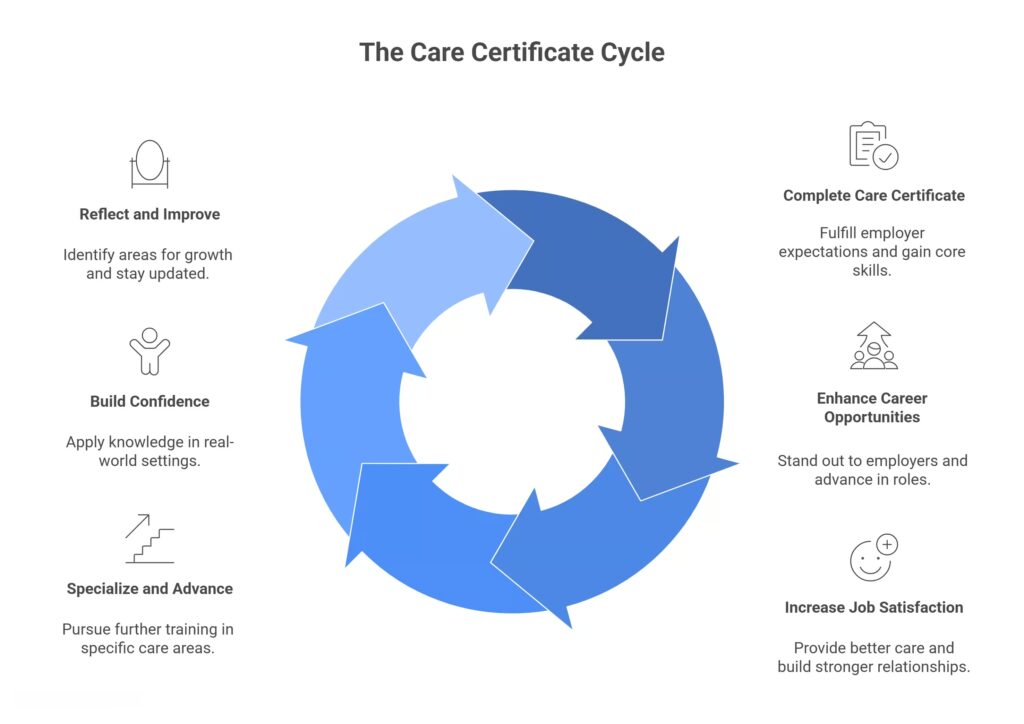
While the Care Certificate might seem like just another step in the induction process, its benefits extend far beyond simply fulfilling an employer’s expectations. By completing the Care Certificate, you’re not just ticking off a list of standards — you’re laying the foundation for a long-term, fulfilling career in the care sector.
1. Enhanced Career Opportunities
Having the Care Certificate on your CV makes you stand out to employers. It signals that you have met a high standard of training and that you understand and can apply the core principles of care. As you progress in your career, this certification may become a prerequisite for more senior roles. It’s also recognised across the sector, meaning it can enhance your job prospects if you decide to switch employers or move into a new type of care setting.
2. Increased Job Satisfaction
One of the core principles of the Care Certificate is developing the right attitude towards providing care — compassionate, respectful, and professional. By completing the certificate, you gain a better understanding of how to provide person-centred care, which not only improves your effectiveness but also increases your job satisfaction. Knowing that you are giving the best possible care to those in need is incredibly rewarding, and this deep understanding will help you build stronger, more empathetic relationships with the people you support.
3. Opportunities for Specialisation and Advancement
Once you’ve completed the Care Certificate, you will have a solid foundation upon which to build your career in the care sector. Many care workers choose to specialise in specific areas, such as dementia care, palliative care, or mental health support. Completing the Care Certificate opens up these opportunities because it shows you have the basic skills and knowledge needed to take on further training in these areas. Employers will often look for staff who are committed to continuous learning, and the Care Certificate demonstrates that you are dedicated to professional growth.
4. Confidence in Your Role
The Care Certificate equips you with essential skills and knowledge to feel confident in your role. While it focuses on theoretical training in areas like moving and handling and infection control, much of your confidence comes from applying this knowledge in a real-world care setting under supervision. This allows you to approach tasks confidently, knowing you’re following industry best practices.
5. Professional Development
The Care Certificate is not a one-time training event; it’s part of an ongoing process of professional development. As part of the Care Certificate, you’ll learn to reflect on your practice and identify areas for improvement, which is essential in a care setting where each day presents new challenges. Many care providers offer additional training and support, helping you to build on what you’ve learned and stay up to date with the latest standards in care.
Benefits of Having the Care Certificate Before You Apply

Completing your Care Certificate before applying for care roles can give you a real head start. It tells employers you already understand the standards, can work safely, and genuinely care about the work you’re doing. It’s not just a certificate — it’s proof you’re ready to make a difference from day one.
You might find your induction is shorter, your confidence grows faster, and you can take on more responsibility sooner.
Ready to begin? Explore the Care Certificate Online Training Course, a flexible way to build your skills and start your care career with confidence.
Conclusion
Working in a care home isn’t just about tasks — it’s about compassion, competence, and consistency. That’s exactly what the Care Certificate helps to build. It may not be a legal requirement, but it’s a clear benchmark of quality, and most employers will expect you to complete it soon after starting. Earning it shows you’re serious about providing care that’s safe, respectful, and person-centred.
If you’re thinking about a career in care, don’t overthink it — just start. Use trusted platforms like HF Learning to study at your own pace, build your confidence, and take that first step. Every great carer begins with learning — and the Care Certificate is where that journey starts.