Exclusive Deal! 94% Off, Today Only!
Sale Ends In
In the UK, over 70% of healthcare documentation relies on standardised medical terminology, yet many support staff report uncertainty when interpreting clinical language. These gaps often surface only after errors, delays, or reduced confidence begin affecting professional performance. This Medical Terminology Training course is designed to close that gap before misunderstanding becomes a lasting risk.
Our CPD-accredited course introduces medical language through a structured, system-led approach, covering body vocabulary, diagnostic equipment, acronyms, and terminology linked to major systems, including cardiovascular, respiratory, musculoskeletal, digestive, neurological, and immune functions. Concepts are broken into prefixes, suffixes, and root words, helping learners recognise meaning patterns rather than memorising isolated terms. Visual references and clear explanations support accurate interpretation across written and verbal contexts.
By completing this course, you will be better prepared to read medical records, follow instructions, and communicate accurately within healthcare-related environments. Enrol today to ensure terminology strengthens your confidence rather than limiting your professional contribution across diverse roles and regulated care settings.

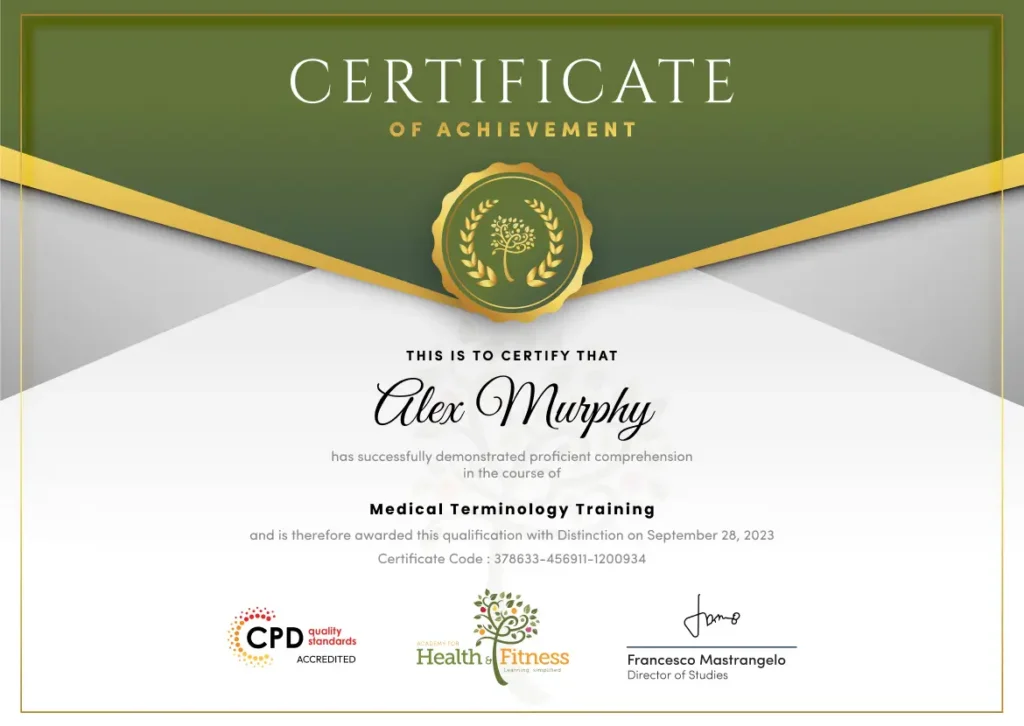
After completing the MCQ assessment, you will qualify for the CPD Certificate from HF Online as proof of your continued professional development. You can order your certificate at a cost of £10 for PDF and £29 for hard copy certificate or both for £39.
For assessing your learning, you have to complete an automated MCQ exam. It is required for the students to score at least 60% to pass the exam. Learners can apply for the certificate after they clear the exam.
There are assignment questions provided at the end of the course. You are suggested to complete the questions to enrich your understanding of the course. You can complete this according to your preferred time. The expert tutor will provide feedback on your performance after assessing your assignment.
There are no prerequisites and you may use any internet-enabled device to study at your own speed, it is adaptable and available to students of all skill levels.
Completing Medical Terminology Training strengthens communication accuracy and documentation awareness. These skills are essential across healthcare, care services, medical administration, and clinical support environments throughout the UK.
Medical terminology is the standard language used to describe the human body, conditions, and procedures. It ensures accurate communication and reduces misunderstandings in healthcare settings.
Clear terminology helps professionals interpret instructions and records correctly. This reduces errors caused by miscommunication or incorrect assumptions.
When taught systematically, medical terminology becomes logical and pattern-based. This course focuses on understanding word structures rather than rote memorisation.
Healthcare environments rely heavily on abbreviations for efficiency. Understanding them prevents confusion when reading records or communicating with teams.
Knowing body systems helps learners understand where terms apply. This context improves retention and practical understanding.
Yes, terminology knowledge is essential for accurate documentation, scheduling, and patient communication. It supports confidence in administrative healthcare roles.
No, the course focuses on language understanding, not diagnosis or clinical decision-making. It supports communication rather than medical practice.
Care workers benefit by understanding care plans, reports, and medical instructions more clearly. This supports safer and more confident care delivery.
Yes, it is widely used in care homes, clinics, pharmacies, insurance, and health administration. Terminology supports consistency across all health-related services.
The four word parts are prefix, word root, suffix, and combining form vowel. When a word root is combined with a combining form vowel, the word part is referred to as a combining form.
| Introduction to Medical Terminology | |||
| Module 01: Human Body Vocabulary with Pictures | |||
| Module 01: Human Body Vocabulary with Pictures | 00:47:00 | ||
| Module 02: Equipment, Instruments and Lab Tests | |||
| Module 02: Equipment, Instruments and Lab Tests | 00:19:00 | ||
| Module 03: Acronyms and Abbreviation | |||
| Module 03: Acronyms and Abbreviation | 00:36:00 | ||
| Module 04: Digestive System | |||
| Module 04: Digestive System | 00:27:00 | ||
| Module 05: Cardiovascular System | |||
| Module 05: Cardiovascular System | 00:20:00 | ||
| Module 06: Blood and Immunity System | |||
| Module 06: Blood and Immunity System | 00:15:00 | ||
| Module 07: Respiratory System | |||
| Module 07: Respiratory System | 00:17:00 | ||
| Module 08: Musculoskeletal System | |||
| Module 08: Musculoskeletal System | 00:17:00 | ||
| Module 09: Central Nervous System | |||
| Module 09: Central Nervous System | 00:14:00 | ||
| Introduction to Medical Terminology | |||
| Module 01: Human Body Vocabulary with Pictures | |||
| Module 01: Human Body Vocabulary with Pictures | 00:47:00 | ||
| Module 02: Equipment, Instruments and Lab Tests | |||
| Module 02: Equipment, Instruments and Lab Tests | 00:19:00 | ||
| Module 03: Acronyms and Abbreviation | |||
| Module 03: Acronyms and Abbreviation | 00:36:00 | ||
| Module 04: Digestive System | |||
| Module 04: Digestive System | 00:27:00 | ||
| Module 05: Cardiovascular System | |||
| Module 05: Cardiovascular System | 00:20:00 | ||
| Module 06: Blood and Immunity System | |||
| Module 06: Blood and Immunity System | 00:15:00 | ||
| Module 07: Respiratory System | |||
| Module 07: Respiratory System | 00:17:00 | ||
| Module 08: Musculoskeletal System | |||
| Module 08: Musculoskeletal System | 00:17:00 | ||
| Module 09: Central Nervous System | |||
| Module 09: Central Nervous System | 00:14:00 | ||
14126
4.7
10739
4.9
3732
4.5