Step into Medical Law, a CPD-accredited programme supporting healthcare administrators, compliance officers, legal assistants, and patient liaison professionals. Aimed at those who want to become confident specialists in healthcare regulation and patient rights, this powerful course turns complex legislation into practical career strength, helping you protect people, services, and decisions.
Exclusive Deal! 94% Off, Today Only!
Sale Ends In
Do you want to understand the rules that shape treatment decisions, patient rights, confidentiality, negligence, and public health—and use that knowledge to strengthen your professional value? If yes, this Medical Law programme matters because modern healthcare is not just clinical; it is legal, ethical, regulated, and constantly scrutinised.
In England alone, NHS employment reached a record 2.07 million in December 2025, reflecting the system’s vast scale and workforce demand. NHS Resolution reported 14,428 new clinical negligence claims in 2024/25, with £3.1 billion paid in costs. Meanwhile, legal services output rose 6.1% in May 2025, highlighting growing demand for healthcare law knowledge and medico-legal expertise.
You will learn core principles of Medical Law, including legislation on access to healthcare, patient consent, and treatment rights. The course also explores medical reports, adult support, public health duties, coronavirus regulations, mental health law, abortion law, and other key statutory areas, helping you build a strong foundation in legal responsibilities within healthcare settings..
Enrol now to build sharper judgement, stronger compliance awareness, and career-relevant legal confidence. It is flexible online training for beginners, support staff, aspiring legal professionals, and healthcare teams needing clearer lawful decision-making today.
Develop essential understanding of healthcare legislation, patient protections, consent, confidentiality, public health duties, and medico-legal reasoning. This section helps you move from general interest to subject knowledge you can apply in healthcare support, compliance, administration, and legal-facing environments with confidence.
This medical law course online UK is designed to help you build essential, career-focused knowledge for healthcare regulation, patient rights, consent, confidentiality, negligence, and healthcare governance support roles, giving you the confidence and subject understanding employers and compliance-focused organisations increasingly value.
Whether you want legal awareness for healthcare work, a first step into compliance, or stronger understanding of patient rights and regulation, this programme suits beginners and developing professionals alike. It is useful for learners seeking career-relevant knowledge for healthcare environments.
There are no specific prerequisites to enrol in this Medical Law Certification Course – CPD Accredited Course. Anyone and everyone can take this course.
The Medical Law Certification Course – CPD Accredited Course is fully accessible from any internet-enabled smart device, allowing you to study from the comfort of your home.
All you need is a passion for learning, basic literacy skills, and to be over the age of 16.
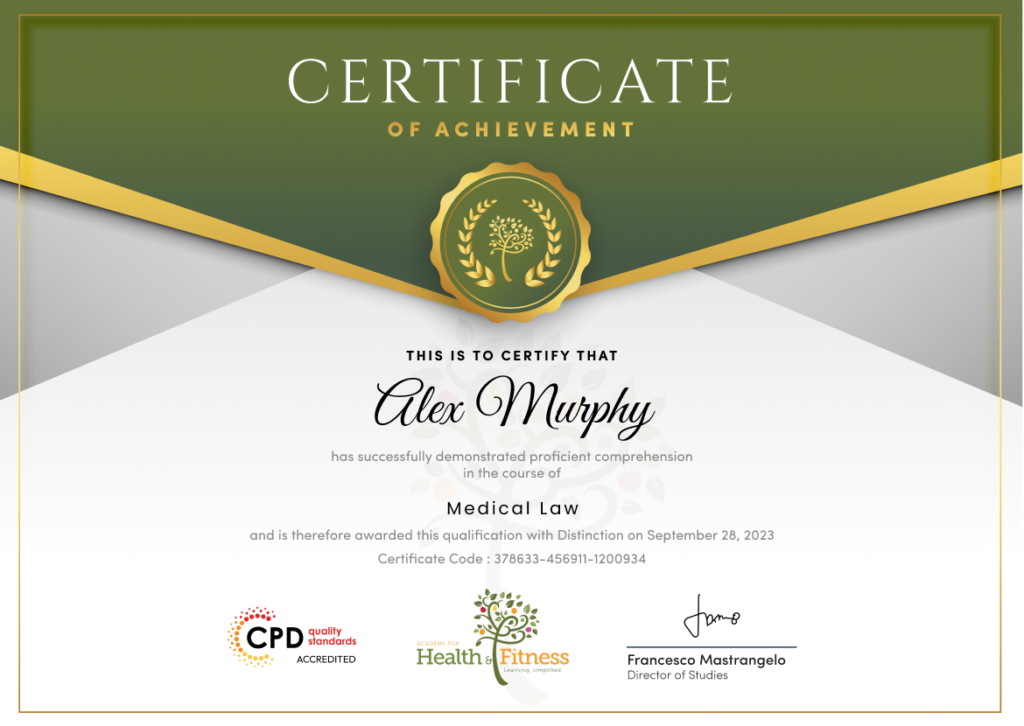
After successfully completing the Medical Law course, you will qualify for a CPD Certificate as proof of your continued professional development and achievement. This certificate can enhance your professional profile and showcase your commitment to building relevant skills and knowledge. You can receive your digital certificate for only £10, or request a printed hard copy sent by post for just £29 or both for £39.
For assessing your learning, you have to complete an automated MCQ exam. It is required for the students to score at least 60% to pass the exam and fulfil the Quality Licence Scheme-endorsed certificate criteria. Learners can apply for the certificate after they clear the exam.
There are assignment questions provided at the end of the Medical Law course. You are suggested to complete the questions to enrich your understanding of the course. You can complete this according to your preferred time. The expert tutor will provide feedback on your performance after assessing your assignment.
Medical Law knowledge can support work across healthcare administration, compliance, governance, complaints, privacy, and legal support settings. Employers value people who understand regulation, rights, consent, confidentiality, and risk. The roles below show realistic directions this learning can support, but regulated legal professions require further formal training before practice independently in reality.
Paralegals support solicitors by researching cases, drafting documents, organising evidence, and managing client files. In healthcare-related matters, they may help with consent disputes, negligence claims, patient records, and regulatory issues. This role suits detail-focused learners who want a practical legal support entry point with room to progress.
Salary range: £20,000 – £40,000.
Legal secretaries keep legal teams organised by preparing correspondence, managing diaries, handling documents, and supporting case administration. In medical negligence or healthcare law settings, they may work with reports, records, court papers, and client communication. This role suits organised learners who want office-based legal support work with strong transferability.
Salary range: £24,000 – £40,000.
Legal executives handle specialised legal work, often in areas such as personal injury, clinical negligence, or regulatory matters. They prepare cases, advise clients, draft documents, and manage files. This role suits learners who want more responsibility than basic support work and a structured route into legal practice.
Salary range: £33,000 – £60,000.
Solicitors advise clients, interpret law, manage cases, negotiate outcomes, and represent organisations or individuals. In medical law-related work, that may include negligence, patient rights, mental health, confidentiality, or healthcare governance matters. This role suits ambitious learners, but it is a regulated profession requiring further legal education and qualification.
Salary range: £30,000 – £80,000.
Barristers provide specialist legal advice and represent clients in court or tribunals. In medical law contexts, they may argue cases involving negligence, consent, public health, or complex healthcare disputes. This role suits highly driven learners who want advocacy-based legal work, but it requires significant additional professional training and qualification.
Salary range: £24,000 – £250,000.
Data protection officers help organisations follow privacy laws, manage risk, and strengthen policy compliance. In healthcare settings, they deal with sensitive patient information, lawful processing, breach response, and staff guidance. This role suits learners interested in privacy law in healthcare, governance, and practical regulatory work with clear relevance.
Salary range: £29,000 – £50,000.
Health service managers oversee healthcare operations, staff coordination, policy delivery, and service performance. Medical law knowledge helps because healthcare decisions sit inside a legal framework covering consent, patient rights, complaints, safeguarding, and confidentiality. This role suits organised learners who want management responsibility in regulated healthcare environments.
Salary range: £26,382 – £68,525.
GP practice managers run the business side of surgeries and health centres, handling staffing, administration, systems, governance, and compliance. Medical law training helps with confidentiality, patient access, complaints, and policy control. This role suits learners who want operational responsibility in primary care with strong legal-awareness value.
Salary range: £35,000 – £65,000.
Court legal advisers support judges and magistrates by explaining law, procedure, and case rules. A background in health law, patient rights, or medico-legal issues can strengthen understanding of regulated decision-making. This role suits learners who want serious legal responsibility, but it also requires further formal professional qualification.
Salary range: £32,000 – £53,000.
Company secretaries make sure organisations follow legal and governance requirements. In healthcare providers or health-focused organisations, that can connect directly with regulation, accountability, risk, and board-level compliance. This role suits learners who are interested in governance and policy oversight rather than frontline legal casework or direct clinical delivery.
Salary range: £26,000 – £90,000.
Medical law is the body of law that governs healthcare practice, patient rights, consent, confidentiality, negligence, mental health decisions, public health duties, and related legal responsibilities in clinical and healthcare settings.
It covers issues such as access to treatment, medical reports, adult support, mental health legislation, abortion law, public health law, confidentiality, patient rights, and medical negligence. That is exactly why a strong Healthcare Law Course or Health Law Course matters.
Yes. A Medical Law Online Course can work well for beginners because it lets you build legal awareness step by step. You do not need to be a lawyer to start learning healthcare law, ethics, and regulation properly.
Absolutely. Healthcare administrators deal with records, confidentiality, consent, complaints, governance, and policy. Medical Law Training gives them better judgement and reduces the stupid mistake of treating legal risk as someone else’s problem.
A Medical Law Certificate can strengthen your CV for healthcare compliance, governance, complaints handling, and legal support roles. It will not magically qualify you as a solicitor, but it can make you more credible for regulated support positions.
A Medical Law and Ethics Course combines legal rules with ethical decision-making. A Health Care Law Course usually focuses more directly on statutes, rights, duties, and compliance. Strong professionals need both, not one without the other.
Yes. Nurses, managers, reception teams, administrators, safeguarding staff, and patient liaison workers all benefit from understanding Patient Rights and Medical Law. Legal ignorance in healthcare is not harmless; it causes complaints, risk, and bad decisions.
Yes. UK healthcare organisations must follow the UK GDPR and the Data Protection Act 2018, and the Data (Use and Access) Act 2025 introduced further privacy-related changes. Anyone handling patient information should understand that framework.
Yes. A Medical Negligence Law Course helps you understand how errors, duty of care, documentation, and patient harm are assessed. That makes it highly relevant for complaints, risk, governance, and medico-legal support work.
Study one module at a time, take notes on legislation, connect legal rules to real healthcare situations, and revise key themes like consent, confidentiality, public health, and mental health. Passive reading is useless; apply what you learn.
A Medical Law Diploma usually gives broader coverage and deeper structure, while shorter Healthcare Law Training can be faster for targeted upskilling. The better choice depends on whether you want quick awareness or stronger long-term subject depth.
Yes, at a foundation level. Core ideas like consent, confidentiality, negligence, and patient rights are widely relevant, but legislation differs by jurisdiction. So if you are comparing U.S. Health Law Fundamentals with UK-focused study, do not confuse one legal system with another.
| Module 1- An Introduction to Medical Law | |||
| An Introduction to Medical Law | 00:11:00 | ||
| Module 2- Legislation on Access to Health, Medical Report, Treatment | |||
| Legislation on Access to Health, Medical Report, Treatment | 00:19:00 | ||
| Module 3- Legislation on Adult Support | |||
| Legislation on Adult Support | 00:20:00 | ||
| Module 4- Legislation on Public Health and Health Service (Part 1) | |||
| Legislation on Public Health and Health Service (Part 1) | 00:20:00 | ||
| Module 5- Legislation on Public Health and Health Service (Part 2) | |||
| Legislation on Public Health and Health Service (Part 2) | 00:32:00 | ||
| Module 6- Legislation on Public Health and Health Service (Part 3) | |||
| Legislation on Public Health and Health Service (Part 3) | 00:28:00 | ||
| Module 7- Legislation on Public Health and Health Service (Part 4) | |||
| Legislation on Public Health and Health Service (Part 4) | 00:32:00 | ||
| Module 8- Legislation on Coronavirus | |||
| Legislation on Coronavirus | 00:29:00 | ||
| Module 9- Legislation on Mental Health (Part 1) | |||
| Legislation on Mental Health (Part 1) | 00:28:00 | ||
| Module 10- Legislation on Mental Health (Part 2) | |||
| Legislation on Mental Health (Part 2) | 00:34:00 | ||
| Module 11- Legislation on Abortion | |||
| Legislation on Abortion | 00:24:00 | ||
| Module 12- Other Legislation (Part 1) | |||
| Other Legislation (Part 1) | 00:23:00 | ||
| Module 13- Other Legislation (Part 2) | |||
| Other Legislation (Part 2) | 00:26:00 | ||
| Assignment | |||
| Assignment – Medical Law | 00:00:00 | ||
| Order Your Certificate | |||
| Order your Certificate | 00:00:00 | ||
| Module 1- An Introduction to Medical Law | |||
| An Introduction to Medical Law | 00:11:00 | ||
| Module 2- Legislation on Access to Health, Medical Report, Treatment | |||
| Legislation on Access to Health, Medical Report, Treatment | 00:19:00 | ||
| Module 3- Legislation on Adult Support | |||
| Legislation on Adult Support | 00:20:00 | ||
| Module 4- Legislation on Public Health and Health Service (Part 1) | |||
| Legislation on Public Health and Health Service (Part 1) | 00:20:00 | ||
| Module 5- Legislation on Public Health and Health Service (Part 2) | |||
| Legislation on Public Health and Health Service (Part 2) | 00:32:00 | ||
| Module 6- Legislation on Public Health and Health Service (Part 3) | |||
| Legislation on Public Health and Health Service (Part 3) | 00:28:00 | ||
| Module 7- Legislation on Public Health and Health Service (Part 4) | |||
| Legislation on Public Health and Health Service (Part 4) | 00:32:00 | ||
| Module 8- Legislation on Coronavirus | |||
| Legislation on Coronavirus | 00:29:00 | ||
| Module 9- Legislation on Mental Health (Part 1) | |||
| Legislation on Mental Health (Part 1) | 00:28:00 | ||
| Module 10- Legislation on Mental Health (Part 2) | |||
| Legislation on Mental Health (Part 2) | 00:34:00 | ||
| Module 11- Legislation on Abortion | |||
| Legislation on Abortion | 00:24:00 | ||
| Module 12- Other Legislation (Part 1) | |||
| Other Legislation (Part 1) | 00:23:00 | ||
| Module 13- Other Legislation (Part 2) | |||
| Other Legislation (Part 2) | 00:26:00 | ||
| Assignment | |||
| Assignment – Medical Law | 00:00:00 | ||
| Order Your Certificate | |||
| Order your Certificate | 00:00:00 | ||