Mastering SQL Programming – CPD-accredited course designed for fitness industry professionals seeking data management roles; ideal for beginners and practitioners; includes recognized certification for career growth.
Learn SQL fundamentals, database creation, joins, and advanced queries through structured lessons. Build practical skills to manage and analyze data efficiently, enhancing decision-making and boosting professional credibility in data-driven fitness environments.
4.6
(7 Reviews)
33 Students
Exclusive Deal! 94% Off, Today Only!
Sale Ends In
CPD Point
Data skills are in high demand across the UK, with tech and data-related roles growing rapidly and SQL consistently ranked among the most sought-after skills by employers. Mastering SQL Programming equips you with the essential tools to manage, query, and analyse data effectively—skills that are increasingly valuable in the fitness industry and beyond.
In this course, you will learn how to set up an SQL environment, write powerful queries, use GROUP BY and JOIN statements, and work with advanced SQL commands to handle real-world datasets. You’ll also gain hands-on experience creating databases and tables from scratch.
Whether you’re managing client data, tracking performance metrics, or improving business insights, this CPD-accredited course enhances your professional credibility and opens doors to data-driven roles. It’s a practical, career-focused investment that helps you stand out in a competitive job market.
Enrol today to gain in-demand SQL skills and take the next step towards a data-driven career in the fitness industry.
This Mastering SQL Programming course is designed to provide a comprehensive understanding of database management, data querying, and structured data analysis, making it ideal for fitness industry professionals looking to build data-driven skills.
Throughout this course, you will develop essential knowledge of SQL fundamentals, including writing queries, using GROUP BY and JOIN statements, and working with advanced SQL commands in real-world scenarios. You will also gain hands-on experience in creating databases and tables, enabling you to organise and manage data efficiently.
In addition to technical expertise, this course strengthens your understanding of how data supports business decisions. This deeper insight allows you to analyse performance metrics, manage client information, and improve operational efficiency with greater accuracy and confidence.
By completing this Mastering SQL Programming online course, you will:
Whether you are beginning your career or aiming to enhance your data skills, the Mastering SQL Programming course equips you with the essential knowledge and practical expertise needed to thrive in today’s data-driven landscape.
This comprehensive course is designed around real-world applications, enabling you to confidently manage databases, write efficient queries, and analyse data effectively. You will gain hands-on experience with SQL techniques widely used across industries, including the fitness sector.
By completing this course, you can progress into roles such as data analyst, database administrator, or data-focused fitness professional. It provides a strong foundation to boost your career prospects, improve decision-making skills, and stay competitive in an increasingly data-centric job market.
This course is ideal for individuals who want to start or advance their career in data-driven roles, particularly within the fitness industry and other business sectors.
It is suitable for:
There are no specific prerequisites to enrol in this Mastering SQL Programming course—anyone can join, regardless of prior experience.
This course is fully accessible from any internet-enabled device, allowing you to study anytime, anywhere, at your own pace.
All you need is a basic understanding of English, a willingness to learn, and to be over the age of 16.
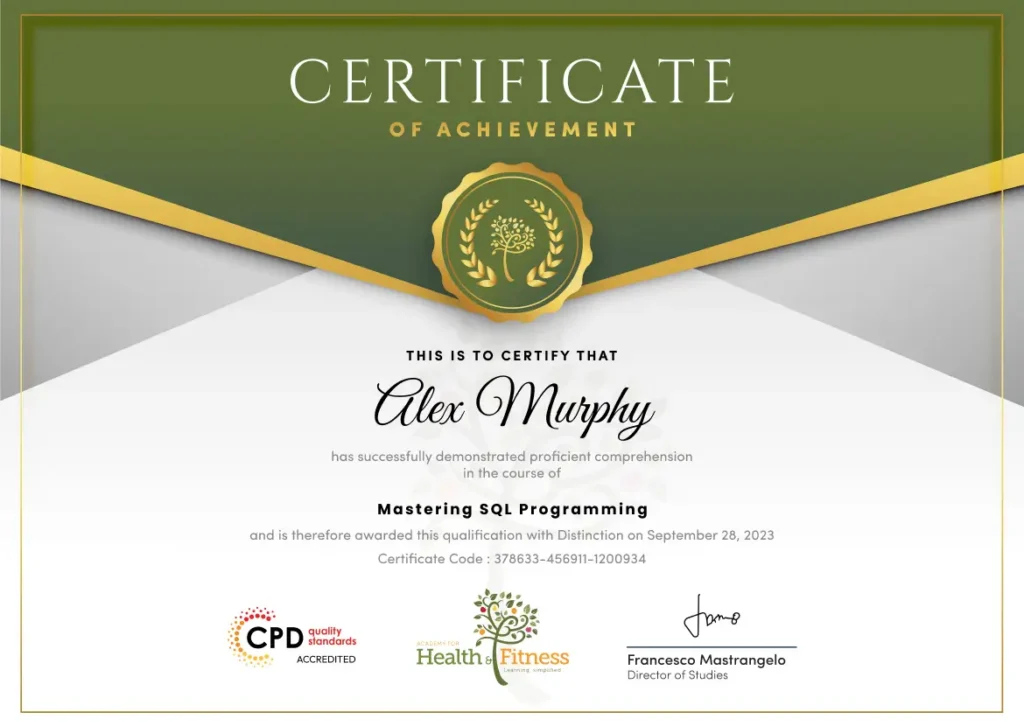
After successfully completing the Mastering SQL Programming course, you will qualify for a CPD Certificate as proof of your continued professional development and achievement. This certificate can enhance your professional profile and showcase your commitment to building relevant skills and knowledge. You can receive your digital certificate for only £10, or request a printed hard copy sent by post for just £29 or both for £39.
For assessing your learning, you have to complete an automated MCQ exam. It is required for the students to score at least 60% to pass the exam and fulfil the Quality Licence Scheme-endorsed certificate criteria. Learners can apply for the certificate after they clear the exam.
There are assignment questions provided at the end of the course. You are suggested to complete the questions to enrich your understanding of the course. You can complete this according to your preferred time. The expert tutor will provide feedback on your performance after assessing your assignment.
The Mastering SQL Programming course is designed to equip you with essential data management and analysis skills that are highly valued across multiple industries, including the fitness sector. While this course does not provide a professional licence, it builds a strong foundation in SQL, enabling you to pursue a wide range of entry-level and support roles in data-driven environments.
This course covers SQL fundamentals, database creation, data querying, GROUP BY statements, JOIN operations, and advanced SQL commands. It is designed to provide a strong foundation in managing and analysing data across real-world scenarios.
Yes. This course is beginner-friendly and suitable for individuals with no prior experience in SQL or programming. It gradually builds your knowledge from basic to more advanced concepts.
Yes. The course is delivered fully online, allowing you to study from home at your own pace and fit learning around your schedule.
Yes. Upon successful completion, you will receive a CPD-accredited certificate, which can help enhance your CV and professional profile.
No. This course provides foundational knowledge and practical skills but does not serve as a formal professional licence. It can, however, support your pathway into entry-level roles.
This course can support roles such as junior data analyst, database assistant, SQL developer (entry-level), and data support roles across various industries, including fitness.
The course typically includes assessments such as multiple-choice quizzes or assignments to test your understanding, with instant results in many cases.
This course is ideal for beginners, fitness professionals, business owners, and anyone interested in learning data management and analysis using SQL.
Yes. SQL is one of the most in-demand technical skills in the UK, widely used in data analysis, business intelligence, and IT roles across industries.
Data plays a key role in modern decision-making. This course helps you gain practical SQL skills to analyze data, improve business performance, and enhance your career opportunities in a data-driven world.
| Course Introduction | |||
| Introduction | 00:04:00 | ||
| Course Curriculum Overview | 00:05:00 | ||
| Overview of Databases | 00:10:00 | ||
| SQL Environment Setup | |||
| MySQL Installation | 00:16:00 | ||
| MySQL Workbench Installation | 00:09:00 | ||
| Connecting to MySQL using Console | 00:09:00 | ||
| SQL Statement Basics | |||
| Overview of Challenges | 00:04:00 | ||
| SQL Statement Basic | 00:16:00 | ||
| SELECT Statement | 00:09:00 | ||
| SELECT DISTINCT | 00:05:00 | ||
| Column AS Statement | 00:12:00 | ||
| COUNT built-in Method usage | 00:11:00 | ||
| SELECT WHERE Clause – Part One | 00:05:00 | ||
| SELECT WHERE Clause – Part Two | 00:11:00 | ||
| SQL Statement Basic | 00:16:00 | ||
| SQL Limit Clause Statement | 00:09:00 | ||
| SQL Using BETWEEN with Same Column Data | 00:11:00 | ||
| How to Apply IN Operator | 00:11:00 | ||
| Wildcard Characters with LIKE and ILIKE | 00:11:00 | ||
| GROUP BY Statements | |||
| Overview of GROUP BY | 00:06:00 | ||
| Aggregation function SUM() | 00:09:00 | ||
| Aggregation MIN() and MAX() | 00:05:00 | ||
| GROUP BY – One | 00:09:00 | ||
| GROUP BY – Two | 00:12:00 | ||
| HAVING Clause | 00:05:00 | ||
| JOINS | |||
| Overview of JOINS | 00:04:00 | ||
| Introduction to JOINS | 00:04:00 | ||
| AS Statement table | 00:03:00 | ||
| INNER Joins | 00:14:00 | ||
| FULL Outer Join | 00:11:00 | ||
| LEFT Outer JOIN | 00:08:00 | ||
| RIGHT JOIN | 00:08:00 | ||
| Union | 00:07:00 | ||
| Advanced SQL Commands / Statements | |||
| Timestamps | 00:12:00 | ||
| EXTRACT from timestamp | 00:10:00 | ||
| Mathematical Functions | 00:12:00 | ||
| String Functions | 00:22:00 | ||
| SUBQUERY | 00:13:00 | ||
| Creating Database and Tables | |||
| Basic of Database and Tables | 00:06:00 | ||
| DataTypes | 00:10:00 | ||
| Primarykey and Foreignkey | 00:06:00 | ||
| Create Table in SQL Script | 00:13:00 | ||
| Insert | 00:11:00 | ||
| Update | 00:07:00 | ||
| Delete | 00:04:00 | ||
| Alter Table | 00:09:00 | ||
| Drop Table | 00:05:00 | ||
| NOT NULL Constraint | 00:08:00 | ||
| UNIQUE Constraint | 00:09:00 | ||
| Databases and Tables | |||
| Creating a Database backup | 00:12:00 | ||
| 10a Overview of Databases and Tables | 00:05:00 | ||
| 10c Restoring a Database | 00:07:00 | ||
| Certificate | |||
| Order Your Certificate | 00:00:00 | ||
| Course Introduction | |||
| Introduction | 00:04:00 | ||
| Course Curriculum Overview | 00:05:00 | ||
| Overview of Databases | 00:10:00 | ||
| SQL Environment Setup | |||
| MySQL Installation | 00:16:00 | ||
| MySQL Workbench Installation | 00:09:00 | ||
| Connecting to MySQL using Console | 00:09:00 | ||
| SQL Statement Basics | |||
| Overview of Challenges | 00:04:00 | ||
| SQL Statement Basic | 00:16:00 | ||
| SELECT Statement | 00:09:00 | ||
| SELECT DISTINCT | 00:05:00 | ||
| Column AS Statement | 00:12:00 | ||
| COUNT built-in Method usage | 00:11:00 | ||
| SELECT WHERE Clause – Part One | 00:05:00 | ||
| SELECT WHERE Clause – Part Two | 00:11:00 | ||
| SQL Statement Basic | 00:16:00 | ||
| SQL Limit Clause Statement | 00:09:00 | ||
| SQL Using BETWEEN with Same Column Data | 00:11:00 | ||
| How to Apply IN Operator | 00:11:00 | ||
| Wildcard Characters with LIKE and ILIKE | 00:11:00 | ||
| GROUP BY Statements | |||
| Overview of GROUP BY | 00:06:00 | ||
| Aggregation function SUM() | 00:09:00 | ||
| Aggregation MIN() and MAX() | 00:05:00 | ||
| GROUP BY – One | 00:09:00 | ||
| GROUP BY – Two | 00:12:00 | ||
| HAVING Clause | 00:05:00 | ||
| JOINS | |||
| Overview of JOINS | 00:04:00 | ||
| Introduction to JOINS | 00:04:00 | ||
| AS Statement table | 00:03:00 | ||
| INNER Joins | 00:14:00 | ||
| FULL Outer Join | 00:11:00 | ||
| LEFT Outer JOIN | 00:08:00 | ||
| RIGHT JOIN | 00:08:00 | ||
| Union | 00:07:00 | ||
| Advanced SQL Commands / Statements | |||
| Timestamps | 00:12:00 | ||
| EXTRACT from timestamp | 00:10:00 | ||
| Mathematical Functions | 00:12:00 | ||
| String Functions | 00:22:00 | ||
| SUBQUERY | 00:13:00 | ||
| Creating Database and Tables | |||
| Basic of Database and Tables | 00:06:00 | ||
| DataTypes | 00:10:00 | ||
| Primarykey and Foreignkey | 00:06:00 | ||
| Create Table in SQL Script | 00:13:00 | ||
| Insert | 00:11:00 | ||
| Update | 00:07:00 | ||
| Delete | 00:04:00 | ||
| Alter Table | 00:09:00 | ||
| Drop Table | 00:05:00 | ||
| NOT NULL Constraint | 00:08:00 | ||
| UNIQUE Constraint | 00:09:00 | ||
| Databases and Tables | |||
| Creating a Database backup | 00:12:00 | ||
| 10a Overview of Databases and Tables | 00:05:00 | ||
| 10c Restoring a Database | 00:07:00 | ||
| Certificate | |||
| Order Your Certificate | 00:00:00 | ||