CompTIA CySA+ Cybersecurity Analyst (CS0-002) | CPD Accredited | For Aspiring Cybersecurity Analysts, SOC Analysts, IT Security Professionals, and Network Administrators | CPD Certificate Included
Learn threat intelligence, vulnerability management, incident response, digital forensics, cloud security, and risk mitigation with this CPD Accredited cybersecurity course designed to support your career in IT security.
4.6
(7 Reviews)
48 Students
Exclusive Deal! 94% Off, Today Only!
Sale Ends In
CPD PointCybersecurity professionals are in greater demand than ever, with 49% of UK businesses reporting a basic cyber security skills gap, highlighting the need for qualified security analysts.
The CompTIA CySA+ Cybersecurity Analyst (CS0-002) course equips you with the practical skills needed to identify threats, manage vulnerabilities, investigate security incidents, and protect modern IT environments. You’ll explore threat intelligence, cloud security, security monitoring, incident response, digital forensics, risk management, and industry best practices aligned with the latest CySA+ exam objectives.
Whether you’re an aspiring cybersecurity analyst, SOC analyst, or IT professional looking to advance, this CPD Accredited course helps you build job-ready knowledge and strengthen your CV. By developing in-demand analytical and defensive security skills, you’ll be better prepared for career progression, certification success, and opportunities in the UK’s rapidly growing cybersecurity sector.
The CompTIA CySA+ Cybersecurity Analyst (CS0-002) course is designed to provide a strong understanding of cybersecurity analysis, threat detection, vulnerability management, and incident response, making it ideal for anyone looking to build a career in IT security.
Throughout this CPD Accredited cybersecurity course, you will learn how to use threat intelligence, analyse security data, identify vulnerabilities, monitor systems, and respond to potential cyber incidents. You will also explore cloud security, digital forensics, automation, software and hardware assurance, and risk mitigation strategies used in modern organisations.
In addition to technical knowledge, this course helps you develop an analytical mindset so you can think like an attacker, recognise indicators of compromise, and support stronger organisational security. It is suitable for aspiring Cybersecurity Analysts, SOC Analysts, IT Security Professionals, and Network Administrators.
By completing this CompTIA CySA+ Cybersecurity Analyst (CS0-002) online course, you will:
Whether you are starting your IT career or looking to progress into cybersecurity, this CompTIA CySA+ Cybersecurity Analyst (CS0-002) course provides the essential knowledge needed to succeed in modern security roles.
As a comprehensive cybersecurity analyst training course, it is designed to help you understand real-world security operations, including threat intelligence, vulnerability management, incident response, cloud security, digital forensics, and security monitoring.
This course supports your progression into roles such as Cybersecurity Analyst, SOC Analyst, IT Security Professional, Security Operations Technician, or Network Administrator, giving you a strong foundation to build confidence, improve your CV, and advance in the cybersecurity industry.
This course is ideal for individuals who want to start or progress in the cybersecurity and IT security sector, particularly in roles involving threat detection, security monitoring, and incident response.
It is suitable for:
There are no specific prerequisites to enrol in this CompTIA CySA+ Cybersecurity Analyst (CS0-002) course. Anyone interested in cybersecurity and IT security can take this course.
The course is fully accessible from any internet-enabled smart device, allowing you to study from home at your own pace.
All you need is a passion for learning, basic literacy skills, and to be over the age of 16.
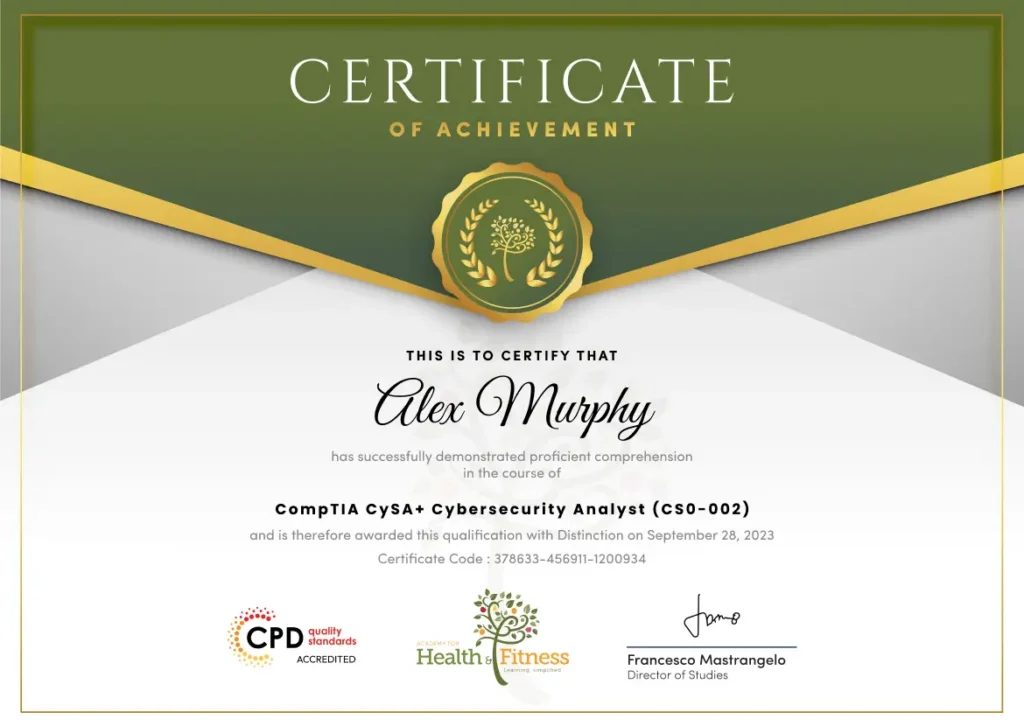
After successfully completing the CompTIA CySA+ Cybersecurity Analyst (CS0-002) course, you will qualify for a CPD Certificate as proof of your continued professional development and achievement. This certificate can enhance your professional profile and showcase your commitment to building relevant skills and knowledge. You can receive your digital certificate for only £10, or request a printed hard copy sent by post for just £29 or both for £39.
For assessing your learning, you have to complete an automated MCQ exam. It is required for the students to score at least 60% to pass the exam and fulfil the Quality Licence Scheme-endorsed certificate criteria. Learners can apply for the certificate after they clear the exam.
There are assignment questions provided at the end of the course. You are suggested to complete the questions to enrich your understanding of the course. You can complete this according to your preferred time. The expert tutor will provide feedback on your performance after assessing your assignment.
The CompTIA CySA+ Cybersecurity Analyst (CS0-002) course is an online knowledge-based training designed to build strong skills in threat detection, vulnerability management, incident response, and security monitoring. While it does not provide a professional licence, it can support career progression into a range of cybersecurity and IT security roles.
This course covers threat intelligence, vulnerability management, security monitoring, incident response, digital forensics, cloud security, data privacy, risk mitigation, and cybersecurity frameworks.
Yes. This course is suitable for learners with basic IT knowledge who want to build cybersecurity analysis skills step by step.
Yes. The course is delivered online, allowing you to study from home at your own pace using any internet-enabled device.
Yes. After successfully completing the course, you will receive a CPD Accredited certificate to support your CV and professional development.
No. This course provides training based on CompTIA CySA+ CS0-002 topics, but the official certification exam must be booked separately.
This course can support progression towards roles such as Cybersecurity Analyst, SOC Analyst, IT Security Specialist, Vulnerability Analyst, and Incident Response Analyst.
Learners are assessed through an online MCQ exam designed to check understanding of the course topics and cybersecurity concepts.
It is ideal for aspiring cybersecurity analysts, IT support staff, network administrators, SOC learners, and professionals moving into cybersecurity roles.
Yes. Cybersecurity skills are highly valued across UK businesses, especially as organisations face growing risks from cyber threats and data breaches.
This course helps you build job-focused security analysis skills, strengthen your CV, prepare for certification study, and improve career prospects in cybersecurity.
| Section 01: Introduction | |||
| Introduction | 00:02:00 | ||
| All about the Exam | 00:08:00 | ||
| What’s New on the CompTIA CySA+ Exam? | 00:05:00 | ||
| Meet the Instructors | 00:02:00 | ||
| Thinking like the Enemy | 00:09:00 | ||
| Tools of the Trade | 00:08:00 | ||
| Resource – CompTIA CySA+ (CS0-002) Exam Objectives | 00:00:00 | ||
| Section 02: The Importance of Threat Data and Intelligence | |||
| Intelligence Sources and Confidence Levels | 00:08:00 | ||
| Threat Indicators and Actors | 00:08:00 | ||
| Threat Trends | 00:07:00 | ||
| Intelligence Cycle and ISACs | 00:06:00 | ||
| Resource: Slides Handouts | 00:00:00 | ||
| Section 03: Threat Intelligence in Support of Organisational Security | |||
| Attack Frameworks | 00:06:00 | ||
| Threat Research | 00:11:00 | ||
| Threat Modeling and Intelligence Sharing | 00:06:00 | ||
| Resource: Slides Handouts | 00:00:00 | ||
| Section 04: Vulnerability Management Activities | |||
| Vulnerability Identification | 00:07:00 | ||
| Scanning Parameters and Criteria | 00:09:00 | ||
| Scanning Special Considerations | 00:06:00 | ||
| Validation | 00:03:00 | ||
| Remediation and Mitigation | 00:08:00 | ||
| Inhibitors to Remediation | 00:07:00 | ||
| Resource: Slides Handouts | 00:00:00 | ||
| Section 05: Vulnerability Assessment Tools | |||
| Web Applications Scanners, Part 1 | 00:10:00 | ||
| Web Applications Scanners, Part 2 | 00:05:00 | ||
| Scanning | 00:06:00 | ||
| Configuring and Executing Scans | 00:08:00 | ||
| Vulnerability Scanning | 00:10:00 | ||
| Reverse Engineering | 00:08:00 | ||
| Enumeration | 00:06:00 | ||
| Wireless Assessment Tools | 00:08:00 | ||
| Cloud Assessment Tools | 00:04:00 | ||
| Resource: Slides Handouts | 00:00:00 | ||
| Section 06: Threats and Vulnerabilities Associated with Specialised Technology | |||
| Mobile and IoT | 00:10:00 | ||
| Embedded and Firmware Systems (RTOS, SoC, and FPGA) | 00:09:00 | ||
| Access and Vehicles Risk | 00:08:00 | ||
| Automation and Control Risk | 00:10:00 | ||
| Resource: Slides Handouts | 00:00:00 | ||
| Section 07: Threats and Vulnerabilities Associated with Operating in the Cloud | |||
| Cloud Models | 00:07:00 | ||
| Remote Service Invocation (FaaS, IaC, API) | 00:10:00 | ||
| Cloud Vulnerabilities | 00:06:00 | ||
| Resource Handouts | 00:00:00 | ||
| Section 08: Mitigating Controls for Attacks and Software Vulnerabilities | |||
| Injection and Overflow Attacks | 00:09:00 | ||
| Authentication Attacks | 00:07:00 | ||
| Exploits | 00:08:00 | ||
| Application Vulnerabilities, Part 1 | 00:08:00 | ||
| Application Vulnerabilities, Part 2 | 00:07:00 | ||
| Resource Handouts | 00:00:00 | ||
| Section 09: Security Solutions for Infrastructure Management | |||
| Network Architecture and Asset Management | 00:09:00 | ||
| Protecting Your Territory | 00:05:00 | ||
| Identity and Access Management | 00:11:00 | ||
| Encryption and Active Defense | 00:08:00 | ||
| Resource Handouts | 00:00:00 | ||
| Section 10: Software Assurance Best Practices | |||
| Platforms | 00:07:00 | ||
| SOA and DevSecOps | 00:09:00 | ||
| Secure Software Development | 00:08:00 | ||
| Best Coding Practices | 00:04:00 | ||
| Resource Handouts | 00:00:00 | ||
| Section 11: Hardware Assurance Best Practices | |||
| Trusted Hardware | 00:10:00 | ||
| Hardware Encryption | 00:04:00 | ||
| Hardware Security | 00:08:00 | ||
| Resource Handouts | 00:00:00 | ||
| Section 12: Data Analysis in Security Monitoring Activities | |||
| Data Analytics | 00:10:00 | ||
| Endpoint Security | 00:08:00 | ||
| Recon Results, Part 1 | 00:13:00 | ||
| Recon Results, Part 2 | 00:05:00 | ||
| Impact Analysis | 00:05:00 | ||
| Collective Tools | 00:09:00 | ||
| Query Writing | 00:07:00 | ||
| E-mail Analysis, Part 1 | 00:10:00 | ||
| E-mail Analysis, Part 2 | 00:08:00 | ||
| Resource Handouts | 00:00:00 | ||
| Section 13: Implement Configuration Changes to Existing Controls to Improve Security | |||
| Permissions | 00:09:00 | ||
| Firewalls | 00:08:00 | ||
| Intrusion Prevention Rules | 00:05:00 | ||
| DLP and Endpoint Detection | 00:05:00 | ||
| Frustration and attrition | 00:13:00 | ||
| Resource Handouts | 00:00:00 | ||
| Section 14: The Importance of Proactive Threat Hunting | |||
| Threat Hunting and the Hypothesis | 00:06:00 | ||
| Threat Hunting Process | 00:07:00 | ||
| Results and Benefits | 00:05:00 | ||
| Resource Handouts | 00:00:00 | ||
| Section 15: Automation Concepts and Technologies | |||
| Workflow and Scripting | 00:07:00 | ||
| API and Malware Signature Creation | 00:08:00 | ||
| Threat Feeds and Machine Learning | 00:06:00 | ||
| Protocols, Standards, and Software Engineering | 00:05:00 | ||
| Resource Handouts | 00:00:00 | ||
| Section 16: The Importance of the Incident Response Process | |||
| IR Roles and Responsibilities | 00:08:00 | ||
| IR Active Preparation | 00:10:00 | ||
| Resource Handouts | 00:00:00 | ||
| Section 17: Appropriate Incident Response Procedures | |||
| Incident Response Process | 00:07:00 | ||
| Resource Handouts | 00:00:00 | ||
| Section 18: Analyse Potential Indicators of Compromise | |||
| Network Symptoms | 00:04:00 | ||
| Host Symptoms | 00:08:00 | ||
| Application Symptoms | 00:04:00 | ||
| Resource Handouts | 00:00:00 | ||
| Section 19: Utilise Basic Digital Forensics Techniques | |||
| Digital Forensics | 00:10:00 | ||
| Seizure and Acquisitions | 00:05:00 | ||
| Forensics Acquisition Tools | 00:09:00 | ||
| Mobile, Virtualization, and Cloud | 00:06:00 | ||
| Forensics Analysis, Part 1 | 00:04:00 | ||
| Forensics Analysis, Part 2 | 00:08:00 | ||
| Packet Capture | 00:12:00 | ||
| Resource Handouts | 00:00:00 | ||
| Section 20: The Importance of Data Privacy and Protection | |||
| Data Privacy and Security | 00:06:00 | ||
| Nontechnical Controls | 00:09:00 | ||
| Technical Controls | 00:08:00 | ||
| Resource Handouts | 00:00:00 | ||
| Section 21: Security Concepts in Support of Organisational Risk Mitigation | |||
| Business Impact Analysis | 00:05:00 | ||
| Risk Identification | 00:05:00 | ||
| Risk Calculation and Communication | 00:06:00 | ||
| Training | 00:04:00 | ||
| Supply Chain Assessment | 00:04:00 | ||
| Resource Handouts | 00:00:00 | ||
| Section 22: The Importance of Frameworks, Policies, Procedures, and Controls | |||
| Frameworks | 00:13:00 | ||
| Policies and Procedures | 00:05:00 | ||
| Controls and Procedures | 00:08:00 | ||
| Verification | 00:06:00 | ||
| Resource Handouts | 00:00:00 | ||
| Section 01: Introduction | |||
| Introduction | 00:02:00 | ||
| All about the Exam | 00:08:00 | ||
| What’s New on the CompTIA CySA+ Exam? | 00:05:00 | ||
| Meet the Instructors | 00:02:00 | ||
| Thinking like the Enemy | 00:09:00 | ||
| Tools of the Trade | 00:08:00 | ||
| Resource – CompTIA CySA+ (CS0-002) Exam Objectives | 00:00:00 | ||
| Section 02: The Importance of Threat Data and Intelligence | |||
| Intelligence Sources and Confidence Levels | 00:08:00 | ||
| Threat Indicators and Actors | 00:08:00 | ||
| Threat Trends | 00:07:00 | ||
| Intelligence Cycle and ISACs | 00:06:00 | ||
| Resource: Slides Handouts | 00:00:00 | ||
| Section 03: Threat Intelligence in Support of Organisational Security | |||
| Attack Frameworks | 00:06:00 | ||
| Threat Research | 00:11:00 | ||
| Threat Modeling and Intelligence Sharing | 00:06:00 | ||
| Resource: Slides Handouts | 00:00:00 | ||
| Section 04: Vulnerability Management Activities | |||
| Vulnerability Identification | 00:07:00 | ||
| Scanning Parameters and Criteria | 00:09:00 | ||
| Scanning Special Considerations | 00:06:00 | ||
| Validation | 00:03:00 | ||
| Remediation and Mitigation | 00:08:00 | ||
| Inhibitors to Remediation | 00:07:00 | ||
| Resource: Slides Handouts | 00:00:00 | ||
| Section 05: Vulnerability Assessment Tools | |||
| Web Applications Scanners, Part 1 | 00:10:00 | ||
| Web Applications Scanners, Part 2 | 00:05:00 | ||
| Scanning | 00:06:00 | ||
| Configuring and Executing Scans | 00:08:00 | ||
| Vulnerability Scanning | 00:10:00 | ||
| Reverse Engineering | 00:08:00 | ||
| Enumeration | 00:06:00 | ||
| Wireless Assessment Tools | 00:08:00 | ||
| Cloud Assessment Tools | 00:04:00 | ||
| Resource: Slides Handouts | 00:00:00 | ||
| Section 06: Threats and Vulnerabilities Associated with Specialised Technology | |||
| Mobile and IoT | 00:10:00 | ||
| Embedded and Firmware Systems (RTOS, SoC, and FPGA) | 00:09:00 | ||
| Access and Vehicles Risk | 00:08:00 | ||
| Automation and Control Risk | 00:10:00 | ||
| Resource: Slides Handouts | 00:00:00 | ||
| Section 07: Threats and Vulnerabilities Associated with Operating in the Cloud | |||
| Cloud Models | 00:07:00 | ||
| Remote Service Invocation (FaaS, IaC, API) | 00:10:00 | ||
| Cloud Vulnerabilities | 00:06:00 | ||
| Resource Handouts | 00:00:00 | ||
| Section 08: Mitigating Controls for Attacks and Software Vulnerabilities | |||
| Injection and Overflow Attacks | 00:09:00 | ||
| Authentication Attacks | 00:07:00 | ||
| Exploits | 00:08:00 | ||
| Application Vulnerabilities, Part 1 | 00:08:00 | ||
| Application Vulnerabilities, Part 2 | 00:07:00 | ||
| Resource Handouts | 00:00:00 | ||
| Section 09: Security Solutions for Infrastructure Management | |||
| Network Architecture and Asset Management | 00:09:00 | ||
| Protecting Your Territory | 00:05:00 | ||
| Identity and Access Management | 00:11:00 | ||
| Encryption and Active Defense | 00:08:00 | ||
| Resource Handouts | 00:00:00 | ||
| Section 10: Software Assurance Best Practices | |||
| Platforms | 00:07:00 | ||
| SOA and DevSecOps | 00:09:00 | ||
| Secure Software Development | 00:08:00 | ||
| Best Coding Practices | 00:04:00 | ||
| Resource Handouts | 00:00:00 | ||
| Section 11: Hardware Assurance Best Practices | |||
| Trusted Hardware | 00:10:00 | ||
| Hardware Encryption | 00:04:00 | ||
| Hardware Security | 00:08:00 | ||
| Resource Handouts | 00:00:00 | ||
| Section 12: Data Analysis in Security Monitoring Activities | |||
| Data Analytics | 00:10:00 | ||
| Endpoint Security | 00:08:00 | ||
| Recon Results, Part 1 | 00:13:00 | ||
| Recon Results, Part 2 | 00:05:00 | ||
| Impact Analysis | 00:05:00 | ||
| Collective Tools | 00:09:00 | ||
| Query Writing | 00:07:00 | ||
| E-mail Analysis, Part 1 | 00:10:00 | ||
| E-mail Analysis, Part 2 | 00:08:00 | ||
| Resource Handouts | 00:00:00 | ||
| Section 13: Implement Configuration Changes to Existing Controls to Improve Security | |||
| Permissions | 00:09:00 | ||
| Firewalls | 00:08:00 | ||
| Intrusion Prevention Rules | 00:05:00 | ||
| DLP and Endpoint Detection | 00:05:00 | ||
| Frustration and attrition | 00:13:00 | ||
| Resource Handouts | 00:00:00 | ||
| Section 14: The Importance of Proactive Threat Hunting | |||
| Threat Hunting and the Hypothesis | 00:06:00 | ||
| Threat Hunting Process | 00:07:00 | ||
| Results and Benefits | 00:05:00 | ||
| Resource Handouts | 00:00:00 | ||
| Section 15: Automation Concepts and Technologies | |||
| Workflow and Scripting | 00:07:00 | ||
| API and Malware Signature Creation | 00:08:00 | ||
| Threat Feeds and Machine Learning | 00:06:00 | ||
| Protocols, Standards, and Software Engineering | 00:05:00 | ||
| Resource Handouts | 00:00:00 | ||
| Section 16: The Importance of the Incident Response Process | |||
| IR Roles and Responsibilities | 00:08:00 | ||
| IR Active Preparation | 00:10:00 | ||
| Resource Handouts | 00:00:00 | ||
| Section 17: Appropriate Incident Response Procedures | |||
| Incident Response Process | 00:07:00 | ||
| Resource Handouts | 00:00:00 | ||
| Section 18: Analyse Potential Indicators of Compromise | |||
| Network Symptoms | 00:04:00 | ||
| Host Symptoms | 00:08:00 | ||
| Application Symptoms | 00:04:00 | ||
| Resource Handouts | 00:00:00 | ||
| Section 19: Utilise Basic Digital Forensics Techniques | |||
| Digital Forensics | 00:10:00 | ||
| Seizure and Acquisitions | 00:05:00 | ||
| Forensics Acquisition Tools | 00:09:00 | ||
| Mobile, Virtualization, and Cloud | 00:06:00 | ||
| Forensics Analysis, Part 1 | 00:04:00 | ||
| Forensics Analysis, Part 2 | 00:08:00 | ||
| Packet Capture | 00:12:00 | ||
| Resource Handouts | 00:00:00 | ||
| Section 20: The Importance of Data Privacy and Protection | |||
| Data Privacy and Security | 00:06:00 | ||
| Nontechnical Controls | 00:09:00 | ||
| Technical Controls | 00:08:00 | ||
| Resource Handouts | 00:00:00 | ||
| Section 21: Security Concepts in Support of Organisational Risk Mitigation | |||
| Business Impact Analysis | 00:05:00 | ||
| Risk Identification | 00:05:00 | ||
| Risk Calculation and Communication | 00:06:00 | ||
| Training | 00:04:00 | ||
| Supply Chain Assessment | 00:04:00 | ||
| Resource Handouts | 00:00:00 | ||
| Section 22: The Importance of Frameworks, Policies, Procedures, and Controls | |||
| Frameworks | 00:13:00 | ||
| Policies and Procedures | 00:05:00 | ||
| Controls and Procedures | 00:08:00 | ||
| Verification | 00:06:00 | ||
| Resource Handouts | 00:00:00 | ||