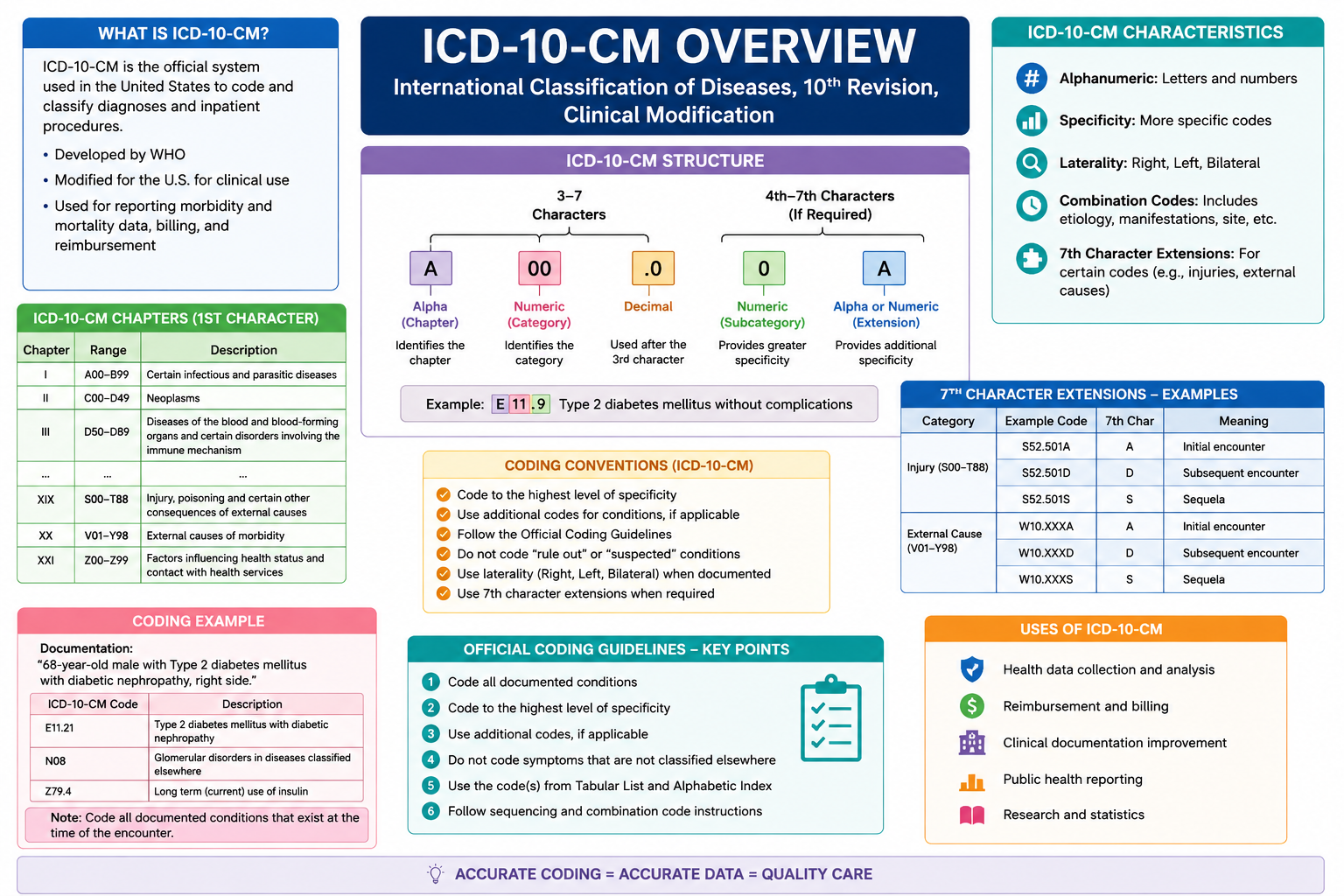
Clinical Coding: ICD-10-CM is a CPD-accredited certificate course designed for learners pursuing intended roles in clinical coding, healthcare administration, medical billing, and fitness industry health documentation.
Gain practical ICD-10-CM coding skills, from medical coding basics and book use to general guidelines and chapter-specific disease, injury, pregnancy, neonatal, and congenital coding.
Exclusive Deal! 94% Off, Today Only!
Sale Ends In
Step into the growing healthcare documentation field with our Clinical Coding: ICD-10-CM course. In England alone, NHS Digital reported 22.6 million Finished Consultant Episodes in 2024–25, showing the huge demand for accurate clinical records and coding skills.
This CPD-accredited course teaches you the foundations of medical coding, how to use coding books, ICD-10-CM conventions, general coding guidelines, and chapter-specific coding for infections, neoplasms, endocrine disorders, mental health, circulatory, respiratory, skin, musculoskeletal, genitourinary, pregnancy, perinatal, congenital, symptoms, injuries, and poisoning cases.
By completing this course, you can strengthen your professional profile, improve accuracy in health documentation, support billing and administrative processes, and gain a valuable certificate for career development in healthcare, clinical coding, medical billing, and fitness industry health-related roles.
Enrol today to master ICD-10-CM clinical coding, strengthen your healthcare documentation skills, and earn a CPD-accredited certificate.
This Clinical Coding: ICD-10-CM course is designed to provide a clear and practical understanding of medical coding, ICD-10-CM conventions, general coding guidelines, and chapter-specific diagnosis coding, making it an ideal course for learners who want to build knowledge in healthcare documentation, clinical coding, medical billing, or health-related administrative roles.
Throughout this CPD-accredited course, you will learn the fundamentals of medical coding, how to use medical coding books, and how ICD-10-CM codes are organised and applied in real healthcare settings. You will explore key coding guidelines for infectious diseases, neoplasms, endocrine disorders, mental health conditions, nervous system diseases, circulatory and respiratory conditions, injuries, pregnancy-related conditions, congenital disorders, and more.
In addition to technical coding knowledge, this course helps you understand how accurate clinical coding supports patient records, healthcare reporting, billing processes, and professional communication. By completing this course, you can improve your confidence, strengthen your CV, and develop valuable skills for healthcare, clinical coding, medical administration, and fitness industry health documentation roles.
By completing this Clinical Coding: ICD-10-CM online course, you will:
Whether you are starting your career or looking to build skills in healthcare administration, this Clinical Coding: ICD-10-CM course provides the essential knowledge and practical understanding needed to work confidently with medical codes and clinical documentation.
As a comprehensive clinical coding course, it is designed to introduce you to real healthcare coding practices, helping you understand ICD-10-CM conventions, general coding guidelines, and chapter-specific rules used for diseases, injuries, pregnancy, congenital conditions, symptoms, and more.
This course supports your progression into roles such as clinical coder, medical billing assistant, healthcare administrator, medical records assistant, or health documentation support worker. It also benefits professionals in the fitness industry who need a stronger understanding of health-related documentation and medical terminology.
This course is ideal for individuals who want to start or progress in healthcare, medical coding, billing, administration, or health documentation roles.
It is suitable for:
There are no specific prerequisites to enrol in this Clinical Coding: ICD-10-CM course. Anyone interested in medical coding, healthcare documentation, or clinical administration can take this course.
The Clinical Coding: ICD-10-CM course is fully accessible from any internet-enabled smart device, allowing you to study comfortably from home at your own pace.
All you need is a passion for learning, basic literacy skills, and to be over the age of 16.
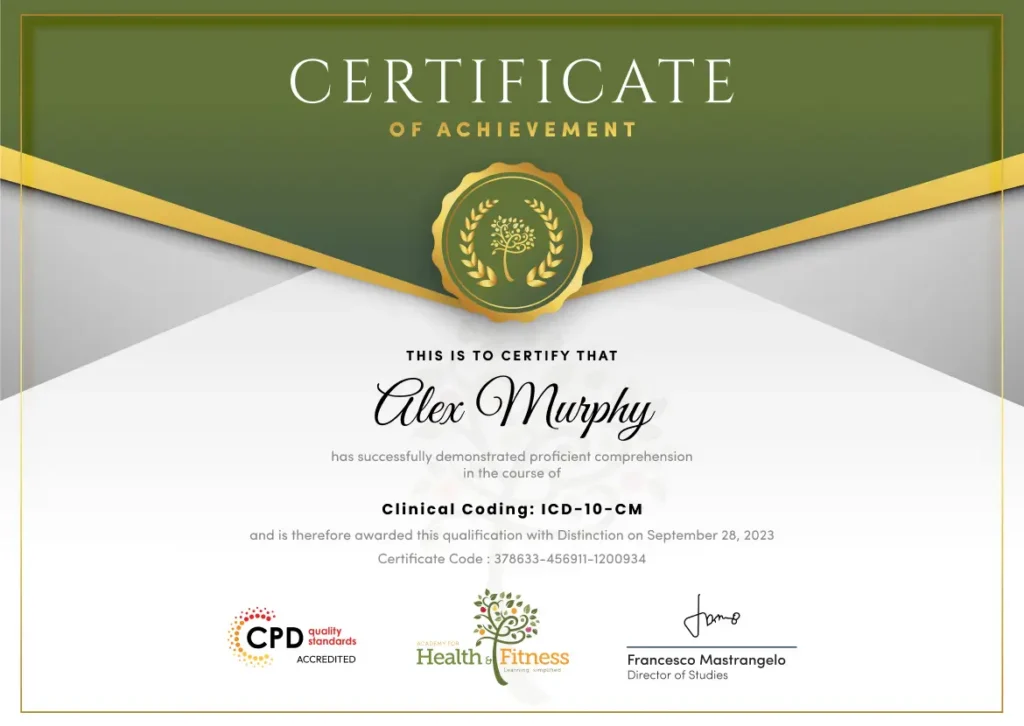
After successfully completing the Clinical Coding: ICD-10-CM course, you will qualify for a CPD Certificate as proof of your continued professional development and achievement. This certificate can enhance your professional profile and showcase your commitment to building relevant skills and knowledge. You can receive your digital certificate for only £10, or request a printed hard copy sent by post for just £29 or both for £39.
For assessing your learning, you have to complete an automated MCQ exam. It is required for the students to score at least 60% to pass the exam and fulfil the Quality Licence Scheme-endorsed certificate criteria. Learners can apply for the certificate after they clear the exam.
There are assignment questions provided at the end of the course. You are suggested to complete the questions to enrich your understanding of the course. You can complete this according to your preferred time. The expert tutor will provide feedback on your performance after assessing your assignment.
The Clinical Coding: ICD-10-CM course builds foundational knowledge in diagnosis coding, medical records, healthcare documentation, and clinical administration. While it does not provide a professional licence, it can support entry-level roles in hospitals, GP practices, private clinics, medical billing teams, and healthcare administration.
This course covers medical coding basics, ICD-10-CM conventions, general coding guidelines, and chapter-specific coding rules. You will learn about coding for infections, neoplasms, endocrine conditions, mental health disorders, circulatory diseases, respiratory diseases, pregnancy, injuries, poisoning, symptoms, and congenital conditions.
Yes. This course is suitable for beginners who want to understand clinical coding, medical terminology, diagnosis coding, and healthcare documentation. It explains key coding concepts step by step, making it accessible for learners with no previous coding experience.
Yes. The Clinical Coding: ICD-10-CM course is delivered online, allowing you to study from home using any internet-enabled device. You can learn at your own pace and fit the course around work, family, or other commitments.
Yes. After successfully completing the course, you will receive a CPD-accredited certificate. This certificate can help demonstrate your learning, strengthen your CV, and support your professional development in healthcare-related roles.
This course provides knowledge-based training and does not guarantee employment or professional registration. However, it can help you build a strong foundation in ICD-10-CM coding, medical records, and clinical documentation for entry-level or supportive healthcare roles.
This course can support your progression towards roles such as clinical coder, trainee clinical coder, medical records clerk, medical billing assistant, healthcare administrator, medical secretary, coding support assistant, and health information assistant.
Assessment methods may include online questions, knowledge checks, or final evaluation depending on the course provider. These assessments are designed to test your understanding of ICD-10-CM conventions, coding rules, and chapter-specific guidelines.
This course is ideal for aspiring clinical coders, healthcare administrators, medical billing assistants, medical records staff, fitness professionals handling health documentation, and anyone interested in learning diagnosis coding and healthcare data management.
Yes. Clinical coding and health information skills are valuable in hospitals, GP practices, private clinics, insurance-related administration, and healthcare data teams. Accurate coding supports patient records, reporting, billing, and service planning.
Accurate clinical coding is essential for reliable healthcare documentation and patient data management. This course helps you understand ICD-10-CM coding rules, improve your attention to detail, and build career-focused knowledge for healthcare administration and medical coding pathways.
| Medical coding Introduction | |||
| Medical Coding Introduction | 00:15:00 | ||
| Placeholder | 00:01:00 | ||
| How to Use Medical Coding Books? | 00:36:00 | ||
| Conventions for the ICD-10-CM | |||
| Conventions Introduction | 00:03:00 | ||
| Conventions Part-1 | 00:19:00 | ||
| Conventions Part-2 | 00:17:00 | ||
| Conventions Part-3 | 00:17:00 | ||
| Conventions Part-4 | 00:37:00 | ||
| General Coding Guidelines | |||
| Locating a code in the ICD-10-CM | 00:02:00 | ||
| Level of Detail in Coding | 00:01:00 | ||
| Code or codes from A00.0 through T88.9, Z00-Z99.8 | 00:01:00 | ||
| Signs and symptoms | 00:02:00 | ||
| Conditions that are an integral part of a disease process | 00:01:00 | ||
| Conditions that are not an integral part of a disease process | 00:02:00 | ||
| Multiple coding for a single condition Part-1 | 00:02:00 | ||
| Multiple coding for a single condition Part 2 | 00:01:00 | ||
| Acute and Chronic Conditions | 00:02:00 | ||
| Combination Code | 00:02:00 | ||
| Sequela (Late Effects) | 00:02:00 | ||
| Impending or Threatened Condition | 00:01:00 | ||
| Reporting Same Diagnosis Code More than Once | 00:01:00 | ||
| Laterality | 00:02:00 | ||
| Documentation by Clinicians Other than the Patient’s Provider | 00:02:00 | ||
| Documentation of Complications of Care Part 1 | 00:02:00 | ||
| Documentation of Complications of Care Part 2 | 00:01:00 | ||
| Borderline Diagnosis | 00:01:00 | ||
| Use of Sign -Symptom- Unspecified Codes | 00:02:00 | ||
| Coding for Healthcare Encounters in Hurricane Aftermath | 00:06:00 | ||
| Chapter Specific Coding Guidelines Introduction | |||
| Digital Medical Coding Mastery (DMCM) | 00:05:00 | ||
| Chapter 1: Certain Infectious and Parasitic Diseases (A00-B99) | |||
| HIV Coding Guidelines | 00:13:00 | ||
| Infections resistant to antibiotics | 00:02:00 | ||
| Coding of Sepsis, Severe Sepsis, and Septic Shock | 00:13:00 | ||
| Zika virus infections | 00:02:00 | ||
| Chapter 2: Neoplasms (C00-D49) | |||
| Introduction of Neoplasm or Cancer | 00:02:00 | ||
| Treatment directed at Malignancy or Cancer | 00:02:00 | ||
| Treatment of Secondary Cancer site | 00:02:00 | ||
| Coding & Sequencing of complications | 00:04:00 | ||
| Primary malignancy previously excised | 00:01:00 | ||
| Encounters involving chemotherapy, immunotherapy and radiation therapy | 00:02:00 | ||
| Encounter to determine extent of malignancy | 00:01:00 | ||
| Signs and Symptoms with Neoplasms | 00:02:00 | ||
| Admission for pain control management | 00:01:00 | ||
| Malignancy in two or more non-contiguous sites | 00:02:00 | ||
| Disseminated Malignant Neoplasm | 00:01:00 | ||
| Malignant Neoplasm without specification of site | 00:01:00 | ||
| Protected: Sequencing of Neoplasm codes | 00:06:00 | ||
| Protected: Current Malignancy versus personal history of Malignancy | 00:04:00 | ||
| Protected: Leukemia, Multiple Myeloma | 00:02:00 | ||
| Aftercare, Follow-up, Prophylactic organ removal | 00:05:00 | ||
| Chapter 3: Endocrine, Nutritional, and Metabolic Diseases (E00-E89) | |||
| Introduction Endocrine, Nutritional, and Metabolic Diseases | 00:01:00 | ||
| Diabetes mellitus (DM) | 00:01:00 | ||
| Diabetes mellitus and use of insulin | 00:01:00 | ||
| DM in Pregnancy | 00:01:00 | ||
| Complications due to Insulin Pump Malfunction | 00:02:00 | ||
| Secondary Diabetes Mellitus (DM) | 00:06:00 | ||
| Chapter 4: Mental, Behavioral and Neurodevelopmental disorders (F01 – F99) | |||
| Pain Disorder related to Psychological Factor | 00:02:00 | ||
| MSBP (Munchausen’s Syndrome By Proxy) | 00:05:00 | ||
| Chapter 5: Diseases of the Nervous System (G00-G99) | |||
| Introduction of Nervous System | 00:04:00 | ||
| Pain Coding Guidelines | 00:03:00 | ||
| Pain due to Device and Post OP Pain | 00:03:00 | ||
| Post OP Pain associated | 00:01:00 | ||
| Chronic Pain, Neoplasm related and Chronic pain Syndrome | 00:05:00 | ||
| Tip for Today | 00:03:00 | ||
| Chapter 6: Diseases of the Eye and Adnexa (H00-H59) | |||
| Glaucoma Coding Guidelines | 00:07:00 | ||
| Blindness Coding Guidelines | 00:07:00 | ||
| Chapter 7: Diseases of the Circulatory System (I00-I99) | |||
| Hypertension (HTN) Coding Guidelines | 00:06:00 | ||
| CBT Tools And Strategies | 00:22:00 | ||
| Coronary Artery Disease (CAD) Coding Guidelines | 00:04:00 | ||
| CBT Theories And Principles | 00:21:00 | ||
| Acute and Sequela Cerebrovascular Accident (CVA) | 00:06:00 | ||
| Myocardial Infarction (MI) | 00:09:00 | ||
| Tip for Today | 00:03:00 | ||
| Chapter 8: Diseases of the Respiratory System (J00-J99) | |||
| Guidelines for COPD | 00:07:00 | ||
| Guidelines for Respiratory Failure and Influenza | 00:07:00 | ||
| Ventilator Associated Pneumonia (VAP) | 00:05:00 | ||
| Chapter 9: Diseases of the Skin and Subcutaneous Tissue (L00-L99) | |||
| Pressure Ulcer Coding Guidelines | 00:07:00 | ||
| Protected: Non Pressure Ulcer Coding Guidelines | 00:06:00 | ||
| Chapter 10: Diseases of the Musculoskeletal System & Connective Tissue (M00-M99) | |||
| Musculoskeletal System | 00:14:00 | ||
| Chapter 11: Diseases of Genitourinary System (N00-N99) | |||
| CKD & Transplant status | 00:09:00 | ||
| Tip for you | 00:02:00 | ||
| Chapter 12: Pregnancy, Childbirth, and the Puerperium (O00-O9A) | |||
| General Rules to code Pregnancy | 00:15:00 | ||
| Selection of Codes in obstetrics | 00:10:00 | ||
| Pre-existing conditions in Pregnancy | 00:07:00 | ||
| Pregnancy Combination conditions | 00:17:00 | ||
| Postpartum and Peri partum | 00:09:00 | ||
| Termination and Spontaneous Abortion | 00:09:00 | ||
| Chapter 13: Certain Conditions Originating in the Perinatal Period (P00-P96) | |||
| Newborn General Guidelines | 00:10:00 | ||
| Additional Diagnosis and Newborn codes | 00:07:00 | ||
| Chapter 14: Congenital malformations, deformations, chromosomal abnormal(Q00-Q99) | |||
| Congenital Malformation Codes | 00:07:00 | ||
| Chapter 15: Symptoms, signs, & abnormal clinical & laboratory findings (R00-R99) | |||
| Symptoms Guidelines R Series | 00:16:00 | ||
| Chapter 16: Injury, poisoning, certain consequences of external causes (S00-T88) | |||
| Coding Injury & Fracture | 00:26:00 | ||
| Coding of Burns and Corrosions | 00:15:00 | ||
| Adult, Child Abuse, Neglect | 00:07:00 | ||
| Adverse effect, Poisoning | 00:17:00 | ||
| Complication of Care | 00:09:00 | ||
| Conclusion | |||
| Conclusion | 00:01:00 | ||
| Assignment | |||
| Assignment – Clinical Coding : ICD-10-CM | 00:00:00 | ||
| Medical coding Introduction | |||
| Medical Coding Introduction | 00:15:00 | ||
| Placeholder | 00:01:00 | ||
| How to Use Medical Coding Books? | 00:36:00 | ||
| Conventions for the ICD-10-CM | |||
| Conventions Introduction | 00:03:00 | ||
| Conventions Part-1 | 00:19:00 | ||
| Conventions Part-2 | 00:17:00 | ||
| Conventions Part-3 | 00:17:00 | ||
| Conventions Part-4 | 00:37:00 | ||
| General Coding Guidelines | |||
| Locating a code in the ICD-10-CM | 00:02:00 | ||
| Level of Detail in Coding | 00:01:00 | ||
| Code or codes from A00.0 through T88.9, Z00-Z99.8 | 00:01:00 | ||
| Signs and symptoms | 00:02:00 | ||
| Conditions that are an integral part of a disease process | 00:01:00 | ||
| Conditions that are not an integral part of a disease process | 00:02:00 | ||
| Multiple coding for a single condition Part-1 | 00:02:00 | ||
| Multiple coding for a single condition Part 2 | 00:01:00 | ||
| Acute and Chronic Conditions | 00:02:00 | ||
| Combination Code | 00:02:00 | ||
| Sequela (Late Effects) | 00:02:00 | ||
| Impending or Threatened Condition | 00:01:00 | ||
| Reporting Same Diagnosis Code More than Once | 00:01:00 | ||
| Laterality | 00:02:00 | ||
| Documentation by Clinicians Other than the Patient’s Provider | 00:02:00 | ||
| Documentation of Complications of Care Part 1 | 00:02:00 | ||
| Documentation of Complications of Care Part 2 | 00:01:00 | ||
| Borderline Diagnosis | 00:01:00 | ||
| Use of Sign -Symptom- Unspecified Codes | 00:02:00 | ||
| Coding for Healthcare Encounters in Hurricane Aftermath | 00:06:00 | ||
| Chapter Specific Coding Guidelines Introduction | |||
| Digital Medical Coding Mastery (DMCM) | 00:05:00 | ||
| Chapter 1: Certain Infectious and Parasitic Diseases (A00-B99) | |||
| HIV Coding Guidelines | 00:13:00 | ||
| Infections resistant to antibiotics | 00:02:00 | ||
| Coding of Sepsis, Severe Sepsis, and Septic Shock | 00:13:00 | ||
| Zika virus infections | 00:02:00 | ||
| Chapter 2: Neoplasms (C00-D49) | |||
| Introduction of Neoplasm or Cancer | 00:02:00 | ||
| Treatment directed at Malignancy or Cancer | 00:02:00 | ||
| Treatment of Secondary Cancer site | 00:02:00 | ||
| Coding & Sequencing of complications | 00:04:00 | ||
| Primary malignancy previously excised | 00:01:00 | ||
| Encounters involving chemotherapy, immunotherapy and radiation therapy | 00:02:00 | ||
| Encounter to determine extent of malignancy | 00:01:00 | ||
| Signs and Symptoms with Neoplasms | 00:02:00 | ||
| Admission for pain control management | 00:01:00 | ||
| Malignancy in two or more non-contiguous sites | 00:02:00 | ||
| Disseminated Malignant Neoplasm | 00:01:00 | ||
| Malignant Neoplasm without specification of site | 00:01:00 | ||
| Protected: Sequencing of Neoplasm codes | 00:06:00 | ||
| Protected: Current Malignancy versus personal history of Malignancy | 00:04:00 | ||
| Protected: Leukemia, Multiple Myeloma | 00:02:00 | ||
| Aftercare, Follow-up, Prophylactic organ removal | 00:05:00 | ||
| Chapter 3: Endocrine, Nutritional, and Metabolic Diseases (E00-E89) | |||
| Introduction Endocrine, Nutritional, and Metabolic Diseases | 00:01:00 | ||
| Diabetes mellitus (DM) | 00:01:00 | ||
| Diabetes mellitus and use of insulin | 00:01:00 | ||
| DM in Pregnancy | 00:01:00 | ||
| Complications due to Insulin Pump Malfunction | 00:02:00 | ||
| Secondary Diabetes Mellitus (DM) | 00:06:00 | ||
| Chapter 4: Mental, Behavioral and Neurodevelopmental disorders (F01 – F99) | |||
| Pain Disorder related to Psychological Factor | 00:02:00 | ||
| MSBP (Munchausen’s Syndrome By Proxy) | 00:05:00 | ||
| Chapter 5: Diseases of the Nervous System (G00-G99) | |||
| Introduction of Nervous System | 00:04:00 | ||
| Pain Coding Guidelines | 00:03:00 | ||
| Pain due to Device and Post OP Pain | 00:03:00 | ||
| Post OP Pain associated | 00:01:00 | ||
| Chronic Pain, Neoplasm related and Chronic pain Syndrome | 00:05:00 | ||
| Tip for Today | 00:03:00 | ||
| Chapter 6: Diseases of the Eye and Adnexa (H00-H59) | |||
| Glaucoma Coding Guidelines | 00:07:00 | ||
| Blindness Coding Guidelines | 00:07:00 | ||
| Chapter 7: Diseases of the Circulatory System (I00-I99) | |||
| Hypertension (HTN) Coding Guidelines | 00:06:00 | ||
| CBT Tools And Strategies | 00:22:00 | ||
| Coronary Artery Disease (CAD) Coding Guidelines | 00:04:00 | ||
| CBT Theories And Principles | 00:21:00 | ||
| Acute and Sequela Cerebrovascular Accident (CVA) | 00:06:00 | ||
| Myocardial Infarction (MI) | 00:09:00 | ||
| Tip for Today | 00:03:00 | ||
| Chapter 8: Diseases of the Respiratory System (J00-J99) | |||
| Guidelines for COPD | 00:07:00 | ||
| Guidelines for Respiratory Failure and Influenza | 00:07:00 | ||
| Ventilator Associated Pneumonia (VAP) | 00:05:00 | ||
| Chapter 9: Diseases of the Skin and Subcutaneous Tissue (L00-L99) | |||
| Pressure Ulcer Coding Guidelines | 00:07:00 | ||
| Protected: Non Pressure Ulcer Coding Guidelines | 00:06:00 | ||
| Chapter 10: Diseases of the Musculoskeletal System & Connective Tissue (M00-M99) | |||
| Musculoskeletal System | 00:14:00 | ||
| Chapter 11: Diseases of Genitourinary System (N00-N99) | |||
| CKD & Transplant status | 00:09:00 | ||
| Tip for you | 00:02:00 | ||
| Chapter 12: Pregnancy, Childbirth, and the Puerperium (O00-O9A) | |||
| General Rules to code Pregnancy | 00:15:00 | ||
| Selection of Codes in obstetrics | 00:10:00 | ||
| Pre-existing conditions in Pregnancy | 00:07:00 | ||
| Pregnancy Combination conditions | 00:17:00 | ||
| Postpartum and Peri partum | 00:09:00 | ||
| Termination and Spontaneous Abortion | 00:09:00 | ||
| Chapter 13: Certain Conditions Originating in the Perinatal Period (P00-P96) | |||
| Newborn General Guidelines | 00:10:00 | ||
| Additional Diagnosis and Newborn codes | 00:07:00 | ||
| Chapter 14: Congenital malformations, deformations, chromosomal abnormal(Q00-Q99) | |||
| Congenital Malformation Codes | 00:07:00 | ||
| Chapter 15: Symptoms, signs, & abnormal clinical & laboratory findings (R00-R99) | |||
| Symptoms Guidelines R Series | 00:16:00 | ||
| Chapter 16: Injury, poisoning, certain consequences of external causes (S00-T88) | |||
| Coding Injury & Fracture | 00:26:00 | ||
| Coding of Burns and Corrosions | 00:15:00 | ||
| Adult, Child Abuse, Neglect | 00:07:00 | ||
| Adverse effect, Poisoning | 00:17:00 | ||
| Complication of Care | 00:09:00 | ||
| Conclusion | |||
| Conclusion | 00:01:00 | ||
| Assignment | |||
| Assignment – Clinical Coding : ICD-10-CM | 00:00:00 | ||