Applied Behavioural Analysis (ABA) – A CPD-accredited course for aspiring ABA practitioners, teachers, SEN professionals, caregivers, support workers, and individuals in the fitness and wellbeing industries. Gain essential ABA knowledge, master core behavioural intervention techniques, support skill development, and earn a recognized CPD certificate to enhance your professional profile.
4.6
(6 Reviews)
25 Students
Exclusive Deal! 94% Off, Today Only!
Sale Ends In
CPD PointApplied Behavioural Analysis (ABA) is one of the most widely used evidence-based approaches for supporting individuals with autism and other developmental needs. In the UK, over 968,000 people have an autism diagnosis recorded in GP records, highlighting the growing demand for skilled professionals who understand effective behavioural support strategies.
This CPD-accredited course introduces the core principles of ABA, including behavioural assessment, reinforcement techniques, skill acquisition, generalisation, and essential strategies for developing motor, language, cognitive, and visuospatial abilities. Through easy-to-follow lessons, you’ll gain the confidence to apply ABA techniques in educational, care, and support settings.
Whether you’re a teacher, SEN professional, caregiver, support worker, or aspiring ABA practitioner, this course will strengthen your essential knowledge, enhance your professional credibility, and help you deliver more effective, person-centred support while boosting your career prospects.
This Applied Behavioural Analysis (ABA) course is designed to provide a clear and essential understanding of behavioural principles, intervention techniques, and skill-development strategies. It is ideal for teachers, SEN professionals, caregivers, support workers, aspiring ABA practitioners, and individuals working in fitness, wellbeing, and care-related environments.
Throughout this course, you will explore the key components of ABA, the rules for applying behavioural techniques, and the foundational methods used to encourage positive behaviour. You will also learn how ABA strategies can support the development of motor, language, cognitive, and visuospatial skills.
In addition to core theory, the course explains how to promote generalisation, helping learners apply newly developed skills across different situations and environments. By completing this CPD-accredited course, you will strengthen your professional knowledge, improve your ability to support individuals with diverse needs, and gain greater confidence in applying person-centred behavioural strategies.
By completing this Applied Behavioural Analysis (ABA) online course, you will:
Whether you are starting a career in education, SEN support, childcare, care, or behavioural support, this Applied Behavioural Analysis (ABA) course provides the essential knowledge needed to understand behaviour and support skill development effectively.
The course introduces key ABA principles, application rules, and foundational techniques used to encourage positive learning outcomes. You will also explore how ABA strategies can support motor, language, cognitive, and visuospatial skills, as well as how learned behaviours can be generalised across different settings.
This course can strengthen your knowledge for roles such as teaching assistant, SEN support worker, caregiver, learning support assistant, childcare professional, or behavioural support worker. It also helps you build greater confidence in applying structured, person-centred approaches when supporting individuals with behavioural or developmental needs.
This Applied Behavioural Analysis (ABA) course is suitable for anyone who wants to understand the fundamentals of ABA and learn how behavioural techniques can support different areas of skill development.
It is ideal for:
There are no formal prerequisites for enrolling in this Applied Behavioural Analysis (ABA) course. It is suitable for beginners, caregivers, educators, support workers, and anyone interested in learning about behavioural support and skill development.
The course is delivered entirely online and can be accessed from any internet-enabled smartphone, tablet, laptop, or computer. This allows you to study comfortably from home and progress at your own pace.
All you need is a genuine interest in Applied Behavioural Analysis, basic English literacy skills, a reliable internet connection, and to be at least 16 years old.
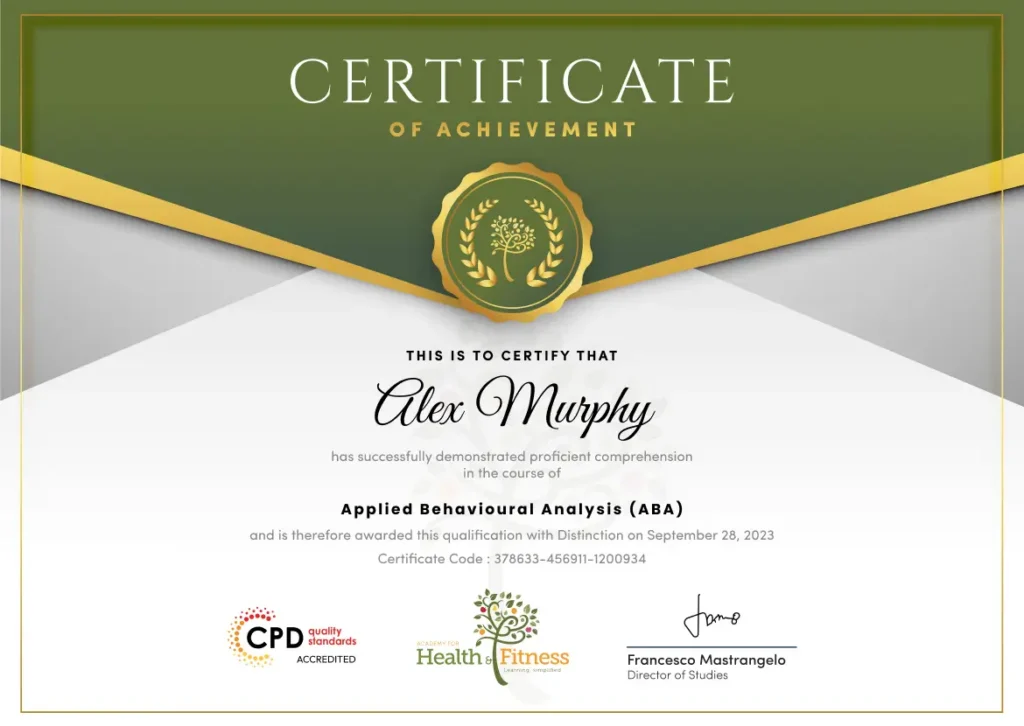
After successfully completing the Applied Behavioural Analysis (ABA) course, you will qualify for a CPD Certificate as proof of your continued professional development and achievement. This certificate can enhance your professional profile and showcase your commitment to building relevant skills and knowledge. You can receive your digital certificate for only £10, or request a printed hard copy sent by post for just £29 or both for £39.
For assessing your learning, you have to complete an automated MCQ exam. It is required for the students to score at least 60% to pass the exam and fulfil the Quality Licence Scheme-endorsed certificate criteria. Learners can apply for the certificate after they clear the exam.
There are assignment questions provided at the end of the course. You are suggested to complete the questions to enrich your understanding of the course. You can complete this according to your preferred time. The expert tutor will provide feedback on your performance after assessing your assignment.
The Applied Behavioural Analysis (ABA) course is an online, knowledge-based programme covering behavioural principles and skill development. While it does not provide a professional licence, it can strengthen your knowledge for entry-level and supportive roles in education, childcare, SEN, and health and social care.
This course covers the fundamentals of ABA, its key components, application rules, foundational techniques, and strategies for supporting motor, language, cognitive, and visuospatial skills. It also introduces generalisation in ABA theory to help learners understand how skills can transfer across different settings.
Yes. This course is suitable for beginners with no previous knowledge of ABA. It explains the main principles and techniques step by step, making it accessible to caregivers, teachers, SEN staff, support workers, and aspiring behavioural support professionals.
Yes. The Applied Behavioural Analysis (ABA) course is delivered entirely online. You can study from home using an internet-enabled smartphone, tablet, laptop, or computer and progress through the modules at your own pace.
Yes. Successful learners will receive a CPD-accredited certificate after completing the course requirements. The certificate can help demonstrate your professional development and strengthen your CV for relevant support-based roles.
No. This is a knowledge-based introductory course and does not provide a professional licence or regulated practitioner status. Additional qualifications, supervised experience, and role-specific training may be required for professional ABA practice.
This course can support your knowledge for roles such as SEN teaching assistant, learning support assistant, behavioural support worker, caregiver, nursery worker, residential support worker, and family support worker.
The course includes an assignment designed to test your understanding of ABA principles, techniques, and skill-development strategies. Recommended learning materials are also provided to support further study and improve subject knowledge.
This course is ideal for aspiring ABA practitioners, teachers, teaching assistants, SEN professionals, caregivers, childcare workers, parents, and individuals supporting people with behavioural or developmental needs.
Yes. The course explains how ABA techniques may support motor, language, cognitive, and visuospatial skill development. It also explores how structured behavioural methods can encourage learning and positive progress.
Studying ABA can help you understand how behaviour and learning are influenced by structured techniques. This knowledge can improve your confidence when supporting individuals in education, childcare, care, family, and community environments.
| Introduction to ABA | |||
| Introduction to ABA | 00:13:00 | ||
| ABA Component Breakdown | |||
| ABA Component Breakdown | 00:09:00 | ||
| Rules when Applying ABA | |||
| Rules When Applying ABA | 00:10:00 | ||
| Foundation Techniques of ABA | |||
| Foundation Techniques of ABA | 00:14:00 | ||
| ABA for Motor Skills | |||
| ABA for Motor Skills | 00:10:00 | ||
| ABA for Language Skills | |||
| ABA for Language Skills | 00:22:00 | ||
| ABA for Cognitive Skills | |||
| ABA for Cognitive Skills | 00:21:00 | ||
| ABA for Visuospatial Skills | |||
| ABA for Visuospatial Skills | 00:22:00 | ||
| Generalization in ABA Theory | |||
| Generalization in ABA Theory | 00:13:00 | ||
| Assignment | |||
| Assignment – Applied Behavioural Analysis (ABA) | 6 days, 1 hour | ||
| Recommended Materials | |||
| Workbook – Applied Behavioural Analysis (ABA) | 1 week, 2 days | ||
| Introduction to ABA | |||
| Introduction to ABA | 00:13:00 | ||
| ABA Component Breakdown | |||
| ABA Component Breakdown | 00:09:00 | ||
| Rules when Applying ABA | |||
| Rules When Applying ABA | 00:10:00 | ||
| Foundation Techniques of ABA | |||
| Foundation Techniques of ABA | 00:14:00 | ||
| ABA for Motor Skills | |||
| ABA for Motor Skills | 00:10:00 | ||
| ABA for Language Skills | |||
| ABA for Language Skills | 00:22:00 | ||
| ABA for Cognitive Skills | |||
| ABA for Cognitive Skills | 00:21:00 | ||
| ABA for Visuospatial Skills | |||
| ABA for Visuospatial Skills | 00:22:00 | ||
| Generalization in ABA Theory | |||
| Generalization in ABA Theory | 00:13:00 | ||
| Assignment | |||
| Assignment – Applied Behavioural Analysis (ABA) | 6 days, 1 hour | ||
| Recommended Materials | |||
| Workbook – Applied Behavioural Analysis (ABA) | 1 week, 2 days | ||