
Lean Six Sigma Green Belt Course
UK organisations lose significant cost through inefficient processes, yet many professionals lack structured improvement knowledge. Enrol now to build Lean Six Sigma insight before inefficiencies quietly limit performance and progression.
(0 Reviews)
 58 Students

Lean Six Sigma Green Belt Course
Exclusive Deal! 94% Off, Today Only!
Sale Ends In

 TAKE All courses for
£99
TAKE All courses for
£99 


This course includes:
-
 Access1 Year Access
 -
 Skill Level
 -
 Duration6 hours, 9 minutes
 -
 Students58 Students
- Original price was: £425.£25Current price is: £25. ex VAT
- 1 year
- Intermediate
- Number of Units23
- Number of Quizzes0
- 6 hours, 9 minutes Gift this course
 14-Day Money-Back Guarantee
Course Overview
Studies consistently show that inefficient processes can consume 20–30% of operational costs across UK organisations, often without being formally identified or measured. When inefficiencies persist, they affect quality, customer satisfaction, and team performance—yet many professionals only recognise the impact after performance gaps become visible.
Our Lean Six Sigma Green Belt course introduces the Lean Six Sigma Green Belt framework using the recognised DMAIC structure: Define, Measure, Analyse, Improve, and Control. You will explore how data-driven analysis, process mapping, root cause evaluation, and improvement planning support more consistent and controlled outcomes. The programme also includes a structured case study to demonstrate how Lean Six Sigma principles are applied within organisational contexts.
By completing this course, you will develop a clearer understanding of process improvement thinking and performance measurement. Begin learning now to strengthen analytical confidence and contribute to improvement initiatives before inefficiencies continue unchecked. SO Join today and be a part of this meaningful experience!
Learning Outcomes
- Apply DMAIC stages logically across improvement project scenarios
- Measure performance accurately to identify inefficiencies and variation
- Analyse root causes affecting process quality and operational consistency
- Evaluate improvement opportunities using structured analytical techniques
- Understand control methods supporting sustainable process performance
- Interpret Lean Six Sigma tools within organisational improvement contexts
- Define process problems clearly using data-driven improvement frameworks
- Analyse case study examples demonstrating structured improvement outcomes
- Strengthen analytical thinking, supporting continuous improvement initiatives
Why People Love and Enrol in this Training?
- CPD Accredited Course
- Unlimited access for 12 months – learn at your own pace ️
- Earn instant certificate upon course completion
- Get a free student ID card to showcase
- Flexible study – no deadlines
- Transparent pricing – no hidden fees
- Dedicated tutor support on weekdays
- Fast assessments & instant results
Who is this Course For?
- Project and team leaders
- Quality and compliance staff
- Business improvement learners
- Performance-focused professionals
- Operations and process professionals
Certificate of Achievement

CPD Certification
After completing the MCQ assessment, you will qualify for the CPD Certificate from HF Online as proof of your continued professional development. You can order your certificate at a cost of £10 for PDF and £29 for hard copy certificate or both for £39.
Assessment
For assessing your learning, you have to complete an automated MCQ exam. It is required for the students to score at least 60% to pass the exam. Learners can apply for the certificate after they clear the exam.
There are assignment questions provided at the end of the course. You are suggested to complete the questions to enrich your understanding of the course. You can complete this according to your preferred time. The expert tutor will provide feedback on your performance after assessing your assignment.
Prerequisites
There are no prerequisites and you may use any internet-enabled device to study at your own speed, it is adaptable and available to students of all skill levels.
Job Opportunities
Lean Six Sigma knowledge supports continuous improvement, operational efficiency, and quality assurance across UK industries. These roles value analytical thinking, structured problem-solving, and performance measurement awareness.
- Lean Six Sigma Green Belt Practitioner
Supports process improvement initiatives using DMAIC methodologies and data analysis. Contributes to efficiency, quality enhancement, and waste reduction projects. Average UK salary: £35,000–£50,000 - Business Improvement Analyst
Analyses organisational processes to identify inefficiencies and improvement opportunities. Supports data-led decision-making and performance optimisation initiatives. Average UK salary: £32,000–£48,000 - Quality Assurance Analyst
Monitors process consistency and compliance against quality standards. Supports continuous improvement through structured measurement and evaluation. Average UK salary: £30,000–£45,000 - Operations Analyst
Evaluates operational workflows to improve efficiency and resource utilisation. Supports performance measurement and operational strategy development. Average UK salary: £33,000–£47,000 - Process Improvement Coordinator
Coordinates improvement initiatives across departments and project teams. Supports structured implementation and performance monitoring activities. Average UK salary: £34,000–£49,000 - Continuous Improvement Officer
Promotes Lean Six Sigma principles across organisational processes. Supports cultural adoption of efficiency and quality improvement frameworks. Average UK salary: £36,000–£52,000 - Project Support Analyst
Supports project teams through data analysis, measurement, and reporting. Applies Lean Six Sigma concepts to project delivery environments. Average UK salary: £31,000–£44,000 - Performance Management Analyst
Tracks KPIs and process metrics to support improvement strategies. Supports evidence-based performance reviews and optimisation plans. Average UK salary: £34,000–£50,000 - Operational Excellence Assistant
Supports excellence initiatives focused on efficiency, quality, and consistency. Assists with improvement planning and performance documentation. Average UK salary: £29,000–£42,000 - Management Consulting Analyst
Supports client improvement projects using structured analysis frameworks. Applies Lean Six Sigma concepts across diverse organisational contexts. Average UK salary: £38,000–£55,000
Course Curriculum
| Section 01: Course Overview | |||
| Course Overview | 00:07:00 | ||
| Section 02: Introduction | |||
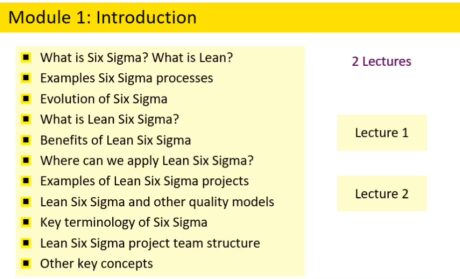
| Introduction | 00:15:00 | ||
| Introduction Part 2 | 00:16:00 | ||
| Section 03: Define | |||
| Define | 00:25:00 | ||
| Define Part 2 | 00:19:00 | ||
| Section 04: Measure | |||
| Measure | 00:13:00 | ||
| Measure Part 2 | 00:30:00 | ||
| Measure Part 3 | 00:18:00 | ||
| Measure Part 4 | 00:15:00 | ||
| Section 05: Analyze | |||
| Analyze | 00:14:00 | ||
| Analyze Part 2 | 00:16:00 | ||
| Analyze Part 3 | 00:25:00 | ||
| Analyze Part 4 | 00:16:00 | ||
| Analyze Part 5 | 00:14:00 | ||
| Analyze Part 6 | 00:16:00 | ||
| Section 06: Improve | |||
| Improve | 00:23:00 | ||
| Improve Part 2 | 00:12:00 | ||
| Improve Part 3 | 00:10:00 | ||
| Improve Part 4 | 00:23:00 | ||
| Improve Part 5 | 00:15:00 | ||
| Section 07: Control | |||
| Control | 00:13:00 | ||
| Section 08: Case Study | |||
| Case Study | 00:10:00 | ||
| Section 09: Conclusion | |||
| Conclusion | 00:04:00 | ||