Intelligence and Data Mining Diploma is a CPD-accredited course for aspiring BI analysts, data mining professionals, business decision-makers, and learners in fitness industries seeking recognised certification.
This course covers BI concepts, dashboards, KPIs, data warehouses, data mining techniques, classification, clustering, and industry applications to build essential data-driven decision-making skills.
4.6
(2 Reviews)
32 Students
Exclusive Deal! 94% Off, Today Only!
Sale Ends In
CPD Point
The Business Intelligence and Data Mining Diploma helps you turn raw data into smart business decisions. In the UK, data roles continue to offer strong career value, with average data salaries reported at around £50,412, above the national average. This CPD-accredited course introduces you to BI concepts, decision support systems, dashboard design, KPI development, data warehouses, data mining stages, classification, clustering, association rules, and real-world applications in banking, CRM, fitness, and other industries.
You will learn how organisations use data to track performance, identify patterns, improve operations, and make evidence-based decisions. Whether you work in fitness, business, administration, marketing, or customer service, this course can strengthen your analytical thinking, improve your CV, and help you move towards roles involving reporting, dashboards, business analysis, or data-driven management.
Enrol in the Business Intelligence and Data Mining Diploma today and start building the data skills employers value.
The Business Intelligence and Data Mining Diploma is designed to give learners a strong understanding of how organisations collect, analyse, and use data to make smarter business decisions. This CPD-accredited course is ideal for learners who want to build practical knowledge in business intelligence, data mining, reporting, dashboard systems, and performance analysis.
Throughout this course, you will explore key BI concepts, decision-making processes, decision support systems, dashboard presentation, different chart types, KPI development, and balanced scorecard ideas. You will also learn how data warehouses work, including their architecture, components, data structures, and database models.
In addition, this course introduces essential data mining techniques such as classification, clustering, and association rules. You will discover how data mining is applied in banking, CRM, fitness industries, and other business sectors. By completing this diploma, you can strengthen your analytical thinking, improve your CV, and build confidence in using data-driven insights for professional decision-making.
By completing this Business Intelligence and Data Mining Diploma online course, you will:
Whether you are starting your career or looking to improve your analytical skills, this Business Intelligence and Data Mining Diploma provides essential knowledge to understand how businesses use data for smarter decision-making.
As a comprehensive BI and data mining course, it introduces you to real-world business practices, including dashboard reporting, KPI development, data warehouses, classification, clustering, and association rules. You will learn how organisations use data to identify patterns, track performance, improve customer relationships, and support strategic planning.
This course supports your progression into roles such as business intelligence assistant, data analyst trainee, reporting assistant, business analyst, dashboard support executive, or data-driven operations professional, giving you a strong foundation to work confidently with business data across sectors such as fitness, banking, CRM, marketing, and management.
This course is ideal for individuals who want to start or progress in business intelligence, data analysis, reporting, or data-driven decision-making roles.
It is suitable for:
There are no specific prerequisites to enrol in this Business Intelligence and Data Mining Diploma. Anyone interested in business intelligence, dashboards, KPIs, data warehouses, or data mining can take this course.
The Business Intelligence and Data Mining Diploma is fully accessible from any internet-enabled smart device, so you can study from the comfort of your home.
All you need is a passion for learning, basic literacy skills, and to be over the age of 16.
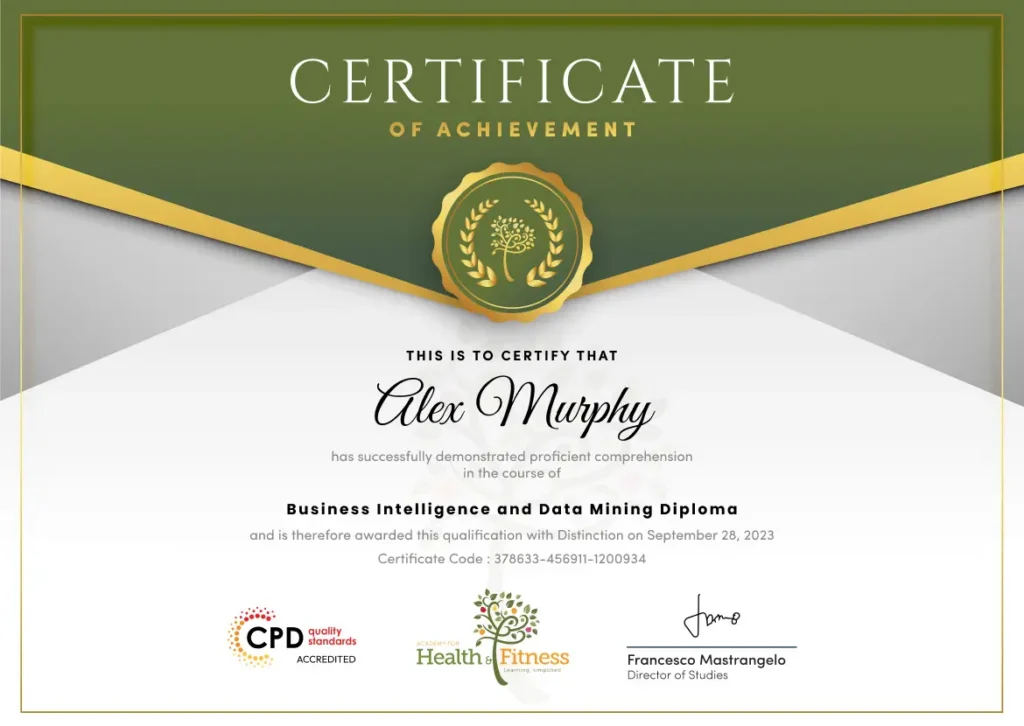
After successfully completing the Business Intelligence and Data Mining Diploma course, you will qualify for a CPD Certificate as proof of your continued professional development and achievement. This certificate can enhance your professional profile and showcase your commitment to building relevant skills and knowledge. You can receive your digital certificate for only £10, or request a printed hard copy sent by post for just £29 or both for £39.
For assessing your learning, you have to complete an automated MCQ exam. It is required for the students to score at least 60% to pass the exam and fulfil the Quality Licence Scheme-endorsed certificate criteria. Learners can apply for the certificate after they clear the exam.
There are assignment questions provided at the end of the course. You are suggested to complete the questions to enrich your understanding of the course. You can complete this according to your preferred time. The expert tutor will provide feedback on your performance after assessing your assignment.
The Business Intelligence and Data Mining Diploma is an online knowledge-based course designed to build strong understanding of data analysis, business reporting, data mining techniques, and decision-making support. While it does not provide a professional licence, it can help learners explore entry-level and supportive roles in business, analytics, IT, finance, marketing, and data-driven organisations.
This course covers BI concepts, decision-making processes, decision support systems, dashboards, charts, KPIs, data warehouses, data mining stages, classification, clustering, association rules, and industry applications.
Yes. This course is suitable for beginners who want to understand business intelligence, data mining, dashboards, reporting, and data-driven decision-making step by step.
Yes. The course is delivered online, allowing you to study from home using any internet-enabled device at your own pace.
Yes. After completing the course, learners can receive a CPD-accredited certificate to support their CV and professional development.
No. This course does not provide a professional licence or formal data analyst qualification. It provides knowledge-based training to support entry-level data and BI-related career pathways.
This course can support roles such as BI assistant, data analyst trainee, reporting assistant, dashboard support executive, CRM data assistant, and KPI reporting coordinator.
The course is usually assessed through online learning activities or assessment tasks designed to check your understanding of the course modules.
This course is ideal for beginners, fitness professionals, business learners, managers, CRM staff, marketing professionals, and anyone interested in BI, dashboards, KPIs, and data mining.
Yes. UK businesses increasingly rely on data for reporting, customer insights, performance tracking, and decision-making, making BI and data skills valuable across many sectors.
This course helps you understand how organisations turn data into useful insights, improve decisions, track performance, and identify patterns for business growth.
| Business Intelligence and Data Mining | |||
| Module 01: What is Business Intelligence? | 00:05:00 | ||
| Module 02: Starting Case in understanding BI needs in diff phase of business | 00:07:00 | ||
| Module 03: Decision Making Process and Need of IT systems | 00:20:00 | ||
| Module 04: Problem Structure and Decision Support System | 00:11:00 | ||
| Module 05: Introduction to BI Applications | 00:18:00 | ||
| Module 06: Dashboard presentation systems | 00:07:00 | ||
| Module 07: Different Types of Charts used in 131 Dashboards | 00:30:00 | ||
| Module 08: Good Dashboard and BSC | 00:13:00 | ||
| Module 09: Examples of Bad Dashboards 1 | 00:07:00 | ||
| Module 10: Examples of Bad Dashboards 2 | 00:01:00 | ||
| Module 11: Process of KPI Development | 00:26:00 | ||
| Module 12: Overview of Data warehouse | 00:08:00 | ||
| Module 13: More explaining of data warehouse and steps in processing | 00:09:00 | ||
| Module 14: Data Warehouse Architecture –Tiers | 00:18:00 | ||
| Module 15: Data Warehouse – components | 00:15:00 | ||
| Module 16: Approach to develop data structure and Models of database | 00:16:00 | ||
| Module 17: Basics of Data Mining – Meaning | 00:35:00 | ||
| Module 18: Basics of Data Mining – Stages of DM | 00:25:00 | ||
| Module 19: Data Mining Technique – Classification | 00:07:00 | ||
| Module 20: Data mining – Clustering | 00:02:00 | ||
| Module 21: Data Mining – Association Rules | 00:05:00 | ||
| Module 22: Data Mining Applications – Banking | 00:03:00 | ||
| Module 23: Data Mining Applications – CRM | 00:04:00 | ||
| Module 24: Data Mining Applications – other industries | 00:04:00 | ||
| Assignment | |||
| Assignment – Business Intelligence and Data Mining Diploma | 00:00:00 | ||
| Business Intelligence and Data Mining | |||
| Module 01: What is Business Intelligence? | 00:05:00 | ||
| Module 02: Starting Case in understanding BI needs in diff phase of business | 00:07:00 | ||
| Module 03: Decision Making Process and Need of IT systems | 00:20:00 | ||
| Module 04: Problem Structure and Decision Support System | 00:11:00 | ||
| Module 05: Introduction to BI Applications | 00:18:00 | ||
| Module 06: Dashboard presentation systems | 00:07:00 | ||
| Module 07: Different Types of Charts used in 131 Dashboards | 00:30:00 | ||
| Module 08: Good Dashboard and BSC | 00:13:00 | ||
| Module 09: Examples of Bad Dashboards 1 | 00:07:00 | ||
| Module 10: Examples of Bad Dashboards 2 | 00:01:00 | ||
| Module 11: Process of KPI Development | 00:26:00 | ||
| Module 12: Overview of Data warehouse | 00:08:00 | ||
| Module 13: More explaining of data warehouse and steps in processing | 00:09:00 | ||
| Module 14: Data Warehouse Architecture –Tiers | 00:18:00 | ||
| Module 15: Data Warehouse – components | 00:15:00 | ||
| Module 16: Approach to develop data structure and Models of database | 00:16:00 | ||
| Module 17: Basics of Data Mining – Meaning | 00:35:00 | ||
| Module 18: Basics of Data Mining – Stages of DM | 00:25:00 | ||
| Module 19: Data Mining Technique – Classification | 00:07:00 | ||
| Module 20: Data mining – Clustering | 00:02:00 | ||
| Module 21: Data Mining – Association Rules | 00:05:00 | ||
| Module 22: Data Mining Applications – Banking | 00:03:00 | ||
| Module 23: Data Mining Applications – CRM | 00:04:00 | ||
| Module 24: Data Mining Applications – other industries | 00:04:00 | ||
| Assignment | |||
| Assignment – Business Intelligence and Data Mining Diploma | 00:00:00 | ||